Wildlife Guide · Deserts worldwide & South-western United States, Middle East, North Africa, Central Asia
Camel Spider
Order Solifugae — about 1,200 described species; not spiders and not camels
Neither camel nor spider — an order of desert arachnids whose internet reputation is larger than the animal.
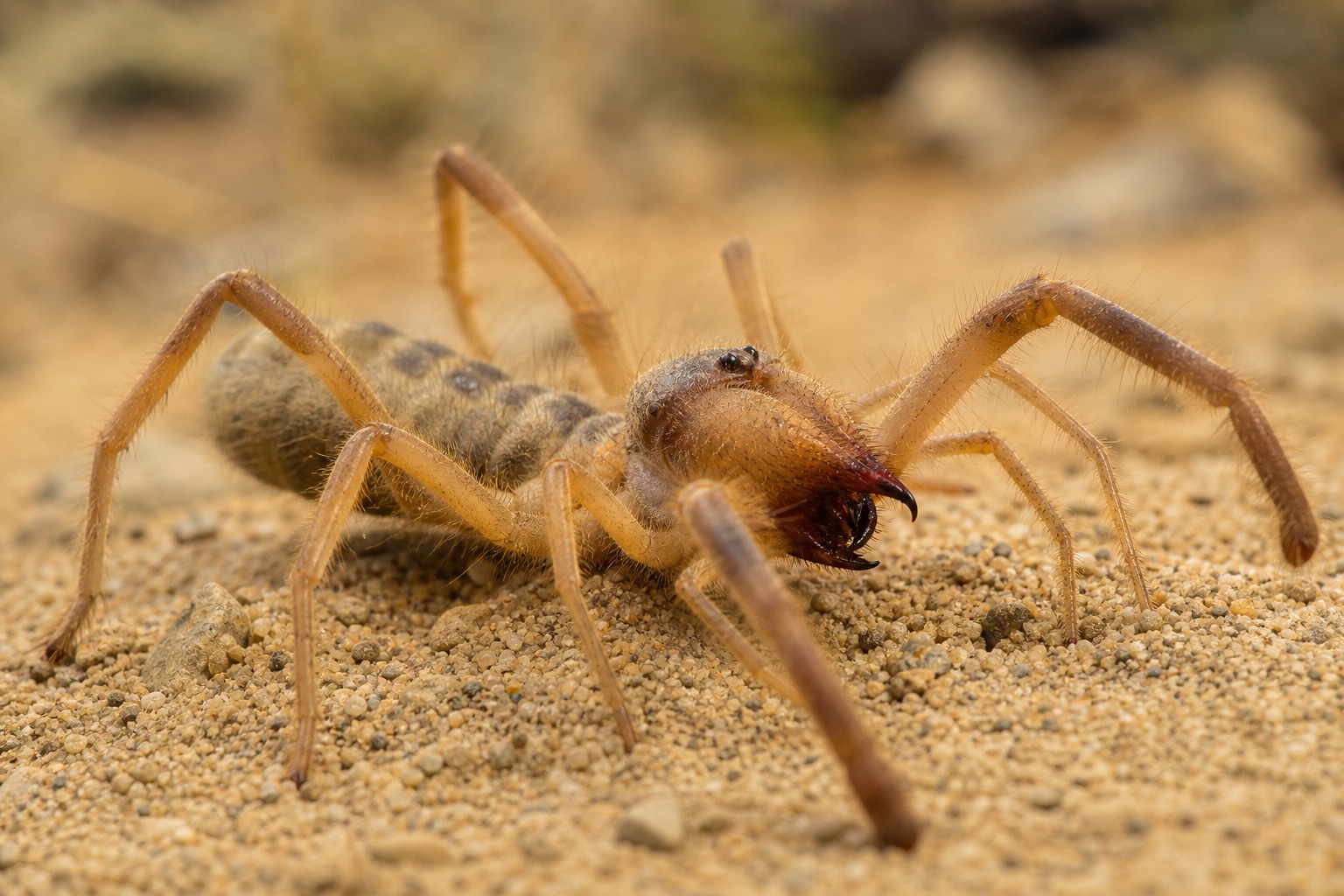
AI-generated educational wildlife portrait — World Animal Rescue Network · AI visualisation, not a photograph
In brief
Camel spiders are solifugids (order Solifugae) — desert arachnids that are not true spiders, do not spin silk, and lack spider-style venom glands. About 1,200 species are described. Viral claims of dinner-plate size, human sprint speed and flesh-melting venom are false. WARN does not run camel-spider programmes.
Also in Animals A to Z · Animals that start with C
By WARN Research & Conservation Team Checked against Kulkarni et al. 2023 solifuge phylogenomics, BugGuide Solifugae and IUCN Red List categories Last updated
Camel spider is a common name for solifugids (order Solifugae), also called sun spiders and wind scorpions. They are arachnids, not insects, and they are not true spiders (order Araneae) and not scorpions (order Scorpiones). A 2023 phylogenomic review counts about 1,200 described species in roughly a dozen families. They have eight walking legs plus a pair of leg-like pedipalps that make photographs look ten-legged. Chelicerae are huge for the body and tear prey; they do not spin silk and they lack spider-style venom glands. The IUCN does not assess 'camel spider' as a taxon. Most species are Not Evaluated. This page is the order encyclopaedia and a myth correction. True spiders: spider. Scorpions: scorpion. Harvestmen: daddy longlegs. WARN does not run solifugid programmes.
Looking for something specific?
These notes clarify the guide’s scope, common mix-ups and related information.
- A named pet solifugid with photo updates. WARN does not offer that.
- Treating 'camel spider' as one IUCN species. It is an order of about 1,200 described species, mostly Not Evaluated.
- A medically significant spider such as a widow or recluse. Those are different animals: black widow spider and brown recluse spider.
- WARN desert-arthropod capture, venom labs or Iraq fieldwork. We do not run those programmes.
- True spiders, scorpions or harvestmen (daddy longlegs). Those guides are spider, scorpion and daddy longlegs.
~1,200
Described species in order Solifugae (Kulkarni et al., 2023)
Not spiders
Separate arachnid order from Araneae
No silk
No spinnerets — not web-builders
~15 cm
Typical maximum leg span in large species — not table-sized
Figures sourced from Kulkarni, Ballesteros et al. (2023) — phylogenomic relationships in Solifugae (PMC10484990), BugGuide — Order Solifugae (windscorpions), Encyclopaedia Britannica — sunspider (Solifugae) and other references on this page.
Camel Spider: Quick Facts
| Also called | Solifugid, sun spider, wind scorpion |
|---|---|
| Order | Solifugae — not Araneae |
| Described species | About 1,200 |
| Venom | No spider-style venom glands |
| Silk | None |
| Body length | Typically a few centimetres |
| Leg span | Up to about 12–15 cm in large species |
| Diet | Insects, other arachnids, sometimes small lizards |
| Habitat | Deserts and arid scrub |
| IUCN | Not Evaluated at order level |
| WARN programmes | None — education only |
Scientific Classification
| Kingdom | Animalia |
|---|---|
| Phylum | Arthropoda |
| Class | Arachnida |
| Order | Solifugae |
Conservation Status
- IUCN Status
- Not Evaluated as an order. Individual species are mostly unassessed.
- Population
- Not applicable at order level
- Trend
- Unknown
- Assessed
- Most species not assessed
- CITES
- Not listed as an order
The public need is identification and myth correction so desert arachnids are not treated as medically significant spiders.
Did you know?
The 'extra legs' beside a camel spider's head are pedipalps. Count walking legs and you still have eight — an arachnid, not a ten-legged desert demon.
Key Facts: Camel Spider
- Camel spiders are solifugids (order Solifugae), not spiders, not scorpions and not camels.
- About 1,200 species are described. The IUCN does not give the order a single Red List badge.
- They lack spider-style venom glands and do not spin silk. Feeding and defence use powerful chelicerae.
- Forced-perspective photos exaggerate size. Body length is usually centimetres; large leg spans reach about 12–15 cm.
- They are fast runners for arthropods. Claims of matching a human sprint, screaming, or eating camel stomachs are folklore.
- WARN does not run solifugid programmes. This guide is education. Habitat appeals sit at /appeals/habitats/.
How to use this camel spider species guide
Match the query to the right WARN page. This URL is order facts: what a solifugid is, venom, size, speed myths and the spider–scorpion–harvestman table. Medical spider bites, UK cellar spiders and tour bookings are different jobs. Use the table and the links below rather than mixing those intents.
- 1
Confirm it is not a spider
Stay here for Solifugae. True spiders (silk, venom glands, order Araneae) are spider. Scorpions: scorpion. Harvestmen: daddy longlegs.
- 2
Separate myth from bite mechanics
Solifugids lack spider-style venom glands. Large chelicerae can break skin if the animal is handled. That is a mechanical nip, not a widow or recluse syndrome. Wash the wound as for any puncture.
- 3
Do not trust forced-perspective photos
An animal held close to the lens looks table-sized. Body length is usually a few centimetres; large species may span about 12–15 cm including legs. They are fast for arthropods. They do not match a human sprint.
- 4
Give only if that is the intent, and through honest doors
WARN does not fund solifugid research or desert-arthropod patrols. Habitat grants: habitat protection appeal. Gifts are not Gift Aid eligible. See registration status.
What is a camel spider?
A camel spider is a solifugid: an arachnid in order Solifugae. English also uses sun spider and wind scorpion. None of those names make it a spider or a scorpion. Kulkarni, Ballesteros, and colleagues (2023) treat the order as about 1,200 described species in around 12 families and 144 genera.
The body is divided into a prosoma and opisthosoma. Chelicerae are two-segmented and huge for the animal. Pedipalps end in adhesive tips used in prey capture. Malleoli — racquet organs — sit on the underside of the fourth legs and are used in chemoreception, analogous in role (not identity) to scorpion pectines.
This page is the order encyclopaedia. It is not a species page for one desert and not a medical toxicology sheet.
WARN publishes myth-correction education. It does not collect solifugids.
Are camel spiders actually spiders?
No. True spiders belong to order Araneae. They have spinnerets and, in almost all species, venom glands that open through fangs. Solifugids produce no silk and lack that venom apparatus. They share class Arachnida with spiders, scorpions, harvestmen and mites, on a separate evolutionary branch.
Pedipalps look like extra legs in photographs, which is why people count ten limbs. They are sensory and grasping appendages, not a fifth pair of walking legs. If the animal on the wall has a circular orb web, it is an orb-weaver, not a solifugid. See spider and daddy longlegs.
Do not use 'spider' as if it cancelled 'solifuge'. The honest sentence is: a camel spider is a desert arachnid in a different order from spiders.
This URL will not pretend the two names are one taxon.
Do camel spiders have venom?
Not in the spider sense. Solifugae apparently have neither venom glands nor a venom-delivery apparatus comparable to spider fangs, scorpion stings or the venomous spines of some caterpillars. Feeding is mechanical: chelicerae slice and masticate prey. That distinction is the whole medical story.
A 1978 paper claimed venom glands in one Indian species, Rhagodes nigrocinctus, with mouse deaths after injected secretion. That account has not been independently confirmed, the authors described no delivery mechanism, and injecting any tissue fluid into a mouse is not how a solifugid bites a person. The working scientific position remains: no confirmed venomous solifuge.
Bites happen if an animal is trapped against skin. Large species can draw blood. Disinfect as for any puncture. That is not a recluse necrosis story. Recluse: brown recluse spider. Widow: black widow spider.
WARN does not run an antivenom lab — and solifugids are not why those labs exist.
How big are camel spiders?
Britannica gives body length of about 10–50 mm (a centimetre to five centimetres). Large species can have a leg span on the order of 12–15 cm. That is a big arthropod in the hand, not a dinner plate and not a forearm. Deployment photos that look table-sized are forced perspective: the animal is centimetres from the lens, the person is not.
Viral emails claiming animals the size of a boot are using that trick, or they are misidentifying something else. Do not scale a thumbnail to a human torso.
Size varies by family and region. North American eremobatids include both tiny species and large ones that can pinch hard. There is no single camel-spider measurement.
WARN does not keep a live specimen for scale.
How fast are camel spiders?
They are unusually quick, erratic runners for arachnids, helped by a well-developed tracheal system. That is why people in deserts notice them. Viral figures such as 25–30 mph (or matching a human sprint) are not supported as ordinary biology. Short bursts of several metres per second are the honest order of magnitude in field talk; this page will not invent a radar-gun number.
Apparent 'chasing' of people is often shade-seeking: a moving human casts the only shadow on open sand, and the animal runs into it. That is thermoregulation folklore with a grain of mechanism, not predation on soldiers.
They do not scream. Stridulation from chelicerae can make a faint sound in some species; it is not a human scream.
Do not use speed myths to justify killing every desert arachnid.
What do camel spiders eat?
They are voracious predators of other arthropods — insects and arachnids — and some take small vertebrates such as lizards. Chelicerae cut and chew. Pedipalps help seize. They do not graze on camel viscera, do not prefer sleeping human faces, and do not liquefy flesh with venom they do not have.
Diet is why they matter in desert food webs: they are ordinary nocturnal hunters, not aberrations. Lifespan in many species is on the order of a year or less — fast-lived arthropods, not long-lived tarantulas.
This is not a feeding schedule for a named pet. Most solifugids are poor captives and this site will not publish a care sheet that reads like an invitation to collect them.
If the query was garden spiders eating flies, that is spider.
Where do camel spiders live?
Diversity peaks in arid regions: North Africa, the Middle East, south-western North America, parts of Central Asia and other drylands. Two families (Eremobatidae and Ammotrechidae) account for the North American fauna. They shelter by day in burrows, under stones or in crevices and hunt at night or in low light.
They are not a British native fauna story. A 'camel spider' in a UK house is almost always a misidentified house spider, harvestman or imported curiosity. See spider and daddy longlegs.
WARN's partner countries are not a solifugid field programme in Iraq, Arizona or the Sahara.
This site will not identify a blurry tent photo.
Why are they called camel spiders?
English speakers reached for camels, sun and wind because the animals live in hot dry country, run quickly, and often look golden. Britannica notes the camel-spider name also tracks the humped prosoma (the 'humped head'). Sun spider and wind scorpion are equally misleading. Solifuge and solifugid are the names that do not imply silk or a sting.
Folklore about animals hiding under camel bellies, screaming, and eating flesh travelled with email forwards during Middle East deployments. The photographs were real solifugids. The captions were not.
Common names are not taxonomy. A wind scorpion still has no sting. A sun spider still has no silk.
This page will not rank which nickname is 'correct English'. It will keep using camel spider because that is the query, then define Solifugae in the first screen.
Are camel spiders dangerous to humans?
They can nip. They are not a medically significant venom group in the way widow, recluse or Australian funnel-web spiders are. BugGuide's practical advice matches the rest of the literature: strong jaws may inflict a sharp bite if handled; disinfect; most species are too small for the bite to amount to more than a pinch.
Fear is driven by appearance, speed and myths, not by a documented human mortality series. Killing every fast desert arachnid does not make camp safer and removes a predator of other invertebrates.
If someone has a necrotic skin lesion, that is a medical appointment, not a solifuge diagnosis from a Facebook photo. Brown recluse: brown recluse spider.
WARN does not run a bite clinic.
How is a camel spider different from a scorpion?
Scorpions (order Scorpiones) have a segmented metasoma ending in a sting, pincers (pedipalps) held forward, and venom. Solifugids have no sting, no scorpion tail, and no spider-style venom glands. They run on the ground with outsized chelicerae at the front. Both are arachnids. That is where the similarity should stop.
Harvestmen (Opiliones, often called daddy longlegs) are a third group: fused body, no venom, no silk, usually harmless. Cellar spiders are true spiders that people also call daddy longlegs. See daddy longlegs and scorpion.
Use the comparison table on this page rather than a single viral image.
WARN will not pretend four arachnid orders share one first-aid sheet.
Why do deployment photos look so large?
Forced perspective. Hold a five-centimetre animal ten centimetres from the camera and stand two metres back, and the brain reads a monster. The same trick inflates fish, spiders and house keys. Solifugids were photogenic victims of that geometry plus a war-zone email culture.
The animal in the photo is usually real. The scale is not. Look for a coin, a rifle magazine with known length, or the holder's fingernails — not the empty desert behind.
This page will not call soldiers liars. It will say the camera lied about size, and the caption often lied about venom and speed.
Do not share the boot-sized version as a fact.
Does WARN work with camel spiders?
No. WARN does not collect, breed, tag or display solifugids and does not fund desert-arthropod surveys in the Middle East or the American south-west. This guide exists so readers and answer engines can cite biology without mixing it with a fake WARN camel-spider appeal.
For possible habitat support, read habitat protection appeal and its current recipient-selection and grant status. It is not solifuge rescue. Figures there are illustrations, not a named-arthropod invoice.
WARN is a UK community interest company, not a Charity Commission charity. Gifts are not Gift Aid eligible. US donors: WARN is not a 501(c)(3). Details: registration status.
Do not post specimens, or treat another site's donate button as this page.
Camel spider vs true spider vs scorpion vs harvestman
| Feature | Camel spider (solifugid) | True spider | Scorpion | Harvestman |
|---|---|---|---|---|
| Order | Solifugae | Araneae | Scorpiones | Opiliones |
| Silk | None | Spinnerets; webs in many families | None | None |
| Venom | No spider-style glands | Almost all species have venom glands | Sting with venom | None |
| Front tools | Huge chewing chelicerae | Fangs | Pincers plus sting | Small chelicerae |
| Typical medical risk | Mechanical nip if handled | Varies; few species medically significant | Varies by species | Negligible |
| WARN programme | Education only | Education only | Education only | Education only |
What WARN Does
WARN publishes this camel spider guide as free myth-correction education. We do not collect solifugids, we do not run venom research, and we do not claim desert fieldwork in Iraq or Arizona. Habitat grants, if you want to give, sit on a separate URL.
WARN does not fund solifugid surveys or desert-arthropod patrols. A gift at /appeals/habitats/ supports partner habitat work — not a named-spider invoice. Not Gift Aid eligible.
Camel Spider: Frequently Asked Questions
Are camel spiders actually spiders?
Do camel spiders have venom?
Are camel spiders dangerous to humans?
How big are camel spiders?
How fast are camel spiders?
What do camel spiders eat?
Where do camel spiders live?
Why are they called camel spiders?
How many camel spider species are there?
Are camel spiders endangered?
Is a camel spider the same as a daddy longlegs?
Can camel spiders jump on camels?
What should I do if one bites me?
Do camel spiders live in the UK?
Does WARN rescue camel spiders?
Should I kill a camel spider in camp?
Sources & References
Population figures, conservation status and biological facts on this page are drawn from authoritative scientific and intergovernmental sources.
Terms used on this page
Plain-English definitions, from our wildlife and conservation glossary.
Explore more animals
Discover more animals, their habitats and their conservation status in the WARN wildlife-guide library.
Enjoyed this Camel Spider guide?
Receive appeal updates, animal-welfare news and published funding reports. Unsubscribe any time.
We only use your address for WARN updates. See our privacy policy.