Wildlife Guide · Every continent except Antarctica & Deserts, grassland, forest, caves and mountains
Scorpion
Order Scorpiones — roughly 2,500 described species in about 22 families
440 million years old, glows under UV, and only about 25 species can seriously harm a person.
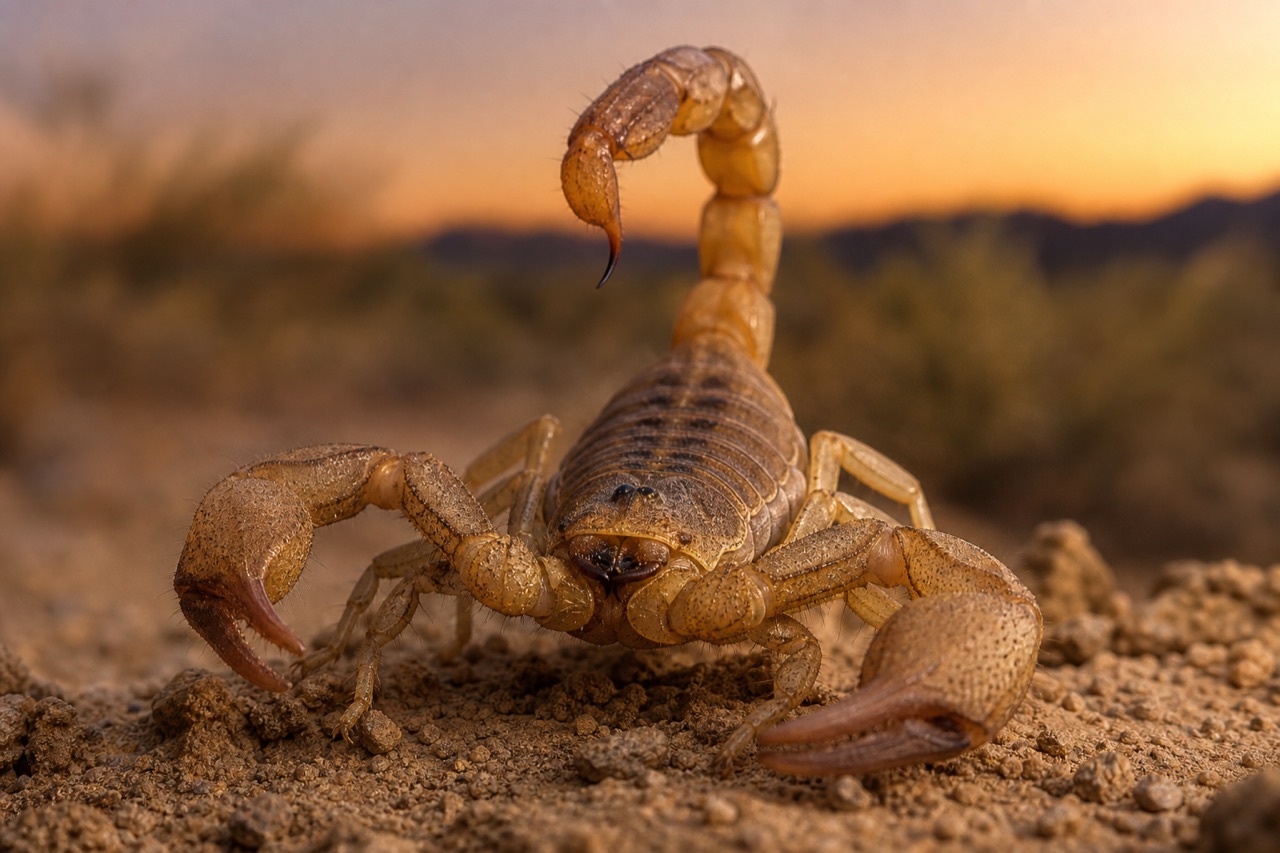
AI-generated educational wildlife portrait — World Animal Rescue Network · AI visualisation, not a photograph
In brief
Scorpions are arachnids of the order Scorpiones — about 2,500 species — that have existed for over 430 million years, fluoresce under ultraviolet light, and give birth to live young; only around 25 species have venom dangerous to humans.
Also in Animals A to Z · Animals that start with S
By WARN Research & Conservation Team Last updated
Scorpions are arachnids — relatives of spiders, ticks and mites — with a body plan that has barely changed since the Silurian, more than 430 million years ago. Grasping pedipalps at the front, a segmented tail carrying a venomous stinger at the back, book lungs for breathing, and a cuticle that fluoresces bright blue-green under ultraviolet light for reasons still debated. Roughly 2,500 species are described. Almost all are nocturnal ambush predators of insects and other invertebrates, and almost all are medically trivial to humans: of the full order, only around 25 species have venom capable of killing a healthy adult. The reputation vastly outruns the risk.
~2,500
Described scorpion species
~25
Species with venom dangerous to a healthy adult
430+ Myr
Age of the scorpion body plan in the fossil record
Live young
All scorpions bear live young, carried on the mother's back
Figures sourced from CITES Appendices, IUCN Red List .
Scorpion: Quick Facts
| Described species | ~2,500 |
|---|---|
| Medically dangerous | ~25 species |
| Fossil record | 430+ million years |
| Reproduction | Viviparous — live birth, young carried on the back |
| Fluorescence | All species glow blue-green under UV |
| Trade status | Emperor scorpion and relatives on CITES Appendix II |
Scientific Classification
| Kingdom | Animalia |
|---|---|
| Phylum | Arthropoda |
| Class | Arachnida |
| Order | Scorpiones |
| Families | ~22, including Buthidae and Scorpionidae |
| Notable genera | Pandinus, Androctonus, Leiurus, Centruroides, Tityus |
Conservation Status
- IUCN Status
- Varies by species — order page
- Population
- Not applicable at order level
- Trend
- Unknown for most species; cave and island endemics under greatest pressure
- Assessed
- Assessed species-by-species; most species unassessed
- CITES
- Appendix II for Pandinus spp. (emperor scorpion and relatives)
Habitat loss and collection for the pet trade are the main documented pressures. Narrow-range cave and island endemics are the species of greatest concern.
Did you know?
Every scorpion so far tested glows blue-green under ultraviolet light — an entire ancient order sharing a trick nobody has yet fully explained.
Key Facts: Scorpion
- Scorpions are arachnids, not insects — eight legs, two body regions, no antennae and no wings.
- All scorpions fluoresce blue-green under UV light; the function is still not settled.
- Every species is venomous, but only around 25 are dangerous to healthy adults.
- As a rule of thumb, large claws and a thin tail signal lower risk; small claws and a thick tail signal higher risk.
- Scorpions give birth to live young, which ride on the mother's back until their first moult.
- Some species survive a year without food and months without water — an extreme low-metabolism strategy.
An ancient, conservative body plan
Scorpions appear in the fossil record over 430 million years ago and are recognisably scorpions from the start. The design — pincered pedipalps for grasping, a flexible metasoma ending in a telson and stinger, comb-like pectines on the underside for sensing substrate texture and chemistry — has needed very little revision.
They breathe with book lungs, detect airborne and substrate vibration through fine sensory hairs and slit organs in the leg cuticle, and hunt largely by touch and vibration rather than sight. Most species have poor vision despite having several pairs of eyes.
Venom, and the risk in proportion
Scorpion venom is a complex mixture of neurotoxic peptides, tuned in most species to subdue invertebrate prey. For the great majority of scorpions, a sting to a human produces local pain, swelling and numbness comparable to a wasp sting.
A small number — mostly in the family Buthidae, including Androctonus, Leiurus, Centruroides and Tityus — carry venom that is medically significant, and scorpion envenomation is a genuine public-health issue in parts of North Africa, the Middle East, Mexico, Brazil and India, particularly for children. The rough guide is anatomical: heavy claws and a slender tail suggest a scorpion that subdues prey mechanically; slender claws and a thick, muscular tail suggest one that relies on potent venom.
Reproduction and maternal care
Scorpion courtship involves the promenade à deux, in which the male grasps the female's pedipalps and manoeuvres her over a spermatophore he has deposited on the ground. Gestation is long — months to over a year in some species — and all scorpions are viviparous, giving birth to live young rather than laying eggs.
The newborn scorplings climb onto the mother's back and stay there until their first moult, protected and kept from desiccating. This level of maternal care is rare among arthropods and is one reason scorpion reproductive rates are low.
Survival strategy, and the pet trade
Scorpions are extreme energy minimisers. Many can lower their metabolic rate to a fraction of the arthropod norm, surviving a year without food and long periods without free water, which is what makes them so successful in deserts. It also makes them slow to recover from population losses.
They are widely kept as pets, with emperor scorpions and related large species dominating the trade. The species is CITES Appendix II listed, largely because of collection pressure. Welfare needs are simple but non-negotiable: correct substrate depth for burrowing, appropriate humidity and heat gradient, secure housing and undisturbed moulting. Handling is unnecessary, stressful for the animal and the main cause of stings to keepers.
What WARN Does
WARN publishes free, sourced species education for the animals people fear as well as the ones they love. Fear-driven killing is a real conservation pressure on scorpions, snakes and spiders, and accurate information about which species actually pose a risk is the most effective thing that changes behaviour.
If this guide helps you understand wildlife and the pressures it faces, a gift to WARN supports habitat protection and free public education in our partner countries.
Scorpion: Frequently Asked Questions
Are scorpions insects?
How dangerous are scorpions?
Why do scorpions glow under UV light?
How can you tell if a scorpion is dangerous?
Do scorpions lay eggs?
Where do scorpions live?
How long do scorpions live?
Sources & References
Population figures, conservation status and biological facts on this page are drawn from authoritative scientific and intergovernmental sources.
Terms used on this page
Plain-English definitions, from our wildlife and conservation glossary.
Explore more animals
Discover more animals, their habitats and their conservation status in the WARN wildlife-guide library.
Enjoyed this Scorpion guide?
Receive appeal updates, animal-welfare news and published funding reports. Unsubscribe any time.
We only use your address for WARN updates. See our privacy policy.