Wildlife Guide · North America
Black Widow Spider
Latrodectus mactans
The glossy black spider with the red hourglass
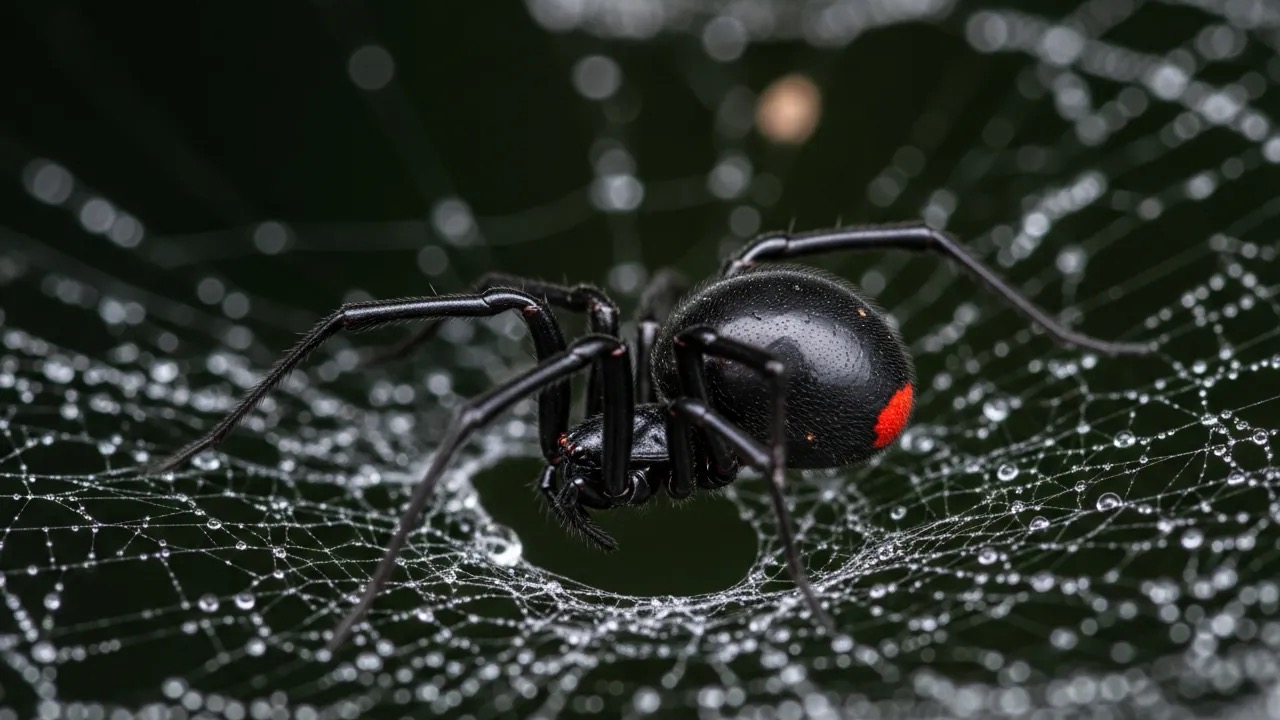
Photo: Jon Bodsworth / Wikimedia Commons (Copyrighted free use)
In brief
The southern black widow (Latrodectus mactans) is a small, glossy black spider famous for the red hourglass marking on the underside of the female's abdomen. It shelters in dark, undisturbed spots such as sheds, woodpiles and field debris, where it builds a tangled web to trap insects.
Also in Animals A to Z · Animals that start with B
By WARN Research & Conservation Team Last updated
The southern black widow (Latrodectus mactans) is a small, glossy black spider famous for the red hourglass marking on the underside of the female's abdomen. It shelters in dark, undisturbed spots such as sheds, woodpiles and field debris, where it builds a tangled web to trap insects. The female's body is only about 1.3 cm long, yet her venom is a potent neurotoxin. Females live one to three years; males are far smaller and shorter-lived.
0.04 m
Typical length
1 g
Typical weight
1.5 km/h
Top speed
3 yrs
Lifespan
Figures sourced from Wikipedia — Black Widow Spider, Wikidata — Black Widow Spider .
Black Widow Spider: Quick Facts
| Scientific name | Latrodectus mactans |
|---|---|
| Diet | Carnivore (insects and other small arthropods) |
| Habitat | Sheltered, dark spots in fields, sheds, and woodpiles |
| Lifespan | 1–3 years (females; males much shorter) |
| Size | Female body about 1.3 cm (0.5 in); legs wider |
| Venom | Potent neurotoxin; bites rarely fatal with care |
| Conservation status | Least Concern (IUCN) |
Scientific Classification
| Kingdom | Animalia |
|---|---|
| Phylum | Arthropoda |
| Class | Arachnida |
| Order | Araneae |
| Family | Theridiidae |
| Genus | Latrodectus |
Conservation Status
- IUCN Status
- Least Concern (IUCN Red List category)
- Population
- Global population not compiled for this guide
- Trend
- See the IUCN Red List assessment
- Assessed
- See the IUCN Red List assessment
- CITES
- See CITES appendices
Conservation figures are drawn from the IUCN Red List and CITES; this guide links to the authoritative sources rather than restating population counts.
Key Facts: Black Widow Spider
- The female black widow is unmistakable: a shiny jet-black body roughly 1.3 cm (0.5 inch) long, with legs spanning wider, and a vivid red hourglass on the underside of her rounded abdomen.
- Black widows are ambush hunters that rely entirely on their web rather than chasing anything down.
- Black widow venom is a neurotoxin called latrotoxin, drop for drop far more potent than a rattlesnake's, which is why the spider has such a fearsome reputation.
Appearance and identification
The female black widow is unmistakable: a shiny jet-black body roughly 1.3 cm (0.5 inch) long, with legs spanning wider, and a vivid red hourglass on the underside of her rounded abdomen. Males are much smaller and paler, often marked with red or yellow streaks, and are rarely noticed. The glossy sheen and bold warning colour advertise the spider's toxicity to would-be predators. Juveniles look different again, with lighter, more patterned bodies that darken as they mature.
Web and how it catches prey
Black widows are ambush hunters that rely entirely on their web rather than chasing anything down. They spin an irregular, tangled cobweb of exceptionally strong silk in a sheltered corner, then wait, hanging upside down at its centre. When an insect blunders into the sticky threads, the spider rushes over, wraps it in silk and delivers a paralysing bite. It then injects digestive enzymes and drinks the liquefied remains. Prey is mostly insects and other small arthropods.
Venom and danger to people
Black widow venom is a neurotoxin called latrotoxin, drop for drop far more potent than a rattlesnake's, which is why the spider has such a fearsome reputation. A bite can cause intense muscle pain, cramping, sweating and nausea, a set of symptoms known as latrodectism. In practice, however, the spider injects only a tiny dose, and with modern medical care bites are very rarely fatal. Deaths are extremely uncommon, and most affect the very young, the elderly or those already unwell.
Behaviour and temperament
Despite their reputation, black widows are shy and reclusive, biting people only when accidentally pressed against the skin or trapped. They are largely nocturnal and slow-moving, ambling across their web at little more than 1.5 km/h. Females spend almost their entire lives within a small web, rarely straying far from this sheltered refuge. Left alone, a black widow poses very little threat and would much rather retreat than confront a much larger animal.
Mating and life cycle
The black widow earns its name from the female's occasional habit of eating the much smaller male after mating, though this happens far less often than folklore suggests. After mating, the female produces several round, papery egg sacs, each holding hundreds of eggs, which she guards within her web. The spiderlings hatch and disperse by releasing silk threads that carry them on the breeze, a technique called ballooning. Females can live one to three years, while males survive only a few months.
What WARN Does
WARN does not run a dedicated black widow spider programme — this guide is part of the World Animal Rescue Network's free educational library. The black widow spider is currently widespread and not globally threatened, and this guide helps readers understand the pressures that can change that. Building public understanding of species like the black widow spider supports the broader conservation awareness that underpins WARN's partner-led rescue work across its network.
If clear, science-based wildlife guides like this help you understand and value animals, please consider supporting the World Animal Rescue Network's educational and rescue work so we can keep producing them.
Black Widow Spider: Frequently Asked Questions
How dangerous is a black widow bite?
How do you identify a black widow spider?
Do female black widows really eat the male?
What do black widow spiders eat?
How long do black widow spiders live?
Where do black widow spiders live?
How big is a black widow spider?
Sources & References
Population figures, conservation status and biological facts on this page are drawn from authoritative scientific and intergovernmental sources.
Terms used on this page
Plain-English definitions, from our wildlife and conservation glossary.
Latest Black Widow Spider Stories
Quick, fact-checked reads on the black widow spider — amazing facts, key questions and the threats it faces.
Species
12 Amazing Facts About Grey Wolves (And Why Alpha Wolves Aren't Real)
A howl that carries 16 km, a pack that is really a family, and the debunked study behind the 'alpha wolf' myth. Twelve verified facts.
Read the storySpecies
12 Amazing Facts About Beavers (Iron in Their Teeth, and They Rebuild Rivers)
Orange iron-hardened incisors, transparent eyelids, and a keystone role that reduces flooding and drought. Twelve facts.
Read the storySpecies
12 Amazing Facts About Wolverines (They Take Down Prey Five Times Their Size)
Frost-resistant fur, jaws that crush frozen bone, and territories the size of small countries. Twelve verified facts.
Read the storyExplore more animals
Discover more animals, their habitats and their conservation status in the WARN wildlife-guide library.
Enjoyed this Black Widow Spider guide?
Receive appeal updates, animal-welfare news and published funding reports. Unsubscribe any time.
We only use your address for WARN updates. See our privacy policy.