Wildlife Guide · Worldwide in temperate and tropical regions & Cellars, sheds and vegetation in Britain and Europe
Daddy Longlegs
Name shared by Pholcidae (cellar spiders), Opiliones (harvestmen) and sometimes Tipulidae (crane flies)
Three different animals share the name — and none of them is the world's most venomous spider.
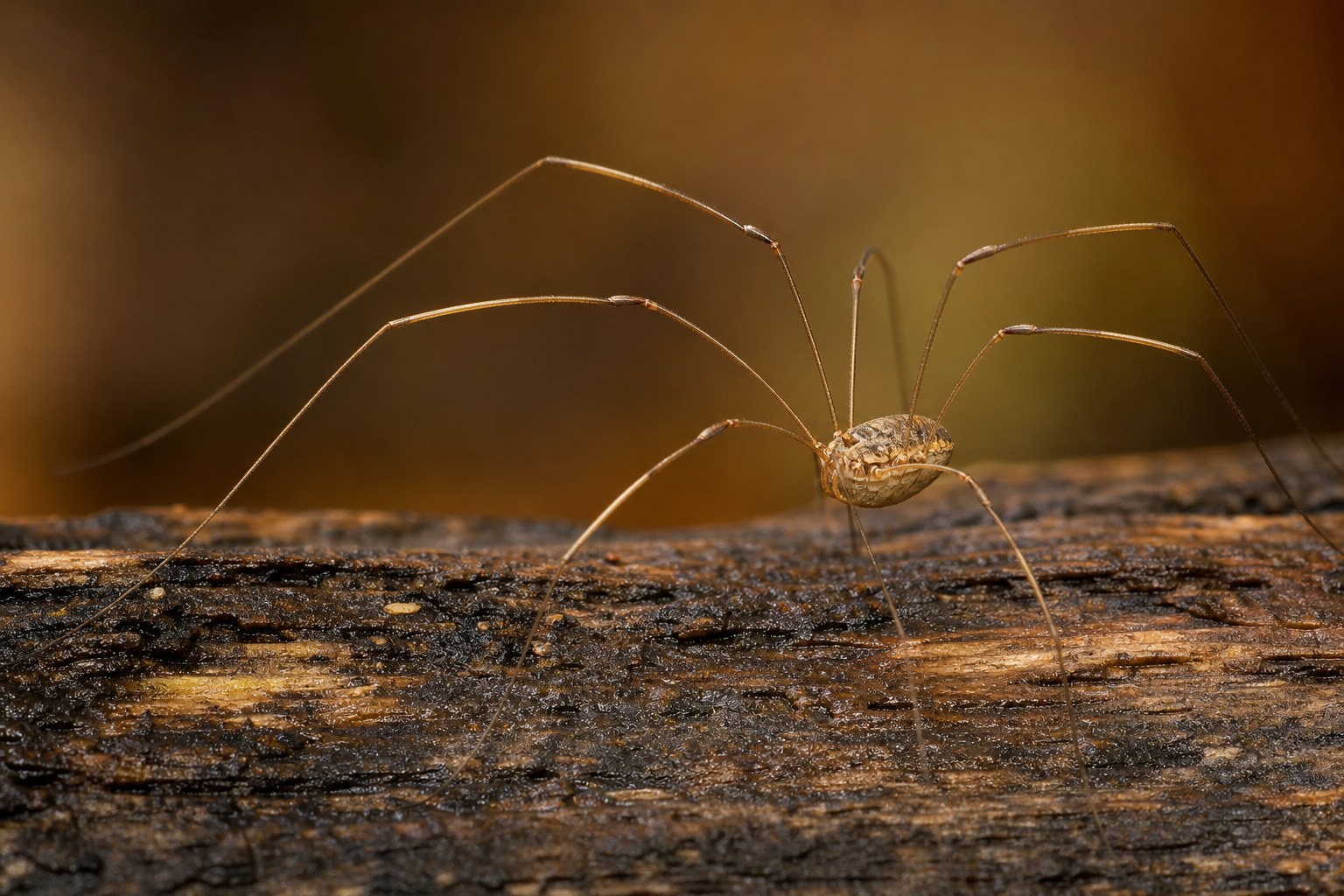
AI-generated educational wildlife portrait — World Animal Rescue Network · AI visualisation, not a photograph
In brief
Daddy longlegs is a shared common name for cellar spiders (Pholcidae), harvestmen (Opiliones) and sometimes crane flies; none is the world's most venomous spider — harvestmen have no venom, cellar-spider venom is not medically significant to humans, and crane flies have none.
Also in Animals A to Z · Animals that start with D
By WARN Research & Conservation Team Last updated
Ask whether daddy longlegs are the most venomous spiders on Earth and the honest first answer is: which animal do you mean? The same English name is used for cellar spiders in the family Pholcidae, for harvestmen in the order Opiliones, and in some places for crane flies. Only one of those three is a spider. None of them carries medically catastrophic venom for humans, and the story that fangs are 'too short to bite' while the toxin is uniquely lethal is false for all of them. That confusion is the reason a single guide has to cover identification before toxicity. People land on this page because of a myth. Correcting the myth without naming which creature is on the windowsill leaves the reader no better at recognising what they actually saw.
3
Unrelated animal groups sharing the English name
0
Venom glands in harvestmen (Opiliones)
Not deadly
Cellar-spider venom effect on humans
2 body parts
True spiders — harvestmen appear as one oval body
Figures sourced from UC Riverside Entomology — daddy longlegs venom myth, UC Riverside Spider Research — daddy longlegs, Burke Museum — spider myths .
Daddy Longlegs: Quick Facts
| Name problem | Three unrelated groups share 'daddy longlegs' |
|---|---|
| Cellar spiders | True spiders (Pholcidae) with mild venom |
| Harvestmen | Opiliones — no venom glands, not spiders |
| Crane flies | Insects — six legs, no venom |
| Myth status | Debunked by arachnologists; still widely repeated |
| IUCN | Most individual species Not Evaluated |
Scientific Classification
| Kingdom | Animalia |
|---|---|
| Phylum | Arthropoda |
| Class | Arachnida (spiders & harvestmen) / Insecta (crane flies) |
| Order | Araneae, Opiliones, or Diptera — depending on the animal meant |
| Family | Pholcidae, various Opiliones families, or Tipulidae |
| Genus | Varies — Pholcus is a common cellar-spider genus |
| Species | Many species across three unrelated groups |
Conservation Status
- IUCN Status
- Not Evaluated
- Population
- No meaningful group estimate — common species are abundant; specialists elsewhere may be rare
- Trend
- Unknown at group level; widespread synanthropic species persist with people
- Assessed
- N/A — not a single assessable taxon
- CITES
- Not applicable as a single listing
The conservation story here is educational rather than demographic: misidentification and fear drive unnecessary killing of harmless invertebrates.
Did you know?
The same English nickname is applied to a spider, a non-spider arachnid and a fly — which is why every confident one-line answer about 'daddy longlegs venom' has to start by asking which animal is meant.
Key Facts: Daddy Longlegs
- Daddy longlegs is not one species. Cellar spiders, harvestmen and crane flies are unrelated groups that share a nickname.
- Harvestmen are arachnids but not spiders: one apparent body region, usually two eyes, no silk, no fangs and no venom glands.
- Cellar spiders are true spiders with venom, and they can bite humans; the venom is not medically significant.
- The claim that fangs are too short to pierce human skin while the venom is uniquely lethal is false for cellar spiders.
- Crane flies are insects with six legs and no venom at all — they are flies, not arachnids.
- Most supposed 'spider bites' blamed on daddy longlegs are other skin conditions or other arthropods.
- Fear of daddy longlegs is out of proportion to risk; they are common indoor predators of small insects.
Three animals, one nickname
In Britain and much of North America, 'daddy longlegs' most often means either a cellar spider hanging in a messy web in a corner, or a harvestman walking across a wall with a compact oval body and eight absurdly long legs. In some regions the same words mean a crane fly — a large, fragile true fly that looks nothing like either arachnid once you count the legs.
The groups are not close relatives. Cellar spiders belong to Araneae, the true spiders. Harvestmen belong to Opiliones, a separate arachnid order that diverged long before spiders evolved silk and fangs. Crane flies are insects in Tipulidae. Treating them as one animal is like writing one guide for 'seagull' and expecting it to cover albatrosses. The myth thrives partly because people argue past each other about different creatures under the same label.
The venom myth, piece by piece
University of California, Riverside arachnologists have summarised the claim clearly: daddy longlegs are said to be among the most venomous spiders, prevented from killing people only by short fangs. That story fails for each animal the name covers.
Harvestmen have no venom glands and no fangs. They cannot inject toxin. Some species produce defensive chemical secretions that deter predators when eaten or contacted, which is poison in the technical sense, not injectable venom — and not a human medical emergency. Cellar spiders do have venom and chelicerae capable of piercing skin; documented effects on people are mild and short-lived where they occur at all. Comparative tests discussed in UCR's public notes found cellar-spider venom far less potent in its effects than black-widow venom. Crane flies have no venom apparatus whatsoever. The myth survives because it is a memorable story, not because any of the three animals matches it.
How to tell cellar spider from harvestman
Look at the body. A cellar spider has two clear regions — a fused head-and-thorax (cephalothorax) and a separate abdomen — and hangs in a loose, irregular web, often vibrating the web violently when disturbed. Eyes are typically clustered near the front. Legs are extremely long and thin, and the animal is a predator of small insects, including other spiders.
A harvestman looks like a single oval body on stilts. There is no narrow waist. Most species have two eyes on a raised turret. They do not spin capture webs. Many feed on decaying material and small soft-bodied prey. If the creature on your wall has six legs and two wings (or wing stubs), it is a crane fly and you have left arachnids entirely. Those three checks — body segments, web presence, leg count — settle almost every household argument about 'daddy longlegs' without needing a microscope.
Risk, fear and what is worth knowing
Cellar spiders are among the invertebrates most often killed in houses out of disproportionate fear. They occupy corners, cellars and sheds where flying insects concentrate, and they pose negligible medical risk in ordinary encounters. Harvestmen are equally harmless to people. Neither group is a conservation priority in the way endemic cave spiders can be; most widespread species have never been Red-Listed because they are common.
What is worth knowing is the identification, because accurate naming stops the myth recycling. A page that says 'daddy longlegs are harmless' without specifying which animal will be contradicted the moment someone meets a different creature under the same name. The useful answer is structural: name the group, describe the body plan, state the venom facts for that group, and leave the urban legend where it belongs — as an example of how a story outruns the evidence.
What WARN Does
WARN publishes free invertebrate education that separates shared nicknames from biology. Daddy longlegs is a high-traffic myth query; answering it accurately reduces needless fear and unnecessary killing of harmless household predators.
If this guide helps you understand wildlife and the pressures it faces, a gift to WARN supports habitat protection and free public education in our partner countries.
Daddy Longlegs: Frequently Asked Questions
Are daddy longlegs the most venomous spiders?
Can a daddy longlegs bite you?
Is a daddy longlegs a spider?
What is the difference between a harvestman and a cellar spider?
Are daddy longlegs dangerous to pets or children?
What do daddy longlegs eat?
Where do daddy longlegs live?
How big is a daddy longlegs?
How long do daddy longlegs live?
Sources & References
Population figures, conservation status and biological facts on this page are drawn from authoritative scientific and intergovernmental sources.
Terms used on this page
Plain-English definitions, from our wildlife and conservation glossary.
Explore more animals
Discover more animals, their habitats and their conservation status in the WARN wildlife-guide library.
Enjoyed this Daddy Longlegs guide?
Receive appeal updates, animal-welfare news and published funding reports. Unsubscribe any time.
We only use your address for WARN updates. See our privacy policy.