Free family & classroom resource
Orangutans and forests
Explore where orangutans live, how forest life connects, and how to check a wildlife story before sharing it. Read, draw and discuss together, then try the short quiz.
Uses your browser’s print menu. Activities and the answer guide are included.
_Sepilok.jpg)
Start here · 5 minutes
Meet the forest’s great apes
A home in the trees
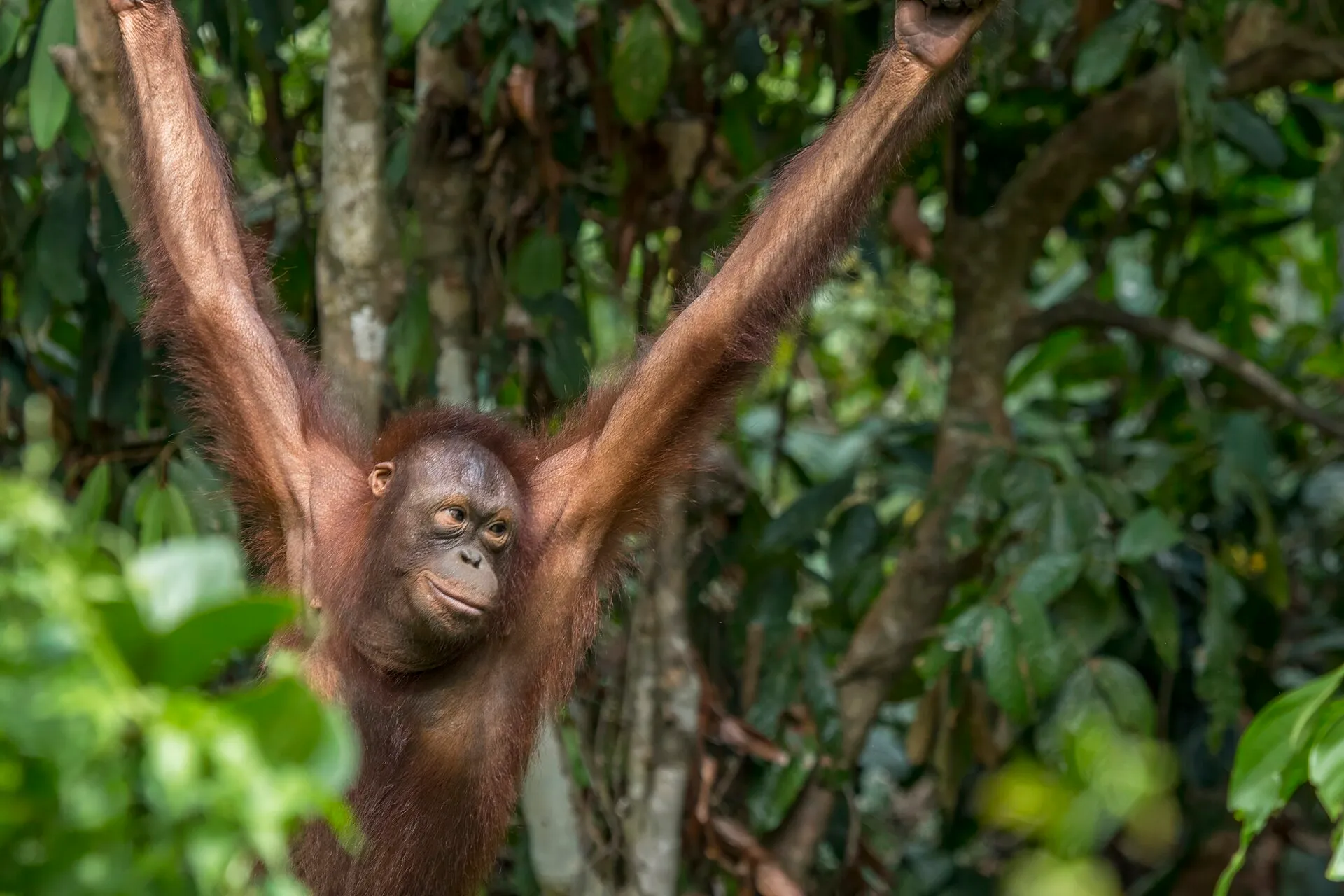
Orangutans are great apes with reddish hair. They spend much of their time in trees, using long arms and grasping hands and feet. They build resting nests from branches and leaves.
Two islands, three species
Wild orangutans live on Borneo and Sumatra. There are three recognised species: Bornean, Sumatran and Tapanuli orangutans. These names help us ask which animals and places a story is about.
Fruit and forest connections
Fruit is an important food, and orangutans also eat other plant material and some insects. By moving seeds, they contribute to the life of the forest.
A habitat worth protecting
Forest loss, hunting and wildlife trafficking threaten orangutans. Protecting them involves people, the animals and the habitats they depend on.
Background: WWF’s orangutan account and Smithsonian’s orangutan profile. Read more in the WARN orangutan guide.
Activity 1 · 5–10 minutes
Find the islands
- Find Southeast Asia in an atlas. Locate Borneo and Sumatra.
- Draw two simple island outlines. Label each one; your drawing does not need to be to scale.
- On Borneo, label the Indonesian part “Kalimantan”. Borneo is shared by Indonesia, Malaysia and Brunei. Sumatra is in Indonesia.
- Write “Bornean” beside Borneo, and “Sumatran” and “Tapanuli” beside Sumatra.
Discuss: A report describes a fire in West Kalimantan. What would you need to check before saying the same thing is happening everywhere in Borneo?
Activity 2 · 10 minutes
Draw a forest connection map
Write these six words around your paper: orangutan, fruit, tree, seed, water, people. Draw arrows between words that you think connect. Put a short explanation beside every arrow.
Start with “tree → fruit: some trees produce fruit” and “fruit → orangutan: fruit provides food”. Then create your own connections. Some words may have more than one arrow.
Change one thing
Imagine that a patch of forest becomes separated from the next patch. Circle two connections that might change. Explain your reasoning rather than trying to guess a single perfect answer.
Extension: Add “wildlife professional” to your map. What information would that person need before deciding how to help an animal?
Activity 3 · 5–10 minutes
Become a wildlife story detective
This is an invented practice post, not a report of a real event:
“This photo proves every orangutan in Borneo needs rescuing today. Share it now!”
The only information beside the photograph is “Borneo, 2015”. Before sharing the post, discuss four checks:
- Who? Who made the original report, and can you find it?
- When? When was the photograph taken, and when did the reported event happen?
- Where? Which place is actually identified?
- What does it show? Does the photograph support the whole claim, or just show an orangutan?
Now rewrite the post as a careful statement in your own words. It is fine to say that you do not yet have enough information.
Activity 4 · 5 minutes
Check what you learned
Choose one answer for each question. Your answers stay on this page and are not sent to WARN.
Answer and discussion guide
Open the answer guide
Map: Borneo and Sumatra are different islands. Kalimantan is part of Borneo. A report from one province does not establish the situation across a whole island.
Connections: Reward explanations rather than the number of arrows. Examples include fruit providing food, trees providing nesting places and orangutans moving seeds. Discuss why a forest is more than a group of individual trees.
Story detective: The example post makes a claim that its photograph cannot establish. A careful alternative could be: “This is an older orangutan photograph. I need a dated original report to understand the current situation and which area is affected.”
Quiz 1: Borneo and Sumatra. Wild orangutans live on Borneo and Sumatra. Borneo is shared by Indonesia, Malaysia and Brunei; Kalimantan is its Indonesian part.
Quiz 2: Grasping hands and feet. Orangutans use their long arms and grasping hands and feet to move through branches.
Quiz 3: Move seeds to new places. Some seeds travel away from the parent plant when an animal eats fruit. Orangutans contribute to seed dispersal.
Quiz 4: No; check the date, place and original report. A useful photograph can illustrate a species without documenting a particular event. Its original date and context still matter.
One thing worth sharing
Make a small poster with one fact, one drawing and one source. Explain what you learned to someone at home or school. Use your own drawing, or check the permission and credit for any photograph you include.
Adults looking for current background can read the dated Kalimantan fire briefing. Teachers can choose which material is suitable for their learners; that separate report discusses an animal’s death.
Prepared by WARN’s editorial team, 8 September 2026. Editorial standards · Suggest a correction.