Wildlife Guide · Every continent except Antarctica & From deep caves and mountaintops to coastlines and houses
Spider
Order Araneae — over 50,000 described species in more than 120 families
Silk, venom and patience — the most successful land predators you mostly notice by accident.
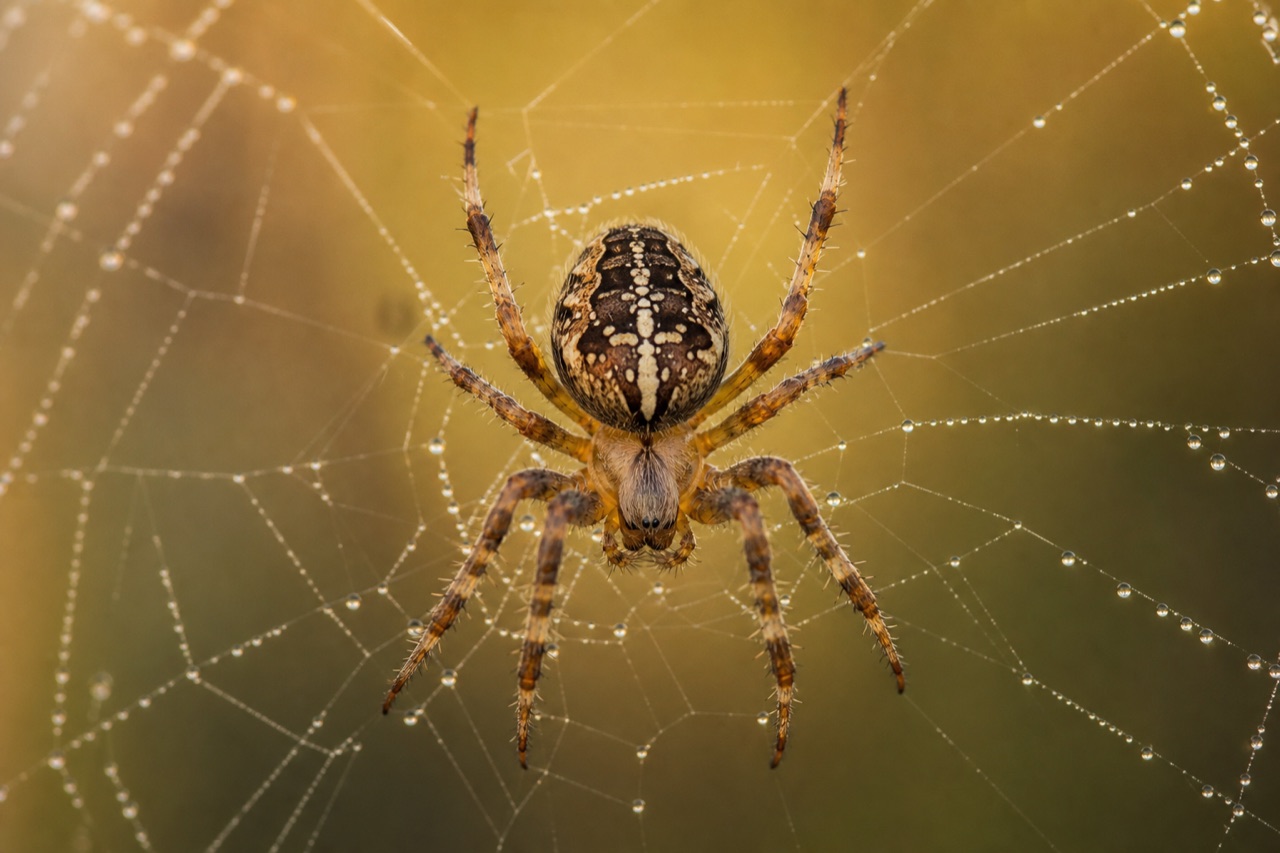
AI-generated educational wildlife portrait — World Animal Rescue Network · AI visualisation, not a photograph
In brief
Spiders (order Araneae) are arachnids — not insects — with more than 50,000 described species, all producing silk and most acting as ambush or trap predators; only a small fraction of species have venom medically significant to humans.
Also in Animals A to Z · Animals that start with S
By WARN Research & Conservation Team Last updated
Spiders are not insects. They belong to the class Arachnida, alongside scorpions, mites and harvestmen, and the order Araneae holds more than 50,000 described species with estimates of twice that still unnamed. Every spider makes silk — a protein fibre evolved once in the spider lineage and then repurposed into webs, draglines, egg sacs, retreats, ballooning threads and communication lines. Silk is stronger per unit weight than steel and can be tuned from sticky to dry, from stretchy to rigid, by changing the protein mix and spinning speed. Ecologically, spiders are among the dominant invertebrate predators on land. A single hectare of meadow may contain millions of individuals taking an enormous tonnage of insects and other small prey each year. They are generalists by default but specialists by adaptation: orb-weavers trap flying insects, wolf spiders run down prey on the ground, crab spiders ambush from flowers, and jumping spiders stalk with acute vision and calculated leaps. Fear of spiders is common and culturally reinforced, but the medical reality is narrower than the reputation. Of thousands of species, only a handful regularly cause serious envenomation in humans, and most spiders you encounter cannot pierce human skin or have venom tuned for insects rather than mammals. Understanding spiders as silk engineers and pest controllers rather than as uniform threats is one of the more useful shifts in everyday natural history.
50,000+
Described spider species; many more await naming
All
Spiders produce silk — webs are one use among many
8
Eyes in most groups; jumping spiders have the sharpest vision
Few
Species worldwide with venom dangerous to healthy adults
Figures sourced from World Spider Catalog, IUCN Red List .
Spider: Quick Facts
| Body plan | Cephalothorax + abdomen; eight legs |
|---|---|
| Silk | Produced by all species; multiple silk types |
| Vision | Varies — jumping spiders have exceptional eyesight |
| Feeding | Liquid diet — venom digests prey externally |
| Medically significant species | A small fraction worldwide |
| Main threats | Habitat loss and pesticides for narrow-range species |
Scientific Classification
| Kingdom | Animalia |
|---|---|
| Phylum | Arthropoda |
| Class | Arachnida |
| Order | Araneae |
| Major families | Salticidae, Araneidae, Lycosidae, Theridiidae, Thomisidae and 115+ others |
| Described species | Over 50,000 |
Conservation Status
- IUCN Status
- Varies by species — order page
- Population
- Not applicable at order level
- Trend
- Unknown for most species; cave and island endemics declining with habitat loss
- Assessed
- Assessed species-by-species; the great majority are unassessed
- CITES
- Not listed
Most spider species have no formal IUCN assessment. Conservation concern concentrates on habitat specialists — cave, dune and single-island endemics — rather than common house and garden species.
Did you know?
Spiderlings balloon on silk threads caught by wind, travelling kilometres through the air — which is how spiders reach isolated islands and turn up on ships far from land.
Key Facts: Spider
- Spiders are arachnids, not insects — eight legs, two body segments (cephalothorax and abdomen), no antennae.
- All spiders make silk; orb webs are one architecture among dozens, including sheets, funnels, triangles and single traplines.
- Spiders are major terrestrial predators, removing vast numbers of insects and other invertebrates from ecosystems.
- Jumping spiders (Salticidae) have excellent vision and elaborate courtship displays — the most 'watchable' spider family.
- Most spider bites cause at most local pain; medically important species are concentrated in a few families such as recluse and widow spiders.
- Habitat loss, pesticide use and invasive species threaten narrow-range and cave-dwelling spiders more than house and garden species.
Silk: one invention, many engineering solutions
Spider silk begins as a liquid protein gel in specialised glands and solidifies as it is drawn through spinnerets at the rear of the abdomen. Different gland types produce different silks — dragline silk for safety lines, capture silk with glue droplets for webs, swathing silk for wrapping prey, and fine silk for egg sacs. An orb-weaver may combine several types in a single web: non-sticky radial spokes, sticky capture spirals, and a retreat line the spider runs along when disturbed.
Web design is not random. Orb webs intercept flying insects efficiently in open space. Sheet webs and funnel webs suit low vegetation and ground-level prey. The bolas spider goes further: it spins a shortened line with a sticky blob at the end and swings it to snag moths, sometimes releasing moth pheromone mimics to lure targets within range. Silk is also used for dispersal — spiderlings release long threads that catch wind and carry them kilometres in a behaviour called ballooning, which explains how spiders colonise islands and appear on ships at sea.
Materials scientists study spider silk because it combines strength, elasticity and toughness in ways synthetic fibres still struggle to match. Farming silk from spiders is impractical — they are cannibalistic — so research focuses on transferring silk genes into other organisms or synthesising analogous proteins. The biological original remains, for now, ahead of the copy.
How spiders hunt without webs
Roughly half of spider species do not build prey-capture webs at all. Wolf spiders (Lycosidae) chase prey across the ground using speed and eyesight, often carrying egg sacs attached to their spinnerets. Crab spiders (Thomisidae) sit on flowers, camouflaged to match petals, and seize pollinators that land within reach — a reminder that spiders eat beneficial insects as well as pests, without favouring either.
Jumping spiders (Salticidae) are the most visually oriented hunters. Their principal eyes give acute resolution and depth perception used to plan jumps many times their body length. Many species perform complex courtship dances — leg waves, palp movements, and abdominal displays — that researchers can only fully appreciate under magnification. Net-casting spiders hold a small web between the front legs and throw it over walking prey.
Venom and fangs do the final work. Chelicerae deliver venom that is usually neurotoxic to invertebrates, liquefying tissues that the spider then sucks up as fluid. Spiders cannot eat solid food. Prey size limits are real — a house spider will not tackle a mouse — but large tarantulas and related mygalomorphs take frogs, lizards and small birds on occasion, which feeds disproportionately into spider folklore.
Venom, bites and the gap between fear and risk
Almost all spiders are venomous in the technical sense — they use venom to subdue prey — but very few are dangerous to humans. Widow spiders (Latrodectus) and recluse spiders (Loxosceles) are the best-known medical concerns in temperate regions; funnel-web spiders (Atrax and Hadronyche) in Australia are among the few that can kill untreated. Symptoms vary from local necrosis to systemic neurotoxicity depending on species, venom dose and individual sensitivity.
Most alleged spider bites are misattributions. Bacterial infections, ticks, fleas and other arthropods cause lesions blamed on spiders because spiders are visible and feared. When genuine bites occur, they are often 'dry' — no venom injected — or defensive nips as a spider is trapped against skin in clothing or bedding. Exterminating all spiders in a home is neither achievable nor desirable; reducing clutter, shaking out boots and using gloves in sheds address the realistic risk paths.
Conservation attention for spiders focuses on microhabitat specialists: cave endemics, single-island species and dune specialists lost to development and trampling. The majority of house and garden spiders are widespread and secure, but they remain valuable indicators of insect abundance and pesticide load — a garden with healthy spider populations usually has enough prey and few enough broad-spectrum sprays to support them.
Spiders in ecosystems and human spaces
In agricultural and garden systems, spiders provide free pest suppression. Studies in orchards, rice fields and pasture repeatedly show that spider abundance correlates with lower herbivore damage when pesticide use is restrained. Broad-spectrum insecticides that wipe out spiders often produce rebound pest outbreaks because the predator community recovers more slowly than the pests.
Human buildings extend spider habitat. House spiders exploit corners, window frames and cellar voids where flying and crawling insects concentrate. Seasonal influxes — autumn males wandering in search of mates — trigger panic disproportionate to risk. Education that distinguishes harmless orb-weavers and daddy-long-legs spiders from the small set of species warranting caution reduces both fear and unnecessary killing.
The order-level picture is one of extraordinary evolutionary success with minimal public understanding. Spiders are older than dinosaurs, present on every continent except Antarctica, and woven into folklore from Anansi to Arachne. Treating them as a single frightening category obscures a radiation of silk technologies, hunting strategies and ecological roles that repay curiosity — ideally at a respectful distance, and with a camera rather than a shoe.
What WARN Does
WARN publishes free, sourced species education for the animal groups people encounter daily but rarely understand. Spiders are near-universal neighbours; accurate guides reduce fear-driven killing and highlight their role as unpaid pest control.
If this guide helps you understand wildlife and the pressures it faces, a gift to WARN supports habitat protection and free public education in our partner countries.
Spider: Frequently Asked Questions
Are spiders insects?
Do all spiders spin webs?
How many spider species exist?
Are spider bites dangerous?
What are jumping spiders?
What do spiders eat?
Where do spiders live?
How long do spiders live?
How big is a spider?
Sources & References
Population figures, conservation status and biological facts on this page are drawn from authoritative scientific and intergovernmental sources.
Terms used on this page
Plain-English definitions, from our wildlife and conservation glossary.
Explore more animals
Discover more animals, their habitats and their conservation status in the WARN wildlife-guide library.
Enjoyed this Spider guide?
Receive appeal updates, animal-welfare news and published funding reports. Unsubscribe any time.
We only use your address for WARN updates. See our privacy policy.