Wildlife Guide · Borneo & Sumatra
Sunda Clouded Leopard
Neofelis diardi (Cuvier, 1823) — family Felidae
A separate species since 2006 — clouded spots and sabre-like teeth in forests cleared for plantations.
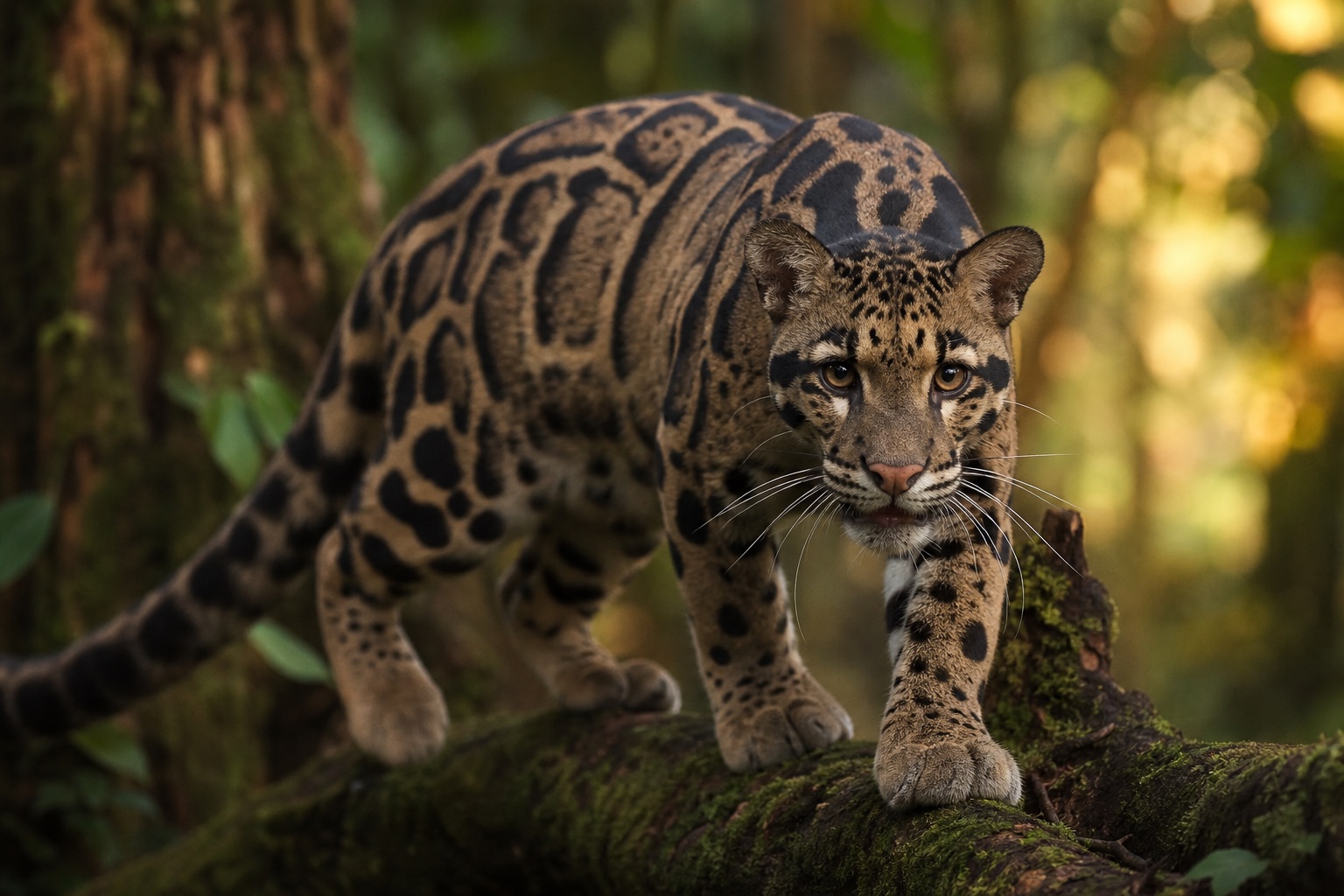
AI-generated educational wildlife portrait — World Animal Rescue Network · AI visualisation, not a photograph
In brief
The Sunda clouded leopard (Neofelis diardi) is a Vulnerable tree-dwelling cat of Borneo and Sumatra, a separate species since 2006, with the longest canines relative to skull among living cats; oil palm, pulpwood, mining and snaring drive losses.
Also in Animals A to Z · Animals that start with S
How you can help
You can support the related appeal — read its purpose, recipient status and fund terms first — or give once to where it is needed most. Sharing accurate information helps too.
By WARN Research & Conservation Team Last updated
The Sunda clouded leopard is a forest cat of Borneo and Sumatra recognised as a separate species from the mainland clouded leopard in 2006 — split on genetics, coat pattern and skull shape. It is smaller than a leopard but built for trees, with short flexible legs, large paws, a long tail for balance and the longest canine teeth relative to skull size of any living cat. Those canines invite comparison with extinct sabre-toothed cats — WARN's saber-toothed cat guide at saber toothed cat covers Smilodon and its true sabre-tooth skull, a different order of magnitude. The Sunda clouded leopard is a modern felid pushing canine proportions to their living limit, not a Pleistocene specialist. It is Vulnerable. Lowland forest on Borneo and Sumatra converts for oil palm and pulpwood; mining and snaring add mortality. Clouded leopards are secretive and poorly counted — Vulnerable may understate pressure where forest is gone.
2006
Recognised as separate from mainland clouded leopard
Canines
Longest relative to skull of any living cat
Vulnerable
IUCN status on Borneo and Sumatra
Arboreal
Short legs, long tail — built for trees
Figures sourced from IUCN Red List — Neofelis diardi, Wilting et al. (2007) — clouded leopard species split .
Sunda Clouded Leopard: Quick Facts
| Weight | About 12–16 kg |
|---|---|
| Species split | 2006 — separate from mainland form |
| Canines | Longest relative to skull among living cats |
| Habitat | Lowland and hill forest canopy |
| IUCN status | Vulnerable |
| Main threats | Oil palm, pulpwood, mining; snaring |
Scientific Classification
| Kingdom | Animalia |
|---|---|
| Phylum | Chordata |
| Class | Mammalia |
| Order | Carnivora |
| Family | Felidae |
| Genus | Neofelis |
| Species | Neofelis diardi |
Conservation Status
- IUCN Status
- Vulnerable
- Population
- Unknown; likely fewer than 10,000 mature individuals
- Trend
- Decreasing
- Assessed
- 2015
- CITES
- Appendix I
Poor survey data on secretive arboreal cats; range loss from conversion may outpace population estimates.
Did you know?
The Sunda clouded leopard has the longest canine teeth relative to skull of any living cat — a living echo of sabre-tooth proportions in Borneo's remaining forest.
Key Facts: Sunda Clouded Leopard
- The Sunda clouded leopard was split from the mainland clouded leopard as a separate species in 2006 on genetic and morphological evidence.
- It has the longest canine teeth relative to skull size of any living cat — convergent with sabre-tooths in proportion, not in mechanism.
- WARN's saber-toothed cat guide at /wildlife-guides/extinct-animals/saber-toothed-cat/ covers true sabre-toothed cats for comparison.
- It is Vulnerable, threatened by oil palm and pulpwood conversion, mining access and snaring across Borneo and Sumatra.
- Arboreal anatomy — large paws, long tail, flexible ankles — suits continuous forest canopy, not plantation.
- Density estimates are poor; secretive cats in disappearing forest are often assessed on range loss before population data exist.
Split on Borneo and Sumatra
Until 2006, clouded leopards were treated as one species across mainland Asia and the islands. Genetic and coat-pattern work separated Neofelis nebulosa on the mainland from Neofelis diardi on Borneo and Sumatra. The Sunda form has smaller cloud markings and a different skull profile.
Species status matters for conservation accounting. Borneo and Sumatra lose forest independently; a single range map for 'clouded leopard' obscured island-specific decline. The split aligned biology with the geography of oil palm and pulpwood expansion.
Canines and the sabre-tooth comparison
Sunda clouded leopards kill with a bite to the neck or skull, using canines long relative to their head but still within modern felid jaw mechanics. True sabre-toothed cats — Smilodon and relatives covered in WARN's guide at saber toothed cat — had canines so long they required specialised skull hinges and likely throat-shearing kills.
The comparison is proportional, not functional. Living clouded leopards are the closest analogue to 'small sabre-tooths' in today's forests — a hook for public interest that should lead to forest protection, not trophy trade. Canine length did not save Pleistocene sabre-tooths from prey loss and competition; it will not save clouded leopards from plantation conversion.
Oil palm, pulpwood, mining and snares
Borneo's lowland forest — primary clouded leopard habitat — has been replaced extensively by oil palm and pulpwood estates. Sumatra shows the same pattern. Mining concessions and roads fragment what remains. Snares set for bushmeat catch cats indiscriminately.
Wildlife trade in Southeast Asia includes cat skins and bones for traditional markets, though clouded leopards are less high-profile than tigers. The dominant driver remains land use: a Vulnerable cat cannot persist in monoculture. Protected areas hold populations where enforcement works; elsewhere the species is functionally absent despite forest fragments on satellite maps.
Big cats of a different scale
Clouded leopards sit on big-cat type pages because public search treats them as small leopards — they are Neofelis, distinct from Panthera. Sunda clouded leopards are island specialists with island-specific threats.
Camera-trap surveys occasionally capture them in remaining forest — proof of persistence, not proof of safety. Each image from an oil-palm-surrounded reserve is a data point on borrowed time unless connectivity and anti-snaring keep pace with conversion outside the boundary.
What WARN Does
WARN publishes free, sourced species education linking living predators to extinct parallels without conflating them. Sunda clouded leopards carry sabre-like proportions into forests being converted for oil palm, pulpwood and mining — the comparison with saber-toothed cats is anatomy, not destiny.
If this guide helps you understand wildlife and the pressures it faces, a gift to WARN supports habitat protection and free public education in our partner countries.
How can I help save the sunda clouded leopard?
Explore practical ways to support the sunda clouded leopard, from everyday choices and sharing reliable information to reviewing a related appeal before giving.
Explore ways to support
Read the related appeal’s purpose, recipient status and fund terms. Choose an affordable gift after checking what is proposed and what has been reported.
Ease the pressures
Avoid the wildlife trade and souvenirs, never buy wild animals as pets, and choose sustainable, habitat-friendly products — the threats behind the sunda clouded leopard's decline fall when demand does.
Spread the word
Share accurate, sourced information about the sunda clouded leopard. Wider awareness is what turns concern into lasting protection.
Sunda Clouded Leopard: Frequently Asked Questions
How can I help save the sunda clouded leopard?
When did the Sunda clouded leopard become a separate species?
Why compare it to saber-toothed cats?
Are Sunda clouded leopards endangered?
Where do they live?
How big is a Sunda clouded leopard?
What threatens them most?
Sources & References
Population figures, conservation status and biological facts on this page are drawn from authoritative scientific and intergovernmental sources.
Terms used on this page
Plain-English definitions, from our wildlife and conservation glossary.
Latest Sunda Clouded Leopard Stories
Quick, fact-checked reads on the sunda clouded leopard — amazing facts, key questions and the threats it faces.
Guides
How Much Does It Cost to Rescue an Orangutan?
Orangutan rescue spans emergency extraction, years of forest-school rehabilitation and soft release — each stage carries real costs. Here is what UK donors actually fund.
Read the storySpecies
12 Amazing Facts About Tigers (That Sound Made Up But Aren't)
From striped skin and swimming big cats to a roar you can hear three kilometres away, here are 12 verified facts about the world's largest cat.
Read the storySpecies
How Big, Fast and Strong Is a Tiger? The Numbers Explained
Tigers are the largest cats alive, with a bite force around 1,000 PSI and short-burst speeds up to 65 km/h. Here are the real measurements.
Read the storyExplore more animals
Discover more animals, their habitats and their conservation status in the WARN wildlife-guide library.
Enjoyed this Sunda Clouded Leopard guide?
Receive appeal updates, animal-welfare news and published funding reports. Unsubscribe any time.
We only use your address for WARN updates. See our privacy policy.