Wildlife Guide · Sumatra & Malay Peninsula and southern Thailand
Siamang
Symphalangus syndactylus (Illiger, 1811) — family Hylobatidae
The largest gibbon — paired duets amplified by an inflatable throat sac.
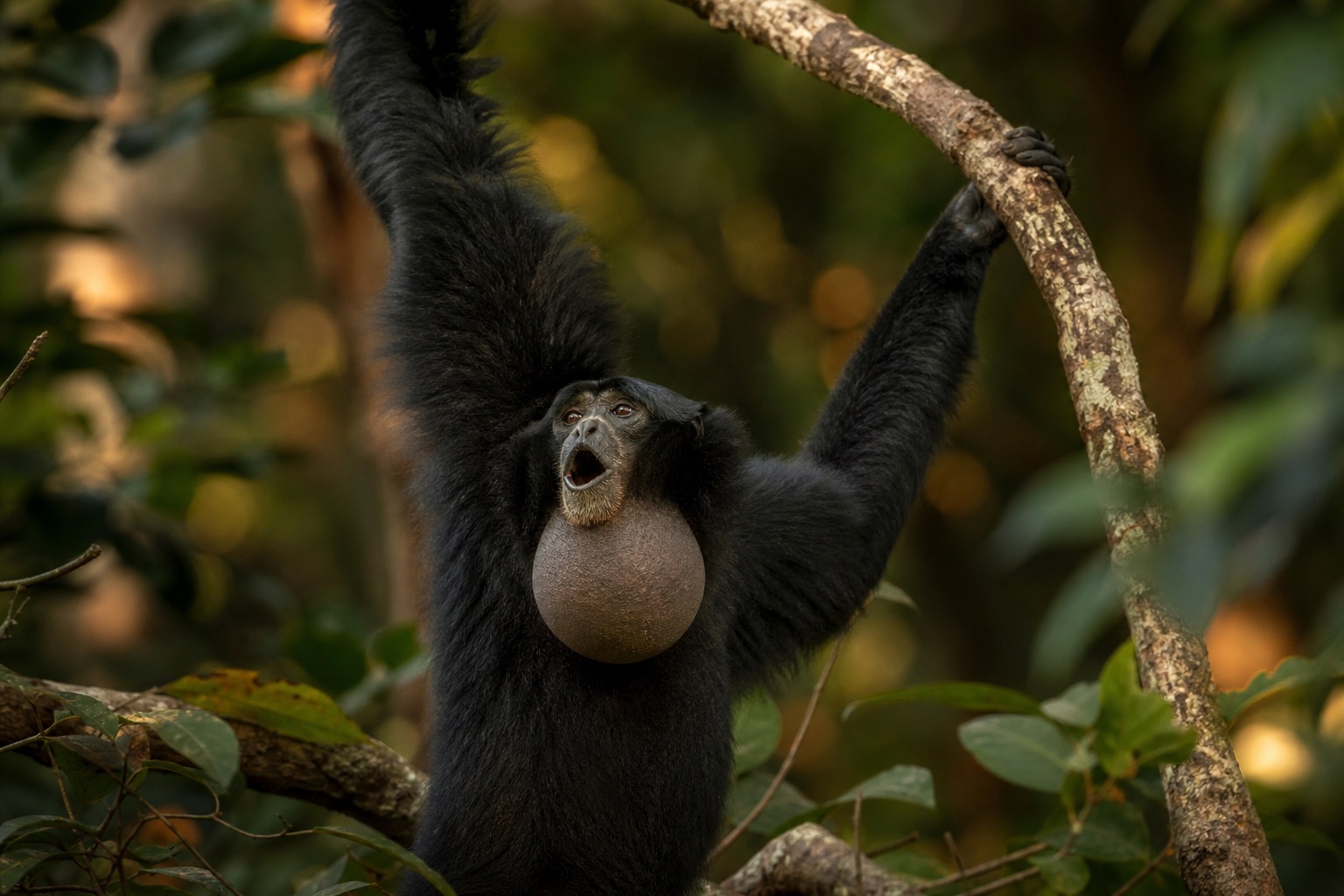
AI-generated educational wildlife portrait — World Animal Rescue Network · AI visualisation, not a photograph
In brief
The siamang (Symphalangus syndactylus) is the largest gibbon, Endangered across Sumatra and the Malay Peninsula, known for paired morning duets amplified by an inflatable throat sac; oil palm, pulpwood and mining drive forest loss across its range.
Also in Animals A to Z · Animals that start with S
How you can help
You can support the related appeal — read its purpose, recipient status and fund terms first — or give once to where it is needed most. Sharing accurate information helps too.
By WARN Research & Conservation Team Last updated
The siamang is the largest gibbon, standing roughly a metre tall and weighing up to 14 kg — nearly twice a white-handed gibbon. It is black-furred, with a naked throat sac that inflates to the size of a grapefruit during the loud duets pairs perform each morning. Those calls carry more than a kilometre through hill forest and advertise territory as effectively as any primate vocalisation in Sundaland. Siamangs are apes, not monkeys — tailless, with arms longer than their legs and a lifestyle built around brachiation through the canopy. Pairs bond for years and coordinate their songs: the male and female alternate phrases in a structured duet that neighbouring groups answer. The throat sac acts as a resonator, amplifying notes that would otherwise dissipate in humid forest air. The species is Endangered. Sumatra and the Malay Peninsula are losing hill forest to oil palm, pulpwood and mining at a pace that fragments the continuous canopy siamangs require. The pet trade takes young gibbons; plantation edges increase hunting access. A gibbon that cannot move between forest blocks has no fallback on the ground.
~14 kg
Maximum weight — the largest gibbon
Throat sac
Inflates during duets to amplify calls
Duets
Paired morning songs advertising territory
Endangered
IUCN status across Sumatra and the Peninsula
Figures sourced from IUCN Red List — Symphalangus syndactylus, Gibbon Network — siamang, CITES Appendices .
Siamang: Quick Facts
| Weight | Up to ~14 kg |
|---|---|
| Throat sac | Inflates to amplify duets |
| Social unit | Pair plus offspring |
| Movement | Brachiation through canopy |
| IUCN status | Endangered |
| Main threats | Oil palm, pulpwood, mining; pet trade |
Scientific Classification
| Kingdom | Animalia |
|---|---|
| Phylum | Chordata |
| Class | Mammalia |
| Order | Primates |
| Family | Hylobatidae |
| Genus | Symphalangus |
| Species | Symphalangus syndactylus |
Conservation Status
- IUCN Status
- Endangered
- Population
- Declining; no precise global count
- Trend
- Decreasing
- Assessed
- 2020
- CITES
- Appendix I
Hill forest clearance for plantations and infrastructure fragments the continuous canopy required for brachiation and duet territories.
Did you know?
A siamang's throat sac inflates to grapefruit size during duets — turning paired morning song into one of the loudest sounds in Sundaland hill forest.
Key Facts: Siamang
- The siamang is the largest gibbon — roughly twice the mass of smaller Hylobates species.
- Pairs perform coordinated morning duets; an inflatable throat sac amplifies calls that carry over a kilometre.
- Siamangs are apes in the family Hylobatidae — tailless, brachiating canopy specialists, not monkeys.
- They are Endangered, with forest loss for oil palm, pulpwood and mining the dominant habitat pressure.
- The pet trade removes infants; plantation roads and logging edges increase hunting and capture.
- Continuous canopy is essential — siamangs are poor on the ground and cannot cross large cleared gaps.
The gibbon that outsings the rest
All gibbons sing, but siamang duets are the loudest. The throat sac — a loose pouch of skin on the neck — inflates during vocalisation and acts as a resonating chamber, boosting low-frequency notes that travel through dense vegetation. A pair's duet follows a species-specific pattern: male and female phrases interlock, and neighbouring pairs answer, mapping territory acoustically each dawn.
The function is defence without contact. Gibbons eat ripe fruit and young leaves in the canopy; overlapping home ranges would mean competition. Song defines boundaries cheaper than fighting. Where forest is fragmented, duets reveal isolated pairs — still calling, but with no forest bridge to the next group.
Ape anatomy in the canopy
Siamangs share the gibbon body plan: extraordinarily long arms, hook-shaped hands, reduced thumbs and no tail. Movement is brachiation — hand-over-hand swinging — with occasional bipedal walking along branches. The syndactyly that names the genus Symphalangus refers to partial fusion of toes two and three on each foot, a gibbon trait visible in the siamang's grip.
Family groups are small — typically a pair and one or two offspring. Development is slow; infants depend for years, which makes population recovery slow when adults are removed. Gibbons are among the primates most heavily represented in the illegal pet trade across Southeast Asia, because infants are small and docile before trauma accumulates.
Oil palm, pulpwood and the Endangered listing
Sumatra has lost a large fraction of its primary forest in two decades, with oil palm and pulpwood plantations the main drivers on lowland and hill land. The Malay Peninsula shows the same pattern at smaller scale but higher fragmentation. Siamangs need hill forest with fruiting trees and connected canopy; plantations provide none of that.
Mining — tin, bauxite and coal depending on region — adds haul roads and clearance patches through remaining forest. Wildlife trade moves captured gibbons through markets for pets and entertainment. The Endangered listing reflects range-wide decline, not a single province. Protected areas help where they exist and are enforced, but gibbon density in oil-palm-dominated landscapes is effectively zero.
Where siamangs sit among primates
Gibbons are the small apes — Hylobatidae — distinct from great apes and from monkeys. The siamang is their largest member, occupying Sundaland hill forest while smaller gibbons share the same forests or adjacent ranges. WARN's primate type pages group apes, monkeys and lemurs for identification context; siamangs belong in the ape branch as brachiating fruit-eaters whose conservation is inseparable from forest remaining on the ground.
Duets make siamangs audible to anyone near hill forest at dawn. Silence where calls were once routine is often the first sign that a population has been trapped, traded or starved of canopy — not a subtle ecological shift but an absence people can hear.
What WARN Does
WARN publishes free, sourced species education for primates lost to forest conversion and trade. Siamang duets are still heard in remnant hill forest on Sumatra, but oil palm and pulpwood expansion maps directly onto Endangered status — the biology requires canopy the plantation economy removes.
If this guide helps you understand wildlife and the pressures it faces, a gift to WARN supports habitat protection and free public education in our partner countries.
How can I help save the siamang?
Explore practical ways to support the siamang, from everyday choices and sharing reliable information to reviewing a related appeal before giving.
Explore ways to support
Read the related appeal’s purpose, recipient status and fund terms. Choose an affordable gift after checking what is proposed and what has been reported.
Ease the pressures
Avoid the wildlife trade and souvenirs, never buy wild animals as pets, and choose sustainable, habitat-friendly products — the threats behind the siamang's decline fall when demand does.
Spread the word
Share accurate, sourced information about the siamang. Wider awareness is what turns concern into lasting protection.
Siamang: Frequently Asked Questions
How can I help save the siamang?
How big is a siamang?
What is the siamang's throat sac for?
Is a siamang a monkey?
Why are siamangs endangered?
Where do siamangs live?
How do siamang duets work?
Are siamangs dangerous?
How long do siamangs live?
What do siamangs eat?
Sources & References
Population figures, conservation status and biological facts on this page are drawn from authoritative scientific and intergovernmental sources.
Terms used on this page
Plain-English definitions, from our wildlife and conservation glossary.
Latest Siamang Stories
Quick, fact-checked reads on the siamang — amazing facts, key questions and the threats it faces.
Species
12 Amazing Facts About Tigers (That Sound Made Up But Aren't)
From striped skin and swimming big cats to a roar you can hear three kilometres away, here are 12 verified facts about the world's largest cat.
Read the storySpecies
How Big, Fast and Strong Is a Tiger? The Numbers Explained
Tigers are the largest cats alive, with a bite force around 1,000 PSI and short-burst speeds up to 65 km/h. Here are the real measurements.
Read the storySpecies
12 Amazing Facts About the Orangutan, the Red Ape of the Asian Rainforest
From nightly tree-top nests to a birth every eight years, here are 12 surprising, science-backed facts about the only great ape native to Asia.
Read the storyExplore more animals
Discover more animals, their habitats and their conservation status in the WARN wildlife-guide library.
Enjoyed this Siamang guide?
Receive appeal updates, animal-welfare news and published funding reports. Unsubscribe any time.
We only use your address for WARN updates. See our privacy policy.