Is it true that the red ape that rarely touches the ground?
Orangutans are the unmistakable rust-coloured great apes of the Southeast Asian rainforest, sharing about 96.4% of their DNA with us. They are also the only great apes that live in Asia, and the only ones that spend nearly their whole lives high in the trees. Here are twelve facts that show just how unusual they are. For the full reference profile, see our orangutan species guide.
What should you know about 12 amazing orangutan facts?
- There are three species, not one. The Bornean (Pongo pygmaeus), Sumatran (Pongo abelii) and Tapanuli (Pongo tapanuliensis) orangutans are all distinct species.
- One was discovered in 2017. The Tapanuli orangutan was formally described that year, making it the most recently recognised great ape on the planet.
- The Tapanuli is the rarest great ape alive. Fewer than 800 survive, all confined to the Batang Toru forest of North Sumatra.
- They are the largest tree-dwelling animals on Earth. An adult male can weigh around 90 kg yet still travels through the canopy.
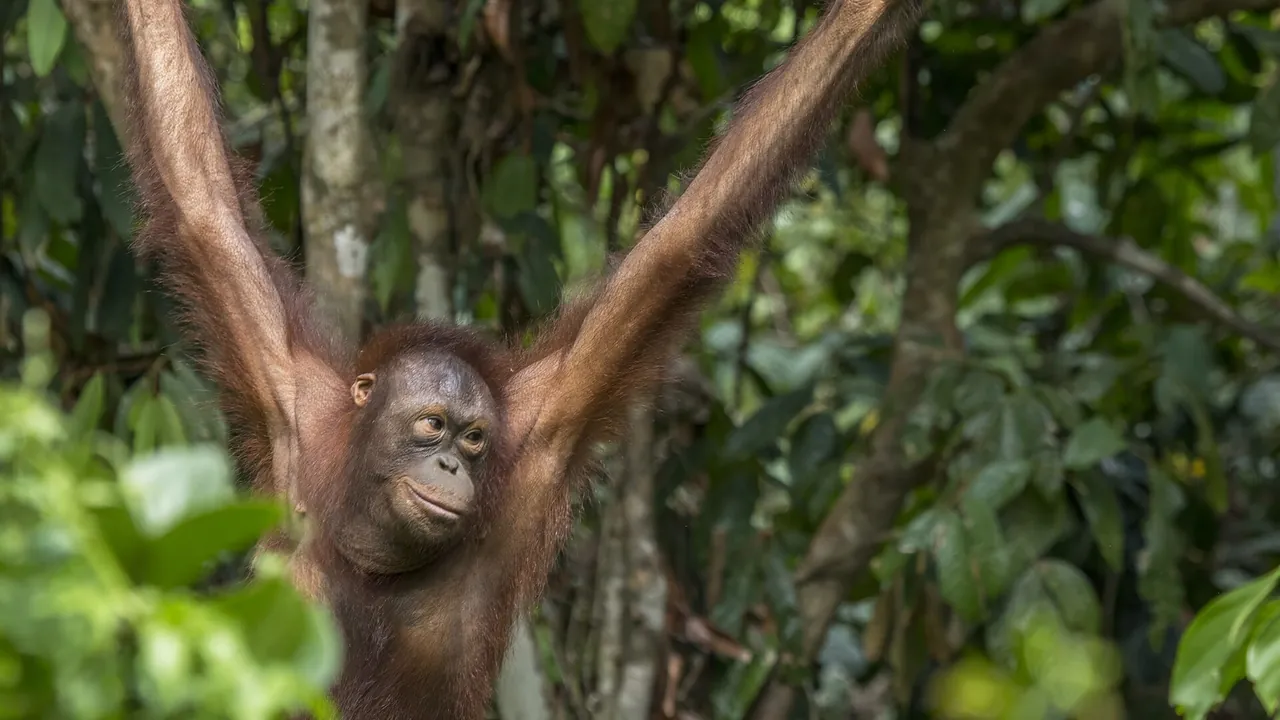
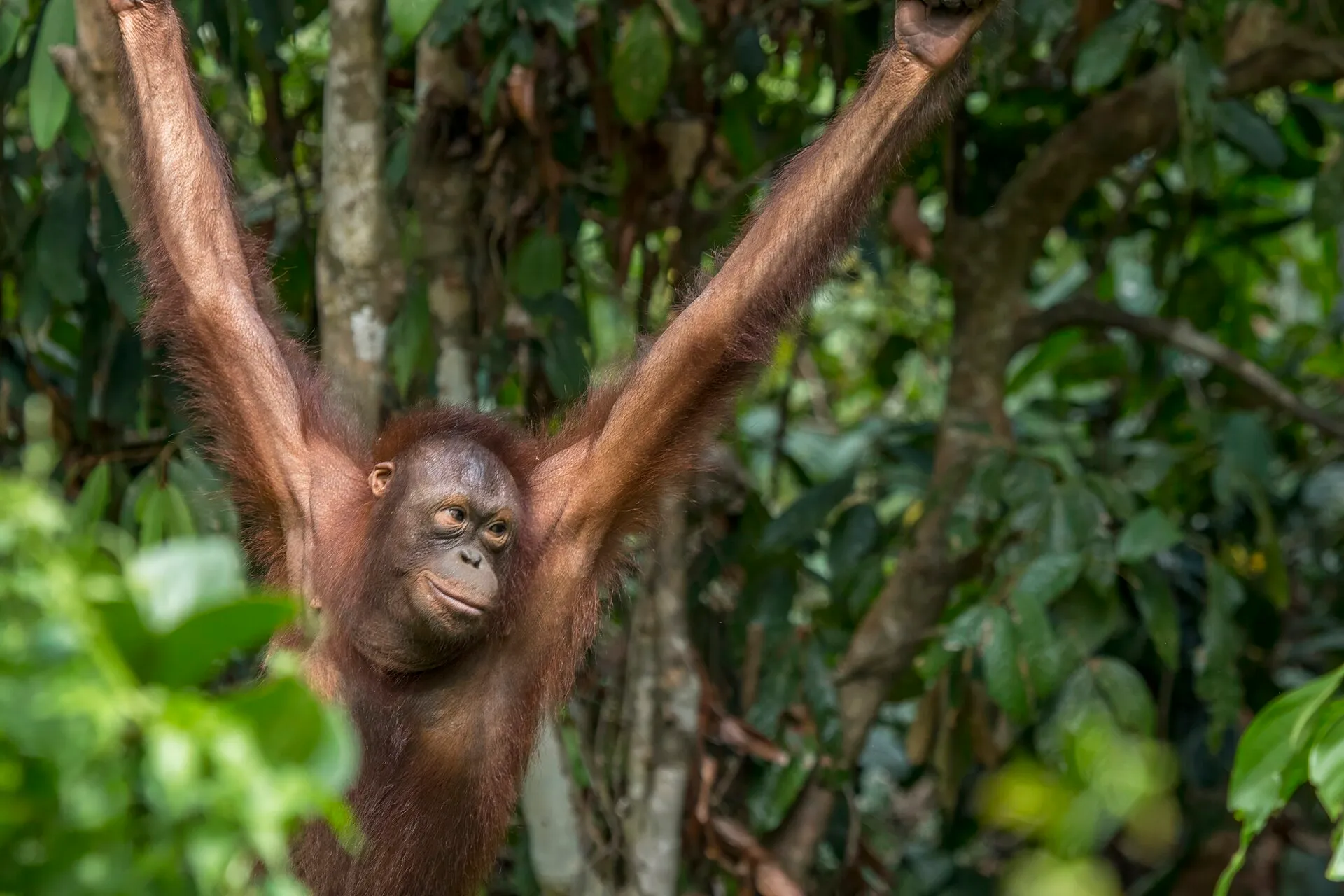
- Their arm span is longer than they are tall. A male's reach can stretch to roughly 2 metres from fingertip to fingertip.
- They build a new bed every night. Each evening an orangutan bends and weaves branches into a fresh sleeping nest, sometimes adding a leafy roof, and rarely reuses an old one.
- They are mostly fruit-eaters. Fruit fills roughly 60% of their foraging time, topped up with leaves, bark, flowers, honey and insects.
- They plant the forest. By swallowing and scattering large seeds, orangutans act as keystone seed dispersers, earning the nickname "gardeners of the forest."
- They have the slowest breeding of any primate. Females give birth only once every 7.6 to 8 years on average.
- Mothers are devoted teachers. A young orangutan stays with its mother for seven to eight years, learning hundreds of foods and skills.
- They are the loners of the ape world. Orangutans are semi-solitary, never forming the tight troops seen in chimpanzees or gorillas.
- All three species are Critically Endangered. The IUCN lists every Pongo species at the highest risk category, each with a decreasing trend.
Why their slow lives matter?
Because a female raises only four or five young in her entire lifetime, orangutan populations recover painfully slowly once forest is lost. Our rehabilitation partners in Indonesia and Malaysia give orphaned infants the years of forest-school training they need before release. If their story moves you, you can support orangutan rescue work.
Read the full Orangutan wildlife guide for the facts, IUCN status and conservation context — or donate to WARN to help fund the local partners protecting this species.
What is this briefing not?
This briefing is not a substitute for the full Orangutan wildlife guide, not a pet-care manual, and not a first-person field dispatch. It is a desk-researched explainer for people who searched a specific question about Orangutan. The setting is Borneo and Sumatra, Indonesia and Malaysia.
12 Amazing Facts About the Orangutan, the Red Ape of the Asian Rainforest sits in the newsroom as a species explainer. It is not a Field notes dispatch from a partner clinic, and it is not a reason to keep Orangutan. Location context: Borneo and Sumatra, Indonesia and Malaysia.
Who should skip this page?
Skip this page if you wanted a complete IUCN-style species profile, veterinary advice, or permission to keep Orangutan as a pet. You will not find those here. Read the wildlife guide next if you need status, range and sources in one place.
Skip it if you needed veterinary instructions, a travel itinerary, or a fundraising story dressed up as science. The skip is the point: a page that cannot say no is not a guide.
How does this briefing compare to the full species guide?
This page answers the search in the headline. The wildlife guide answers status, threats, and what is actually known. Use both; do not cite the listicle as if it were the Red List. From nightly tree-top nests to a birth every eight years, here are 12 surprising, science-backed facts about the only great ape native to Asia.
| Takeaway |
|---|
| There are three orangutan species — Bornean, Sumatran and Tapanuli — and all are Critically Endangered. |
| The Tapanuli orangutan, described only in 2017, is the rarest great ape on Earth, with fewer than 800 individuals. |
| Orangutans are the largest tree-dwelling mammals and build a fresh sleeping nest in the canopy every night. |
| Females breed roughly once every eight years, the longest interbirth interval of any primate. |
The canonical profile is the Orangutan wildlife guide — IUCN context, range, and the sources behind the numbers. This newsroom page is the short, question-shaped route into that guide.
What is the catch with a short wildlife briefing?
The catch with wildlife listicles is that a true fact can still be the wrong takeaway. “Amazing” is not the same as “safe to keep”, and a number without a source is trivia. Every figure on this page should be read against the cited IUCN or zoo pages, not against a screenshot.
Factory “12 facts” pages elsewhere on the web pad the same three sentences. Here each heading is a real question, each answer is meant to stand alone, and the sources at the end are the audit trail. If a number is not on this page or in those sources, we did not invent it.
What should you do after reading this?
Use this briefing to answer the question in the title, then go to the species guide for status and sources. If you want to help Orangutan, fund habitat and enforcement — do not buy the animal. Orangutans are the only great apes native to Asia and the largest tree-dwelling mammals on Earth, with three Critically Endangered species, a new sleeping nest built every night, and a birth roughly once every eight years.
If you want to support WARN’s partner work, donate knowing we are a community interest company, not a registered charity. If you want the animal itself, you have the wrong page.
Read the verdict on the first screen, the skip-if before you share the page, and the sources at the end before you quote a number. That is the whole contract of this briefing.