Wildlife Guide · Borneo & Sumatra
Helmeted Hornbill
Rhinoplax vigil (Forster, 1781) — family Bucerotidae
The only hornbill whose casque is solid keratin — carved and sold as 'red ivory'.
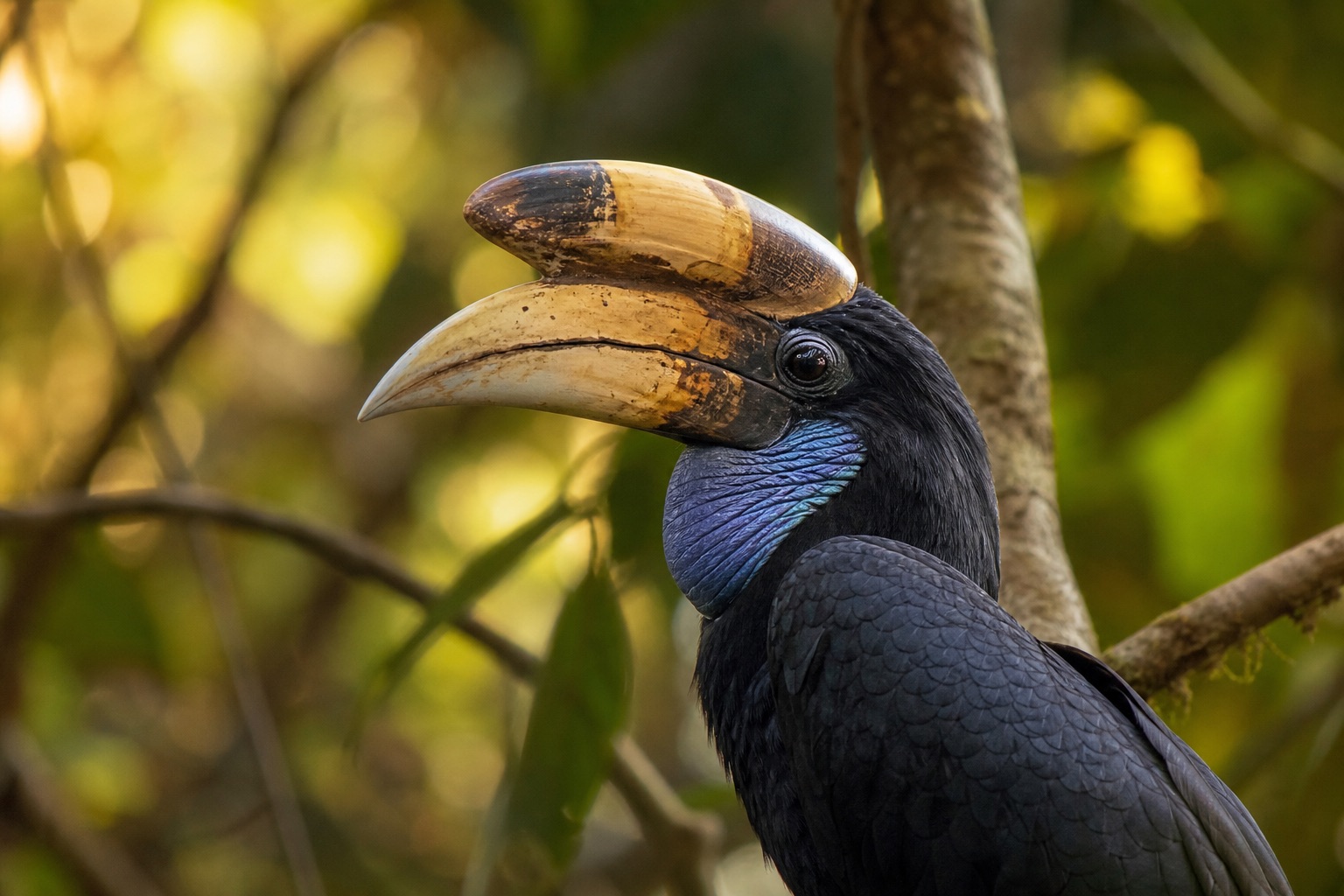
AI-generated educational wildlife portrait — World Animal Rescue Network · AI visualisation, not a photograph
In brief
The helmeted hornbill (Rhinoplax vigil) is a Critically Endangered hornbill of Borneo and Sumatra whose almost solid casque is carved and traded as 'red ivory'; it was uplisted in one step in 2015 and depends on old-growth forest being cleared for oil palm, pulpwood and mining.
Also in Animals A to Z · Animals that start with H
How you can help
You can support the related appeal — read its purpose, recipient status and fund terms first — or give once to where it is needed most. Sharing accurate information helps too.
By WARN Research & Conservation Team Last updated
The helmeted hornbill is a large forest bird of Sundaland whose casque is unlike any other hornbill's. In most species the casque is a lightweight honeycomb of keratin; in Rhinoplax vigil it is almost solid, accounting for roughly a tenth of the bird's three-kilogram body weight. Males use it in head-to-head aerial jousts. Collectors and carvers use it as 'red ivory' or 'golden jade' — a substitute for elephant ivory that is, in trade terms, the bird itself. The species went from Near Threatened to Critically Endangered in a single IUCN step in 2015, skipping two categories — an unusual jump that reflects how fast casque poaching escalated once ivory markets shifted. It is listed on CITES Appendix I, yet seizures of thousands of casques across Indonesia, Malaysia and China show that law and demand are not aligned. Helmeted hornbills depend on large old trees for nest cavities and on contiguous lowland and hill forest across Borneo and Sumatra — exactly the elevation band being cleared for oil palm, pulpwood and mining concessions. Trade and conversion act together: a forest can lose its hornbills to poachers before the bulldozers arrive, or lose breeding trees before either pressure is visible on a range map.
Solid
Casque — almost solid keratin, unlike other hornbills
~11%
Of body weight in the casque alone
2015
Year of Near Threatened to Critically Endangered jump
CITES I
Appendix I — commercial international trade banned
Figures sourced from IUCN Red List — Rhinoplax vigil, Bird Conservation International — helmeted hornbill trade, CITES Appendices .
Helmeted Hornbill: Quick Facts
| Length | About 110 cm including tail extension |
|---|---|
| Casque | Almost solid keratin — traded as red ivory |
| Nest | Tree cavity; female sealed inside for months |
| Diet | Fruit — important seed disperser |
| IUCN status | Critically Endangered |
| Main threats | Casque poaching; oil palm, pulpwood and mining |
Scientific Classification
| Kingdom | Animalia |
|---|---|
| Phylum | Chordata |
| Class | Aves |
| Order | Bucerotiformes |
| Family | Bucerotidae |
| Genus | Rhinoplax |
| Species | Rhinoplax vigil |
Conservation Status
- IUCN Status
- Critically Endangered
- Population
- Declining; no reliable global count
- Trend
- Decreasing
- Assessed
- 2015
- CITES
- Appendix I
Uplisted from Near Threatened to Critically Endangered in one step, reflecting rapid casque trade growth. Forest conversion for oil palm and pulpwood removes habitat in parallel.
Did you know?
Every hornbill casque except the helmeted hornbill's is hollow — which is why only this species is carved and sold as 'red ivory'.
Key Facts: Helmeted Hornbill
- The helmeted hornbill is the only hornbill with an almost solid casque — every other species has a hollow, lightweight one.
- The casque is carved and traded as 'red ivory' or 'golden jade', making this bird a target for poaching independent of bushmeat or feather demand.
- The IUCN moved the species from Near Threatened to Critically Endangered in 2015 in one step, reflecting rapid trade-driven decline.
- It needs large old trees for nest cavities and contiguous forest — the same lowland and hill forest being converted for oil palm and pulpwood across Borneo and Sumatra.
- CITES Appendix I bans commercial international trade, but casque seizures in Indonesia, Malaysia and China show enforcement gaps.
- It belongs among Sundaland's tropical forest birds — see WARN's tropical and forest birds type page at /wildlife-guides/birds/tropical-birds/ for how hornbills fit the wider canopy guild.
Why 'red ivory' targets this bird alone
Hornbill casques evolved for display and combat. In most species the structure is pneumatised — hollow chambers keep it light enough for flight. The helmeted hornbill's casque is the exception: dense keratin, red at the front and yellow at the base, heavy enough that the skull and casque together make up around eleven per cent of body mass.
That density is what traders want. When elephant ivory became harder to move through international markets, carvers and collectors shifted to casques that could be worked similarly — rings, figurines, ornaments. The trade names — red ivory, golden jade — disguise the source. A carved casque is not a by-product of hunting for meat; it is the product. Every solid casque in a seizure represents a bird killed for its head.
Ecology of a slow forest breeder
Helmeted hornbills are frugivores of lowland and hill rainforest, moving long distances between fruiting trees. Like other hornbills, they nest in trunk cavities; the female seals herself inside with mud and faeces, moulting flight feathers while the male feeds her through a narrow slit. That strategy requires a cavity large enough for an adult bird — which means old trees, often centuries in the making.
Reproduction is slow. A pair may raise one chick per attempt, and the sealed-nest period lasts months. Remove nest trees through selective logging, or remove adults through casque poaching, and a population cannot replace losses at the rate the trade extracts them. The biology was never compatible with industrial-scale harvest of adults.
Oil palm, pulpwood and trade on Borneo and Sumatra
Sundaland's lowland forest is being converted faster than almost any other biome for oil palm and pulpwood plantations, with mining concessions fragmenting what remains. Helmeted hornbills occupy precisely that band — not montane refuge forest, but the elevations where plantation expansion is most profitable.
Trade adds a second axis. Logging roads and plantation edges give poachers access to forest that was previously costly to reach. Casques move through regional markets into China and beyond; online platforms have made listing and sale easier to monitor but not always easier to stop. A Critically Endangered listing and CITES Appendix I status describe the legal framework; seizures describe the reality. Both forest conversion and casque demand must fall for the species to stabilise.
Where it sits among tropical forest birds
Hornbills are canopy frugivores and seed dispersers — ecological engineers of tropical forest, not background colour. The helmeted hornbill is among the largest and most trade-vulnerable of Sundaland's hornbills, but the family shares nest-cavity dependence and forest connectivity requirements.
WARN groups tropical forest specialists — toucans, hornbills, birds-of-paradise and others — on the tropical and forest birds type page at tropical birds, because the threats repeat: old-growth loss, fragmentation and targeted harvest. For the helmeted hornbill, the harvest is not generic bushmeat but a single body part traded as luxury material — which makes consumer refusal of carved casques as important as forest protection.
What WARN Does
WARN publishes free, sourced species education, including for animals destroyed by a single commodity trade. The helmeted hornbill's casque is not a side product — it is the reason the bird is Critically Endangered, and naming that trade accurately matters as much as naming the forest it needs.
If this guide helps you understand wildlife and the pressures it faces, a gift to WARN supports habitat protection and free public education in our partner countries.
How can I help save the helmeted hornbill?
Explore practical ways to support the helmeted hornbill, from everyday choices and sharing reliable information to reviewing a related appeal before giving.
Explore ways to support
Read the related appeal’s purpose, recipient status and fund terms. Choose an affordable gift after checking what is proposed and what has been reported.
Ease the pressures
Avoid the wildlife trade and souvenirs, never buy wild animals as pets, and choose sustainable, habitat-friendly products — the threats behind the helmeted hornbill's decline fall when demand does.
Spread the word
Share accurate, sourced information about the helmeted hornbill. Wider awareness is what turns concern into lasting protection.
Helmeted Hornbill: Frequently Asked Questions
How can I help save the helmeted hornbill?
What is red ivory?
Why is the helmeted hornbill critically endangered?
Where does the helmeted hornbill live?
Is helmeted hornbill ivory legal to trade?
How is it different from other hornbills?
What do helmeted hornbills eat?
Are helmeted hornbills dangerous?
How long do helmeted hornbills live?
How big is a helmeted hornbill?
Sources & References
Population figures, conservation status and biological facts on this page are drawn from authoritative scientific and intergovernmental sources.
Terms used on this page
Plain-English definitions, from our wildlife and conservation glossary.
Latest Helmeted Hornbill Stories
Quick, fact-checked reads on the helmeted hornbill — amazing facts, key questions and the threats it faces.
Guides
How Much Does It Cost to Rescue an Orangutan?
Orangutan rescue spans emergency extraction, years of forest-school rehabilitation and soft release — each stage carries real costs. Here is what UK donors actually fund.
Read the storySpecies
12 Amazing Facts About Tigers (That Sound Made Up But Aren't)
From striped skin and swimming big cats to a roar you can hear three kilometres away, here are 12 verified facts about the world's largest cat.
Read the storySpecies
How Big, Fast and Strong Is a Tiger? The Numbers Explained
Tigers are the largest cats alive, with a bite force around 1,000 PSI and short-burst speeds up to 65 km/h. Here are the real measurements.
Read the storyExplore more animals
Discover more animals, their habitats and their conservation status in the WARN wildlife-guide library.
Enjoyed this Helmeted Hornbill guide?
Receive appeal updates, animal-welfare news and published funding reports. Unsubscribe any time.
We only use your address for WARN updates. See our privacy policy.