Wildlife Guide · Borneo & Sumatra
Colugo
Galeopterus variegatus (Audebert, 1799) — order Dermoptera
The flying lemur that neither flies nor is a lemur — and has the most extensive gliding membrane of any mammal.
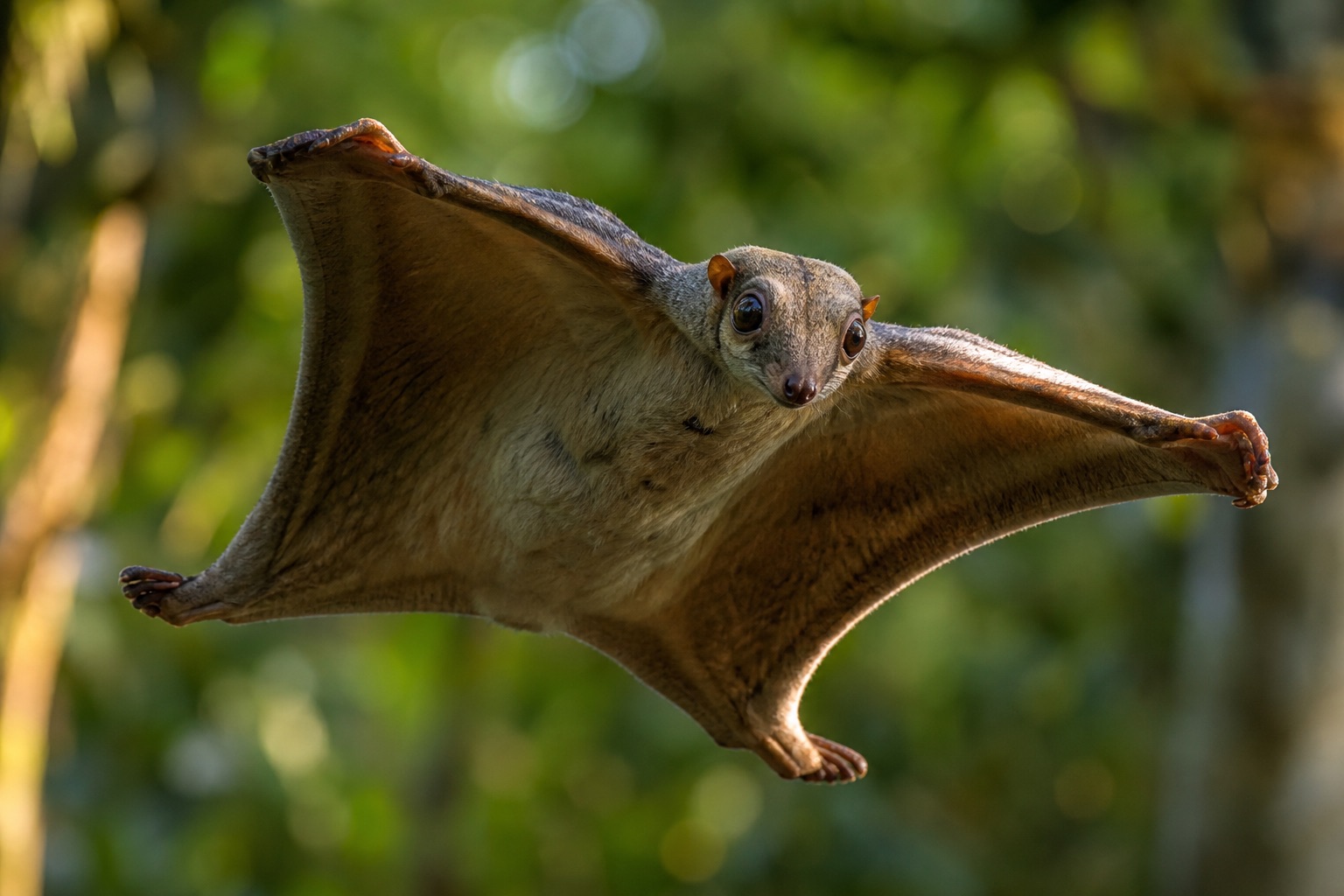
AI-generated educational wildlife portrait — World Animal Rescue Network · AI visualisation, not a photograph
In brief
The Sunda colugo (Galeopterus variegatus) is a nocturnal gliding mammal of Borneo and Sumatra with the most extensive gliding membrane of any mammal; it is not a lemur and cannot fly, and its closest living relatives are primates.
Also in Animals A to Z · Animals that start with C
By WARN Research & Conservation Team Last updated
Colugos are called flying lemurs, which is wrong twice. They do not fly — they glide, using a membrane of skin that stretches from the neck to the fingertips, toes and tail tip, the most extensive patagium of any gliding mammal. And they are not lemurs: they belong to the order Dermoptera, on an ancient branch of the tree closer to primates than to anything else alive, though they diverged tens of millions of years ago. The Sunda colugo (Galeopterus variegatus) is a nocturnal herbivore of lowland and hill forest, clinging vertically to trunks by day and gliding between trees at night to reach leaves, buds and fruit. It is not fast on the ground and cannot gain altitude once airborne, so gaps in the canopy — from logging, oil palm or mining access roads — are barriers as real as cliffs. For comparison with other gliding mammals, WARN's sugar glider guide covers the marsupial glider of Australia and New Guinea, and the lemur guide covers the true lemurs of Madagascar — a name colugos borrowed through convergent appearance, not shared ancestry.
Patagium
Gliding membrane from neck to fingertips, toes and tail
~70 m
Typical glide distance between trees
Not a lemur
Order Dermoptera — closer to primates than to lemurs
Nocturnal
Active at night; clings to trunks by day
Figures sourced from IUCN Red List — Galeopterus variegatus, Animal Diversity Web — Galeopterus variegatus .
Colugo: Quick Facts
| Head and body | About 34–38 cm |
|---|---|
| Glide | Up to ~70 m between trees |
| Activity | Nocturnal |
| Diet | Leaves, buds and fruit |
| IUCN status | Least Concern |
| Main threats | Oil palm, pulpwood and mining-driven forest loss |
Scientific Classification
| Kingdom | Animalia |
|---|---|
| Phylum | Chordata |
| Class | Mammalia |
| Order | Dermoptera |
| Family | Cynocephalidae |
| Genus | Galeopterus |
| Species | Galeopterus variegatus |
Conservation Status
- IUCN Status
- Least Concern
- Population
- No reliable estimate
- Trend
- Decreasing in converted areas
- Assessed
- 2016
- CITES
- Not listed
Wide range masks local loss as gliding connectivity breaks across converted lowland forest.
Did you know?
Colugos have the most extensive gliding membrane of any mammal — yet they are called flying lemurs despite neither flying nor being lemurs.
Key Facts: Colugo
- Colugos are not lemurs and do not fly — they glide on a skin membrane more extensive than any other mammal's.
- The Sunda colugo belongs to the order Dermoptera, whose closest living relatives are primates, not flying squirrels or lemurs.
- Glides of up to 70 metres or more connect forest trees; gaps from logging, oil palm or roads strand animals that cannot climb down and walk far.
- They are nocturnal folivores — leaf eaters — with slow digestion and low metabolic rates, like many canopy specialists.
- Females carry young in a pouch-like membrane fold rather than a true marsupial pouch.
- Compare with WARN's sugar glider guide for a marsupial glider, and the lemur guide for the true lemurs colugos are often mistaken for.
Neither flies nor lemurs
The name flying lemur is a double mislabel. Powered flight requires musculature and anatomy colugos do not possess; they launch from a height and glide downward, steering with limbs and tail. A sugar glider — covered in WARN's sugar glider guide — solves the same problem with a smaller membrane and a marsupial's ancestry. Flying squirrels do it with a rodent's body plan. Colugos arrived at gliding independently, with a patagium that wraps further around the body than either.
Lemurs are strepsirrhine primates of Madagascar. Colugos are not primates at all, though genetic work places Dermoptera as the sister group to primates — closer to monkeys and apes than to bats or rodents. The large eyes and vertical clinging posture echo lemurs because nocturnal arboreal life produces similar silhouettes, not because of shared descent.
The gliding membrane
The colugo's patagium connects the neck, all four limbs and the tail tip in one continuous sheet. When spread, it creates an aerofoil that can sustain glides of seventy metres or more between trees, with some reports of longer distances on a steep gradient.
Launch is from a vertical trunk or branch, usually at night when the animal moves to feed. Landing targets another trunk, which the colugo strikes feet-first and immediately grips. The skill is precise, but it requires forest — continuous canopy at gliding height. A cleared strip for a plantation road or a mine haul route breaks the chain. An animal on the wrong side cannot regain altitude and is vulnerable on the ground.
Forest loss on Borneo and Sumatra
Sunda colugos occupy lowland and hill forest across Sundaland — the same forest being converted for oil palm and pulpwood at rates that lead global deforestation statistics. They tolerate some edge habitat better than large carnivores, but gliding connectivity is not the same as presence in a fragment. A colugo in a small patch may survive until the patch shrinks below gliding distance to the next tree.
Mining concessions and infrastructure cut additional corridors through remaining forest. Wildlife trade is not the primary pressure on colugos — they are not a commercial target — but the conversion economy that drives Sundaland's land use removes their habitat directly. Least Concern on the Red List reflects a still-wide range, not security in any given province.
Primates, gliders and convergent solutions
Evolution produced gliding mammals several times — squirrels, possums, colugos — each with a membrane and a launch strategy suited to its ancestry. Colugos represent the primate-adjacent solution: a slow nocturnal folivore that crosses gaps without descending. Primates including gibbons and siamang cross gaps by brachiation; colugos bypass the ground entirely in a different way.
Understanding colugos clarifies why 'flying lemur' confuses searchers. WARN's lemur guide covers Madagascar's strepsirrhines; the sugar glider guide covers a marsupial glider people compare with colugos. None of those pages describes this animal — which is why a dedicated guide matters for a species that is common in name but rare in accurate explanation.
What WARN Does
WARN publishes free, sourced species education that separates common names from biology. Colugos are searched as flying lemurs and compared with sugar gliders; both comparisons miss what they actually are — gliding relatives of the primate line on forests being cleared for oil palm and pulpwood.
If this guide helps you understand wildlife and the pressures it faces, a gift to WARN supports habitat protection and free public education in our partner countries.
Colugo: Frequently Asked Questions
Is a colugo a lemur?
Can colugos fly?
What are colugos related to?
How far can a colugo glide?
Where do Sunda colugos live?
What do sunda colugo / malayan flying lemurs eat?
Are sunda colugo / malayan flying lemurs dangerous?
How long do sunda colugo / malayan flying lemurs live?
How big is a sunda colugo / malayan flying lemur?
Sources & References
Population figures, conservation status and biological facts on this page are drawn from authoritative scientific and intergovernmental sources.
Terms used on this page
Plain-English definitions, from our wildlife and conservation glossary.
Latest Colugo Stories
Quick, fact-checked reads on the colugo — amazing facts, key questions and the threats it faces.
Guides
How Much Does It Cost to Rescue an Orangutan?
Orangutan rescue spans emergency extraction, years of forest-school rehabilitation and soft release — each stage carries real costs. Here is what UK donors actually fund.
Read the storySpecies
12 Amazing Facts About Tigers (That Sound Made Up But Aren't)
From striped skin and swimming big cats to a roar you can hear three kilometres away, here are 12 verified facts about the world's largest cat.
Read the storySpecies
How Big, Fast and Strong Is a Tiger? The Numbers Explained
Tigers are the largest cats alive, with a bite force around 1,000 PSI and short-burst speeds up to 65 km/h. Here are the real measurements.
Read the storyExplore more animals
Discover more animals, their habitats and their conservation status in the WARN wildlife-guide library.
Enjoyed this Colugo guide?
Receive appeal updates, animal-welfare news and published funding reports. Unsubscribe any time.
We only use your address for WARN updates. See our privacy policy.