Wildlife Guide · Americas, Africa, Europe and Asia & Absent from Australasia and oceanic islands except where introduced
Viper
Family Viperidae — pit vipers and true vipers; roughly 350 species worldwide
Solitary, heavy-bodied venomous snakes — from adders on British moors to fer-de-lance in Neotropical forest.
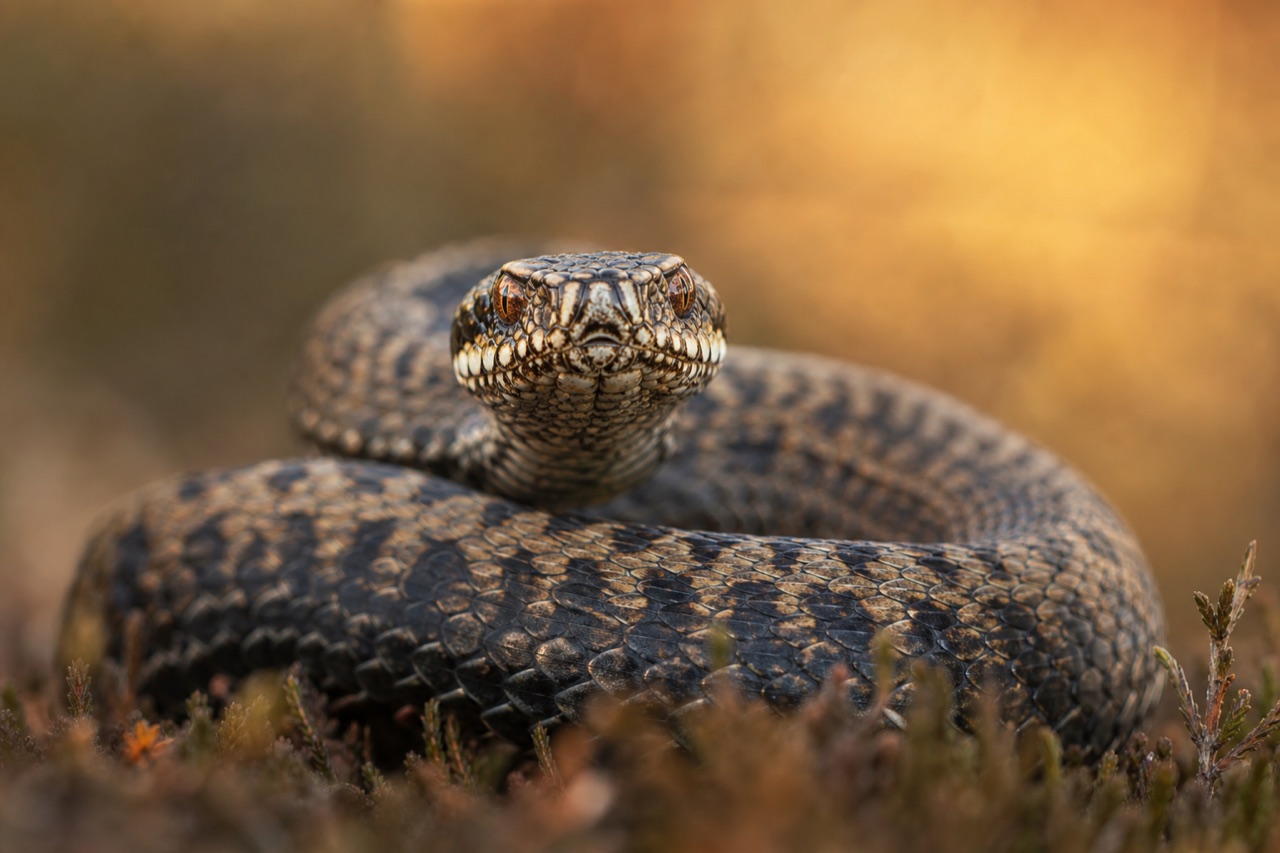
AI-generated educational wildlife portrait — World Animal Rescue Network · AI visualisation, not a photograph
In brief
Vipers (family Viperidae) are roughly 350 species of venomous snake with hinged solenoglyph fangs and ambush hunting — including adders, rattlesnakes and fer-de-lance — responsible for a major share of global snakebite envenomation.
Also in Animals A to Z · Animals that start with V
By WARN Research & Conservation Team Last updated
Vipers are venomous snakes of the family Viperidae, divided broadly into true vipers (Viperinae) of Africa, Europe and Asia, and pit vipers (Crotalinae) of the Americas and Asia. Roughly 350 species share a toolkit: long hinged fangs that fold against the palate when the mouth is closed, potent venom delivered by a strike and often a withdrawal rather than pursuit, and a generally stout body built for ambush rather than speed. Pupils are vertical in most species — a slit that contracts in bright light. Medically, vipers cause a large share of serious snakebite globally. Russell's viper in South Asia, saw-scaled vipers in dry Africa and Asia, fer-de-lance in Central and South America, and timber rattlesnakes in North America all kill or maim where antivenom access is poor and hospitals distant. Venom composition varies: haemotoxins damaging tissue and blood clotting in many true vipers; mixed haemo- and neurotoxic effects in some pit vipers. Ecologically, vipers are rodent controllers. An adder on a heath or a bushmaster in leaf litter consumes small mammals that would otherwise multiply. Fear drives persecution — vipers killed on sight regardless of risk — which removes beneficial predators without reducing bite incidence where human-viper overlap is structural. Understanding vipers as family, not as a single monster, is the basis for coexistence and for targeting antivenom production to the species that matter locally.
~350
Viper species worldwide
Solenoglyph
Hinged fangs folded against the roof of the mouth
Pit organs
In pit vipers — heat-sensing loreal pits between eye and nostril
Ambush
Most hunt by waiting, not chasing
Figures sourced from WHO — snakebite envenoming, IUCN Red List .
Viper: Quick Facts
| Species count | ~350 |
|---|---|
| Fangs | Long, hinged, hollow — solenoglyph |
| Hunting | Ambush — strike and track |
| Pit vipers | Infrared-sensing loreal pits |
| Reproduction | Many species live-bearing |
| Main threats | Persecution, habitat loss, snakebite response gaps |
Scientific Classification
| Kingdom | Animalia |
|---|---|
| Phylum | Chordata |
| Class | Reptilia |
| Order | Squamata |
| Family | Viperidae |
| Subfamilies | Viperinae (true vipers), Crotalinae (pit vipers) |
Conservation Status
- IUCN Status
- Varies by species — family page
- Population
- Not applicable at family level
- Trend
- Declining where heathland and forest habitat is lost; stable in much of range
- Assessed
- Assessed species-by-species
- CITES
- Some species listed
Snakebite mortality is a human health crisis overlapping viper range. Antivenom access and habitat coexistence are parallel priorities.
Did you know?
Pit vipers can strike accurately at warm prey in total darkness — their heat pits build a thermal image merged with vision in the brain.
Key Facts: Viper
- Viperidae includes true vipers and pit vipers — adders, rattlesnakes, lanceheads and many others.
- Long hinged fangs deliver venom in a fast strike; most vipers do not chase prey or people.
- Pit vipers have heat-sensing pits for detecting warm-blooded prey at night.
- Vipers are major contributors to global snakebite burden where antivenom access is limited.
- Many vipers give birth to live young rather than laying eggs — ovoviviparity is common.
- Persecution and habitat loss threaten vipers; they also control rodent populations.
Fangs, venom and the strike
Viper fangs are solenoglyph — hollow and mounted on a movable maxillary bone that rotates forward when the mouth opens. At rest, fangs fold against the palate. In a strike, the rotation is rapid and the injection deliberate. Venom glands sit behind the eyes; muscles compress them during the bite. Some vipers 'dry bite' — strike without envenoming — especially in defensive contexts, though treating any bite as envenomed is prudent.
Venom is tuned to prey. Rodent-killing vipers use haemotoxins that disrupt clotting, destroy tissue and drop blood pressure — effective on small mammals, devastating on human tissue if untreated. Some species add neurotoxic components. Prey is usually released after the bite and tracked by scent once immobilised; the viper follows rather than constricting.
Defensive bites differ from predatory ones. A viper on a path wants escape, not conflict. Many bites occur when snakes are stepped on, handled or attacked. Footwear, light at night, and not reaching into unseen crevices address most risk without needing to kill every viper encountered.
Pit vipers and heat vision
Pit vipers — subfamily Crotalinae — include rattlesnakes, copperheads, bushmasters and Asian pit vipers. A heat-sensitive pit organ sits between eye and nostril on each side of the head, detecting infrared radiation from warm bodies. The brain merges heat and visual maps, allowing accurate strikes in darkness at prey a viper cannot see clearly.
Rattlesnakes add a warning device: keratin rattle segments appended at each shed, clicked by muscular vibration. Not all pit vipers rattle — Old World species lack the structure — but the Americas associate pit vipers strongly with the sound. Juveniles are born with a pre-button; the first shed adds the first rattle segment.
Tropical pit vipers such as Bothrops — the lanceheads — cause enormous snakebite morbidity in Latin America because they thrive in disturbed habitat edges where rodents concentrate. Fer-de-lance is a name applied to several Bothrops species; all are heavy-bodied, cryptically patterned and quick to bite when cornered.
True vipers: adders and their relatives
Subfamily Viperinae — true vipers without heat pits — ranges across Africa, Europe and Asia. The common European adder (Vipera berus) is the only venomous snake native to Britain, found on heaths and moorlands from Scotland to Dorset. Bites are medically significant but rarely fatal with care; adders are protected in the UK under wildlife law.
Russell's viper (Daboia rufus) and saw-scaled viper (Echis carinatus) dominate snakebite mortality in South Asia and dry Africa respectively. Both favour agricultural and semi-urban edges where rodents abound. Saw-scaled vipers rub coils together to produce a loud rasp — a warning that precedes many bites when the snake is not left alone.
True vipers illustrate regional medical priority. Antivenom must match the species responsible for bites in each area — polyvalent products cover multiple species where geography overlaps. Stockouts kill; education on first response and rapid transport saves limbs and lives as much as serum does.
Conservation versus fear
Most viper species are Least Concern or unassessed with stable populations in suitable habitat. Exceptions include island endemics and species lost to persecution before they were counted. Adders decline in Britain from heathland loss and historical killing. Some rattlesnake roundups still remove thousands of animals annually for entertainment — a practice increasingly criticised as ecologically damaging and medically irrelevant.
Vipers benefit agriculture by controlling rodents that eat grain and carry disease. Indiscriminate killing increases rodent problems without eliminating snakebite risk if habitat overlap remains. Habitat management — retaining rough margins, rock piles and unmown strips — concentrates vipers away from heavy foot traffic while preserving their ecological role.
Snakebite is a health equity issue: rural poor populations in tropical viper range bear the burden while antivenom production is underfunded and poorly distributed. Conservation and public health align when habitat protection reduces accidental encounters and when health systems stock appropriate antivenom. Fear without infrastructure helps neither people nor snakes.
Living with vipers: practical coexistence
In adder country — British heaths, Scandinavian birch woods, Alpine meadows — walkers reduce bite risk with sturdy footwear and by not reaching into blind spots under logs. Dogs should be kept on leads in known adder habitat during spring when snakes bask openly.
In tropical viper range, torch use at night, bed nets elevated off floors, and storing boots upside down or shaking them before wearing address most household encounters. Farmers benefit from rodent control that does not rely solely on poison — poisoned rodents are easier prey and attract vipers to human proximity.
Community programmes that train health workers in snakebite first response and maintain cold-chain antivenom stocks save more lives than snake eradication campaigns ever have. Viper family literacy — knowing which species occur locally and which antivenom applies — belongs in rural health planning alongside malaria and childbirth protocols.
What WARN Does
WARN publishes free, sourced species education for animals caught between ecological value and human fear. Vipers kill rodents and people depending on context — accurate family-level guides support coexistence and smarter health policy.
If this guide helps you understand wildlife and the pressures it faces, a gift to WARN supports habitat protection and free public education in our partner countries.
Viper: Frequently Asked Questions
What is a viper?
What is the difference between vipers and pit vipers?
Are viper bites deadly?
Do all rattlesnakes belong to vipers?
What do vipers eat?
Where do vipers live?
Are vipers dangerous?
How long do vipers live?
How big is a viper?
Sources & References
Population figures, conservation status and biological facts on this page are drawn from authoritative scientific and intergovernmental sources.
Terms used on this page
Plain-English definitions, from our wildlife and conservation glossary.
Explore more animals
Discover more animals, their habitats and their conservation status in the WARN wildlife-guide library.
Enjoyed this Viper guide?
Receive appeal updates, animal-welfare news and published funding reports. Unsubscribe any time.
We only use your address for WARN updates. See our privacy policy.