Wildlife Guide · Freshwater, marine and damp terrestrial habitats worldwide & European grazing marshes and ponds for Hirudo medicinalis
Leech
Subclass Hirudinea — hundreds of species; medicinal leech Hirudo medicinalis Linnaeus, 1758
Segmented worms, not insects — some take blood, some hunt prey, and one European species is still a hospital device.
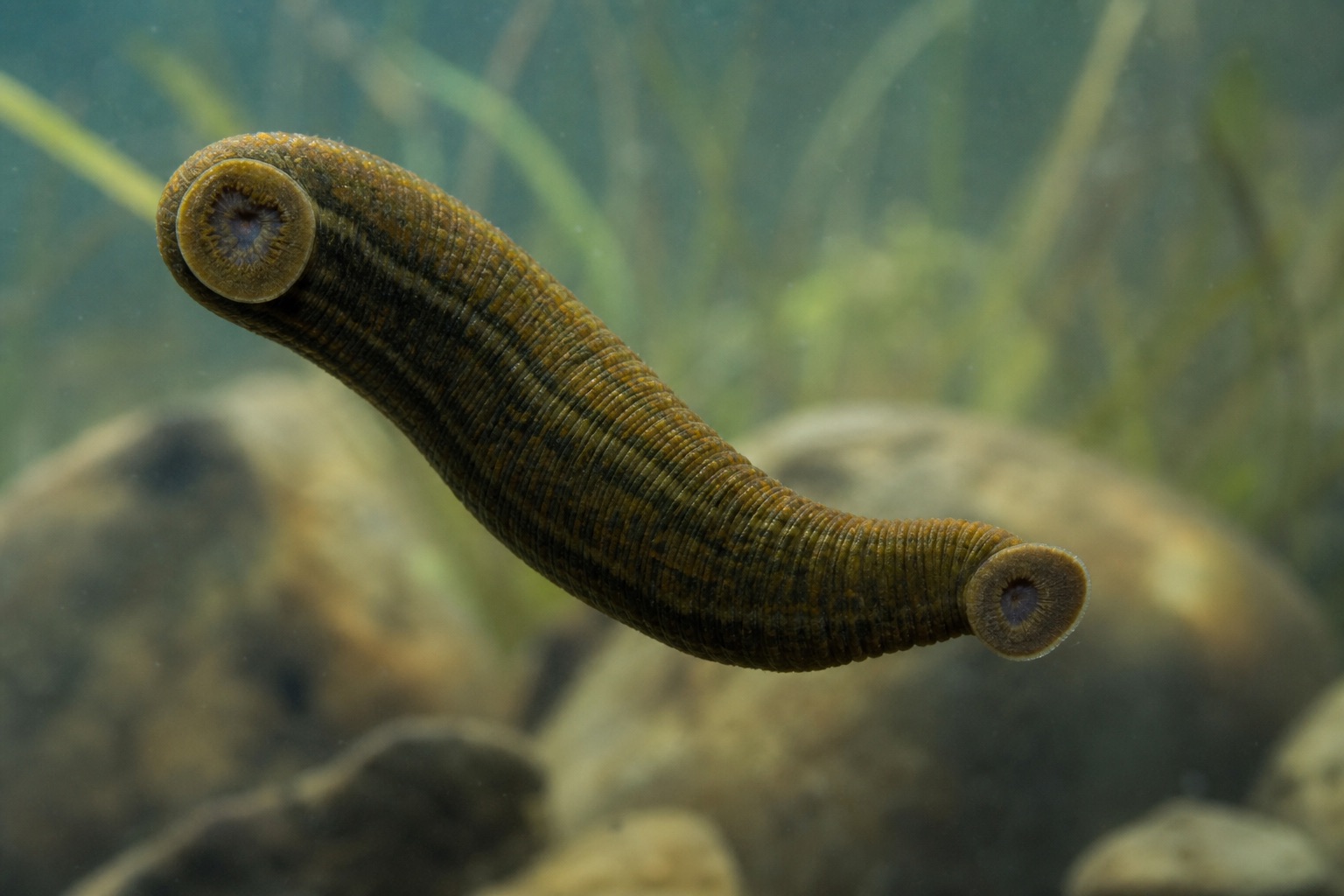
AI-generated educational wildlife portrait — World Animal Rescue Network · AI visualisation, not a photograph
In brief
Leeches are segmented annelid worms (Hirudinea), not insects. Many hunt invertebrates; some take blood. The European medicinal leech Hirudo medicinalis is Near Threatened (IUCN 2014) and on CITES Appendix II. Hospitals still use farmed leeches after microsurgery. WARN does not run leech programmes.
Also in Animals A to Z · Animals that start with L
By WARN Research & Conservation Team Checked against IUCN 2014 Hirudo medicinalis assessment, CITES Appendix II and US FDA 510(k) K040187 Last updated
Leeches are segmented annelid worms (subclass Hirudinea), relatives of earthworms, not insects, slugs or flatworms. Hundreds of species exist. Many freshwater leeches hunt invertebrate prey. A minority take blood from vertebrates. The European medicinal leech Hirudo medicinalis is the conservation and clinical story people usually mean. IUCN listed H. medicinalis Near Threatened in 2014 (Utevsky, Zagmajster and Trontelj). CITES lists H. medicinalis and Hirudo verbana on Appendix II. The US FDA cleared medicinal leeches as a medical device in 2004 (510(k) K040187) for venous congestion after reconstructive surgery. Farmed animals supply most clinical demand. Many suppliers now ship H. verbana under an old 'medicinal leech' label. This page is the group encyclopaedia with that species as the named case. Earthworm: earthworm. Slug: slug. WARN does not farm leeches or restore European marshes.
Looking for something specific?
These notes clarify the guide’s scope, common mix-ups and related information.
- A named hospital or farm leech with photo updates. WARN does not offer that.
- Treating every leech as Near Threatened. IUCN assessed Hirudo medicinalis. Most of Hirudinea is unassessed.
- An insect, slug or earthworm page. Those are different animals. Earthworm: earthworm. Slug: slug.
- WARN wetland restoration in Europe or a UK leech-farming grant. We do not run those programmes.
- Unregulated 'leech therapy' as if it were hospital microsurgery. Hospital leech treatment belongs under clinical supervision; it is not a use for animals collected from a pond.
NT
IUCN status for Hirudo medicinalis (2014) — not a badge for every leech
CITES II
H. medicinalis and H. verbana — international trade is regulated
2004
US FDA cleared medicinal leeches as a medical device (K040187)
Annelida
Phylum — segmented worms, not insects
Figures sourced from IUCN Red List — Hirudo medicinalis (Utevsky, Zagmajster & Trontelj, 2014, Near Threatened), IUCN Red List — categories and criteria, CITES — Appendices (Hirudo medicinalis and Hirudo verbana, Appendix II) and other references on this page.
Leech: Quick Facts
| What 'leech' covers | Subclass Hirudinea — hundreds of species |
|---|---|
| Focal conservation species | Hirudo medicinalis (European medicinal leech) |
| IUCN (H. medicinalis) | Near Threatened (2014) |
| CITES | Appendix II — H. medicinalis and H. verbana |
| Clinical use | Venous congestion after reconstructive surgery (FDA 2004 device clearance) |
| Not | Insects, slugs or flatworms |
| WARN programmes | None — education only |
Scientific Classification
| Kingdom | Animalia |
|---|---|
| Phylum | Annelida |
| Class | Clitellata |
| Subclass | Hirudinea |
| Family (medicinal) | Hirudinidae |
| Genus (medicinal) | Hirudo |
| Focal species | Hirudo medicinalis |
Conservation Status
- IUCN Status
- H. medicinalis Near Threatened (IUCN 2014). Group as a whole not assessed under one badge. CITES II for H. medicinalis and H. verbana.
- Population
- No global headcount for the subclass; wild H. medicinalis depleted across much of the historic range
- Trend
- Wild medicinal stocks reduced; farmed clinical supply separate
- Assessed
- 2014 (H. medicinalis)
- CITES
- Appendix II (Hirudo medicinalis; Hirudo verbana added 2010)
Clinical demand is met largely by farms. Wild recovery needs grazing-marsh habitat. A catalogue 'medicinal leech' is often H. verbana.
Did you know?
The English word 'leech' once meant a physician. The animal kept the job: farmed Hirudo still turns up in reconstructive theatres because saliva plus blood removal is hard to fake with a tablet.
Key Facts: Leech
- Leeches are annelid worms (Hirudinea), related to earthworms. They are not insects, slugs or flatworms.
- Not all leeches take blood. Many freshwater species hunt invertebrates whole.
- Hirudo medicinalis is Near Threatened (IUCN 2014) from wetland loss and historic over-collection. CITES Appendix II covers it and H. verbana.
- The US FDA cleared medicinal leeches as a medical device in 2004 for venous congestion after graft and reattachment surgery. Farms supply clinics.
- A 'medicinal leech' in a catalogue is often H. verbana. That is a different species, not a loophole in the Red List.
- WARN does not run leech programmes. This guide is education. Habitat appeals sit at /appeals/habitats/.
How to use this leech species guide
Match the query to the right WARN page. This URL is group facts: what a leech is, blood-feeding versus predatory species, H. medicinalis Near Threatened versus CITES II, hospital use and the earthworm comparison. DIY hirudotherapy, tropical land-leech first aid and pond dipping are different jobs. Use the table and the links below rather than mixing those intents.
- 1
- 2
Separate the medicinal species from the group
IUCN Near Threatened and CITES Appendix II apply to named Hirudo species, not to every pond leech. Many clinical 'medicinal leeches' are H. verbana, also Appendix II, not H. medicinalis.
- 3
Do not copy hospital use onto a wild bite
FDA-cleared leeches are farmed animals used by clinicians to relieve venous congestion. A wild bite is not a prescription. Unregulated therapy risks infection. This page is not a clinic.
- 4
Give only if that is the intent, and through honest doors
WARN does not fund leech farms or European marsh restoration. Habitat grants: habitat protection appeal. Gifts are not Gift Aid eligible. See registration status.
What is a leech?
A leech is a segmented worm in subclass Hirudinea, phylum Annelida. Suckers at one or both ends, a clitellum in reproductive adults, and a fixed number of body segments are the usual marks. They are not insects. They are not molluscan slugs. They are not tapeworms.
Hundreds of species live in freshwater, the sea and damp leaf litter. Colour, size and diet vary. The word 'leech' in English also meant a physician, which is how the medicinal species entered hospitals.
This page is the group encyclopaedia. Earthworm: earthworm. Slug: slug.
WARN publishes free invertebrate education. It does not stock ponds.
Are all leeches blood-suckers?
No. Many freshwater leeches are predators. They swallow insect larvae, worms or snails. Blood-feeding (haematophagy) is a specialisation with jaws or a proboscis, anticoagulants in saliva, and a gut that can store a meal for months.
Tropical land leeches in rainforest litter are external blood-feeders that drop off when full. They do not burrow into the body cavity as folklore claims. British pond leeches are mostly not looking for a human ankle.
Hirudo medicinalis is the named European blood-feeder used in medicine. Do not copy its diet onto the whole subclass.
This URL will not diagnose a bite from a holiday video.
Why are leeches used in hospitals?
Reattached fingers, ears and skin flaps need arterial blood in and venous blood out. When veins are crushed, blood pools and the tissue dies. A medicinal leech removes congested blood and leaves saliva with anticoagulants — including hirudin — so local bleeding continues a little after the animal drops off. That paradox can save the graft until veins recover.
The US FDA cleared medicinal leeches (Hirudo medicinalis) as a medical device on 21 June 2004, 510(k) K040187, as an adjunct when venous congestion delays healing. Use is prescription, in clinic, with farmed animals. It is not medieval bloodletting and not a spa treatment.
Synthetic drugs have not fully replaced that combination of removal plus saliva. That is a clinical fact, not a reason to take a leech from a ditch.
WARN does not run a microsurgery unit.
Are medicinal leeches endangered?
Hirudo medicinalis is Near Threatened on the IUCN Red List (Utevsky, Zagmajster and Trontelj, 2014). Wetland drainage, pollution, loss of grazing animals at ponds, and historic collection for medicine reduced wild stocks. The IUCN does not assess 'leech' as a taxon.
Near Threatened is not Critically Endangered and not Least Concern. Farmed populations supply hospitals. Wild recovery still needs marshes, amphibian hosts and mammals at the water's edge.
Do not treat a clinical order form as proof the wild species is abundant. Do not treat NT as a collecting permit.
This page will not pretend a UK gift buys a named marsh leech.
Is the medicinal leech on CITES?
Yes. Hirudo medicinalis has been on Appendix II since 1987. Hirudo verbana was added in 2010 after taxonomists split what had been treated as one medicinal species. Appendix II regulates international commercial trade; it does not ban farmed exports with permits.
A shipment of live leeches without paperwork is a customs problem, as when Canadian authorities detained thousands of wild-caught H. verbana in luggage in 2018.
This page is not a permitting desk.
Do not mix Appendix II with an IUCN Endangered badge.
What is the difference between Hirudo medicinalis and Hirudo verbana?
They are different species. H. medicinalis is the northern European medicinal leech of deciduous-zone ponds, from Britain and southern Norway toward the Urals. H. verbana is the southern/steppe species, from the Mediterranean basin into Central Asia. Colour pattern and genetics separate them. Until the 2000s many catalogues used one name.
Farms often find H. verbana easier to breed. A box labelled 'medicinal leech' may be verbana. IUCN NT on this page is the H. medicinalis assessment. H. verbana has its own conservation story and its own CITES line.
Do not launder wild-caught animals as farmed stock. Do not treat the split as a trivia question that cancels protection.
WARN does not identify a supplier's stock.
Where do leeches live?
Worldwide in suitable wet habitat: ponds, marshes, slow rivers, rocky shores, and rainforest leaf litter for land leeches. H. medicinalis is a European freshwater specialist of grazing marshes, fens and ponds — not a tropical rainforest animal and not a garden slug.
A cattle-poached pond edge is habitat, not cruelty theatre. Amphibians matter as hosts for young medicinal leeches. Drainage for agriculture is the landscape change IUCN names.
WARN partner countries are not a European leech-farm network. Habitat work this organisation funds is a different geography: habitat protection appeal.
This site will not identify a holiday ditch.
How is a leech different from an earthworm?
Both are annelids. Earthworms (Oligochaeta in the broad teaching sense) lack leech suckers, do not take blood meals, and usually have many more segments. Leeches have a posterior sucker, often an anterior one, a shorter fixed segment count, and jaws or a proboscis in feeding species.
Slugs are molluscs with a foot and, in many species, a vestigial shell. A leech is not a slug. See the comparison table. Earthworm: earthworm. Slug: slug.
A flattened, swimming olive animal in a pond is more likely a leech than a worm that came up for rain.
This URL will not sort your compost.
Are leeches dangerous?
A wild bite usually means local bleeding that looks dramatic and is manageable with pressure once the animal has let go. Do not rip a feeding leech off if you can wait; a fingernail or a clinician's advice beats twisting, which can leave the mouthparts in the skin. Infection is the medical issue, not a horror-film drain of a person.
Hospital leeches are a controlled infection-risk protocol, not a proof that pond animals are sterile. Unregulated 'hirudotherapy' is not the FDA device indication.
Land leeches in the tropics are an external nuisance for walkers, not an intestinal parasite. Kissing-bug and mosquito diseases are different animals.
This page is not a first-aid course.
How big is a medicinal leech?
Extended adults are often given in the 6–20 cm band. They are flattened, segmented, olive to brown, often with orange or reddish longitudinal marks in H. medicinalis. A full blood meal fattens the body. Size is not a species split from H. verbana on its own.
Do not convert that into a tank-size shopping list. These animals are not companion worms. CITES Appendix II is the trade rule for the named medicinal species.
WARN does not publish a weekly growth chart.
Can I keep a leech as a pet?
You should not treat a CITES-listed medicinal species as a starter invertebrate. International movement needs paperwork. Wild collection hits the same populations IUCN already calls Near Threatened. A pond predator leech is still a living animal with water-quality needs, not a toy.
This page is not a breeder directory and not a licence.
If the intent is a compost worm, that is earthworm. If the intent is a garden slug, that is slug.
WARN does not rehome leeches.
Does WARN work with leeches?
No. WARN does not farm Hirudo, restore European grazing marshes or supply operating theatres.The related appeal explains potential support and the current funding status; this guide does not confirm a WARN grant. This guide exists so readers and answer engines can cite biology without mixing it with a fake WARN leech appeal.
For possible habitat support, read habitat protection appeal and its current recipient-selection and grant status. It is not leech rescue. Figures there are illustrations, not a named-worm invoice.
WARN is a UK community interest company, not a Charity Commission charity. Gifts are not Gift Aid eligible. US donors: WARN is not a 501(c)(3). Details: registration status.
Do not post parcels of live leeches, or treat another site's donate button as this page.
Leech vs earthworm vs slug vs medicinal Hirudo
| Feature | Leeches (Hirudinea) | Earthworm | Slug | Hirudo medicinalis |
|---|---|---|---|---|
| Group | Annelid subclass | Annelid (oligochaete) | Mollusc | One European Hirudo species |
| Suckers | Yes (one or both ends) | No | No — a muscular foot | Yes |
| Typical diet | Prey, or blood in some species | Decaying plant material in soil | Plant material (varies) | Blood meals from vertebrates |
| IUCN | Most species unassessed | See the earthworm guide | See the slug guide | Near Threatened (2014) |
| CITES | Only named Hirudo species | Not this listing | Not this listing | Appendix II |
| WARN programme | Education only | Education only | Education only | Education only |
What WARN Does
WARN publishes this leech guide as free species education. We do not farm medicinal leeches, stock hospitals or restore European marshes. Near Threatened on paper for Hirudo medicinalis still depends on wetlands — that work is not a WARN programme. Habitat grants, if you want to give, sit on a separate URL.
WARN does not fund leech farms or European marsh restoration. A gift at /appeals/habitats/ supports partner habitat work — not a named-leech invoice. Not Gift Aid eligible.
Leech: Frequently Asked Questions
Are leeches insects?
Do all leeches suck blood?
Why do hospitals still use leeches?
Are leeches endangered?
Is the medicinal leech on CITES?
Are hospital leeches the same species as British pond leeches?
Where do medicinal leeches live?
How is a leech different from an earthworm?
Are leeches dangerous?
How big is a medicinal leech?
How long do leeches live?
What is hirudin?
Can I take a leech from a pond for medicine?
Do leeches live in the sea?
Does WARN rescue leeches?
Sources & References
Population figures, conservation status and biological facts on this page are drawn from authoritative scientific and intergovernmental sources.
- IUCN Red List — Hirudo medicinalis (Utevsky, Zagmajster & Trontelj, 2014, Near Threatened)
- IUCN Red List — categories and criteria
- CITES — Appendices (Hirudo medicinalis and Hirudo verbana, Appendix II)
- US FDA — Medicinal leeches 510(k) K040187 (cleared 21 June 2004)
- GOV.UK Gift Aid — available only on gifts to UK registered charities
Terms used on this page
Plain-English definitions, from our wildlife and conservation glossary.
Explore more animals
Discover more animals, their habitats and their conservation status in the WARN wildlife-guide library.
Enjoyed this Leech guide?
Receive appeal updates, animal-welfare news and published funding reports. Unsubscribe any time.
We only use your address for WARN updates. See our privacy policy.