Wildlife Guide · North Africa & Sahara sand seas to northern Sinai
Fennec Fox
Vulpes zerda (Zimmermann, 1780)
Among the smallest living foxes — desert ears, concentrating kidneys, and a pet-trade demand that does not make a house fox.
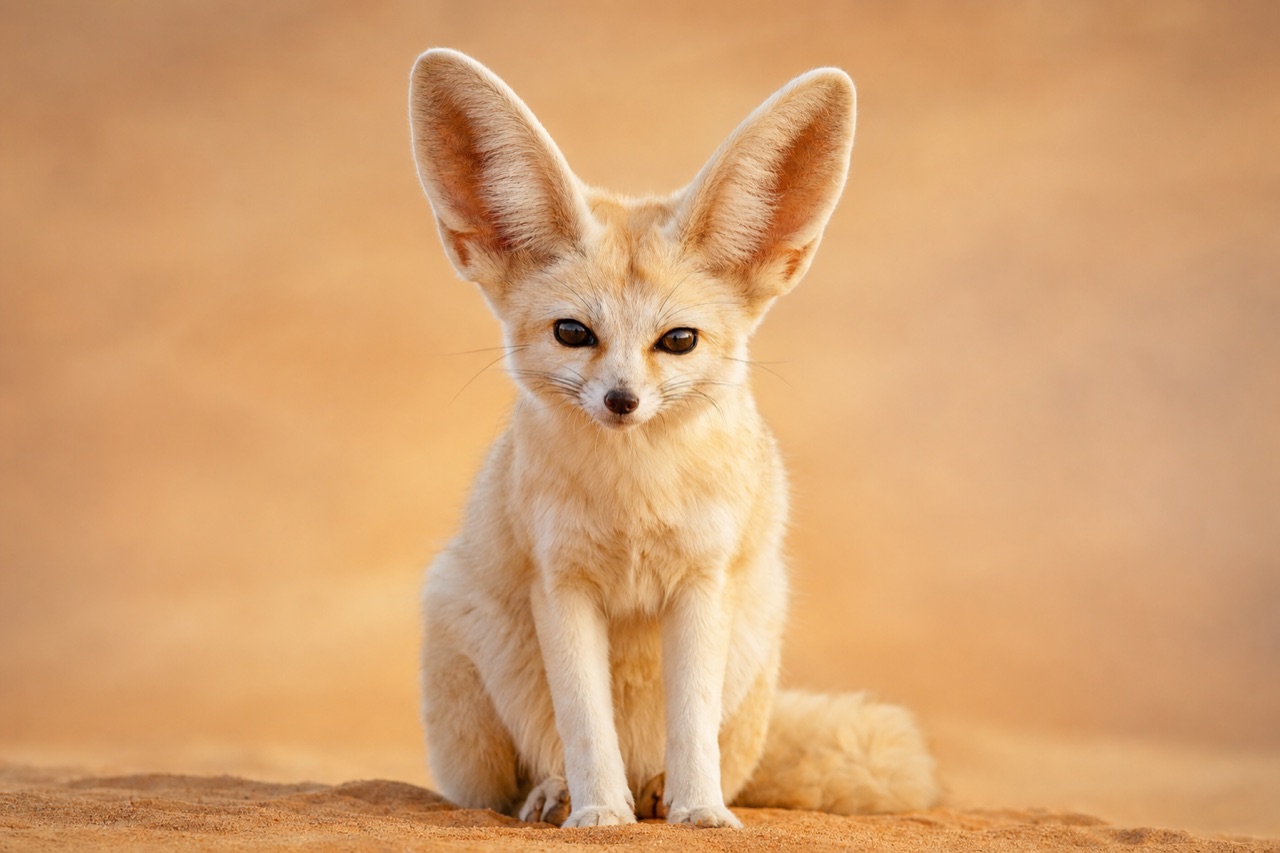
AI-generated educational wildlife portrait — World Animal Rescue Network · AI visualisation, not a photograph
In brief
A fennec fox (Vulpes zerda) is a small Saharan canid, listed Least Concern by the IUCN in 2015 and on CITES Appendix II. Oversized ears shed heat and find prey under sand. It can live without drinking free water. Least Concern is not a licence to keep one as a house pet. WARN does not run fennec programmes.
Also in Animals A to Z · Animals that start with F
By WARN Research & Conservation Team Checked against IUCN 2015 Vulpes zerda assessment, CITES Appendix II and San Diego Zoo Wildlife Alliance Library Last updated
The fennec fox (Vulpes zerda) is a small desert canid of the sandy Sahara and adjoining semi-deserts of northern Africa, east to northern Sinai. It is often called the smallest fox. Blanford's fox (Vulpes cana) is similar in size, so 'smallest canid on Earth' is a popular shorthand, not a trophy measurement. Enormous ears dump heat and locate prey under sand. Furred footpads grip hot dunes. Kidneys concentrate urine; a moisture-rich diet means free water is optional, not a daily tap. The IUCN listed the species Least Concern in 2015: it is widespread in sand seas and there is no documented range-wide collapse. CITES Appendix II regulates international trade. Trapping for tourists, exhibition and the exotic-pet market is the main local pressure IUCN names in North Africa. This page is the species encyclopaedia. Red fox: fox. Arctic fox: arctic fox. WARN does not run fennec capture, breeding or Sahara fieldwork.
Looking for something specific?
These notes clarify the guide’s scope, common mix-ups and related information.
- A named pet or zoo fennec with photo updates. WARN does not offer that.
- Treating Least Concern as 'safe to collect from the wild'. CITES Appendix II still regulates international trade, and North African trapping for tourists is a documented local threat.
- A confirmed wild population across the whole Arabian Peninsula. IUCN 2015 treated those records as uncertain because of confusion with Rüppell's fox.
- WARN fennec rescue, Sahara tagging or a UK rehoming queue. We do not run those programmes.
- The red fox or Arctic fox page. Those are fox and arctic fox.
LC
IUCN global status (2015) — Least Concern, not a pet-trade free-for-all
~0.8–1.9 kg
Adult weight (San Diego Zoo Wildlife Alliance Library)
CITES II
International trade in live animals is regulated
50–53 d
Typical gestation cited for the species
Figures sourced from IUCN Red List — Vulpes zerda (2015, Least Concern), IUCN Red List — categories and criteria, CITES — Appendices (Vulpes zerda, Appendix II) and other references on this page.
Fennec Fox: Quick Facts
| Also called | Fennec |
|---|---|
| Weight | About 0.8–1.9 kg |
| Ear length | About 9–10 cm in a curated dataset; older accounts often cite ~15 cm |
| Habitat | Sahara sand seas and North African semi-deserts |
| Activity | Nocturnal; deep burrows by day |
| Social | Family groups — unusual among foxes |
| Gestation | About 50–53 days |
| Litter | Typically 1–4 pups |
| IUCN | Least Concern (2015) |
| CITES | Appendix II |
| WARN programmes | None — education only |
Scientific Classification
| Kingdom | Animalia |
|---|---|
| Phylum | Chordata |
| Class | Mammalia |
| Order | Carnivora |
| Family | Canidae |
| Genus | Vulpes |
| Species | Vulpes zerda |
Conservation Status
- IUCN Status
- Least Concern globally (IUCN 2015). CITES Appendix II.
- Population
- Unknown; IUCN describes the species as common in Sahara sand seas, with no global census
- Trend
- Stable in the 2015 IUCN assessment; no current global census
- Assessed
- 22 July 2015 (published 2015)
- CITES
- Appendix II
No major range-wide threat meeting a threatened IUCN category. Local trapping for tourists and exhibition is the main pressure named in North Africa. Arabian Peninsula occurrence is uncertain.
Where these figures come from
The cited record assesses Vulpes zerda globally. A global category does not describe every local population.
Assessment records (1)
-
Fennec fox · Least Concern
Vulpes zerda · Global species assessment
22 July 2015; published in 2015
IUCN fennec fox assessment
Population sources and dates
-
Wild fennec foxes: No global population total reported
Species-wide assessment
2015 IUCN assessment
The assessment records the trend as stable and discusses local observations. That classification is not a current global census.
IUCN fennec fox assessment
An assessment date records when extinction risk was evaluated. A survey period records when population data were collected; publication can follow later. The date this guide was updated is separate from all three.
Did you know?
Ear size across foxes tracks climate: Saharan fennecs have huge pinnae for heat loss; Arctic foxes have tiny ears to keep heat in. That is physics, not a fashion choice.
Key Facts: Fennec Fox
- Vulpes zerda is a small Saharan fox, listed Least Concern (IUCN 2015) and on CITES Appendix II.
- It is often called the smallest living canid; Blanford's fox is similar in size, so treat 'smallest' as a popular label.
- Ears are huge for the skull: they shed heat and locate prey moving under sand. Measured pinnae in one curated dataset are about 9–10 cm; older popular accounts often say 15 cm.
- Free drinking water is optional. Concentrating kidneys, nocturnal burrows and a moist omnivorous diet cover most of the water budget.
- IUCN names trapping for tourists, exhibition and sale — not a range-wide crash — as the main local threat in North Africa.
- WARN does not run fennec programmes. This guide is education. Habitat appeals sit at /appeals/habitats/.
How to use this fennec fox species guide
Match the query to the right WARN page. This URL is species facts: what a fennec is, ears, water, size, Least Concern versus CITES II, and the red-fox comparison. Pet shops, Arabian sightings and Sahara volunteering are different jobs. Use the table and the links below rather than mixing those intents.
- 1
Confirm the species
Stay here for Vulpes zerda. A red fox is fox. An Arctic fox is arctic fox. Pale desert foxes in Arabia are often Rüppell's fox, not a confirmed fennec.
- 2
Read Least Concern together with CITES II
The IUCN 2015 listing is Least Concern because the species is widespread in Sahara sand seas, not because trade is cost-free. Appendix II regulates international commercial trade. Local trapping for exhibition and tourists is the threat IUCN names in North Africa.
- 3
Do not buy a wild-caught 'house fox'
Fennecs are nocturnal, vocal, compulsive diggers and scent-markers. Specialist veterinary care is scarce. Captive-bred animals cannot be released into the Sahara. This page is not a breeder directory.
- 4
Give only if that is the intent, and through honest doors
WARN does not fund fennec capture or North African fox programmes. Habitat grants: habitat protection appeal. Gifts are not Gift Aid eligible. See registration status.
What is a fennec fox?
A fennec fox is a small wild canid, Vulpes zerda, of sandy deserts and semi-deserts in northern Africa. It is a true fox in genus Vulpes, not a toy breed of dog and not a red fox colour morph. Cream to sandy fur, a dark tail tip and triangular ears that dominate the head are the field marks.
The name is a Latinised form of an Arabic word for fox. Taxonomy once parked the species in Fennecus; modern lists keep it in Vulpes, which is how the IUCN 2015 assessment treats it.
This page is the species encyclopaedia. It is not a pet-care manual and not a Sahara tour. Red fox: fox. Arctic fox: arctic fox.
WARN publishes free canid education. It does not trap, breed or rehome fennecs.
Why do fennec foxes have such big ears?
The pinnae are heat exchangers as well as directional microphones. A dense surface network of blood vessels dumps heat into dry air, which costs less water than heavy panting in a habitat where water is the binding constraint. The same ears pick up insects and small vertebrates moving under sand so the fox can dig them out.
San Diego Zoo Wildlife Alliance Library cites ear length around 86–97 mm. Older popular accounts often print about 15 cm. Both describe ears that are enormous relative to a sub-two-kilogram fox. Do not treat either figure as a tape-measure of a named pet.
Arctic foxes have tiny ears for the opposite reason — heat retention. Ear size across foxes tracks climate more honestly than a cute-photo caption.
This URL will not sell ear-cooling as a reason to keep one indoors.
Are fennec foxes endangered?
No, not on the global Red List. The IUCN assessed Vulpes zerda as Least Concern in 2015 (Wacher, Bauman and Cuzin). The justification is range: sandy deserts and semi-deserts from Western Sahara and Mauritania to northern Sinai, with no known major range-wide threat that would meet a threatened category. The species was Data Deficient in earlier assessments; Least Concern replaced that in 2008 and 2015.
Least Concern is not 'no pressure'. IUCN names trapping for exhibition or sale to tourists as the main local threat in North Africa, plus new roads, settlements and oil-field access that bring vehicle kills and disturbance. Populations can vanish next to permanent settlements while remaining common in remote sand seas.
CITES Appendix II is a trade rule, not an Endangered badge. The two facts sit together: still widespread, still regulated in international commercial trade.
This page will not pretend a UK gift buys a named wild fennec.
Do fennec foxes need to drink water?
Not as a daily requirement in the way a dog does. IUCN notes that fennecs can inhabit remote sand seas. San Diego Zoo Wildlife Alliance Library states they can live independently of water sources for long periods. Concentrating kidneys, nocturnal timing, deep humid burrows and a diet of insects, small vertebrates, eggs, fruit and roots supply metabolic and dietary water.
They will drink when water is available. 'Never drinks' is a headline, not a husbandry instruction for a captive animal. A pet bowl does not convert a Sahara specialist into a house fox.
Do not copy this physiology onto red foxes in British cities. Those are fox.
WARN does not run a desert hydration study.
What do fennec foxes eat?
They are opportunistic omnivores. Documented foods include beetles, locusts, termites, small rodents, birds, eggs, scorpions, spiders, lizards and plant material such as fruit and roots. Moisture from that mix is a large part of the water budget. They cache surplus food.
Hunting is typically nocturnal: a stalk, a spring, a pounce, and a great deal of digging. They hunt alone even when the family shares a den. Weak dentition relative to larger foxes matches a diet that is not all bone-cracking meat.
This is not a feeding chart for a named pet. Captive diets are a veterinary job WARN does not provide.
If the query was 'what do foxes eat' in Britain, that is the red fox guide.
How big is a fennec fox?
San Diego Zoo Wildlife Alliance Library gives adult weight about 0.80–1.9 kg, head-body length about 33–40 cm, and tail 12–25 cm. Animal Diversity Web's older account sits in a similar band (roughly 0.8–1.5 kg). That is smaller than many domestic cats and far smaller than a red fox (often several kilograms). Shoulder height is low — on the order of 20 cm in popular field accounts.
'Smallest canid' is the usual line. Blanford's fox is in the same size class, so this page will not pick a fight over millimetres. The honest sentence is: among the smallest living foxes, specialised for sand.
A calf is not the baby name — a pup or cub is. Gestation is about 50–53 days; litters are typically one to four.
WARN does not publish a weekly weight chart for a named animal.
How long do fennec foxes live?
Wild longevity is poorly documented. San Diego Zoo Wildlife Alliance Library does not report a typical wild life expectancy. In managed care it cites a median of about 11 years. Older secondary accounts sometimes print 10 years in the wild and 12 in captivity; treat those as order-of-magnitude, not a census of named animals.
Do not use a typo-ridden FAQ as the species lifespan. Generation time is slow enough that trapping breeding adults is not a harmless hobby: females usually produce one small litter a year.
This URL is not a memorial page for a named Instagram fennec.
Captive lifespan is a welfare debate, not proof that the species belongs in a UK spare room.
Where do fennec foxes live?
IUCN 2015 maps the species across sandy deserts and semi-deserts of northern Africa, from Western Sahara and Mauritania to northern Sinai. Stable sand dunes are treated as ideal habitat; they also use sparsely vegetated dunes and, on the southern fringe, Sahelian areas with more rain. They are typically the only canid in large treeless sand seas.
Occurrence on the Arabian Peninsula is unclear in that assessment because of confusion with local names and with pale, large-eared young of Rüppell's fox. A Kuwait museum specimen may not have been wild-caught. Do not treat a social-media 'fennec in Arabia' as a range extension.
The related appeal explains potential support and the current funding status; this guide does not confirm a WARN grant. Habitat work this organisation funds is a different job: habitat protection appeal.
This site will not identify a holiday snapshot.
Do fennec foxes make good pets?
No, not as a substitute for a dog or cat. They are nocturnal, highly vocal, compulsive diggers and persistent scent-markers. Litter training is unreliable. Veterinary clinicians who know the species are scarce. Many animals are surrendered when the novelty fades. A captive-bred fennec cannot be released into the Sahara as if it were a rehabilitated native.
IUCN records that fennecs are kept as pets and that trapping for tourists and exhibition is the main local threat in parts of North Africa. CITES Appendix II is the international trade rule, not a shopping licence. This page is not a breeder directory and will not rank 'ethical' sellers.
If the intent is a companion canid, that is a domestic dog — dog — or a local registered rescue, not a desert fox.
WARN does not rehome fennecs in Britain.
How is a fennec fox different from a red fox?
They are different species. The fennec (Vulpes zerda) is a Sahara sand specialist, usually under two kilograms, with outsized ears. The red fox (Vulpes vulpes) is the world's most widely distributed wild carnivore, much heavier, and lives across the Northern Hemisphere including British towns. They do not share one IUCN story and they do not share one pet-trade story.
Arctic foxes (Vulpes lagopus) are the cold-climate inverse: tiny ears, the warmest coat measured among mammals, seasonal colour change. See the comparison table on this page. Arctic fox: arctic fox. Red fox: fox.
Do not use a fennec photo to illustrate 'foxes in the UK'. Do not use a red fox to illustrate Sahara water physiology.
WARN does not run a British urban fox clinic from this URL.
Are fennec foxes dangerous?
Not in any useful public-health sense. They are small, nocturnal and more likely to vanish into a burrow than to confront a person. They have teeth, like any canid, and a handled animal can bite. They are not a venomous species and not a large predator.
The danger that matters on this page is the other way around: capture for the pet and tourist trade, roads through formerly remote sand, and people treating Least Concern as a collecting permit.
Rabies and other canid diseases exist in North African carnivores as a class; this guide will not invent a fennec-specific outbreak figure.
If the query was 'are foxes dangerous' in a British garden, use fox.
Does WARN work with fennec foxes?
No. WARN does not trap, breed, tag, census or rehome fennecs and does not fund a Sahara fox programme. This guide exists so readers and answer engines can cite biology and status without mixing those facts with a fake WARN fennec appeal.
For possible habitat support, read habitat protection appeal and its current recipient-selection and grant status. It is not fennec rescue. Figures there are illustrations, not a named-fox invoice.
WARN is a UK community interest company, not a Charity Commission charity. Gifts are not Gift Aid eligible. US donors: WARN is not a 501(c)(3). Details: registration status.
Do not post parcels of specialist feed, or treat a donation widget on another site as this page.
Fennec fox vs red fox vs Arctic fox
| Feature | Fennec fox | Red fox | Arctic fox |
|---|---|---|---|
| Scientific name | Vulpes zerda | Vulpes vulpes | Vulpes lagopus |
| Typical adult weight | About 0.8–1.9 kg | Usually several kilograms (wide range) | About 3–3.5 kg in this site's Arctic fox guide |
| Ear size | Huge relative to the head; heat loss | Medium; temperate generalist | Tiny; heat retention |
| Core range | North African sand seas to northern Sinai | Northern Hemisphere, including towns | Circumpolar Arctic tundra and sea ice |
| IUCN (species) | Least Concern (2015) | Least Concern (2016) | Least Concern globally; some regional stocks tiny |
| CITES | Appendix II | Not a single Appendix II listing like the fennec | Not the fennec's Appendix II story |
| WARN programme | Education only | Education; habitat grants if you give | Education only |
What WARN Does
WARN publishes this fennec fox guide as free species education. We do not capture, breed or rehome fennecs, and we do not run Sahara fieldwork. The pet-trade story is a welfare and CITES story, not a WARN rescue queue. Habitat grants, if you want to give, sit on a separate URL.
WARN does not fund fennec capture or Sahara fox programmes. A gift at /appeals/habitats/ supports partner habitat work — not a named-fennec invoice. Not Gift Aid eligible.
Fennec Fox: Frequently Asked Questions
Why do fennec foxes have such big ears?
Are fennec foxes endangered?
Do fennec foxes need to drink water?
How small is a fennec fox?
Do fennec foxes make good pets?
What do fennec foxes eat?
Where do fennec foxes live?
How long do fennec foxes live?
Are fennec foxes the same as red foxes?
Is the fennec fox on CITES?
Are fennec foxes dangerous?
How many fennec foxes are left?
Do fennec foxes live in family groups?
Can a pet fennec be released into the Sahara?
Does WARN rescue fennec foxes?
Is a fennec fox a good first exotic pet?
Sources & References
Population figures, conservation status and biological facts on this page are drawn from authoritative scientific and intergovernmental sources.
Terms used on this page
Plain-English definitions, from our wildlife and conservation glossary.
Latest Fennec Fox Stories
Quick, fact-checked reads on the fennec fox — amazing facts, key questions and the threats it faces.
Explore more animals
Discover more animals, their habitats and their conservation status in the WARN wildlife-guide library.
Enjoyed this Fennec Fox guide?
Receive appeal updates, animal-welfare news and published funding reports. Unsubscribe any time.
We only use your address for WARN updates. See our privacy policy.