Wildlife Guide · Arctic tundra of Eurasia, North America, Greenland, Iceland and Svalbard & Sea ice in winter
Arctic Fox
Vulpes lagopus (Linnaeus, 1758) — family Canidae
The warmest coat of any mammal, a coat that changes colour, and a species being pushed north by its bigger cousin.
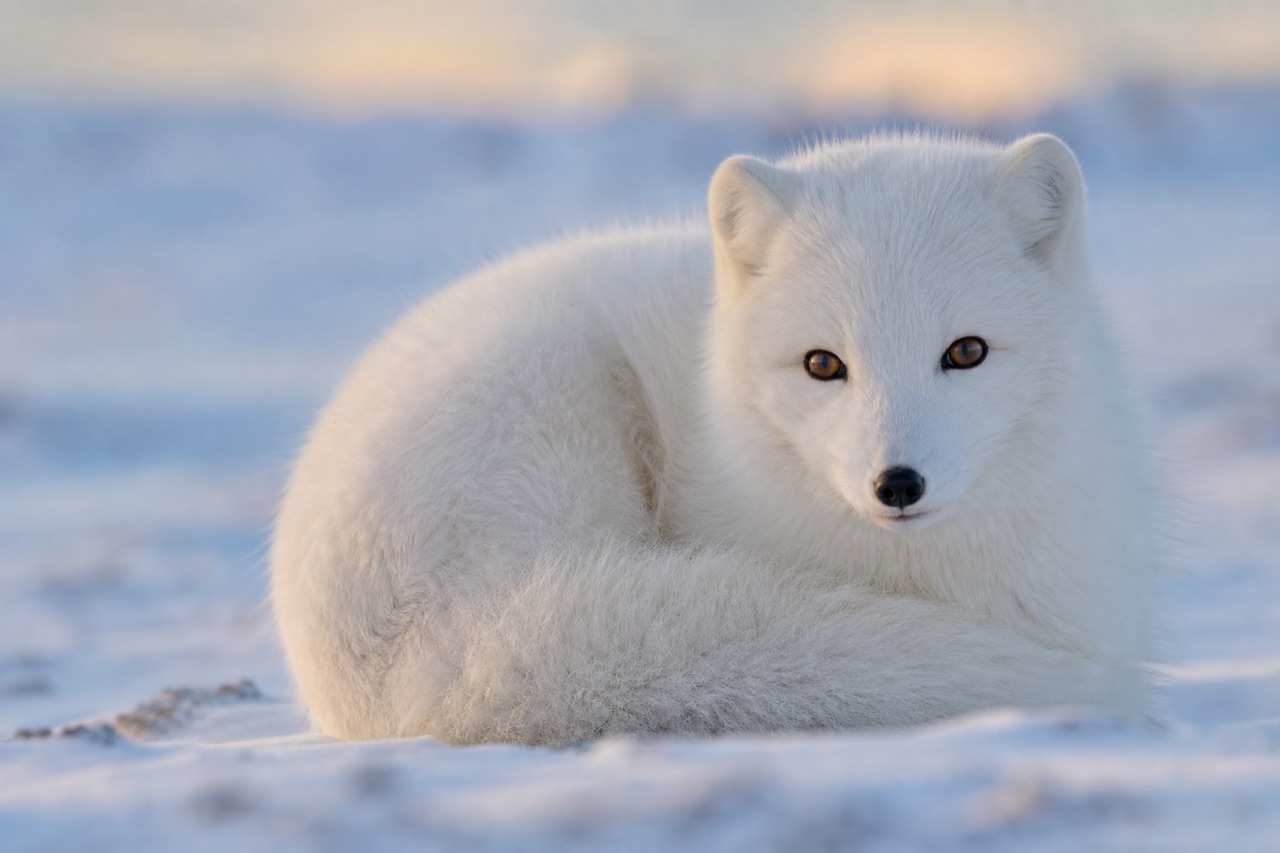
AI-generated educational wildlife portrait — World Animal Rescue Network · AI visualisation, not a photograph
In brief
The Arctic fox (Vulpes lagopus) has the warmest coat of any mammal, does not begin shivering until around −40°C, and changes from a brown-grey summer coat to thick white winter fur; its main modern threat is the red fox expanding north.
Also in Animals A to Z · Animals that start with A
By WARN Research & Conservation Team Last updated
The Arctic fox is built for cold to a degree few mammals match. Its winter coat is the warmest of any mammal measured, and the fox does not begin to shiver until the temperature falls below roughly −40°C. Short ears, a short muzzle, compact body and fur-covered footpads all minimise heat loss — the exact inverse of the fennec fox's desert design. Most Arctic foxes change colour seasonally, from brown-grey summer coats to thick white winter ones. A minority, the 'blue' morph, stay dark year-round and are commoner on coasts where snow cover is unreliable.
−40 °C
Temperature at which shivering begins
Warmest
Winter coat of any mammal measured
Up to 14
Pups in a litter in a peak lemming year
>1,000 km
Distances individuals have been tracked across sea ice
Figures sourced from IUCN Red List — Vulpes lagopus, IUCN Red List .
Arctic Fox: Quick Facts
| Weight | 3–3.5 kg |
|---|---|
| Cold tolerance | No shivering above about −40 °C |
| Coat | Seasonal white/brown, or year-round 'blue' morph |
| Litter size | Up to 14 in peak lemming years |
| Range | Circumpolar Arctic tundra and sea ice |
| Key threat | Northward expansion of the red fox |
Scientific Classification
| Kingdom | Animalia |
|---|---|
| Phylum | Chordata |
| Class | Mammalia |
| Order | Carnivora |
| Family | Canidae |
| Genus | Vulpes |
| Species | Vulpes lagopus |
Conservation Status
- IUCN Status
- Least Concern
- Population
- Several hundred thousand circumpolar
- Trend
- Stable globally; Scandinavian population critically small
- Assessed
- 2014
- CITES
- Not listed
The global listing masks a severe regional situation in Fennoscandia, where the population survives only with active red fox control and supplementary feeding.
Did you know?
One tracked Arctic fox walked from Svalbard to Canada in 76 days, crossing more than 3,500 km of sea ice.
Key Facts: Arctic Fox
- The Arctic fox has the warmest coat of any mammal and tolerates −40°C before shivering.
- Body shape minimises heat loss — the exact inverse of the fennec fox's design.
- Most change from brown-grey summer coats to white winter coats; 'blue' morphs stay dark.
- Litter size tracks lemming abundance and can reach 14 pups in a peak year.
- They travel enormous distances over sea ice, including crossings of over 1,000 km.
- Red foxes moving north with warming are outcompeting and killing Arctic foxes.
Engineered against heat loss
Every proportion works against losing warmth: small rounded ears, a short muzzle, short legs, a compact trunk and a thick tail used as a wrap when curled up. Fur covers the footpads — the species name *lagopus* means 'hare-foot' — insulating against ice and improving grip.
A countercurrent heat exchanger in the legs keeps the paws close to freezing while the core stays warm, so heat is not wasted at the extremities. The result is an animal that maintains core temperature through Arctic winters with no shelter beyond a snow hollow.
Two colour morphs
The white morph turns brown-grey in summer and thick white in winter, matching snow cover. The blue morph keeps a dark charcoal or brown coat year-round and is commoner in coastal and island populations — Iceland's foxes are predominantly blue — where snow cover is patchy and a white coat would be conspicuous.
The morphs interbreed freely; colour is determined by a single genetic locus rather than by separate populations.
Lemmings, and travelling for food
Inland Arctic foxes depend heavily on lemmings, and litter size tracks the lemming cycle sharply — up to 14 pups in a peak year, few or none in a crash. Coastal foxes rely more on seabirds, eggs and carrion and are less volatile.
Winter forces long movements. Arctic foxes follow polar bears to scavenge kills and range across sea ice; tracked individuals have covered well over a thousand kilometres, including crossings between continents. That mobility depends on sea ice being there.
The red fox problem
The clearest modern threat is competition. As the Arctic warms and shrub tundra advances north, red foxes — larger, more aggressive and better suited to milder conditions — expand into Arctic fox range. Red foxes take over dens, outcompete for food and kill Arctic foxes directly.
The Scandinavian Arctic fox population remains critically small despite decades of protection, and red fox control alongside supplementary feeding has been necessary to keep it viable. Globally the species is Least Concern because the circumpolar population is large; that number conceals a real and worsening squeeze at the southern edge of the range.
What WARN Does
WARN publishes free, sourced species education including the pressures that are hard to see. The Arctic fox is not declining because of hunting or trade — it is losing ground to another fox that warming has let move north, which is what climate-driven biodiversity loss usually looks like in practice.
If this guide helps you understand wildlife and the pressures it faces, a gift to WARN supports habitat protection and free public education in our partner countries.
Arctic Fox: Frequently Asked Questions
How cold can an Arctic fox survive?
Why are red foxes a threat to Arctic foxes?
Where do Arctic foxes live?
Are Arctic foxes dangerous?
How long do Arctic foxes live?
How big is an Arctic fox?
What do Arctic foxes eat?
Sources & References
Population figures, conservation status and biological facts on this page are drawn from authoritative scientific and intergovernmental sources.
Terms used on this page
Plain-English definitions, from our wildlife and conservation glossary.
Explore more animals
Discover more animals, their habitats and their conservation status in the WARN wildlife-guide library.
Enjoyed this Arctic Fox guide?
Receive appeal updates, animal-welfare news and published funding reports. Unsubscribe any time.
We only use your address for WARN updates. See our privacy policy.