Wildlife Guide · Western Indian Ocean & Indonesia
Coelacanth
Latimeria spp. — coelacanthiform lobe-finned fishes (two living species)
Assumed extinct for tens of millions of years until a fisherman landed one off South Africa on 22 December 1938.
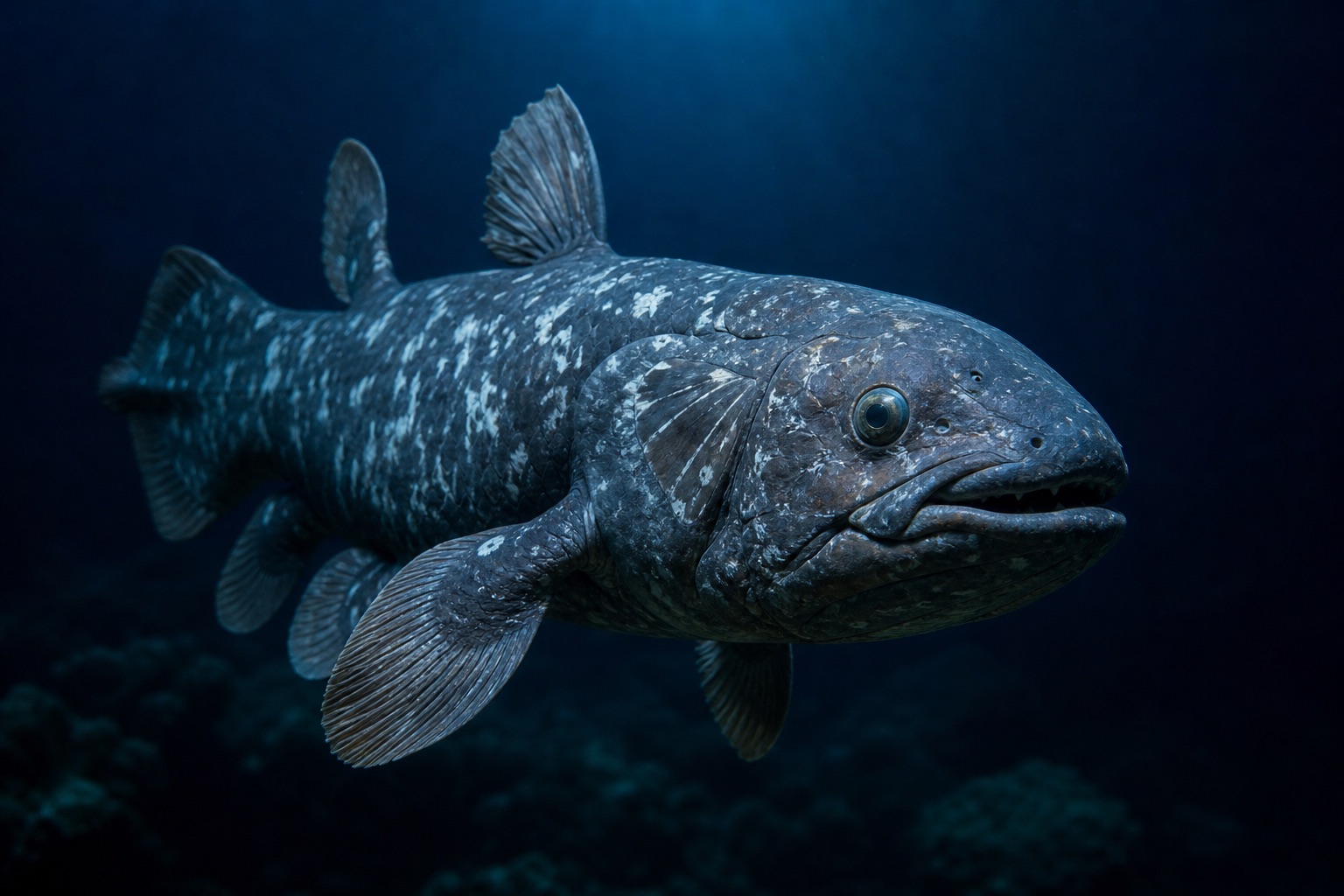
AI-generated educational wildlife portrait — World Animal Rescue Network · AI visualisation, not a photograph
In brief
The coelacanth is a lobe-finned deep-sea fish in the genus Latimeria, known from fossils and assumed extinct until a living specimen was landed off South Africa on 22 December 1938; two species survive in the western Indian Ocean and Indonesia and are listed as Critically Endangered and Vulnerable respectively.
Also in Animals A to Z · Animals that start with C
How you can help
You can support the related appeal — read its purpose, recipient status and fund terms first — or give once to where it is needed most. Sharing accurate information helps too.
By WARN Research & Conservation Team Last updated
Coelacanths are lobe-finned fishes whose lineage was known only from fossils until a living specimen was landed at the mouth of the Chalumna River near East London, South Africa, on 22 December 1938. Marjorie Courtenay-Latimer, curator of the local museum, recognised that the steel-blue fish with lobed fins on stalks was something extraordinary. The discovery made headlines worldwide: an animal thought to have died out with the dinosaurs was alive. Two living species are recognised today. Latimeria chalumnae lives in the western Indian Ocean, mainly around the Comoros and nearby islands. Latimeria menadoensis was described from Indonesia in 1999. Both inhabit deep volcanic slopes and caves, typically below 100 metres. They are slow, nocturnal drift-hunters with a hinged skull that lifts to swallow large prey whole. Their lobed fins are structurally closer to the limbs of early tetrapods than to the rays of most modern fish — which is why coelacanths sit at the centre of discussions about how vertebrates moved onto land, even though the living species are not direct ancestors of tetrapods.
1938
Year the first living coelacanth was recognised
2
Living species — western Indian Ocean and Indonesia
100–700 m
Typical depth range for daytime habitat
Hinged skull
Upper jaw swings up to engulf prey
Figures sourced from IUCN Red List — Latimeria chalumnae, IUCN Red List — Latimeria menadoensis, Smithsonian Ocean — coelacanth .
Coelacanth: Quick Facts
| Living species | Two — western Indian Ocean and Indonesia |
|---|---|
| Depth | Typically 100–700 m |
| Reproduction | Live-bearing — internal fertilisation |
| Discovery | 22 December 1938, off South Africa |
| Fin type | Lobed, on fleshy stalks |
| Main threat | Accidental deep-water bycatch |
Scientific Classification
| Kingdom | Animalia |
|---|---|
| Phylum | Chordata |
| Class | Sarcopterygii (lobe-finned fishes) |
| Order | Coelacanthiformes |
| Family | Latimeriidae |
| Genus | Latimeria |
| Species | L. chalumnae and L. menadoensis |
Conservation Status
- IUCN Status
- Critically Endangered (L. chalumnae); Vulnerable (L. menadoensis)
- Population
- No reliable estimate — likely fewer than 1,000 mature individuals for L. chalumnae
- Trend
- Decreasing
- Assessed
- 2019
- CITES
- Appendix I (L. chalumnae)
Slow life history and localised deep habitat mean even low bycatch rates can be significant. Protection depends on enforcing gear restrictions in known coelacanth areas.
Did you know?
The 1938 coelacanth was almost thrown away — the taxidermist had removed the internal organs before the fish was recognised as a scientific specimen.
Key Facts: Coelacanth
- Coelacanths were known only from fossils until 1938, when Latimeria chalumnae was identified from a fish landed off South Africa — the classic living-fossil rediscovery.
- Two living species exist: L. chalumnae in the western Indian Ocean and L. menadoensis in Indonesia.
- They are lobe-finned fishes (Sarcopterygii), more closely related to lungfish and tetrapods than to ray-finned fish such as salmon or tuna.
- Lobed pectoral and pelvic fins move on fleshy stalks; the paired fins of early four-legged animals are thought to derive from similar structures in ancient sarcopterygians.
- Coelacanths give birth to live young after internal fertilisation — unusual among fishes and one reason populations recover slowly from mortality.
- The West Indian Ocean coelacanth is Critically Endangered; accidental bycatch in shark and deep-set fishing gear is the main documented threat.
The 1938 rediscovery
By the late nineteenth century, coelacanths were fossils — impressions in rock from the Devonian through the Cretaceous, the last records roughly 66 million years old. No one expected a living population.
Captain Hendrick Goosen brought an unusual blue fish ashore in December 1938. Courtenay-Latimer contacted the ichthyologist J. L. B. Smith, who confirmed it as a coelacanth and named the genus Latimeria in her honour. Smith's famous telegram — "MOST IMPORTANT PRESERVE SKELETON AND GILLS = FISH DESCRIBED" — captured the shock. The find did not mean coelacanths were unchanged since the Mesozoic; molecular clocks show substantial evolution. It meant a lineage thought lost was persisting in deep water, largely invisible to science until industrial fishing and submersibles reached their depth.
Living fossil — what the phrase gets wrong
Coelacanths are often called living fossils, and the label draws traffic because it suggests an animal frozen in time. The reality is more precise. Living coelacanths are the surviving members of a ancient order, but they are not identical to their fossil relatives. Genome work shows gene loss, changed regulatory sequences and adaptations to deep, low-oxygen habitats that their Cretaceous counterparts did not share.
The useful comparison is with extinct-animal profiles at extinct animals — species assumed gone that have living parallels facing the same pressures. Coelacanths inverted the story — assumed extinct, then found — but the conservation lesson matches. Slow reproduction and specialised habitat make a lineage fragile once human fishing reaches its depth. Being ancient does not confer immunity.
Anatomy that links fish to land
Coelacanths carry lobed fins — muscular stalks with a central axis of bones arranged in a pattern echoing the limb bones of early tetrapods. They are not legs, and the coelacanth is not an ancestor of humans, but the shared architecture illustrates how sarcopterygian fins could be modified into weight-bearing limbs in related lineages that did colonise land.
Other features are equally distinctive. The skull hinges intracranially: the upper jaw and braincase lift together, opening the mouth wide for whole-fish prey. A fat-filled notochord-like organ replaces a swim bladder, helping buoyancy control in deep water. Electrosensory pores on the snout detect prey in darkness. These are adaptations to a deep, cave-adjacent life, not a preview of terrestrial walking — but they made the animal central to textbooks on vertebrate evolution.
Conservation in deep water
Latimeria chalumnae is Critically Endangered; L. menadoensis is Vulnerable. Populations are small, localised and slow to replace losses. Females produce relatively few young after gestation estimated at around thirteen months in some studies — exact figures vary, but the life history is unambiguously slow.
Documented mortality comes mainly from accidental bycatch in deep-set gillnets and other gear targeting sharks and oilfish. Coelacanths have no commercial fishery of their own; their value is scientific and cultural. Protected status exists in several range states, and international trade is restricted under CITES Appendix I for L. chalumnae. Submersible surveys and tagging programmes have mapped caves and migration routes, but deep-water species are expensive to monitor — population sizes remain uncertain, and a Critically Endangered listing reflects risk as much as a precise head count.
What WARN Does
WARN publishes free education on species whose stories connect evolution, extinction and survival. Coelacanths show how a lineage can persist unseen in deep habitat until fishing reaches it — a parallel to the extinct-animal profiles elsewhere on the site, where the pressure arrived too fast for recovery.
If this guide helps you understand wildlife and the pressures it faces, a gift to WARN supports habitat protection and free public education in our partner countries.
How can I help save the coelacanth?
Explore practical ways to support the coelacanth, from everyday choices and sharing reliable information to reviewing a related appeal before giving.
Explore ways to support
Read the related appeal’s purpose, recipient status and fund terms. Choose an affordable gift after checking what is proposed and what has been reported.
Ease the pressures
Avoid the wildlife trade and souvenirs, never buy wild animals as pets, and choose sustainable, habitat-friendly products — the threats behind the coelacanth's decline fall when demand does.
Spread the word
Share accurate, sourced information about the coelacanth. Wider awareness is what turns concern into lasting protection.
Coelacanth: Frequently Asked Questions
How can I help save the coelacanth?
What do coelacanths eat?
Where do coelacanths live?
Are coelacanths dangerous to humans?
How long do coelacanths live?
How big is a coelacanth?
Why was the coelacanth called a living fossil?
Sources & References
Population figures, conservation status and biological facts on this page are drawn from authoritative scientific and intergovernmental sources.
Terms used on this page
Plain-English definitions, from our wildlife and conservation glossary.
Latest Coelacanth Stories
Quick, fact-checked reads on the coelacanth — amazing facts, key questions and the threats it faces.
Briefings
Kalimantan forest fires 2026: orangutans, smoke and how to help
Dated reports on Kalimantan’s fires, Sampurna and Mama Penja, wildlife response and how to help. Includes IAR’s 27 September 2026 rescue update.
Read the storyBriefings
Three Rehabilitated Orangutans Released Back Into the Wild in East Kalimantan
Three Bornean orangutans — Bagus, Eboni and Ruby — were released into a protected forest in East Kutai, East Kalimantan, on 23 June 2026, after years of rehabilitation following rescue from the illegal pet trade. All three are Critically Endangered Pongo pygmaeus.
Read the storySpecies
Why Are Orangutans Endangered? Palm Oil, Deforestation and the Rescue Crisis in Borneo
Orangutans are endangered because of a single dominant cause: deforestation. All three remaining species have been reduced to small, fragmented populations in what remains of Borneo's and Sumatra's lowland and peat-swamp forests — and the crisis is getting worse, not better.
Read the storyExplore more animals
Discover more animals, their habitats and their conservation status in the WARN wildlife-guide library.
Enjoyed this Coelacanth guide?
Receive appeal updates, animal-welfare news and published funding reports. Unsubscribe any time.
We only use your address for WARN updates. See our privacy policy.