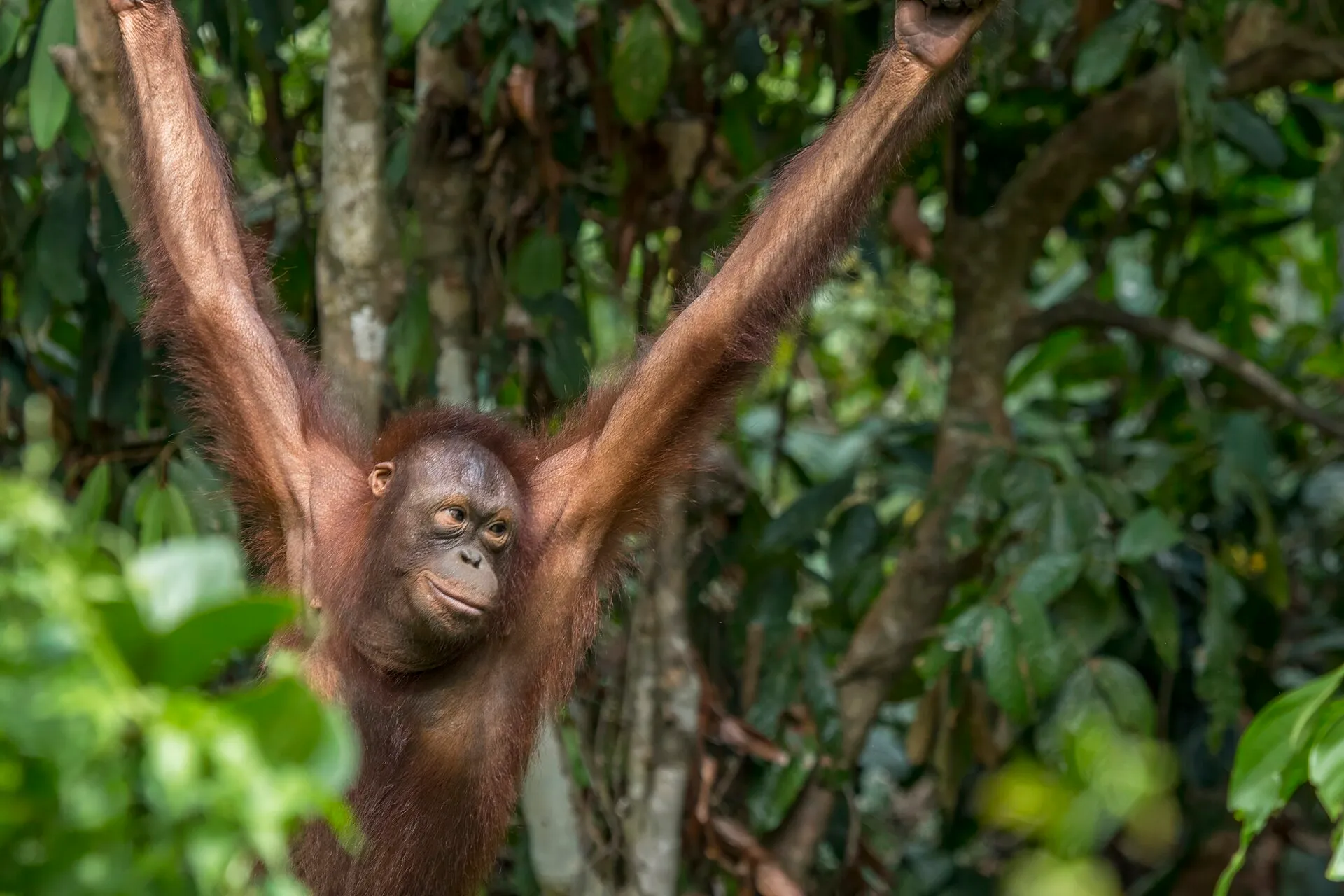
A Bornean orangutan in the forest canopy — one of fewer than 104,700 estimated to remain in the wild
Species

· INDONESIA · MALAYSIA · 6 min read

Why Are Orangutans Endangered? Palm Oil, Deforestation and the Rescue Crisis in Borneo

In brief

Orangutans are endangered primarily because of deforestation — the clearing of Borneo's and Sumatra's lowland forests for palm-oil plantations, pulpwood and logging has destroyed more than 50% of their habitat in 40 years, confining surviving populations to increasingly fragmented and isolated forest patches.

What are the key takeaways from this briefing?

  • The Bornean orangutan (Pongo pygmaeus) is listed as Endangered — its population has declined by over 50% in 60 years and stands at approximately 104,700 individuals.
  • The Sumatran orangutan (Pongo abelii) is Critically Endangered with around 13,846 individuals remaining.
  • The Tapanuli orangutan (Pongo tapanuliensis) is the most endangered great ape on Earth, with fewer than 800 individuals left.
  • Palm-oil plantation expansion is the single largest driver of orangutan habitat loss in both Indonesia and Malaysia.
  • When orangutans are displaced by deforestation, they enter human settlements and become vulnerable to capture, killing and trafficking.

Orangutans are endangered because of a single dominant cause: deforestation. The three remaining orangutan species have all been reduced to small, fragmented populations in what remains of the lowland and peat-swamp forests of Borneo and Sumatra — and the rate of habitat loss continues to outpace the rate of rescue and rehabilitation.

How many orangutans are left?

Current IUCN population estimates:

  • Bornean orangutan (Pongo pygmaeus): approximately 104,700 — listed as Endangered
  • Sumatran orangutan (Pongo abelii): approximately 13,846 — listed as Critically Endangered
  • Tapanuli orangutan (Pongo tapanuliensis): fewer than 800 — listed as Critically Endangered, the most endangered great ape on Earth

The Bornean population may seem large, but it represents a decline of over 50% from population levels 60 years ago — and surveys show it is still falling.

Why palm oil threatens orangutans?

Palm oil is found in approximately 50% of supermarket products — from bread and biscuits to cosmetics and biofuel. The oil palm industry in Indonesia and Malaysia has been responsible for the largest portion of Bornean and Sumatran deforestation over the past four decades. When lowland forest is cleared for a plantation, orangutans lose their food sources, their shelter, and their ability to move through the landscape.

Isolated by cleared land they cannot cross, they starve, are killed by plantation workers who view them as pests, or are captured by traffickers. Infant orangutans are particularly vulnerable: mothers are killed so their infants can be sold as pets — a trade that WARN's partner rescue programmes in Indonesia and Malaysia respond to directly.

What should you know about beyond palm oil: the other drivers?

  • Illegal logging removes individual large trees — the kind that orangutans nest in and that provide their main food sources.
  • Peatland fires, often deliberately set to clear land, create mass mortality events. The 2015 Indonesian fires killed thousands of orangutans directly.
  • Infrastructure development — roads built through forest fragment populations and provide access for hunters and traffickers.
  • Plantation expansion into secondary forest, which many orangutans rely on as primary habitat has become unavailable.

What orangutans need to survive in the wild?

Orangutans are slow-reproducing primates. Females give birth approximately every 7–8 years and invest years teaching their offspring survival skills. Each death is a significant population setback. Each adult male needs up to 6 km² of forested range, with diverse fruiting trees available year-round. They cannot survive in plantation monocultures. After rescue and rehabilitation, released orangutans require intact, connected forest to establish a territory, find a mate and access the food diversity their diet requires. If the forest isn't there, release isn't possible — and the rescue becomes a permanent sanctuary burden.

What should you know about wARN's response?

WARN funds partner rescue centres in Indonesia and Malaysia for orangutans confiscated from the illegal wildlife trade or displaced by plantation operations. But rescue without habitat restoration is a revolving door. WARN's Restore Natural Habitats appeal funds the native tree planting and corridor restoration that gives rehabilitated orangutans a viable future — turning rescue into genuine recovery.

What is this briefing not?

This briefing is not a substitute for the full Bornean orangutan wildlife guide, not a pet-care manual, and not a first-person field dispatch. It is a desk-researched explainer for people who searched a specific question about Bornean orangutan. The setting is INDONESIA · MALAYSIA.

Why Are Orangutans Endangered? Palm Oil, Deforestation and the Rescue Crisis in Borneo sits in the newsroom as a species explainer. It is not a Field notes dispatch from a partner clinic, and it is not a reason to keep Bornean orangutan. Location context: INDONESIA · MALAYSIA.

Who should skip this page?

Skip this page if you wanted a complete IUCN-style species profile, veterinary advice, or permission to keep Bornean orangutan as a pet. You will not find those here. Read the wildlife guide next if you need status, range and sources in one place.

Skip it if you needed veterinary instructions, a travel itinerary, or a fundraising story dressed up as science. The skip is the point: a page that cannot say no is not a guide.

How does this briefing compare to the full species guide?

This page answers the search in the headline. The wildlife guide answers status, threats, and what is actually known. Use both; do not cite the listicle as if it were the Red List. Orangutans are endangered because of a single dominant cause: deforestation.

Claims this briefing actually stands behind
Takeaway
The Bornean orangutan (Pongo pygmaeus) is listed as Endangered — its population has declined by over 50% in 60 years and stands at approximately 104,700 individuals.
The Sumatran orangutan (Pongo abelii) is Critically Endangered with around 13,846 individuals remaining.
The Tapanuli orangutan (Pongo tapanuliensis) is the most endangered great ape on Earth, with fewer than 800 individuals left.
Palm-oil plantation expansion is the single largest driver of orangutan habitat loss in both Indonesia and Malaysia.

What is the catch with a short wildlife briefing?

The catch with wildlife listicles is that a true fact can still be the wrong takeaway. “Amazing” is not the same as “safe to keep”, and a number without a source is trivia. Every figure on this page should be read against the cited IUCN or zoo pages, not against a screenshot.

Factory “12 facts” pages elsewhere on the web pad the same three sentences. Here each heading is a real question, each answer is meant to stand alone, and the sources at the end are the audit trail. If a number is not on this page or in those sources, we did not invent it.

What should you do after reading this?

Use this briefing to answer the question in the title, then go to the species guide for status and sources. If you want to help Bornean orangutan, fund habitat and enforcement — do not buy the animal. Orangutans are endangered primarily because of deforestation — the clearing of Borneo's and Sumatra's lowland forests for palm-oil plantations, pulpwood and logging has destroyed more than 50% of their habitat in 40 years, confining surviving populations to increasingly fragmented and isolated forest patches.

If you want to support WARN’s partner work, donate knowing we are a community interest company, not a registered charity. If you want the animal itself, you have the wrong page.

Read the verdict on the first screen, the skip-if before you share the page, and the sources at the end before you quote a number. That is the whole contract of this briefing.

What do people ask about this briefing?

How many orangutans are left in the world?
Approximately 104,700 Bornean orangutans, 13,846 Sumatran orangutans, and fewer than 800 Tapanuli orangutans are estimated to remain in the wild, giving a combined wild total of roughly 120,000 individuals. All three species are declining. Orangutans are endangered because of a single dominant cause: deforestation.
What is the main cause of orangutan extinction risk?
Deforestation — primarily for oil palm and pulpwood plantations — is the dominant cause. Secondary drivers include illegal hunting, live capture for the pet trade, and palm-oil plantation workers deliberately killing orangutans as crop pests. Orangutans are endangered because of a single dominant cause: deforestation.
Is palm oil the only reason orangutans are endangered?
Palm oil is the largest single driver of orangutan habitat loss, but not the only one. Illegal logging, peatland fires (often deliberately set to clear land) and infrastructure development all contribute. The 2015 Indonesian peatland fires alone killed thousands of orangutans.
Can orangutans be released back into the wild?
Yes, but only if suitable intact or restored forest exists. Released orangutans need connected forest corridors to establish territories and find mates. WARN's habitat appeal funds exactly this kind of corridor restoration to make rescue outcomes sustainable. Orangutans are endangered because of a single dominant cause: deforestation.
Is this Bornean orangutan briefing a complete species guide?
No. It is a newsroom explainer for a specific search. Status, range and the full source list live on the wildlife guide where one exists. The briefing is set in INDONESIA · MALAYSIA. Orangutans are endangered because of a single dominant cause: deforestation.
Should you keep a Bornean orangutan as a pet after reading this?
No. Amazing facts are not a care plan. Wild animals belong in wild habitat; buying one, posing with one, or sharing selling ads all worsen the trade. Location context on this page is INDONESIA · MALAYSIA. Orangutans are endangered because of a single dominant cause: deforestation.
Who should skip this Bornean orangutan page?
Anyone who needed veterinary advice, a full IUCN profile, or permission to handle the animal. This page will tell you to leave if that is you. Orangutans are endangered because of a single dominant cause: deforestation. All three remaining species have been reduced to small, fragmented populations in what remains of Borneo's and Sumatra's lowland and peat-swamp forests — and the crisis is getting worse, not better.
What is the one-line answer on Bornean orangutan?
Orangutans are endangered primarily because of deforestation — the clearing of Borneo's and Sumatra's lowland forests for palm-oil plantations, pulpwood and logging has destroyed more than 50% of their habitat in 40 years, confining surviving populations to increasingly fragmented and isolated forest patches.
W

WARN Research & Conservation Team

World Animal Rescue Network

Published Updated 6 min read · 1,164 words
Share
Support animal rescue