Wildlife Guide · Africa & Asia
Centipede
Chilopoda
The fast, venomous predator with many legs
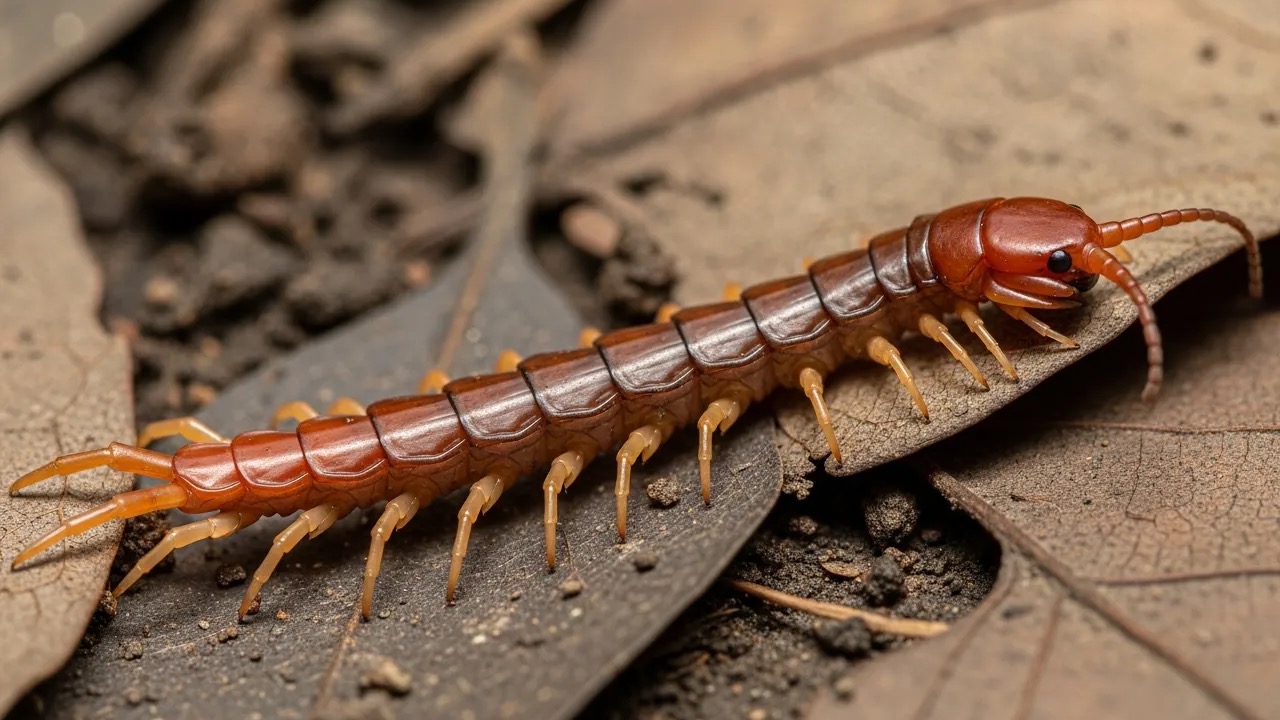
Photo: Thomas Brown AfroBrazilian Warut Siriwut, Gregory D. Edgecombe, Chirasak Sutcharit, Piyoros Tongkerd, Somsak Panha Katja Schulz / Wikimedia Commons (CC BY-SA 4.0)
In brief
Centipedes (class Chilopoda) are fast, venomous invertebrate predators recognised by their long, flattened bodies and many legs, one pair per body segment. Found in soil, leaf litter, and damp places worldwide, they range from a few millimetres to over 30 cm (12 in) long and run swiftly on their many legs to catch insects, spiders, and other small animals.
Also in Animals A to Z · Animals that start with C
By WARN Research & Conservation Team Last updated
Centipedes (class Chilopoda) are fast, venomous invertebrate predators recognised by their long, flattened bodies and many legs, one pair per body segment. Found in soil, leaf litter, and damp places worldwide, they range from a few millimetres to over 30 cm (12 in) long and run swiftly on their many legs to catch insects, spiders, and other small animals. Most species live 1 to 6 years and are listed as Least Concern.
0.15 m
Typical length
10 g
Typical weight
1.8 km/h
Top speed
5 yrs
Lifespan
Figures sourced from Wikipedia — Centipede, Wikidata — Centipede .
Centipede: Quick Facts
| Scientific name | Chilopoda (class) |
|---|---|
| Diet | Carnivore (insects, spiders, small animals) |
| Habitat | Soil, leaf litter, and damp places worldwide |
| Lifespan | 1–6 years (varies by species) |
| Length | From a few mm to over 30 cm (12 in) |
| Top speed | Fast; some sprint to escape and hunt |
| Conservation status | Least Concern (IUCN, most species) |
Scientific Classification
| Kingdom | Animalia |
|---|---|
| Phylum | Arthropoda |
| Class | Chilopoda |
Conservation Status
- IUCN Status
- Least Concern (IUCN Red List category)
- Population
- Global population not compiled for this guide
- Trend
- See the IUCN Red List assessment
- Assessed
- See the IUCN Red List assessment
- CITES
- See CITES appendices
Conservation figures are drawn from the IUCN Red List and CITES; this guide links to the authoritative sources rather than restating population counts.
Key Facts: Centipede
- A centipede has a long, flattened body divided into many segments, each bearing a single pair of legs, which is what sets it apart from the millipede with its two pairs per segment.
- Centipedes are active carnivores, hunting insects, spiders, worms, and, in the largest species, small vertebrates such as lizards.
- The centipede is built for speed and runs rapidly on its many legs, coordinating them in smooth waves so it can dart across the ground to catch prey or flee danger.
Body and legs
A centipede has a long, flattened body divided into many segments, each bearing a single pair of legs, which is what sets it apart from the millipede with its two pairs per segment. Despite the name, which means hundred-footed, the number of leg pairs varies widely between species and is always odd. The many legs are set out along the sides so they do not tangle during a quick escape or chase. Body length ranges enormously, from tiny species just a few millimetres long to tropical giants exceeding 30 cm (12 in).
Venom and hunting
Centipedes are active carnivores, hunting insects, spiders, worms, and, in the largest species, small vertebrates such as lizards. Just behind the head sits a pair of modified front legs called forcipules, curved fang-like claws that inject venom to subdue prey. They seize a victim, pin it with their legs, and deliver a venomous bite that quickly overwhelms it. Their swift movement and quick strike make them formidable ambush and pursuit predators in the leaf litter.
Speed and movement
The centipede is built for speed and runs rapidly on its many legs, coordinating them in smooth waves so it can dart across the ground to catch prey or flee danger. Its low, flattened shape lets it slip through narrow cracks in soil, bark, and stone. Long rear legs and sensitive antennae help it feel its way and react instantly in the dark. This combination of quickness and agility is central to how it both hunts and avoids being eaten.
Where centipedes live
Centipedes are found almost worldwide, thriving in soil, leaf litter, rotting wood, and other damp, sheltered places. Because they lose water easily through their bodies, they need moisture and generally hide by day, coming out at night to hunt. Some species enter houses in search of prey and humidity, most famously the house centipede that patrols bathrooms and basements. From tropical forests to temperate gardens, damp cover is the common thread in their habitats.
Life cycle and lifespan
Depending on the species, centipedes live anywhere from about one to six years, which is long-lived for such small invertebrates. In many species the female guards her eggs and newly hatched young, curling protectively around them until they can fend for themselves. The young hatch resembling small adults and add segments and legs as they grow and moult. This slow maturation and parental care are unusual among the small predators of the leaf litter.
Centipedes and people
A centipede bite can be painful to humans, and large tropical species deliver enough venom to cause significant local pain and swelling, though bites are very rarely dangerous to healthy people. In gardens and homes they are broadly beneficial, preying on cockroaches, flies, and other pests. Most of the roughly 8,000 known species are harmless to us and are assessed as Least Concern. Leaving them undisturbed usually means free pest control.
What WARN Does
WARN does not run a dedicated centipede programme — this guide is part of the World Animal Rescue Network's free educational library. The centipede is currently widespread and not globally threatened, and this guide helps readers understand the pressures that can change that. Building public understanding of species like the centipede supports the broader conservation awareness that underpins WARN's partner-led rescue work across its network.
If clear, science-based wildlife guides like this help you understand and value animals, please consider supporting the World Animal Rescue Network's educational and rescue work so we can keep producing them.
Centipede: Frequently Asked Questions
How many legs does a centipede have?
Are centipedes venomous?
What do centipedes eat?
What is the difference between a centipede and a millipede?
How fast can a centipede move?
Where do centipedes live?
Are centipedes dangerous?
How long do centipedes live?
How big is a centipede?
Sources & References
Population figures, conservation status and biological facts on this page are drawn from authoritative scientific and intergovernmental sources.
Terms used on this page
Plain-English definitions, from our wildlife and conservation glossary.
Latest Centipede Stories
Quick, fact-checked reads on the centipede — amazing facts, key questions and the threats it faces.
Species
Slow Loris: Why the Internet's Favourite Pet Is a Conservation Disaster
The slow loris looks like a cartoon character — and that has nearly destroyed the species. Here is the truth behind the viral videos.
Read the storySpecies
The Snow Leopard: Why the Ghost of the Mountains Is Still Vulnerable
The snow leopard is one of the most elusive big cats on earth, with an estimated 4,000-6,500 individuals across twelve range states — including Pakistan, where WARN is preparing to operate. This briefing explains why the species was downlisted from Endangered to Vulnerable in 2017 and why that is not the success story it sounds like.
Read the storyGuides
Sun Bear vs Moon Bear: The Two Most Trafficked Asian Bears
The sun bear and the Asiatic black bear (moon bear) are the two most commonly trafficked bears in Asia — for the pet trade, for traditional medicine and for bear-bile farming. Here is how to tell them apart.
Read the storyExplore more animals
Discover more animals, their habitats and their conservation status in the WARN wildlife-guide library.
Enjoyed this Centipede guide?
Receive appeal updates, animal-welfare news and published funding reports. Unsubscribe any time.
We only use your address for WARN updates. See our privacy policy.