Wildlife Guide · Southeast Asia & Borneo, Sumatra, Malay Peninsula and tropical Asia
Atlas Moth
Attacus atlas (Linnaeus, 1758) — family Saturniidae
One of the largest moths on Earth — no mouthparts, living on larval fat for a week or two as an adult.
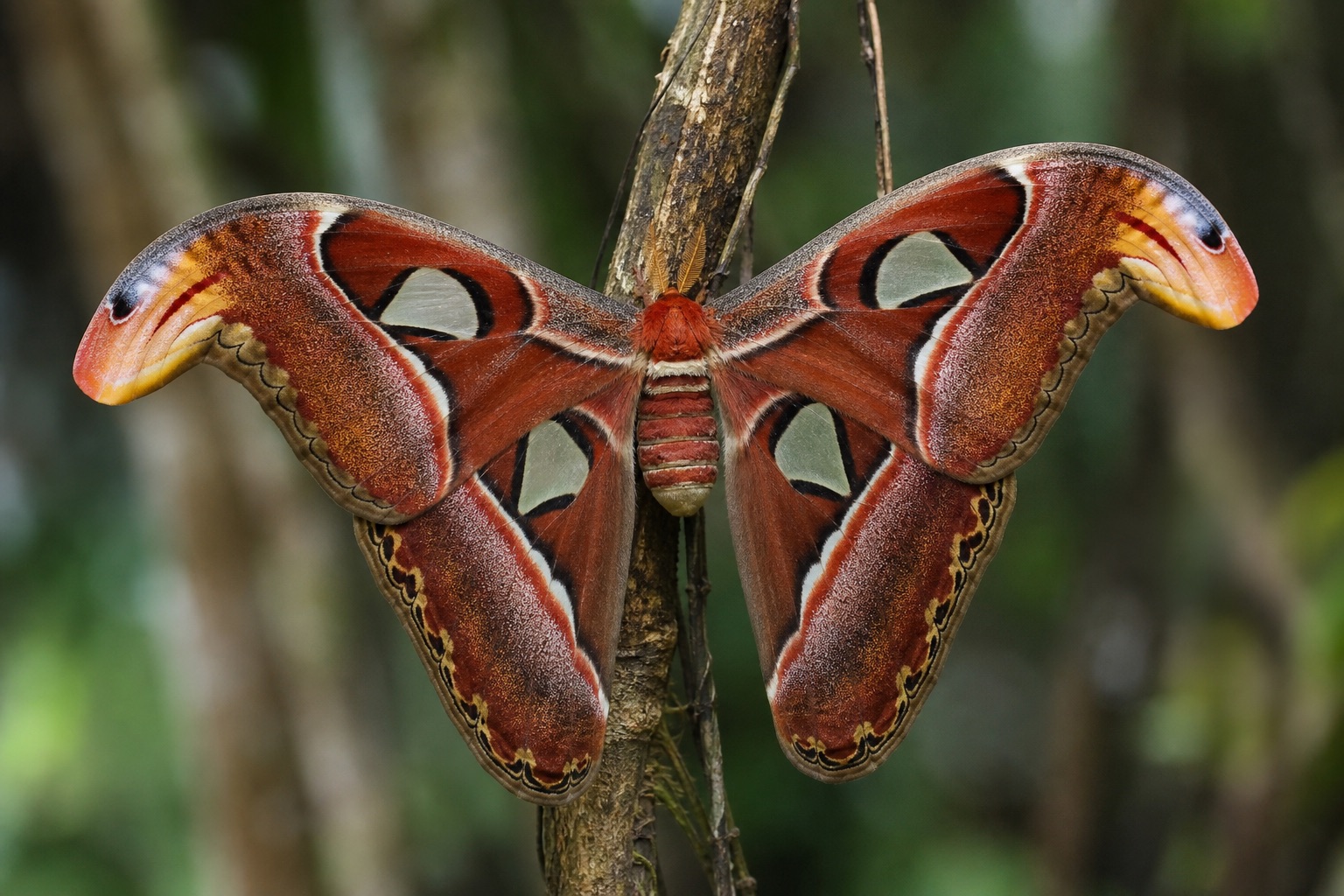
AI-generated educational wildlife portrait — World Animal Rescue Network · AI visualisation, not a photograph
In brief
The atlas moth (Attacus atlas) is one of the world's largest moths, with snake-head wingtips and no functional adult mouthparts — it lives one to two weeks on larval fat while Sundaland forest conversion removes host trees.
Also in Animals A to Z · Animals that start with A
By WARN Research & Conservation Team Last updated
The atlas moth is among the largest lepidopterans by wing area — wingspan up to twenty-four centimetres or more, marked with rusty browns, pinks and translucent panels. The tips of the forewings bear patterns that resemble snake heads, a defensive illusion when the moth shakes at rest. Adult atlas moths have no functional mouthparts. They do not eat. The entire adult life — typically one to two weeks — runs on fat stored from larval feeding. Reproduction, not foraging, is the adult agenda: females emit pheromones; males, with feathery antennae tuned to detect them over kilometres, fly to mate. Then they die. Caterpillars feed on a range of trees and shrubs — citrus, privet, willow and tropical hosts including those cleared for oil palm and pulpwood. WARN's comet moth guide at comet moth covers Madagascar's Argema mittrei — another giant saturniid with dramatic wingtips and a short adult stage, on an island facing its own forest losses. Atlas moths share the giant-moth template; Sundaland's conversion removes host trees across Borneo and Sumatra.
~24 cm
Wingspan — among the largest moths
No mouth
Adults do not feed — live on stored fat
1–2 wk
Typical adult lifespan
Snake-heads
Wingtip patterns mimicking snake heads
Figures sourced from Natural History Museum — atlas moth facts, Animal Diversity Web — Attacus atlas .
Atlas Moth: Quick Facts
| Wingspan | Up to ~24 cm or more |
|---|---|
| Adult feeding | None — no functional mouthparts |
| Adult lifespan | About 1–2 weeks |
| Defence | Snake-head wingtip mimicry |
| IUCN status | Not Evaluated |
| Main threats | Host-tree loss; oil palm, pulpwood, mining |
Scientific Classification
| Kingdom | Animalia |
|---|---|
| Phylum | Arthropoda |
| Class | Insecta |
| Order | Lepidoptera |
| Family | Saturniidae |
| Genus | Attacus |
| Species | Attacus atlas |
Conservation Status
- IUCN Status
- Not Evaluated
- Population
- Unknown
- Trend
- Unknown; likely decreasing where host forest is cleared
- Assessed
- Not assessed
- CITES
- Not listed
Conservation is tied to larval host trees in mixed forest, not adult moth abundance at lights.
Did you know?
An atlas moth adult has no mouth and lives about two weeks on fat stored as a caterpillar — among the largest animals that never eat after metamorphosis.
Key Facts: Atlas Moth
- Atlas moths are among the largest moths by wing area, with wingspans exceeding twenty centimetres.
- Adults lack functional mouthparts and do not eat — they survive one to two weeks on fat stored as caterpillars.
- Wingtips mimic snake heads, startling predators when the moth moves.
- Caterpillars feed on tree and shrub leaves; oil palm and pulpwood conversion removes host plants across Sundaland.
- Males locate females by pheromone using large feathery antennae — adult life is reproduction only.
- WARN's comet moth guide at /wildlife-guides/comet-moth covers Madagascar's Argema mittrei — a parallel giant saturniid with similar short-lived adult biology.
Adult life without eating
Saturniid moths including Attacus atlas emerge from pupae with vestigial mouthparts — no proboscis, no feeding. Energy for flight, mating and egg-laying comes entirely from larval stores. A large caterpillar eating voraciously for weeks buys a short adult window.
That strategy works when emergence synchronises with mates and suitable egg-laying sites. It fails when host trees are removed between generations. The moth is not pollinator-dependent as an adult; it is host-plant-dependent as a caterpillar.
Snake-head wingtips
The forewing tips bear scale patterns resembling cobra heads — dark patches with 'eye' spots. When a resting moth drops and flutters, the illusion startles birds long enough to escape. It is mimicry without close mimicry of any single species — good enough to buy a second.
Madagascar's comet moth, covered in WARN's guide at comet moth, uses a similar wingtip strategy on a different continent. Giant saturniids converge on short adult lives, bold wing patterns and caterpillar bulk — evolution's template for big moths.
Host trees and plantation landscapes
Atlas moth caterpillars accept several host genera — tropical trees and shrubs cleared when lowland forest becomes oil palm or pulpwood monoculture. Plantations are not moth habitat; edge trees may host individuals but not populations at scale.
Mining and infrastructure scatter remnant forest. Wildlife trade in Southeast Asia focuses on vertebrates; atlas moths appear in tourist displays and occasionally in cocoons for silk, but conversion is the structural threat. Not Evaluated on the Red List reflects survey gaps, not abundance in a converted landscape.
Giant moths in the invertebrate frame
Atlas moths belong among the largest insects people search by name — alongside birdwing butterflies and, in Madagascar, comet moths. WARN groups moths with butterflies and beetles on invertebrate type pages because public interest clusters on size and appearance, while conservation hinges on larval host plants.
Protecting atlas moths means protecting mixed forest with host trees — not charismatic-adult campaigns. The adult you photograph lives two weeks and never eats; the caterpillar that mattered ate leaves on trees now replaced by plantation rows on Borneo and Sumatra.
What WARN Does
WARN publishes free, sourced species education for invertebrates whose adult form is famous and whose larval needs are ignored. Atlas moths live two weeks without eating — their conservation is host-forest conservation amid oil palm and pulpwood expansion.
If this guide helps you understand wildlife and the pressures it faces, a gift to WARN supports habitat protection and free public education in our partner countries.
Atlas Moth: Frequently Asked Questions
Do atlas moths eat as adults?
How big is an atlas moth?
Why do atlas moth wings look like snakes?
Where do atlas moths live?
What do atlas moth caterpillars eat?
How is the atlas moth related to the comet moth?
Are atlas moths dangerous?
How long do atlas moths live?
Sources & References
Population figures, conservation status and biological facts on this page are drawn from authoritative scientific and intergovernmental sources.
Terms used on this page
Plain-English definitions, from our wildlife and conservation glossary.
Latest Atlas Moth Stories
Quick, fact-checked reads on the atlas moth — amazing facts, key questions and the threats it faces.
Species
Slow Loris: Why the Internet's Favourite Pet Is a Conservation Disaster
The slow loris looks like a cartoon character — and that has nearly destroyed the species. Here is the truth behind the viral videos.
Read the storyGuides
Sun Bear vs Moon Bear: The Two Most Trafficked Asian Bears
The sun bear and the Asiatic black bear (moon bear) are the two most commonly trafficked bears in Asia — for the pet trade, for traditional medicine and for bear-bile farming. Here is how to tell them apart.
Read the storySpecies
12 Amazing Facts About the Asian Elephant
From a 22-month pregnancy to a trunk with tens of thousands of muscles, here are 12 surprising, science-backed facts about Asia's largest land animal.
Read the storyExplore more animals
Discover more animals, their habitats and their conservation status in the WARN wildlife-guide library.
Enjoyed this Atlas Moth guide?
Receive appeal updates, animal-welfare news and published funding reports. Unsubscribe any time.
We only use your address for WARN updates. See our privacy policy.