Wildlife Guide · Madagascar & Eastern humid forest — very restricted range
Comet Moth
Argema mittrei (Guérin-Méneville, 1847) — family Saturniidae
Madagascar's largest silk moth — tails up to 15 cm, and it cannot eat as an adult.
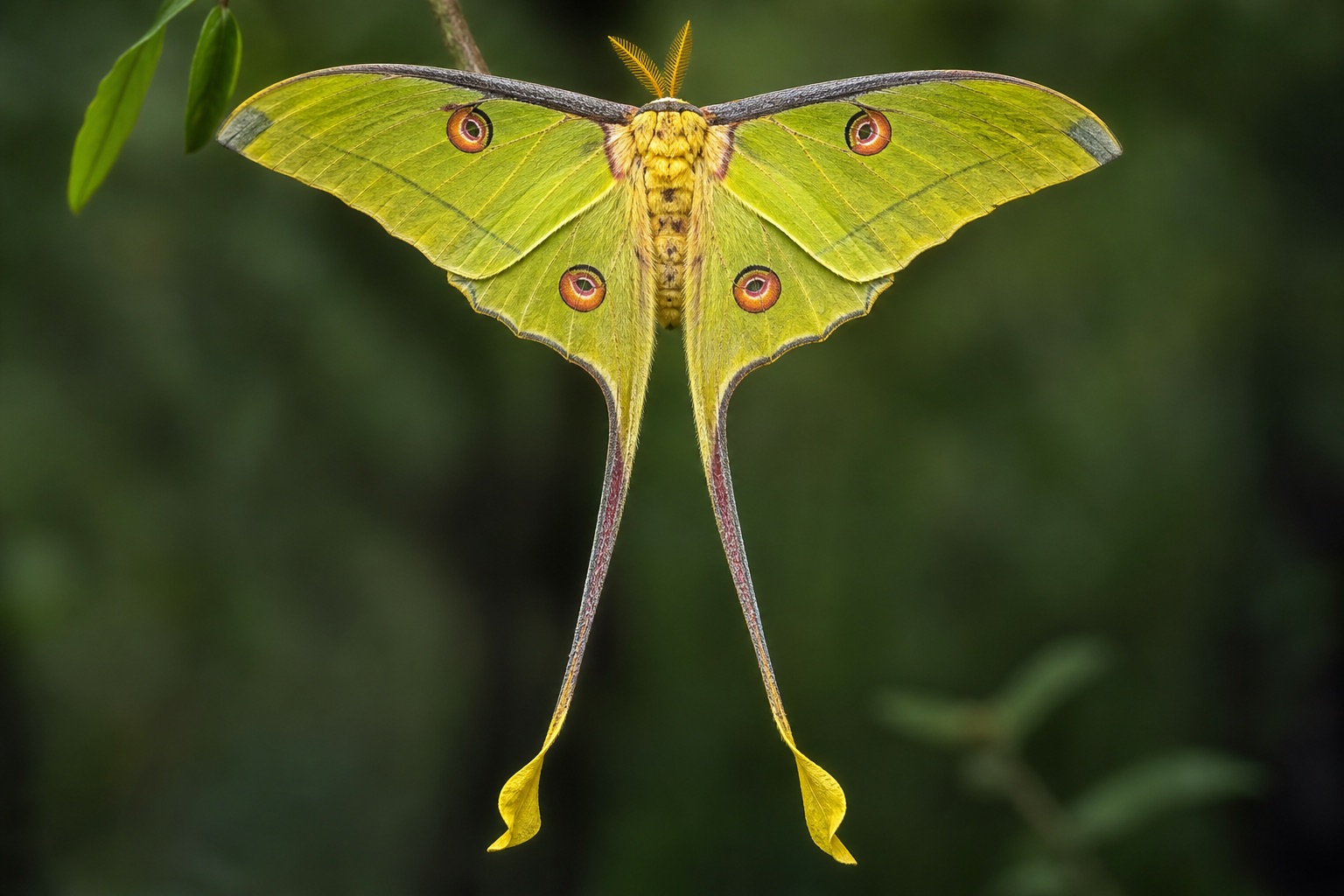
AI-generated educational wildlife portrait — World Animal Rescue Network · AI visualisation, not a photograph
In brief
The comet moth (Argema mittrei) is Madagascar's largest silk moth, with hindwing tails up to 15 cm; adults have no mouthparts, live four to five days without eating, and the species is Critically Endangered as an estimated 80–90% of Madagascar's original forest has been lost.
Also in Animals A to Z · Animals that start with C
How you can help
You can support the related appeal — read its purpose, recipient status and fund terms first — or give once to where it is needed most. Sharing accurate information helps too.
By WARN Research & Conservation Team Last updated
The comet moth — Argema mittrei — is among the largest silk moths in the world and the largest in Madagascar. Females reach a wingspan of around 20 centimetres, with males slightly smaller but carrying the feature that gives the species its name: long trailing tails on the hindwings that can extend to around 15 centimetres. Like other saturniids, adult comet moths have no functional mouthparts and cannot feed. They live only four to five days — long enough to mate and lay eggs. The entire feeding life happens as a caterpillar on the leaves of Eugenia and Weinmannia trees. Madagascar holds roughly 90% vertebrate endemism, and the comet moth is part of an invertebrate fauna equally irreplaceable. It is listed Critically Endangered, with an estimated 80–90% of the island's original forest already lost to tavy, charcoal production and logging — pressures rooted in rural poverty. WARN's atlas moth guide at atlas moth covers the Asian giant that rivals the comet moth for wingspan.
~20 cm
Female wingspan — among the largest silk moths
~15 cm
Length of the hindwing tails in males
4–5 days
Adult lifespan — no feeding, mouthparts absent
Critically Endangered
IUCN status
Figures sourced from IUCN Red List — Argema mittrei, CITES Appendices .
Comet Moth: Quick Facts
| Wingspan | Up to about 20 cm in females |
|---|---|
| Tail length | Up to about 15 cm in males |
| Adult lifespan | Four to five days — no feeding |
| Larval food | Eugenia and Weinmannia trees |
| IUCN status | Critically Endangered |
| Main threats | Forest loss; insect collection |
Scientific Classification
| Kingdom | Animalia |
|---|---|
| Phylum | Arthropoda |
| Class | Insecta |
| Order | Lepidoptera |
| Family | Saturniidae |
| Genus | Argema |
| Species | Argema mittrei |
Conservation Status
- IUCN Status
- Critically Endangered
- Population
- Unknown; restricted range
- Trend
- Decreasing
- Assessed
- 2014
- CITES
- Appendix II
An estimated 80–90% of Madagascar's original forest has been lost. Tavy and charcoal production are driven by rural poverty.
Did you know?
An adult comet moth has no mouth and lives four to five days — its entire adult life spent finding a mate on fat stored months earlier as a caterpillar in a forest that is disappearing.
Key Facts: Comet Moth
- The comet moth is among the largest silk moths in the world, endemic to Madagascar.
- Males carry hindwing tails up to around 15 cm long — the 'comet' that gives the species its name.
- Adults have no functional mouthparts and cannot eat; they live four to five days, mating and laying eggs only.
- Caterpillars feed on Eugenia and Weinmannia trees in eastern humid forest.
- Listed Critically Endangered; an estimated 80–90% of Madagascar's original forest has been lost.
- The atlas moth of Asia rivals it for size — see WARN's guide at /wildlife-guides/atlas-moth for comparison.
A moth that cannot eat
Saturniid moths — the giant silk moths — emerge from the pupa with vestigial mouthparts and no digestive system capable of processing food. The comet moth's entire adult existence lasts four to five days, powered by fat reserves stored during the caterpillar stage.
Those days are spent finding a mate, reproducing and laying eggs on host plants. There is no feeding, no refuelling, no second chance. A comet moth that fails to mate in its brief adult window has no fallback. This life history makes the species entirely dependent on caterpillar host trees — lose the forest and you lose both the food plant and the humidity the pupae need to survive.
The comet tails
Male comet moths carry extraordinarily long hindwing tails — streamers that can reach around 15 centimetres and flutter behind the moth in flight. The function is debated: they may deflect bat echolocation, distract predators, or play a role in mate attraction through flight display.
Whatever their function, the tails make the comet moth unmistakable — and among the most sought-after specimens in insect collections. Collection pressure adds to habitat loss on a species already Critically Endangered. For size comparison with the other giant of the silk moth world, WARN's atlas moth guide at atlas moth covers Attacus atlas of South and Southeast Asia.
Critically Endangered on a deforested island
Argema mittrei is listed Critically Endangered with a restricted range in eastern humid forest. An estimated 80–90% of Madagascar's original forest cover has been lost island-wide, and the comet moth's host trees disappear with it.
Tavy slash-and-burn clears understorey and removes saplings. Charcoal production fells mature trees. Logging opens canopy and dries the microclimate pupae need. All three are widespread, driven by rural poverty and the absence of affordable cooking fuel and agricultural alternatives — not by subsistence farmers acting without cause. A Critically Endangered moth on an island that has already lost most of its forest is facing an immediate rather than theoretical risk.
Madagascar's giant moths
The comet moth and the atlas moth — the subject of WARN's guide at atlas moth — are the two largest silk moths most people encounter in photographs. Both adults lack mouthparts. Both live a few days. Both depend entirely on caterpillar-stage feeding in forest habitat.
The difference is geography: the atlas moth is Asian; the comet moth is Malagasy, part of the island's roughly 90% vertebrate endemism extended into an invertebrate fauna found nowhere else. Losing the comet moth means losing a life history that evolved in isolation — a four-day adult that never eats, on trees that tavy and charcoal production remove daily.
What WARN Does
WARN publishes free, sourced species education for Madagascar's invertebrates and their Asian counterparts. The comet moth lives four to five days without eating — and those days are numbered if eastern humid forest continues to fall to tavy and charcoal on an island where an estimated 80–90% of original cover is already gone.
If this guide helps you understand wildlife and the pressures it faces, a gift to WARN supports habitat protection and free public education in our partner countries.
How can I help save the comet moth?
Explore practical ways to support the comet moth, from everyday choices and sharing reliable information to reviewing a related appeal before giving.
Explore ways to support
Read the related appeal’s purpose, recipient status and fund terms. Choose an affordable gift after checking what is proposed and what has been reported.
Ease the pressures
Avoid the wildlife trade and souvenirs, never buy wild animals as pets, and choose sustainable, habitat-friendly products — the threats behind the comet moth's decline fall when demand does.
Spread the word
Share accurate, sourced information about the comet moth. Wider awareness is what turns concern into lasting protection.
Comet Moth: Frequently Asked Questions
How can I help save the comet moth?
Can comet moths eat?
How long are comet moth tails?
Are comet moths endangered?
How does the comet moth compare to the atlas moth?
What do comet moth caterpillars eat?
Where do comet moths live?
Are comet moths dangerous?
How long do comet moths live?
How big is a comet moth?
Sources & References
Population figures, conservation status and biological facts on this page are drawn from authoritative scientific and intergovernmental sources.
Terms used on this page
Plain-English definitions, from our wildlife and conservation glossary.
Latest Comet Moth Stories
Quick, fact-checked reads on the comet moth — amazing facts, key questions and the threats it faces.
Explore more animals
Discover more animals, their habitats and their conservation status in the WARN wildlife-guide library.
Enjoyed this Comet Moth guide?
Receive appeal updates, animal-welfare news and published funding reports. Unsubscribe any time.
We only use your address for WARN updates. See our privacy policy.