Wildlife Guide · The Americas & Europe
Tree Frog
Family Hylidae (Rafinesque, 1815) and related arboreal families — over 800 species
Frogs that climb glass, and a pair of red eyes that exist to buy half a second.
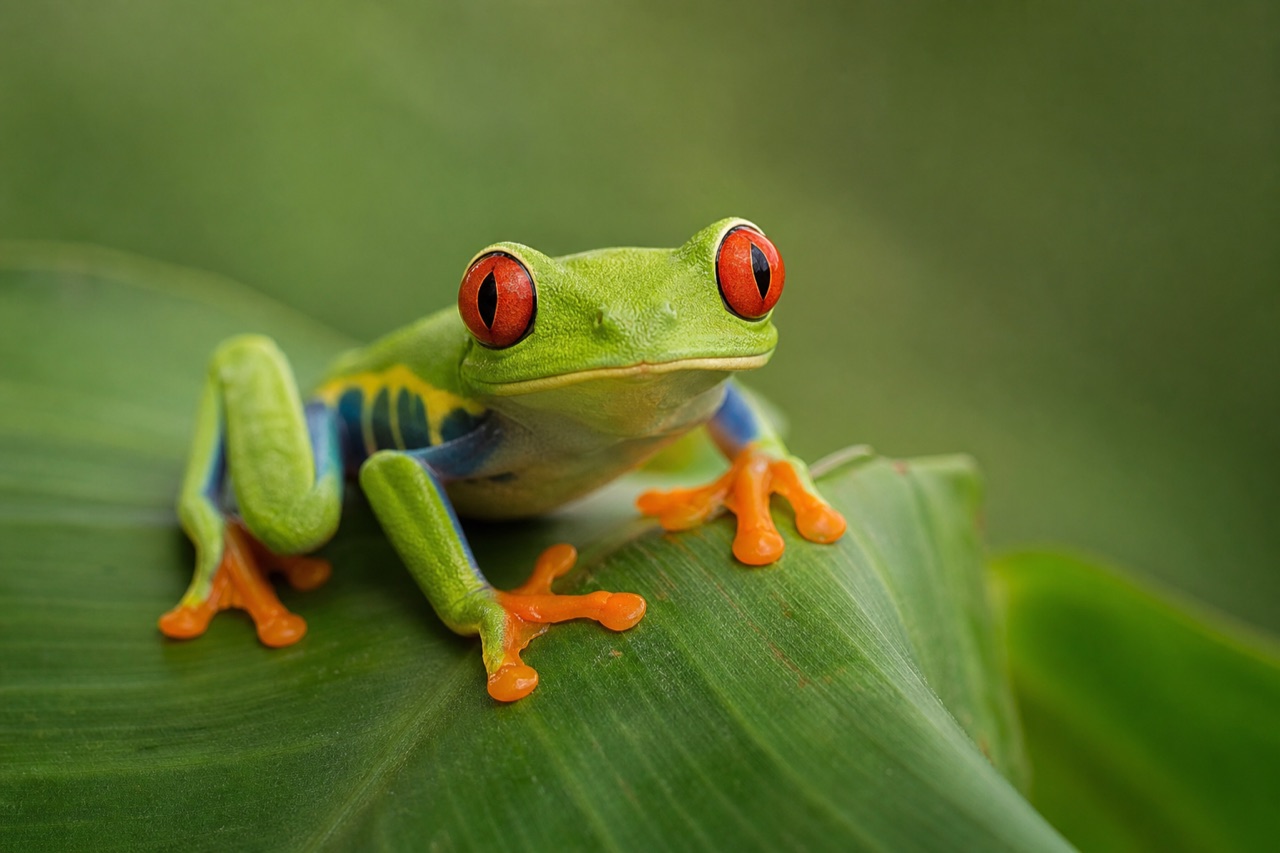
AI-generated educational wildlife portrait — World Animal Rescue Network · AI visualisation, not a photograph
In brief
Tree frogs are over 800 species of arboreal frogs, mainly in the family Hylidae, that climb using adhesive toe pads which work by wet adhesion — a thin layer of mucus creating surface tension against the surface rather than suction.
Also in Animals A to Z · Animals that start with T
By WARN Research & Conservation Team Last updated
Tree frogs are not a single group but a life strategy that has evolved repeatedly. The largest family, Hylidae, holds over 700 species, and other families across Africa, Asia and Australia have arrived at the same solution independently. What they share is a set of adaptations for living off the ground: expanded adhesive toe pads, long limbs, light bodies and, in many species, the ability to change colour. The most photographed of them, the red-eyed tree frog of Central America, is a good illustration of how tree frog defences work. It is green and almost invisible at rest. Disturbed, it flashes red eyes and blue-and-orange flanks — not to frighten a predator away, but to startle it for the fraction of a second the frog needs to jump.
800+
Species across Hylidae and other arboreal families
Wet adhesion
How toe pads grip — surface tension, not suction
Deimatic
The red-eyed tree frog's startle display, buying time to escape
~41%
Of assessed amphibian species are threatened with extinction
Figures sourced from IUCN Red List — Agalychnis callidryas, AmphibiaWeb — Hylidae .
Tree Frog: Quick Facts
| Length | 2–14 cm depending on species |
|---|---|
| Adhesion mechanism | Wet adhesion — surface tension, not suction |
| Best-known species | Red-eyed tree frog (Agalychnis callidryas) |
| Defence | Camouflage at rest, deimatic startle display when disturbed |
| Egg laying | Often on leaves overhanging water, so tadpoles drop in |
| Main threats | Habitat loss, chytrid fungus, climate change |
Scientific Classification
| Kingdom | Animalia |
|---|---|
| Phylum | Chordata |
| Class | Amphibia |
| Order | Anura |
| Family | Hylidae, plus other arboreal families |
| Genus | Hyla, Agalychnis, Litoria and many others |
| Species | Over 800 described species |
Conservation Status
- IUCN Status
- Varies by species — Least Concern to Critically Endangered
- Population
- Varies widely; many species have not been surveyed
- Trend
- Decreasing for most assessed species
- Assessed
- Varies
- CITES
- Some species listed on Appendix II
Chytrid fungus has affected over 500 amphibian species worldwide. Tree frogs' dependence on both forest and clean standing water means they are exposed to two habitat threats at once.
Did you know?
Red-eyed tree frog embryos can decide to hatch early. If they feel the specific vibration of a snake eating the clutch, they break out within seconds — days ahead of schedule — and drop into the water below.
Key Facts: Tree Frog
- Tree frogs are not one taxonomic group. Arboreal life has evolved independently in several frog families across the Americas, Europe, Asia and Australia.
- Their toe pads work by wet adhesion, not suction. A thin layer of mucus creates surface tension between pad and surface, which is why a tree frog can climb wet glass but struggles on dry dust.
- The red-eyed tree frog's colours are a deimatic display — a startle response. At rest it is plain green; disturbed, it flashes red eyes and blue flanks to buy a moment to jump.
- Many species change colour, shifting between green and brown according to temperature, light and stress.
- Tree frog eggs are often laid on leaves overhanging water, so hatching tadpoles drop straight in. Some species' embryos can hatch early if they detect a predator attacking the clutch.
- Amphibians are the most threatened vertebrate class on Earth, with around 41% of assessed species at risk from habitat loss, chytrid fungus and climate change.
How tree frogs stick to glass
The mechanism is not suction, which is the common assumption. A tree frog's toe pad is covered in hexagonal epithelial cells separated by channels, and mucus glands keep a very thin fluid layer across the surface. Adhesion comes from surface tension in that layer — the same force that makes two wet glass slides hard to pull apart — combined with friction from close contact between the pad and the surface.
The channels between cells matter: they drain excess fluid so the layer stays thin enough to grip rather than becoming a lubricant. This is why tree frogs perform well on wet surfaces, where a suction cup would fail, and poorly on dry dusty ones. The design has been studied extensively by materials engineers working on reusable adhesives, and synthetic pads modelled on frog toes now exist in the laboratory.
Why the red-eyed tree frog has red eyes
Agalychnis callidryas spends the day asleep on the underside of a leaf, legs tucked in, eyes closed, showing only uniform green. In that posture it is extremely difficult to see. The colours are entirely hidden.
When a predator disturbs it, the frog opens its eyes and leaps, exposing large red irises, blue-and-cream barred flanks and orange feet all at once. This is a deimatic display — a sudden change designed to startle rather than to intimidate. A snake or bird that hesitates for a fraction of a second loses the frog, and a fraction of a second is all the display needs to buy. It works because it is a surprise, which is also why the frog stays plain green the rest of the time.
Eggs that hatch early to escape
Red-eyed tree frogs and several relatives lay eggs in gelatinous clutches on leaves overhanging ponds. Tadpoles normally hatch after about six or seven days and drop into the water below.
If a snake begins eating the clutch, the remaining embryos can hatch immediately — as early as four days — and drop out of reach. The embryos detect the specific pattern of vibration produced by an attacking predator and distinguish it from wind or rain, and hatching is triggered within seconds. It is one of the clearest documented cases of an embryo making an escape decision before birth, and it comes at a cost: early-hatched tadpoles are smaller and more vulnerable to aquatic predators. The embryo is trading one risk for another.
What WARN Does
WARN publishes free, sourced species education. Amphibians are the most threatened vertebrate class on Earth and among the least funded, so free accurate material on how they live and what is happening to them is a genuine gap worth filling.
If this guide helps you understand wildlife and the pressures it faces, a gift to WARN supports habitat protection and free public education in our partner countries.
Tree Frog: Frequently Asked Questions
How do tree frogs stick to surfaces?
Why does the red-eyed tree frog have red eyes?
Are tree frogs poisonous?
How many species of tree frog are there?
What do tree frogs eat?
Where do tree frogs live?
Are tree frogs dangerous?
How long do tree frogs live?
How big is a tree frog?
Sources & References
Population figures, conservation status and biological facts on this page are drawn from authoritative scientific and intergovernmental sources.
Terms used on this page
Plain-English definitions, from our wildlife and conservation glossary.
Latest Tree Frog Stories
Quick, fact-checked reads on the tree frog — amazing facts, key questions and the threats it faces.
Species
Slow Loris: Why the Internet's Favourite Pet Is a Conservation Disaster
The slow loris looks like a cartoon character — and that has nearly destroyed the species. Here is the truth behind the viral videos.
Read the storySpecies
The Snow Leopard: Why the Ghost of the Mountains Is Still Vulnerable
The snow leopard is one of the most elusive big cats on earth, with an estimated 4,000-6,500 individuals across twelve range states — including Pakistan, where WARN is preparing to operate. This briefing explains why the species was downlisted from Endangered to Vulnerable in 2017 and why that is not the success story it sounds like.
Read the storyGuides
Sun Bear vs Moon Bear: The Two Most Trafficked Asian Bears
The sun bear and the Asiatic black bear (moon bear) are the two most commonly trafficked bears in Asia — for the pet trade, for traditional medicine and for bear-bile farming. Here is how to tell them apart.
Read the storyExplore more animals
Discover more animals, their habitats and their conservation status in the WARN wildlife-guide library.
Enjoyed this Tree Frog guide?
Receive appeal updates, animal-welfare news and published funding reports. Unsubscribe any time.
We only use your address for WARN updates. See our privacy policy.