Wildlife Guide · Breeds across Europe, Asia and North America & Winters in sub-Saharan Africa, South Asia and South America
Swallow
Hirundo rustica (Linnaeus, 1758) — family Hirundinidae
The bird that means summer — and the mud cup under your eaves that proves it.
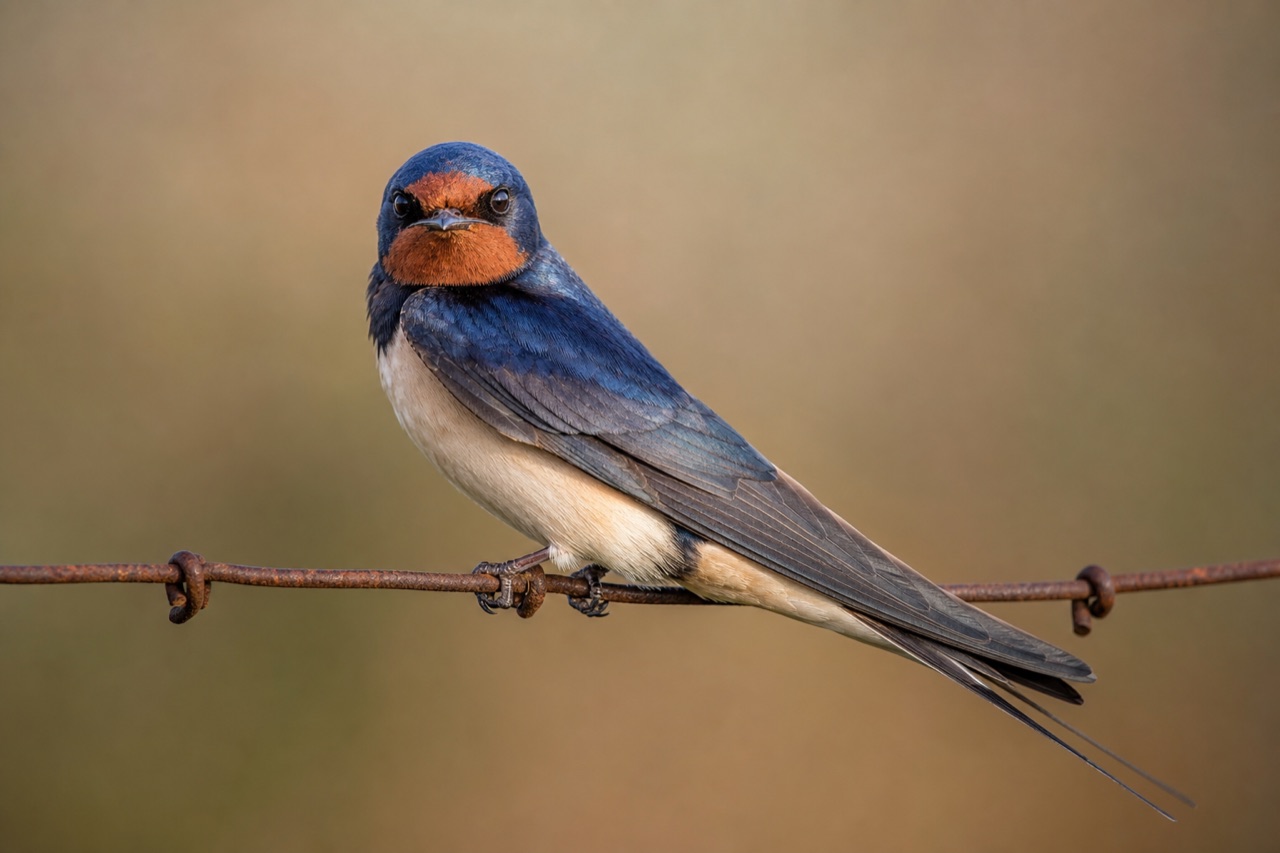
AI-generated educational wildlife portrait — World Animal Rescue Network · AI visualisation, not a photograph
In brief
The barn swallow (Hirundo rustica) is a long-distance migrant that breeds across the Northern Hemisphere and winters in Africa, South Asia or South America; in Britain it nests in mud cups under eaves and barns and feeds entirely on flying insects caught in agile aerial pursuit.
Also in Animals A to Z · Animals that start with S
By WARN Research & Conservation Team Last updated
The barn swallow is the swallow most people in Britain mean when they say 'swallow'. Glossy blue above, brick-red below, with a deeply forked tail that makes it unmistakable in flight, it arrives from Africa in April and spends the summer hawking insects over fields, ponds and village streets. Its nest is a cup of mud pellets lined with feathers, built under eaves, in barns, sheds and sometimes inside open garages. That dependence on human structures is ancient — swallows followed livestock and settlement long before modern farming — and it is why a swallow choosing your outbuilding feels personal. When the last bird leaves in autumn, the silence marks the turn of the season as clearly as any calendar. Swallows are among the most aerial of all birds. They drink, bathe and feed entirely on the wing, and their migration between Britain and sub-Saharan Africa is one of the longest of any songbird — a round trip that can exceed 10,000 km. Long-term monitoring shows declining numbers across much of Europe, linked to falling insect abundance and the loss of nest sites as traditional farm buildings are converted or sealed.
~11,000 km
Round-trip migration for some European birds to southern Africa
Mud cup
Nest built from pellets of wet mud under shelter
2 broods
Typical in a British summer when insects are plentiful
Forked tail
Deeply forked outer feathers aid tight aerial manoeuvring
Figures sourced from IUCN Red List — Hirundo rustica, BTO — BirdFacts: Swallow, RSPB — Swallow .
Swallow: Quick Facts
| Length | 17–19 cm including tail streamers |
|---|---|
| Wingspan | 32–35 cm |
| Nest | Mud cup under eaves or in barns and sheds |
| Diet | Flying insects caught on the wing |
| Migration | Britain to sub-Saharan Africa and back |
| Broods | Usually two per summer in Britain |
| Main threats | Insect loss, nest-site loss, migration hazards, cat predation |
Scientific Classification
| Kingdom | Animalia |
|---|---|
| Phylum | Chordata |
| Class | Aves |
| Order | Passeriformes |
| Family | Hirundinidae |
| Genus | Hirundo |
| Species | Hirundo rustica |
Conservation Status
- IUCN Status
- Least Concern
- Population
- Hundreds of millions globally; declining in parts of Europe including Britain
- Trend
- Decreasing in Europe; stable or increasing in some regions
- Assessed
- 2019
- CITES
- Not listed
The global Least Concern listing reflects a very wide range. Long-term declines in Britain and much of Europe are linked to farmland change and falling invertebrate abundance.
Did you know?
Barn swallows often return to the same nest site year after year — a pair that raised chicks under your eaves last summer is quite likely to come back to the same beam.
Key Facts: Swallow
- Barn swallows are long-distance migrants — British birds winter in sub-Saharan Africa and return in April.
- They build mud-cup nests under eaves, in barns and sheds, and often reuse the same site for years.
- Both parents feed chicks on flying insects caught in continuous aerial hawking.
- Declines in Britain track loss of livestock farming, wet meadows and the flying insects swallows depend on.
- Leave barn doors and outbuildings accessible through summer; disturbing an active nest is illegal.
- Domestic cats kill grounded swallows — fledglings learning to fly are especially vulnerable near gardens.
- Large clean windows and glass doors can kill swallows at speed when reflections show open sky.
A bird built for catching insects on the wing
Swallows feed almost exclusively in flight. They sweep low over water, pasture and village streets, taking flies, midges, aphids and other small insects with a wide gape and precise manoeuvring. The deeply forked tail and long wings give the tight turns and sudden accelerations that hawking demands — a swallow can change direction in a fraction of a second, following prey that no ground-based predator could catch.
Chicks are fed the same diet — no seeds, no kitchen scraps. A pair may raise two broods in a good British summer, each clutch of four or five eggs demanding thousands of insect trips. When invertebrate numbers fall — through pesticide use, drainage of wet meadows or simplification of pasture — swallow breeding success drops directly. The bird at the apex of the aerial insect food chain is an early indicator that flying insects are disappearing from a landscape.
Swallows also drink and bathe on the wing, skimming pond surfaces and splashing through shallow water without landing. This complete aerial lifestyle means they are almost never seen on the ground except when collecting mud for nest-building or when fledglings are learning to fly. A swallow on the ground is a swallow that needs help or is gathering nest material.
Mud nests and the buildings they need
A swallow nest begins as a mud pellet carried in the bill and pressed against a beam or rafter under shelter. Layer by layer the cup forms; feathers line the inside. The site must stay dry and accessible — old barns, open stables, porches and the undersides of bridges are classic choices. Both sexes build, though the female does most of the lining.
In modern Britain, sealed agricultural buildings and converted barns remove nest sites faster than swallows find alternatives. Leaving a door ajar through the breeding season, or fixing a shallow shelf under a protected eave, can mean the difference between a pair nesting and passing over. Active nests are protected by law in the UK; wait until birds have left in autumn before closing access or renovating.
Swallows often return to the same nest or building year after year. A pair that nested in your shed last summer is quite likely to try again — which is why small, low-cost access decisions on outbuildings matter disproportionately. Providing a muddy puddle or damp patch near a potential nest site helps pairs that would otherwise travel further to find building material.
Migration and what happens in your garden
British swallows winter mainly in sub-Saharan Africa, crossing the Sahara in both directions. The journey is hazardous — drought, habitat loss on the wintering grounds and hunting in some Mediterranean countries all take a toll — but the timing of return is remarkably consistent, with first birds appearing in southern England from mid-April.
In gardens, swallows are more visitor than resident. They drink from ponds, skim over lawns taking insects and sometimes perch on wires or fences. They do not visit seed feeders. Fledglings leaving the nest for the first time fly weakly and rest on the ground or low walls — the moment when domestic cats cause serious losses. Keeping cats indoors at dawn and dusk during the breeding season, and delaying lawn mowing near active nests, are practical steps anyone with swallows nearby can take.
Autumn departure is protracted — birds gather on wires and rooftops in September before moving south in stages. The last birds leave Britain in October. Their absence through winter is total; no swallow overwinters in Britain. The first returning bird in April is a genuine seasonal marker, and its timing varies by only a few days in most years.
Windows, cats and the wider decline
Swallows occasionally strike large windows and glass doors, especially when a reflection shows sky or open passage through a courtyard. Decals, external screens or partial shading break up the illusion and reduce collisions. Swallows fly fast and low, which makes glass particularly dangerous when it reflects open sky or vegetation behind the viewer. Conservatory extensions and bi-fold doors have added new collision surfaces to suburban gardens that swallows traverse daily between nest sites and feeding grounds.
Cat predation hits swallows at two points: adults and fledglings caught on the ground or low perches, and chicks taken from accessible nests in open outbuildings. A single cat can devastate a local colony over several seasons. Bells on collars reduce but do not eliminate kills. Swallows nesting in open-sided barns offer no defence against a cat that learns the beam location.
Population monitoring shows long-term declines in Britain and much of Europe, linked to agricultural intensification, loss of livestock rearing and falling invertebrate abundance. Wetland drainage removes the midges and aquatic insects that swallows hawking over pasture depend on, while the switch from hay to silage cuts flowering margins that support flying invertebrates through summer. The species remains Least Concern globally because of its enormous range, but the swallow's retreat from everyday rural life is one of the clearest signals that insect-rich farmland is thinning out — and that the buildings and pasture it depended on are changing faster than the bird can adapt.
What WARN Does
WARN publishes free, sourced species education for the birds people live beside, not only distant flagship species. The barn swallow is a summer neighbour whose survival depends on mud, flying insects and a barn door left open — everyday conditions that free public education can help people protect.
If this guide helps you understand wildlife and the pressures it faces, a gift to WARN supports habitat protection and free public education in our partner countries.
Swallow: Frequently Asked Questions
When do swallows arrive in the UK?
What do swallows eat?
Can I feed swallows?
Is it illegal to remove a swallow nest?
Why are swallows declining in Britain?
Where do barn swallows live?
Are barn swallows dangerous?
How long do barn swallows live?
How big is a barn swallow?
Sources & References
Population figures, conservation status and biological facts on this page are drawn from authoritative scientific and intergovernmental sources.
Terms used on this page
Plain-English definitions, from our wildlife and conservation glossary.
Explore more animals
Discover more animals, their habitats and their conservation status in the WARN wildlife-guide library.
Enjoyed this Swallow guide?
Receive appeal updates, animal-welfare news and published funding reports. Unsubscribe any time.
We only use your address for WARN updates. See our privacy policy.