Wildlife Guide · Eurasia and North America & Tundra, moorland, farmland and woodland edge
Stoat
Mustela erminea (Linnaeus, 1758) — family Mustelidae
A weasel that turns white in winter, kills prey ten times its weight, and once trimmed royal robes.
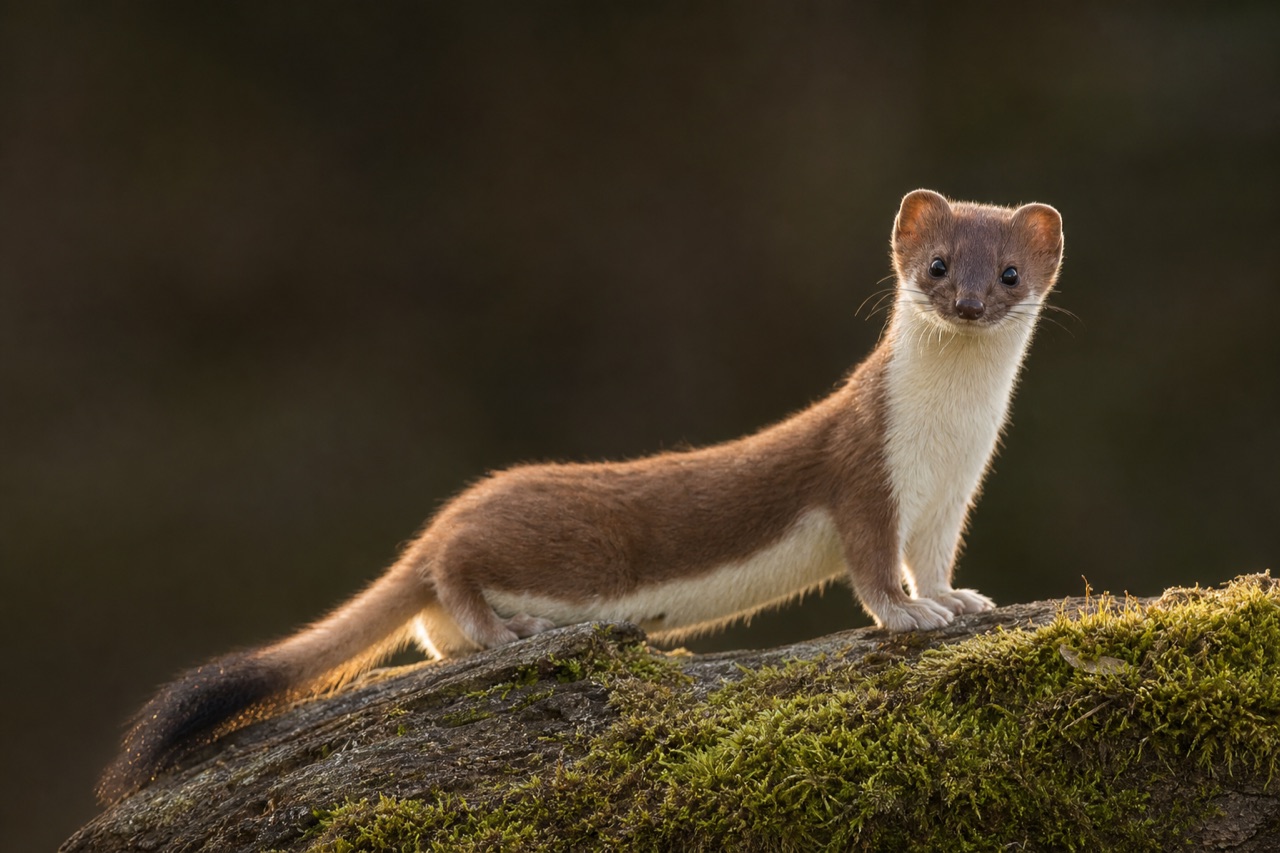
AI-generated educational wildlife portrait — World Animal Rescue Network · AI visualisation, not a photograph
In brief
The stoat (Mustela erminea) is a small mustelid of Eurasia and North America that turns white in winter except for a black-tipped tail, hunts prey far larger than itself including rabbits, and was introduced to New Zealand where it is now a major invasive predator.
Also in Animals A to Z · Animals that start with S
By WARN Research & Conservation Team Last updated
The stoat is a small carnivore of the weasel family found across Eurasia and North America — roughly the length of a ruler, with a black-tipped tail that distinguishes it from the closely related least weasel. In summer its coat is brown with a cream belly; in winter, across much of its range, it turns white except for that tail tip. The white pelt, known as ermine, was used to trim royal and ceremonial robes for centuries. Stoats are formidable hunters for their size. They kill rabbits many times their own weight, using a bite to the back of the skull, and cache surplus kills for later. They are largely solitary, territorial, and active day and night. In New Zealand, where they were introduced for rabbit control, they have become one of the most damaging invasive predators of native birds. The stoat's conservation story is split by geography. In its native range across Eurasia and North America, it is Least Concern — widespread, adaptable and abundant. In New Zealand, it is an ecological catastrophe, preying on flightless birds, seabird colonies and reptiles that evolved without mammalian predators. The same animal, two completely different ecological roles.
10×
Can kill prey many times its own body weight
White in winter
Coat turns ermine-white across most of the range
Black tip
Tail tip stays dark — distinguishes stoat from least weasel
Invasive
Introduced to New Zealand; major predator of native birds
Figures sourced from IUCN Red List — Mustela erminea, New Zealand Department of Conservation — Stoats .
Stoat: Quick Facts
| Length | 17–33 cm body; tail 6–12 cm |
|---|---|
| Weight | 200–400 g |
| Winter coat | White (ermine) except black tail tip |
| Range | Eurasia and North America; invasive in New Zealand |
| Hunting | Kills prey up to ten times its weight |
| Activity | Diurnal and nocturnal; largely solitary |
| Main note | Least Concern natively; major invasive predator in New Zealand |
Scientific Classification
| Kingdom | Animalia |
|---|---|
| Phylum | Chordata |
| Class | Mammalia |
| Order | Carnivora |
| Family | Mustelidae |
| Genus | Mustela |
| Species | Mustela erminea |
Conservation Status
- IUCN Status
- Least Concern
- Population
- Unknown; widespread and abundant in native range
- Trend
- Stable in native range; destructive where introduced
- Assessed
- 2016
- CITES
- Not listed
Least Concern in Eurasia and North America. In New Zealand, introduced stoats are among the most damaging invasive predators of native birds and are the focus of extensive control programmes.
Did you know?
Medieval English royal robes were trimmed with ermine — the stoat's white winter fur — and the scattered black spots from tail tips became a symbol of nobility in heraldry.
Key Facts: Stoat
- Stoats are small mustelids found across Eurasia and North America, turning white in winter except for a black-tipped tail.
- The white winter pelt is called ermine and was historically used to trim royal and ceremonial robes.
- They kill prey far larger than themselves, including rabbits, using a precise bite to the back of the skull.
- They are largely solitary and territorial, active by day and night across varied habitats.
- In New Zealand, introduced stoats are among the most damaging invasive predators of native birds.
- Least Concern globally, but an serious ecological threat where introduced outside their native range.
Ermine — the coat that trimmed crowns
The stoat's winter transformation is one of the most familiar colour changes in temperate mammals. Triggered by shortening day length rather than temperature directly, the brown summer coat is replaced by white fur across most of the range — though southern populations and those in Ireland may remain brown year-round, and individuals at low elevation in mild climates may moult partially or not at all.
The black tail tip persists in all morphs. It may function as a decoy: a predator striking at the conspicuous tail tip may miss the stoat's body, allowing escape. The white pelt, called ermine, became a symbol of purity and authority in medieval European heraldry. English royal robes were traditionally trimmed with ermine, and the white fur with its scattered black tail-tip spots became a visual shorthand for nobility across European courts.
Ermine fur remains commercially traded, though most now comes from farmed or wild stoats and weasels in regions where the species is abundant. The cultural association between ermine and authority persists in heraldry, academic dress and judicial robes across much of Europe. The stoat's winter coat is one of the few examples where an animal's seasonal biology became embedded in human ceremonial tradition.
Killing above its weight
A stoat weighing 200–400 g routinely kills European rabbits weighing 2–3 kg — ten times its mass or more. The technique is a fast rush, a leap onto the back, and a bite through the skull. Stoats do not throttle prey; they kill with precision and speed, and the entire encounter may last only seconds.
Surplus kills are cached in burrows or under cover for later consumption — a behaviour that reflects the unpredictability of hunting success. Stoats also take rodents, birds, eggs, frogs and insects, and will climb trees to reach nests. Their slender body allows entry into burrows and crevices too small for most predators, giving them access to prey that larger carnivores cannot reach.
Stoats are largely solitary and territorial, maintaining home ranges that overlap minimally between same-sex individuals. Males range more widely than females, particularly during the breeding season when they search for mates. A female stoat mates in summer but delays implantation — the fertilised egg does not develop until the following spring, ensuring that kits are born when prey is abundant. This delayed implantation is unusual among carnivores and allows stoats to time reproduction precisely to prey cycles.
The New Zealand catastrophe
Stoats were introduced to New Zealand in the late nineteenth century, along with weasels and ferrets, in an attempt to control introduced rabbits. The rabbit control failed — rabbits remain abundant — and the stoats thrived in an ecosystem with no native mammalian predators and abundant naive prey.
New Zealand's native birds evolved without mammalian predators. Many are ground-nesting or cavity-nesting, flightless or poor fliers, and utterly vulnerable to a fast, burrow-capable carnivore. Stoats now prey on kiwi, kākā, yellowhead, kererū and dozens of other native species across forest, tussock and alpine habitat. They are widely regarded as the most damaging invasive predator in New Zealand and are the target of extensive trapping programmes across conservation land.
The scale of the problem is enormous. Stoats occur across both main islands and many offshore islands, and eradication from the mainland is considered impractical. Conservation effort focuses on predator-free fenced sanctuaries, offshore islands cleared of stoats, and landscape-scale trapping in areas where critical species persist. The stoat in New Zealand is a permanent, managed threat — not a problem that will resolve on its own, and one that costs millions annually to contain.
Least Concern — but not harmless
In its native range across Eurasia and North America, the stoat is Least Concern: widespread, adaptable and abundant in suitable habitat. It occupies tundra, moorland, farmland, woodland edge and mountain scrub, feeding on whatever small prey is available. Population cycles track those of voles and rabbits — stoats boom when prey booms and crash when prey crashes. A good vole year can produce a stoat population surge the following spring.
The conservation story is therefore split by geography. In Europe and North America, stoats are a normal component of ecosystems — a predator of rodents and rabbits that also takes eggs and birds, but within a system that evolved alongside them. In Britain, stoats are widespread in moorland, hedgerow and woodland edge, and their winter ermine coat remains one of the most familiar seasonal colour changes in temperate mammals.
The stoat illustrates a broader principle: a Least Concern listing in a native range says nothing about the damage the same animal can do when moved elsewhere. Invasive stoats, ferrets and weasels are a global problem — introduced to New Zealand, introduced to some Mediterranean islands, and present as feral populations in several countries. The species is common; the ecological harm it can cause is not. Every introduction of a small mustelid for pest control should be viewed through the New Zealand lens: the control often fails, and the predator stays forever.
What WARN Does
WARN publishes free, sourced species education including the invasive-species stories that complicate simple status labels. The stoat is Least Concern in Eurasia and a conservation emergency in New Zealand — the same animal, two completely different ecological roles.
If this guide helps you understand wildlife and the pressures it faces, a gift to WARN supports habitat protection and free public education in our partner countries.
Stoat: Frequently Asked Questions
What is the difference between a stoat and an ermine?
Why does the stoat's tail tip stay black in winter?
How can a stoat kill a rabbit?
Are stoats a problem in New Zealand?
What do stoat / ermine / short-tailed weasels eat?
Where do stoat / ermine / short-tailed weasels live?
Are stoat / ermine / short-tailed weasels dangerous?
How long do stoat / ermine / short-tailed weasels live?
How big is a stoat / ermine / short-tailed weasel?
Sources & References
Population figures, conservation status and biological facts on this page are drawn from authoritative scientific and intergovernmental sources.
Terms used on this page
Plain-English definitions, from our wildlife and conservation glossary.
Explore more animals
Discover more animals, their habitats and their conservation status in the WARN wildlife-guide library.
Enjoyed this Stoat guide?
Receive appeal updates, animal-welfare news and published funding reports. Unsubscribe any time.
We only use your address for WARN updates. See our privacy policy.