Wildlife Guide · Arctic tundra of North America, Greenland, Scandinavia and Russia & Irregular winter movements far south of the breeding range
Snowy Owl
Bubo scandiacus (Linnaeus, 1758) — family Strigidae
A day-hunting Arctic owl whose breeding success rises and falls with the lemming cycle.
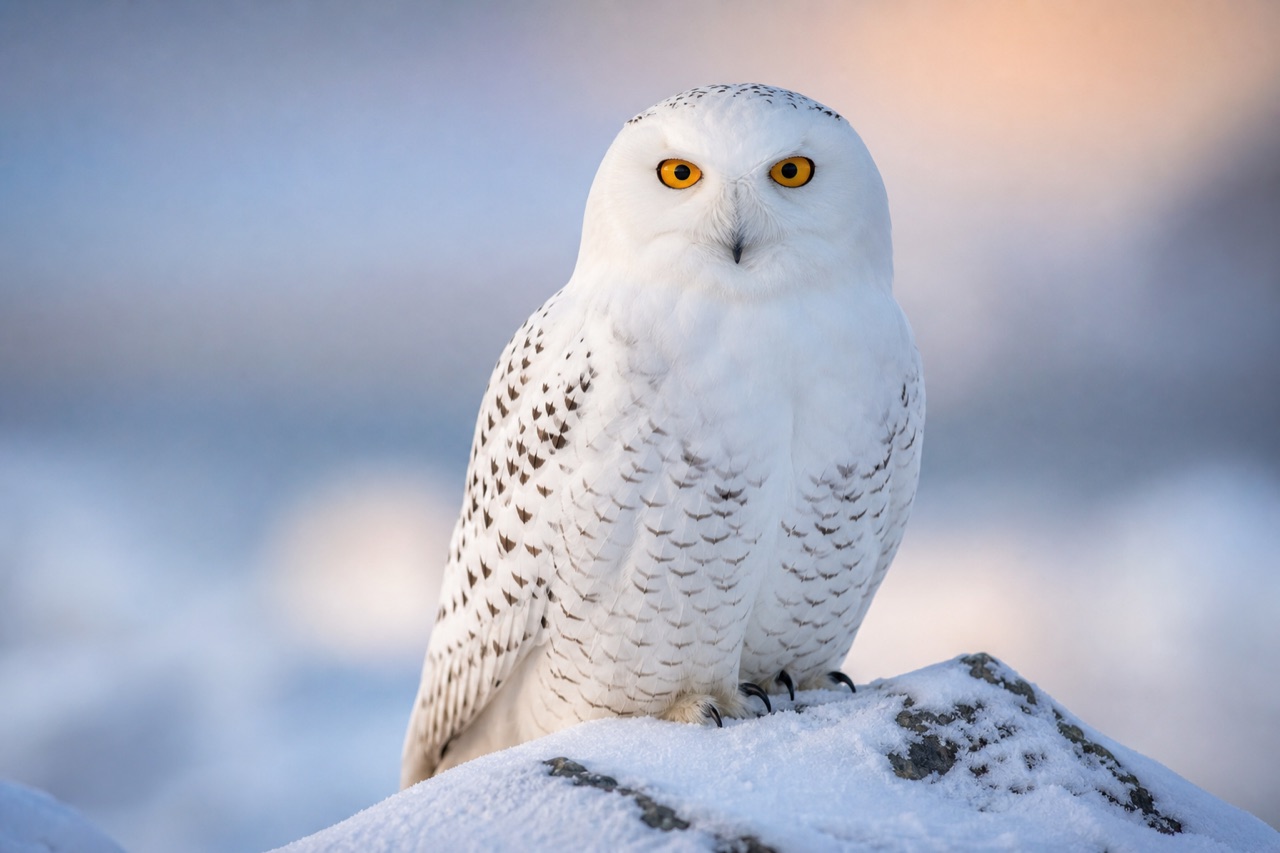
AI-generated educational wildlife portrait — World Animal Rescue Network · AI visualisation, not a photograph
In brief
The snowy owl (Bubo scandiacus) is a large, mainly white Arctic owl that hunts by day and is nomadic rather than territorial; its breeding success tracks lemming abundance, and it was reclassified as Vulnerable in 2017.
Also in Animals A to Z · Animals that start with S
How you can help
You can support the related appeal — read its purpose, recipient status and fund terms first — or give once to where it is needed most. Sharing accurate information helps too.
By WARN Research & Conservation Team Last updated
The snowy owl is the heaviest owl in North America and one of the few that hunts by day — an adaptation to an Arctic summer with no darkness to hunt in. Males become progressively whiter with age; females and juveniles keep dark barring across the white. Almost everything about snowy owl ecology tracks lemmings. In a good lemming year a pair may raise a large brood; in a poor one they may not breed at all. Rather than holding a fixed territory, snowy owls are nomadic, moving across the Arctic between seasons in search of rodent-rich ground — which is why tracking individuals has repeatedly overturned assumptions about how many there are.
~2 kg
Weight — the heaviest owl in North America
3–11
Eggs per clutch, varying with lemming abundance
~1,600
Lemmings an adult may eat in a year
Nomadic
No fixed territory between breeding seasons
Figures sourced from IUCN Red List — Bubo scandiacus, CITES Appendices .
Snowy Owl: Quick Facts
| Weight | 1.6–2.9 kg — heaviest North American owl |
|---|---|
| Wingspan | 125–150 cm |
| Activity | Diurnal — hunts in daylight |
| Main prey | Lemmings; also voles, ptarmigan and waterfowl |
| Movement | Nomadic, not territorial |
| Key threat | Climate disruption of the lemming cycle |
Scientific Classification
| Kingdom | Animalia |
|---|---|
| Phylum | Chordata |
| Class | Aves |
| Order | Strigiformes |
| Family | Strigidae |
| Genus | Bubo |
| Species | Bubo scandiacus |
Conservation Status
- IUCN Status
- Vulnerable
- Population
- Revised sharply downward after tracking studies; estimates remain uncertain
- Trend
- Decreasing
- Assessed
- 2017 (reclassified from Least Concern)
- CITES
- Appendix II (all Strigiformes)
The 2017 reclassification followed improved measurement rather than a new threat: tracking showed individuals range so widely that earlier surveys counted the same birds more than once.
Did you know?
Snowy owls do not hold territories between seasons — a bird that bred in Canada one summer may nest in Siberia the next, wherever the lemmings are.
Key Facts: Snowy Owl
- Snowy owls hunt in daylight — an adaptation to the Arctic summer's continuous light.
- Breeding is tied to lemming abundance; in poor years pairs may not breed at all.
- They are nomadic, not territorial, moving across the Arctic between seasons.
- Males whiten with age; females and juveniles retain dark barring.
- 'Irruptions' bring birds far south in some winters — usually young birds after a good breeding year.
- Reclassified from Least Concern to Vulnerable in 2017 when population estimates were revised down.
Life on the lemming cycle
Arctic lemming populations rise and crash on multi-year cycles, and snowy owl reproduction follows them closely. In a peak lemming year a female may lay a large clutch and fledge many young; in a crash year the pair may skip breeding entirely rather than start a nest that cannot be provisioned.
This makes snowy owl numbers naturally volatile and makes any single-season count misleading. It also means the birds cannot afford to sit still: they move to wherever rodents are abundant, sometimes thousands of kilometres between consecutive breeding attempts.
Why the status changed in 2017
Snowy owls were long listed as Least Concern on the assumption of a large global population. Satellite tracking then revealed that individual birds range enormously and that the same owls were being counted in different places, meaning earlier estimates had substantially overcounted.
The revised figure was far lower, and combined with evidence of decline the IUCN moved the species to Vulnerable in 2017. It is a good example of a status change driven by better measurement rather than by a sudden new threat.
Irruptions
In some winters snowy owls appear well south of their range — across southern Canada, the northern United States, and occasionally western Europe. These irruptions are widely reported as birds fleeing starvation, but the pattern often follows a *good* breeding season: an unusually large cohort of young birds disperses widely.
Irrupting owls are typically juveniles, often in poor condition by the time they are noticed, and they attract crowds. Repeated disturbance at a roost forces a bird already low on reserves to burn more energy, which is why photographers and birders are asked to keep distance and never bait owls with live or dead prey to obtain a flight shot.
Pressures on an Arctic specialist
Climate change is the central long-term threat: warming disrupts the snow conditions lemmings depend on for winter breeding beneath the snowpack, which destabilises the cycle the owls rely on. Rain-on-snow events and shifting vegetation compound it.
Other documented pressures include collisions with vehicles and aircraft when birds winter in open agricultural and airport landscapes that resemble tundra, secondary rodenticide poisoning in wintering areas, and localised hunting. Disturbance at wintering sites is an increasing, and entirely avoidable, addition.
What WARN Does
WARN publishes free, sourced species education including the cases where public behaviour matters directly. Wintering snowy owls are among the most photographed wild birds in the world, and the difference between a bird surviving the winter and not can come down to how often it is flushed from a roost.
If this guide helps you understand wildlife and the pressures it faces, a gift to WARN supports habitat protection and free public education in our partner countries.
How can I help save the snowy owl?
Explore practical ways to support the snowy owl, from everyday choices and sharing reliable information to reviewing a related appeal before giving.
Explore ways to support
Read the related appeal’s purpose, recipient status and fund terms. Choose an affordable gift after checking what is proposed and what has been reported.
Ease the pressures
Avoid the wildlife trade and souvenirs, never buy wild animals as pets, and choose sustainable, habitat-friendly products — the threats behind the snowy owl's decline fall when demand does.
Spread the word
Share accurate, sourced information about the snowy owl. Wider awareness is what turns concern into lasting protection.
Snowy Owl: Frequently Asked Questions
How can I help save the snowy owl?
Are snowy owls endangered?
Do snowy owls hunt during the day?
Why do snowy owls appear far south some winters?
Do snowy owls turn whiter as they age?
What do snowy owls eat?
Where do snowy owls live?
Are snowy owls dangerous?
How long do snowy owls live?
How big is a snowy owl?
Sources & References
Population figures, conservation status and biological facts on this page are drawn from authoritative scientific and intergovernmental sources.
Terms used on this page
Plain-English definitions, from our wildlife and conservation glossary.
Explore more animals
Discover more animals, their habitats and their conservation status in the WARN wildlife-guide library.
Enjoyed this Snowy Owl guide?
Receive appeal updates, animal-welfare news and published funding reports. Unsubscribe any time.
We only use your address for WARN updates. See our privacy policy.