Wildlife Guide · Europe, western Asia and North Africa & Introduced in New Zealand, Argentina, Chile and elsewhere; North American elk/wapiti closely related or conspecific
Red Deer
Cervus elaphus (Linnaeus, 1758) — family Cervidae
The stag on the hillside — Europe's largest native land mammal in many regions, and a global introduction story.
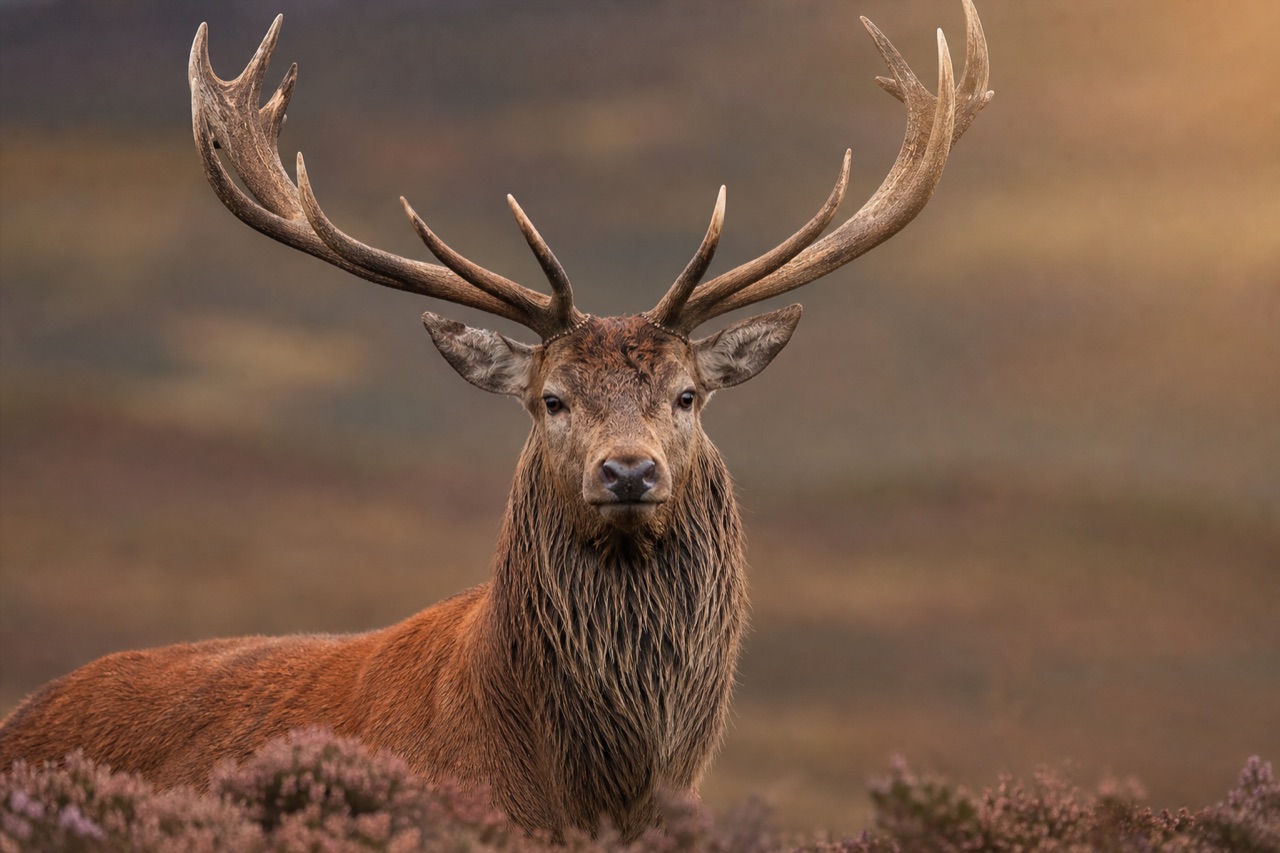
AI-generated educational wildlife portrait — World Animal Rescue Network · AI visualisation, not a photograph
In brief
The red deer (Cervus elaphus) is a large Eurasian cervid — stags with branched antlers, autumn rut, Least Concern globally — closely related to North American elk and widely introduced outside native range.
Also in Animals A to Z · Animals that start with R
By WARN Research & Conservation Team Last updated
The red deer is the large cervid of European imagination: a stag with branched antlers silhouetted on moorland in autumn mist, roaring during the rut. Cervus elaphus spans from Scotland and Scandinavia through central Europe, the Balkans, Turkey and the Caucasus into North Africa. Stags may exceed 200 kg; hinds are smaller. Antlers are the fastest-growing bone in nature, rebuilt each year for display and combat rather than for permanent defence. Taxonomy is contested at the margins. North American elk or wapiti were long considered the same species; many authorities now treat them as Cervus canadensis, separate from Eurasian red deer, though they interbreed where introduced ranges overlap. Within Europe, red deer show regional size and antler variation — Scottish hill stags are smaller than forest stags in central Europe — but remain one widely recognised species. Red deer live in sexually segregated groups for much of the year: hinds and calves in herds, stags in bachelor groups until the rut gathers males on traditional grounds. They browse and graze, shaping upland vegetation and serving as flagship prey for recovering wolf populations in parts of Europe. Introduced populations in New Zealand and South America tell a parallel story of ecological impact where deer lack native predators. Stag roaring carries for kilometres across open moorland — a sound that anchors autumn in upland Britain and Scandinavia and draws tourists who hear the rut from valley car parks without ever seeing the deer. Highland estates in Scotland manage red deer for stalking revenue and habitat objectives simultaneously — the same animal supports tourism, venison trade and contentious debates about rewilding versus sporting tradition. None of those human frames change the deer's ecological role as a large herbivore shaping tree regeneration. Winter mortality in harsh Highland winters culls weak animals independently of stalking — weather and food remain co-managers of population size where wolves are absent. Exclosures in Scottish glens demonstrate how tree saplings grow when deer are excluded — visual proof used in public debates about culling levels and rewilding targets. Antler size in red deer signals age and condition to rivals and observers alike — a mature forest stag carries a rack that would be impossible on poor winter forage.
200+ kg
Large stag weight in productive habitat
Antlers
Shed and regrown annually — fastest-growing bone
Sep–Oct
Rut in most European populations
Least Concern
Globally — island subspecies exceptions
Figures sourced from IUCN Red List — Cervus elaphus, British Deer Society — red deer .
Red Deer: Quick Facts
| Stag weight | Up to 200+ kg in good habitat |
|---|---|
| Antlers | Annual growth; branched in mature stags |
| Rut | September–October (Europe) |
| IUCN status | Least Concern |
| Related species | North American elk/wapiti (C. canadensis) |
| Main conflicts | Forestry damage, introductions, road collisions |
Scientific Classification
| Kingdom | Animalia |
|---|---|
| Phylum | Chordata |
| Class | Mammalia |
| Order | Artiodactyla |
| Family | Cervidae |
| Genus | Cervus |
| Species | Cervus elaphus |
Conservation Status
- IUCN Status
- Least Concern
- Population
- Millions across native range; large introduced populations
- Trend
- Stable or increasing in much of native range
- Assessed
- 2016
- CITES
- Not listed
Global listing masks local issues — island subspecies, hybridisation with sika, and overabundance in introductions.
Did you know?
Red deer antlers are rebuilt from scratch every year — among the fastest-growing bone tissue known, expanding under velvet before hardening for the rut.
Key Facts: Red Deer
- Red deer are among the largest wild mammals native to much of Europe.
- Stags grow and shed antlers each year; the rut involves roaring, herding hinds and clashes.
- North American elk/wapiti are closely related; many taxonomies now split them as Cervus canadensis.
- Introduced populations in New Zealand and South America cause major ecological impact.
- Wolf recovery in Europe depends partly on abundant red deer as prey.
- Forestry, hunting and vehicle collisions are primary human interactions.
Antlers, rut and reproductive politics
Antler growth begins in spring under velvet — a vascular skin supplying nutrients. As testosterone peaks before the rut, velvet is rubbed off against trees, exposing hard bone. Antlers are display weapons: size signals age and condition to rivals and hinds. Fights between stags are common but often ritualised — parallel walking, roaring, clashing — with serious injury less frequent than appearance suggests.
The rut concentrates males on traditional rutting grounds — hilltops, forest clearings, meadows — where hinds gather. Dominant stags attempt to monopolise access to oestrous hinds, but younger males sneak copulations at the margins. Roaring carries across valleys; it is both advertisement and intimidation.
After the rut, testosterone falls and antlers are shed, usually by late winter. Hinds carry calves through spring gestation and give birth in May or June, typically to a single calf in European populations. Twins occur but are less common than in roe deer.
Ecology from moorland to plantation
Red deer occupy diverse habitats: Scottish open hill, German mixed forest, Mediterranean maquis where they persist. Diet mixes grazing on grasses and sedges with browsing on heather, birch, rowan and plantation leaders. High densities suppress woodland regeneration — a documented conflict in Scottish native forest restoration where deer fencing and culling are management tools.
Seasonal movement varies. Some populations are relatively sedentary; others migrate altitudinally between summer high ground and winter shelter. In the absence of wolves and bears, density is regulated by winter weather, hunting and food limitation.
As wolves recolonise parts of Germany, Poland and the Alps, red deer behaviour is shifting — more vigilant grouping, altered habitat use — re-establishing predator-prey dynamics absent for centuries in much of western Europe.
Introductions and island subspecies
Humans moved red deer globally. New Zealand holds large introduced populations damaging native forest understorey and competing with livestock. Argentina and Chile have red deer in Patagonian forest and steppe with measurable browse impact on native vegetation. These introductions follow a pattern: deer prosper without native predators and become landscape engineers.
Island endemics tell the opposite story — local rarity. Corsican red deer (C. e. corsicanus) and other isolated forms face genetic bottlenecks and habitat squeeze. Barasingha and sika are related Asian cervids sometimes confused with red deer; sika hybridise with red deer where both occur, muddying genetics in Scotland and Japan.
Conservation within native range focuses on sustainable hunting, corridor connectivity and predator recovery. Outside native range, control and eradication on sensitive islands are goals — expensive and politically difficult once populations establish.
Red deer and people
Red deer hunting is culturally central in Europe — stalking in Scotland, driven hunts in continental tradition, venison markets supplying restaurants. Hunting revenue funds estate management and provides the main population control where large predators are absent.
Vehicle collisions occur on routes crossing deer range, especially at dawn and dusk during autumn movement. Forestry economics balances timber production against deer damage — too many deer mean failed natural regeneration unless fenced or culled intensively.
Tourism around the rut — listening to stags roar from safe distances — generates income in national parks from Exmoor to the Bavarian Forest. The animal sits at the intersection of wildness and management: never fully domesticated, rarely left entirely alone.
Hybridisation and sika overlap
Sika deer — introduced to Britain and parts of Europe from Asia — hybridise with red deer where both occur, producing intermediate offspring that muddy population genetics and complicate census methods. In Scotland, sika expansion into red deer range is a long-term concern for genetic integrity of native stocks.
Management sometimes treats sika as the higher-priority control target because they cause similar forestry damage and hybridise. Red deer stalkers learn to distinguish species by rump patch, antler form and seasonality — mistakes in culling policy follow from misidentification.
The hybridisation story generalises: introduced cervids worldwide — red deer in New Zealand, sambar in Australia — interact with natives and with each other in ways single-species management plans miss.
What WARN Does
WARN publishes free, sourced species education for species that are simultaneously conservation icons and ecological engineers. Red deer density decides whether woodland regenerates or stagnates — context matters more than the label Least Concern.
If this guide helps you understand wildlife and the pressures it faces, a gift to WARN supports habitat protection and free public education in our partner countries.
Red Deer: Frequently Asked Questions
Are red deer and elk the same species?
When is the red deer rut?
Are red deer endangered?
What is the difference between red deer and roe deer?
Where do red deers live?
Are red deers dangerous?
How long do red deers live?
How big is a red deer?
What do red deer eat?
Sources & References
Population figures, conservation status and biological facts on this page are drawn from authoritative scientific and intergovernmental sources.
Terms used on this page
Plain-English definitions, from our wildlife and conservation glossary.
Explore more animals
Discover more animals, their habitats and their conservation status in the WARN wildlife-guide library.
Enjoyed this Red Deer guide?
Receive appeal updates, animal-welfare news and published funding reports. Unsubscribe any time.
We only use your address for WARN updates. See our privacy policy.