Wildlife Guide · Grassland and cropland across Eurasia and Africa & Common quail a rare summer visitor and breeder in Britain
Quail
Phasianidae — family including Coturnix quail and related small gamebirds
The gamebird you hear but rarely see — and the one on your plate is mostly domestic.
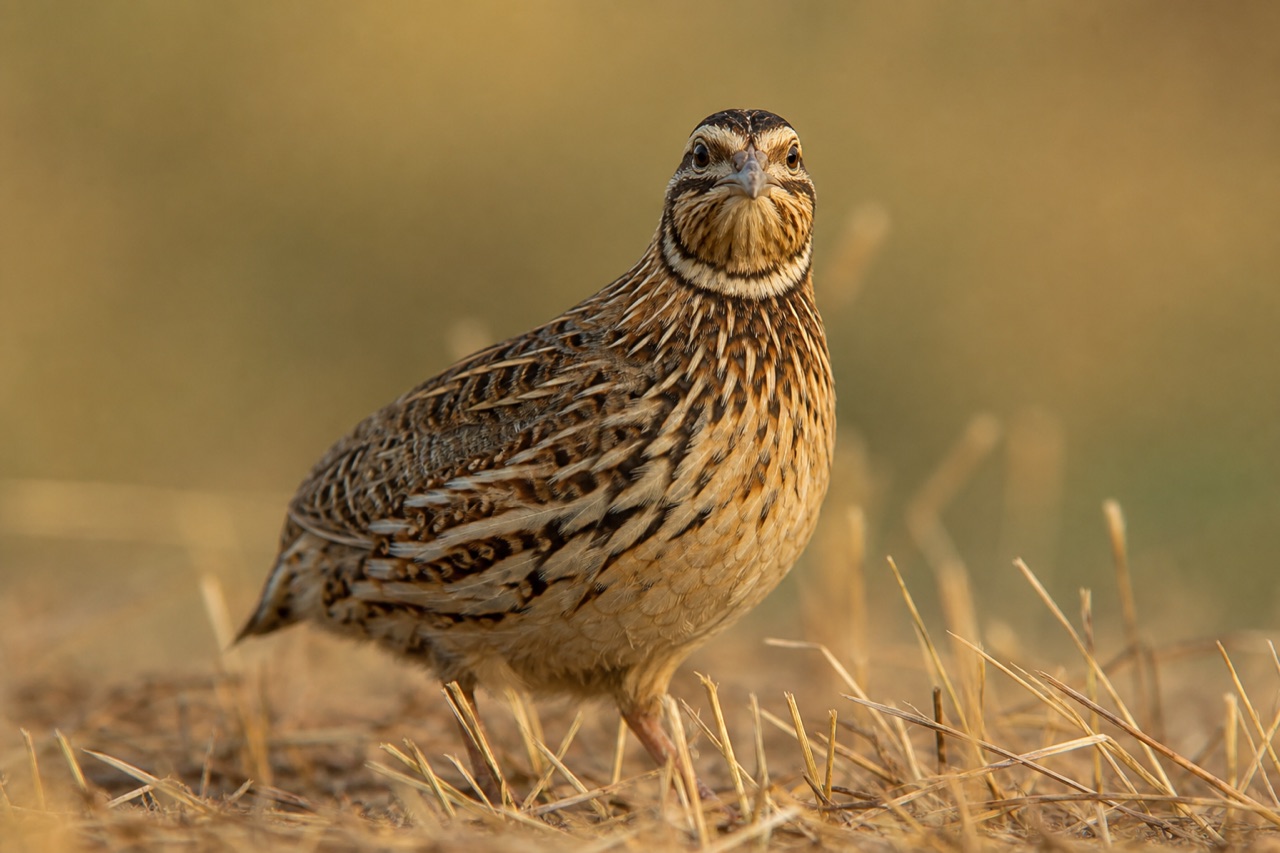
AI-generated educational wildlife portrait — World Animal Rescue Network · AI visualisation, not a photograph
In brief
Quails are small cryptic gamebirds; the common quail (Coturnix coturnix) is a scarce British summer visitor heard calling from arable crops, while the Japanese quail is domesticated for eggs and meat — both in family Phasianidae with grouse and pheasant.
Also in Animals A to Z · Animals that start with Q
By WARN Research & Conservation Team Last updated
Quail are small, cryptic gamebirds of open grassland and cropland — streaked brown, compact, designed to crouch and hide rather than fly. When people say 'quail' they may mean the common quail (Coturnix coturnix) — a summer visitor and scarce breeder in Britain whose male calls a distinctive three-note 'wet-my-lips' from deep cover — or the Japanese quail (Coturnix japonica) — domesticated worldwide for eggs and meat and rarely confused in the field. Common quails arrive in Britain from Africa and southern Europe in spring, breed occasionally in arable crops and rough grassland, and are far more often heard than seen. The call carries from wheat fields and hay meadows; the bird itself stays hidden in crop rows. Hunting and migration take birds across the Mediterranean; in Britain the species is a bird of passage and rare nester rather than a farmland regular. Searching 'quail' without context mixes wild migrants, domestic stock and restaurant portions. A family-level guide separates the common quail's cryptic wild ecology from the Japanese quail's domestication — same family, different stories. Common quail searches spike in summer when males call from crops — most searchers hear the bird without seeing it, which makes accurate family-level guidance essential before confusing wild migrants with domestic poultry.
Cryptic
Streaked brown — hides in crop rows, rarely seen
'Wet-my-lips'
Male common quail call from deep cover
Scarce UK breeder
Summer visitor; nests occasionally in arable
Domestic Japanese quail
Separate species — global egg and meat production
Figures sourced from IUCN Red List — Coturnix coturnix, BTO — BirdFacts: Quail .
Quail: Quick Facts
| Common quail call | Three-note 'wet-my-lips' from cover |
|---|---|
| British status | Scarce summer visitor and breeder |
| Visibility | Cryptic — heard more than seen |
| Nest | Ground scrape in arable or grassland |
| Domestic quail | Japanese quail — eggs and meat production |
| Family relatives | Pheasant, partridge, grouse |
| Migration | Africa/southern Europe to Britain in summer |
Scientific Classification
| Kingdom | Animalia |
|---|---|
| Phylum | Chordata |
| Class | Aves |
| Order | Galliformes |
| Family | Phasianidae |
| Wild British species | Common quail (Coturnix coturnix) |
| Domestic species | Japanese quail (Coturnix japonica) |
Conservation Status
- IUCN Status
- Least Concern
- Population
- Wide Eurasian and African range; scarce British breeder
- Trend
- Decreasing in parts of western Europe
- Assessed
- 2018
- CITES
- Not listed (family overview)
Common quail Least Concern globally. British breeding sporadic. Mediterranean migration hunting documented pressure.
Did you know?
Common quail males call 'wet-my-lips' from deep inside crop fields — most people who have heard a quail have never seen one.
Key Facts: Quail
- Common quail is a small streaked gamebird — heard calling from crops, rarely seen in Britain.
- Male call is a three-note 'wet-my-lips' — diagnostic from arable and hay meadows in summer.
- Scarce breeder in Britain; most records are migrants and summer visitors.
- Japanese quail is domesticated for eggs and meat — not the bird calling in wheat fields.
- Quails crouch and hide rather than flush — cryptic plumage matches crop and grassland.
- Migration across Mediterranean faces hunting pressure; Britain is edge of breeding range.
- Family Phasianidae includes pheasant, grouse and partridge — quail are the smallest.
Common quail — heard, not seen
The common quail is a summer migrant to Britain — arriving from wintering areas in Africa and southern Europe, occasionally staying to nest in arable crops, rough grassland and hay meadows. The male advertises with a distinctive three-note whistle — rendered 'wet-my-lips' — from deep cover. Walkers hear quail from field edges; seeing one requires flushing it from almost underfoot.
Plumage is streaked brown and buff — camouflage for crouching in crop rows. Quails prefer to run and hide; flight is explosive, short and low when finally forced. Nests are ground scrapes in vegetation, often in cereals; clutches are large for the bird's size.
British breeding is sporadic and local — many quail records are calling males on passage rather than confirmed nesting. The species is not a Red List priority in the same way as curlew but remains a scarce and declining breeder across parts of western Europe.
Common quail are legally hunted in some European countries during migration — the Mediterranean bottleneck is a documented mortality source unrelated to British breeding habitat. Conservation of British quail as a scarce breeder connects to international migration policy as well as arable field management.
Common quail are sometimes recorded on nocturnal migration over Britain — detected by call on calm nights rather than seen. Daytime records in arable fields usually mean a lingering male on territory or passage, not a established breeding colony.
Quail are migratory across much of their range — British records include overshooting migrants and weather-driven influxes as well as occasional breeders. A calling male in June does not confirm nesting without later evidence of chicks or confirmed breeding behaviour.
Japanese quail — domestic, not wild
The Japanese quail is the species behind most quail eggs in shops and quail meat in restaurants — domesticated from East Asian wild stock, bred in captivity globally for rapid egg production and small meat yield. It is not the bird calling from British wheat fields.
Confusion arises because both are called quail and share genus Coturnix. Wild Japanese quail occur in East Asia; feral populations exist in some regions from escapes. In Britain, any quail in a cage or on a menu is almost certainly domestic Japanese quail, not common quail.
The domestication story matters for search accuracy: 'quail' queries mix wildlife, farming and cuisine. Common quail conservation is migration and occasional breeding habitat; Japanese quail welfare is poultry husbandry — unrelated except at family level.
Quail chicks are precocial — they leave the nest soon after hatching and follow the female through crop rows. Early harvest or field spraying during breeding destroys broods as completely as nest destruction — the mobile chick strategy fails against modern arable calendars as ground-nesting waders do.
Arable field margins with retained stubble and reduced early cultivation benefit quail and other cryptic ground nesters generally — the same agri-environment logic that helps skylark and lapwing helps quail where they attempt to breed.
Migration, hunting and the Mediterranean bottleneck
Common quails migrate nocturnally across the Mediterranean — a route where hunting in some southern European countries takes large numbers during spring and autumn passage. Satellite tracking has revealed complex routes between African wintering grounds and Eurasian breeding areas.
Britain lies at the northwestern edge of breeding range. Climate and crop patterns may shift where occasional nesting succeeds — arable fields with retained winter stubble and reduced early mowing of hay benefit ground-nesting cryptic birds generally.
Quail are Least Concern globally with a wide range across Eurasia and Africa. Regional declines in western Europe link to agricultural intensification and migration mortality rather than British farmland alone.
Japanese quail in captivity are bred in intensive systems for egg and meat production — welfare and disease standards apply to poultry, not wildlife law. Confusion between wild common quail and domestic Japanese quail affects search results, cuisine queries and occasional illegal release stories that do not help wild populations.
Gamebird releases of non-native species on estates are separate from wild common quail ecology — pheasant and red-legged partridge releases do not supplement quail populations and can confuse searchers looking for small brown gamebirds in farmland.
Quail versus partridge and pheasant
Quails share family Phasianidae with pheasant, red-legged partridge, grey partridge and grouse — all ground-dwelling gamebirds shaped by open-country hunting culture. Quail are the smallest and most cryptic — a bird of summer crops and grassland rather than hedgerow and woodland edge.
Grey partridge and quail sometimes occupy similar mental space for searchers — small brown farmland birds. Partridge are chunkier, covey-forming, resident; quail are migratory, solitary in display, vocally advertised. Identification by call separates them instantly in summer.
A family quail guide serves searchers who hear a call from a field and type 'quail' — directing them to common quail ecology, not domestic egg production or pheasant shooting culture.
Quail occupy the same mental search space as grey partridge for some users — both are cryptic brown gamebirds of open country. Partridge are resident, covey-forming and chunkier; quail are migratory, vocal and smaller. Summer call is the reliable separator when plumage is never seen.
Quail in European folklore and cuisine long predates Japanese quail domestication — wild common quail were eaten historically where caught; modern menu quail is almost entirely farmed Japanese quail, not wild-shot common quail from British fields.
What WARN Does
WARN publishes free, sourced species education that separates wild migrants from domestic stock. 'Quail' in a wheat field is common quail — heard, hidden, scarce; 'quail' on a menu is usually Japanese quail from a cage.
If this guide helps you understand wildlife and the pressures it faces, a gift to WARN supports habitat protection and free public education in our partner countries.
Quail: Frequently Asked Questions
What does a quail sound like?
Do quails breed in Britain?
Is quail on a menu wild?
How do I see a quail?
What do quails eat?
Where do quails live?
Are quails dangerous?
How long do quails live?
How big are quails?
Sources & References
Population figures, conservation status and biological facts on this page are drawn from authoritative scientific and intergovernmental sources.
Terms used on this page
Plain-English definitions, from our wildlife and conservation glossary.
Explore more animals
Discover more animals, their habitats and their conservation status in the WARN wildlife-guide library.
Enjoyed this Quail guide?
Receive appeal updates, animal-welfare news and published funding reports. Unsubscribe any time.
We only use your address for WARN updates. See our privacy policy.