Wildlife Guide · Native to Asia from the Caucasus to China & Introduced and established across Europe, North America and New Zealand
Pheasant
Phasianus colchicus (Linnaeus, 1758) — family Phasianidae
The gamebird in your lane — introduced, abundant and rarely out of sight in rural Britain.
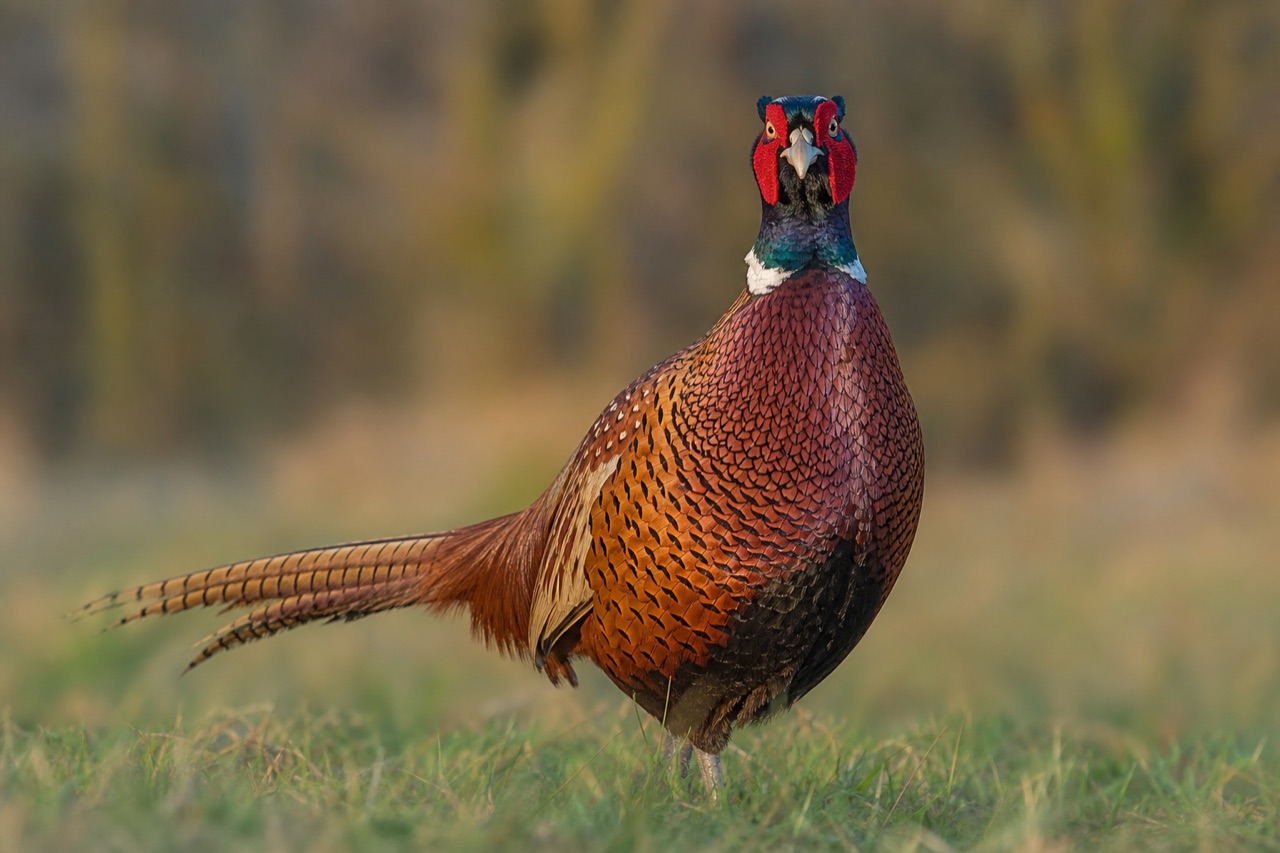
AI-generated educational wildlife portrait — World Animal Rescue Network · AI visualisation, not a photograph
In brief
The common pheasant (Phasianus colchicus) is a large Asian gamebird introduced to Britain for shooting; males are brightly coloured with a long barred tail, females are mottled brown, and millions are released annually — making road deaths, cat predation on chicks and fence entanglement common in rural gardens and lanes.
Also in Animals A to Z · Animals that start with P
By WARN Research & Conservation Team Last updated
The common pheasant is the large, long-tailed bird that crosses rural roads, struts through field margins and occasionally appears at the bottom of a garden bordering farmland. Males are unmistakable — iridescent copper and gold, a green head, red facial wattles and a white neck ring in most British birds. Females are mottled brown and far harder to spot. In Britain the pheasant is not native. It was introduced for sport centuries ago and is now maintained at extraordinary density by annual releases for shooting — tens of millions of birds each year. Whether you encounter one as wildlife or as stock depends on where you live, but the same hazards apply: road collisions, cat predation on chicks and fence entanglement. Understanding the pheasant as an introduced gamebird rather than a native wild species clarifies why it is so abundant while native farmland birds such as grey partridge, lapwing and skylark have declined. Its presence in a garden reflects nearby shooting or farmland management, not the garden's ecological quality.
Introduced
Not native to Britain — established through releases for sport
Millions
Released annually for shooting in the UK
Ground nest
Scrape lined with grass, hidden in vegetation
Road deaths
Among the commonest birds killed on rural roads
Figures sourced from IUCN Red List — Phasianus colchicus, BTO — BirdFacts: Pheasant, RSPB — Pheasant .
Pheasant: Quick Facts
| Length | 60–90 cm including tail (male) |
|---|---|
| Weight | Male roughly 1.2 kg; female smaller |
| Origin in Britain | Introduced from Asia for shooting |
| Nest | Ground scrape in tall vegetation |
| UK releases | Millions annually for driven shooting |
| Typical diet | Grain, seeds, buds, insects and worms |
| Main hazards | Road collisions, cat predation on chicks, fence entanglement |
Scientific Classification
| Kingdom | Animalia |
|---|---|
| Phylum | Chordata |
| Class | Aves |
| Order | Galliformes |
| Family | Phasianidae |
| Genus | Phasianus |
| Species | Phasianus colchicus |
Conservation Status
- IUCN Status
- Least Concern
- Population
- Large native range in Asia; tens of millions in Britain including releases
- Trend
- Stable globally; artificially inflated in Britain by shooting releases
- Assessed
- 2018
- CITES
- Not listed
Least Concern reflects the wide native Asian range. British abundance is driven by annual releases for sport, not natural population dynamics.
Did you know?
Most pheasants seen in rural Britain in autumn are birds released for shooting that year — their abundance reflects sporting economics more than the habitat's natural carrying capacity.
Key Facts: Pheasant
- The common pheasant is native to Asia and was introduced to Britain for shooting; it is not a native wild bird.
- Males are brightly coloured with a long tail; females are cryptic mottled brown.
- Millions are released each year for sport, creating densities far above natural levels.
- Road collisions kill large numbers on rural lanes — especially in release areas in autumn.
- Domestic cats take pheasant chicks and eggs from ground nests in rough grass and hedgerows.
- Pheasants do not use nest boxes; hens nest in a grass-lined scrape on the ground.
- Supplementary grain feeding occurs on shooting estates; garden feeding is unnecessary and can attract rats.
An introduced gamebird, not a native wild species
Phasianus colchicus originates in Asia from the Caucasus east to China. Romans and later landowners brought it to Britain; it persisted and spread through woodland, farmland and hedgerows. Today its British population is sustained largely by annual releases for driven shooting — estimated at over 40 million birds in some recent assessments. Without releases, the wild breeding population would be far smaller than the numbers seen in autumn.
That scale matters ecologically. Pheasants compete with native ground-feeding birds, eat large quantities of grain and invertebrates, and disturb woodland understorey. They are Least Concern globally because of their vast native range in Asia, but in Britain they are a managed introduction whose numbers reflect shooting economics, not habitat carrying capacity. Grey partridge, lapwing and skylark — native farmland birds — have declined in the same landscapes where pheasant numbers have risen.
In rural gardens bordering fields or woodland, pheasants appear as everyday wildlife — strutting males crowing in spring, hens leading chicks along hedgerows in summer. Understanding their introduced status clarifies why they are so abundant while native farmland birds declined. The pheasant in your lane is not evidence of a healthy ecosystem; it is evidence of a nearby release pen and the management regime that sustains it.
Ground nesting, chicks and cat predation
Hen pheasants nest in a shallow scrape on the ground, lined with grass and hidden in tall vegetation, nettles or hedge bottoms. Clutches contain around eight to twelve eggs; incubation lasts about three weeks. Chicks leave the nest immediately and follow the hen on foot — unable to fly for two weeks. During this period the brood stays within rough cover, moving along hedgerow bases and field margins where the hen can lead chicks to insects and seeds.
That ground-based life exposes pheasants to domestic cats at every stage. Cats take eggs and chicks from nests and kill young birds in rough grass. Foxes and corvids take a larger share in the countryside, but in gardens and village edges cats are a consistent predator. A hen pheasant with chicks crossing a garden lawn is vulnerable whenever a cat is present.
Nest boxes are irrelevant — pheasants need undisturbed rough margins, nettle patches and hedge bottoms. Leaving a strip of rough grass unmown through June and July gives nesting hens cover. Keeping cats in at dawn and dusk reduces chick kills when hens lead broods through garden boundaries. A garden with a cat and a pheasant hen with chicks is a garden where the cat will eventually find the brood, regardless of how well hidden the nest scrape appears.
Roads, fences and release-time mortality
Pheasants are among the commonest birds killed on rural British roads. They fly low across lanes, flush late in front of vehicles and often fail to clear oncoming traffic. Mortality peaks in autumn when released birds disperse and again in spring when cock birds hold territory beside roads. A lane bordered by release woodland can see dozens of road-killed pheasants in a single month after the shooting season ends.
Fence entanglement kills birds that attempt to fly through mesh they misjudge. Netting on fruit cages and deer fencing near release woods adds to losses. Window strikes are less common than in songbirds but occur where pheasants see reflections of open ground on outbuilding glass. Electric fencing and barbed wire on farmland boundaries also cause injuries to birds attempting low flights between cover patches.
These are practical hazards in rural gardens: slow down on lanes bordered by release woodland, mark large glass on outbuildings, and avoid loose netting at pheasant height. None of this addresses the scale of release mortality, but it reduces kills where birds overlap with daily life. The pheasant's road-death rate is a direct consequence of release density — more birds released means more birds on roads, regardless of how careful individual drivers are.
Feeding, gardens and what not to do
Pheasants find their own food — grain, seeds, buds, insects and worms — and shooting estates supplement with spill from feeders designed for release pens. Garden feeding of pheasants is unnecessary and can attract rats and corvids. Scatter grain beneath a feeder intended for pheasants quickly draws rats, which in turn attract more cats to the garden — worsening the predation pressure on native ground-nesting birds.
If pheasants raid vegetable beds or strip newly sown seed, netting and fencing are more effective than scatter feeding elsewhere. The bird's presence reflects nearby shooting or farmland, not a gap in garden ecology that feeding should fill. Pheasants will also take fallen fruit and dig in soft soil for worms, which can damage newly planted beds if birds visit regularly.
For conservation-minded gardeners, the relevant action is protecting native species — nest boxes for tits, cat control for blackbirds, insect habitat for swallows — rather than managing pheasants as if they were native garden birds. Their abundance is a product of release, not of garden suitability. Feeding pheasants does not help native birds and may attract predators that take native nests as well. The practical response to pheasants in a garden is tolerance or deterrence, not supplementary feeding.
What WARN Does
WARN publishes free, sourced species education that includes honest context about introduced species. The pheasant is the bird most rural Britons see weekly yet few recognise as an Asian gamebird maintained by release — understanding that distinction matters for every conversation about farmland bird decline and cat predation on ground nesters.
If this guide helps you understand wildlife and the pressures it faces, a gift to WARN supports habitat protection and free public education in our partner countries.
Pheasant: Frequently Asked Questions
Are pheasants native to Britain?
Should I feed pheasants in my garden?
Do pheasants use nest boxes?
Why do so many pheasants die on roads?
What do common pheasants eat?
Where do common pheasants live?
Are common pheasants dangerous?
How long do common pheasants live?
How big is a common pheasant?
Sources & References
Population figures, conservation status and biological facts on this page are drawn from authoritative scientific and intergovernmental sources.
Terms used on this page
Plain-English definitions, from our wildlife and conservation glossary.
Explore more animals
Discover more animals, their habitats and their conservation status in the WARN wildlife-guide library.
Enjoyed this Pheasant guide?
Receive appeal updates, animal-welfare news and published funding reports. Unsubscribe any time.
We only use your address for WARN updates. See our privacy policy.