Wildlife Guide · Deciduous and mixed woodland across Europe and temperate Asia & England and Wales in Britain; absent from Ireland
Nuthatch
Sitta europaea (Linnaeus, 1758) — family Sittidae
The only British bird that walks down a tree trunk as easily as up.
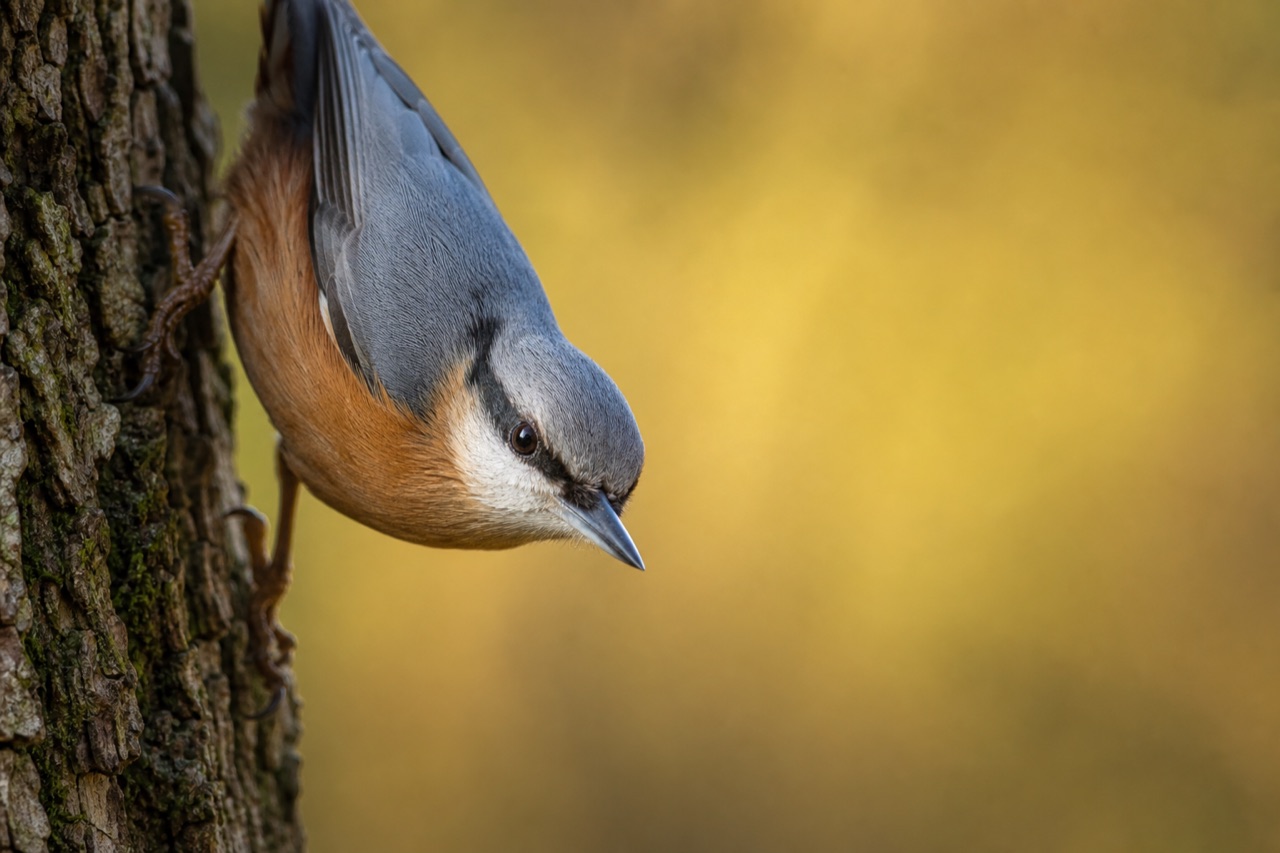
AI-generated educational wildlife portrait — World Animal Rescue Network · AI visualisation, not a photograph
In brief
The Eurasian nuthatch (Sitta europaea) is a compact woodland bird that climbs tree trunks in any direction including head-first, nests in tree holes often narrowed with mud, and visits garden feeders where mature trees lie near deciduous woodland.
Also in Animals A to Z · Animals that start with N
By WARN Research & Conservation Team Last updated
The Eurasian nuthatch is a compact woodland bird with blue-grey upperparts, peachy buff underparts and a black eye-stripe that gives it a bandit look. Its signature behaviour is locomotion: nuthatches climb tree trunks and branches in any direction — up, sideways and head-first down — using strong feet and sharp claws to grip bark. No other British bird habitually descends a trunk face-first. That climbing ability is tied to feeding ecology. Nuthatches probe bark crevices for insects, spiders and seeds, working methodically along branches and down trunks in a way that complements treecreepers, which always climb upward and must fly to the base of the next tree. A nuthatch can inspect an entire tree without leaving the bark surface. Where both species share a wood, they effectively divide the bark by direction — treecreepers ascending, nuthatches descending — which reduces direct competition for the same invertebrate prey. Nuthatches nest in tree holes — old woodpecker cavities or natural hollows — and are notorious for reducing the entrance with mud to exclude larger competitors. In gardens with mature trees near woodland, they visit peanut and sunflower feeders readily, often caching food in bark fissures for later. Their range in Britain has expanded northward in recent decades, and they remain absent from Ireland. The expansion is one of the few positive woodland-bird trends in a country where many specialists have retreated — though it still depends on mature trees and cavity-bearing dead wood that many managed woods lack.
Head-first
Only British bird that routinely descends trunks downward
Mud wall
Nest-hole entrance often plastered to exclude rivals
~14 cm
Compact body with short tail — built for bark climbing
Expanding
British range has moved north in recent decades
Figures sourced from IUCN Red List — Sitta europaea, BTO — BirdFacts: Nuthatch .
Nuthatch: Quick Facts
| Length | 14 cm |
|---|---|
| Climbing | Up, down and sideways on bark — head-first descent unique in Britain |
| Nest | Tree hole, entrance often reduced with mud |
| Diet | Insects, spiders, seeds and nuts |
| British range | England, Wales and southern Scotland; absent from Ireland |
| Feeder food | Peanuts, sunflower hearts, fat balls |
| Main requirements | Mature deciduous trees and woodland nearby |
Scientific Classification
| Kingdom | Animalia |
|---|---|
| Phylum | Chordata |
| Class | Aves |
| Order | Passeriformes |
| Family | Sittidae |
| Genus | Sitta |
| Species | Sitta europaea |
Conservation Status
- IUCN Status
- Least Concern
- Population
- Widespread across temperate Eurasia; expanding northward in Britain
- Trend
- Stable to increasing in Britain
- Assessed
- 2018
- CITES
- Not listed
Not Red-listed in the UK. Dependent on mature deciduous woodland with cavity-bearing trees.
Did you know?
Nuthatches plaster mud around their nest-hole entrance until the gap fits only a nuthatch — evicting starlings and other larger cavity competitors.
Key Facts: Nuthatch
- Nuthatches climb tree trunks up, down and sideways — the only British bird that routinely goes head-first down bark.
- They nest in tree holes and plaster mud around the entrance to keep out larger birds.
- Diet is insects, spiders and seeds; garden feeders with peanuts and sunflower hearts attract them.
- They cache food in bark crevices — a habit visible if you watch a feeder visitor depart with a seed.
- Treecreepers always climb up; nuthatches work the same trees in the opposite direction.
- Absent from Ireland; range in Britain has expanded northward.
- Domestic cats near feeders and loss of mature hollow trees are the main garden-scale pressures.
Built for bark — in every direction
Nuthatch feet are strong and clawed, with a rear toe that pivots to grip bark from above or below. The short tail is not used as a prop — unlike woodpeckers — so the bird depends entirely on foot strength to hold its position. Watching a nuthatch walk down a vertical trunk head-first looks impossible until you see how the feet alternate in small, precise steps, the body held close to the bark.
Feeding follows the same methodical pattern. Nuthatches prise bark flakes, probe crevices and take caterpillars, beetles and spiders from surfaces that treecreepers — which always ascend — may have already worked from below. The two species coexist in the same woodland by dividing the tree surface by direction and microhabitat. Nuthatches also take advantage of branches and twigs that treecreepers ignore, working outward from the trunk along limbs where bark texture and crevice depth differ.
In winter, seeds and nuts dominate. Nuthatches hammer hard seeds against bark or a stone 'anvil' — the behaviour that gave the family its name — and store surplus food in bark cracks and behind loose flakes. A garden nuthatch may take a peanut from a feeder, wedge it in bark and return later, or cache many seeds across a single tree in an hour. Cache recovery depends on spatial memory; birds revisit stored sites through cold weather when feeder visits are less reliable. The combination of bark foraging and caching makes nuthatches less dependent on garden feeding than finches, but more visible at feeders in hard frost when natural food is buried or scarce.
Nest holes, mud walls and territory
Nuthatches are cavity nesters. They use old great spotted woodpecker holes, natural hollows and occasionally nest boxes with the right entrance size. Before laying, the pair often builds a mud rim around the hole entrance, reducing the diameter until only a nuthatch can enter. This excludes starlings and larger competitors that might otherwise take over the cavity.
The nest cup itself is lined with bark flakes and wood chips. Clutch size is typically six to eight eggs; both parents feed chicks on insects gathered from nearby trees. Territories are centred on a breeding hole and feeding trees, and are defended through song — a rapid, loud trill repeated from a high perch — and by chasing rivals along branches. Nuthatch pairs often remain together across seasons, reusing the same hole where woodpeckers have not reclaimed it or where the tree still stands.
Mature deciduous woodland with dead wood and woodpecker activity provides the best nesting habitat. Gardens can support breeding nuthatches if a large garden tree holds a suitable hole or if a nest box with a small entrance is sited on woodland edge. The mud-plastering behaviour has been observed at nest boxes, where pairs sometimes reduce the entrance hole themselves over several days. Competition for cavities is real: great tits, blue tits and starlings all want the same holes, and the mud wall is the nuthatch's engineering response — a behaviour unique among British garden birds and visible only if you watch the hole closely through early spring.
Garden feeders and the trees they require
Nuthatches visit feeders where woodland is nearby — typically within a short flight of mature oak, beech or hazel. Peanuts, sunflower hearts and fat balls attract them; they prefer clinging to mesh or wire rather than perching on open trays. They are bolder than jays but less aggressive than great tits, and often queue at busy feeders in winter. A single pair may visit the same feeder daily through cold months, arriving from tree cover, grabbing food and retreating to cache or eat on bark nearby.
The limiting factor is almost always trees, not food. A feeder in a treeless suburban estate will not hold nuthatches regardless of what is offered. Conversely, a garden on woodland edge with one mature oak may host a pair year-round. Nuthatches are sedentary — most British birds do not migrate — and use the same territory across seasons. Juvenile birds disperse in autumn to find territories with available holes; a garden that loses its nest tree may lose its nuthatches even if feeding continues.
Cats kill nuthatches at feeders and on the ground beneath them. Because nuthatches approach feeders from tree cover, placing feeders within a metre of dense shrub or within arm's reach of a trunk gives birds an escape route. Window strikes are less common than for blackbirds because nuthatches rarely fly across open lawn, but feeders placed between house and woodland can still cause collisions if glass reflects trees. Sparrowhawks also hunt nuthatches at feeders — a natural predator whose presence indicates healthy prey numbers rather than a garden problem requiring intervention.
Range, status and what nuthatches signal
The Eurasian nuthatch is Least Concern globally and has expanded its British range northward into Scotland in recent decades — one of the few woodland birds with a northward trend rather than a retreat. Absence from Ireland reflects post-glacial colonisation limits rather than current habitat loss. The Irish Sea barrier and the timing of woodland spread after the last ice age left a gap that nuthatches have never crossed, despite being common across England and Wales.
Population trend in Britain is broadly stable to increasing in suitable woodland. The species is not Red-listed. Its presence in a garden indicates mature trees and woodland nearby — a simple habitat indicator that requires no specialist survey. Where nuthatches disappear from a formerly reliable garden, the cause is usually tree loss, hole loss or increased cat pressure rather than regional population collapse.
Conservation for nuthatches is conservation for dead wood, woodpecker cavities and connected deciduous woodland. Retaining standing dead trees in parks, allowing natural hollows in old garden trees where safe, and planting oak and beech for the long term all support nuthatches without targeted intervention. They are a woodland bird that will use a well-placed feeder, but they cannot live on feeders alone. A landscape that holds nuthatches holds the structural complexity — old trees, woodpecker activity, bark invertebrates — that many other woodland specialists also need.
What WARN Does
WARN publishes free, sourced species education for the woodland birds that visit gardens when the trees are right. The nuthatch is a bark specialist whose presence signals mature woodland nearby — and whose nest-hole mud walls are one of the clearest examples of bird engineering in a British garden.
If this guide helps you understand wildlife and the pressures it faces, a gift to WARN supports habitat protection and free public education in our partner countries.
Nuthatch: Frequently Asked Questions
Why is it called a nuthatch?
How do nuthatches walk down trees head-first?
Do nuthatches use nest boxes?
What do nuthatches eat?
Are nuthatches found in Ireland?
Where do eurasian nuthatchs live?
Are eurasian nuthatchs dangerous?
How long do eurasian nuthatchs live?
How big is an eurasian nuthatch?
Sources & References
Population figures, conservation status and biological facts on this page are drawn from authoritative scientific and intergovernmental sources.
Terms used on this page
Plain-English definitions, from our wildlife and conservation glossary.
Explore more animals
Discover more animals, their habitats and their conservation status in the WARN wildlife-guide library.
Enjoyed this Nuthatch guide?
Receive appeal updates, animal-welfare news and published funding reports. Unsubscribe any time.
We only use your address for WARN updates. See our privacy policy.