Wildlife Guide · Native: North America & Introduced: Europe, Asia, South America
Muskrat
Ondatra zibethicus (Linnaeus, 1766) — family Cricetidae
A wetland engineer in North America — a burrowing pest in European dikes.
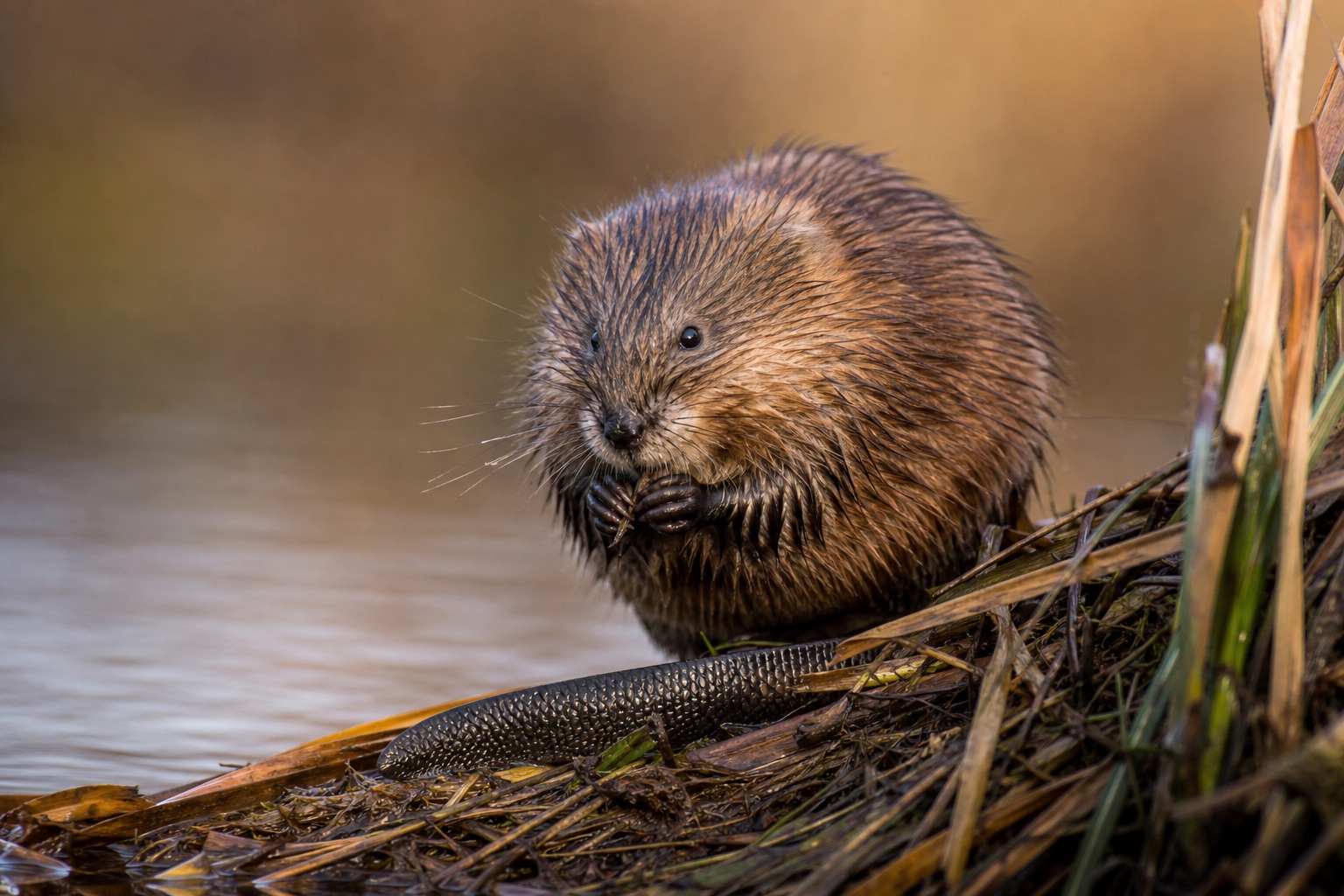
AI-generated educational wildlife portrait — World Animal Rescue Network · AI visualisation, not a photograph
In brief
The muskrat (Ondatra zibethicus) is a large semiaquatic rodent native to North American wetlands and listed Least Concern there; introduced to Europe from 1905 for fur farming, it burrows into dikes and river banks and is an EU-listed invasive species.
Also in Animals A to Z · Animals that start with M
By WARN Research & Conservation Team Last updated
The muskrat is a large semiaquatic rodent of North American wetlands — not a rat despite the name, but the biggest member of the vole subfamily Arvicolinae, adapted to life in slow water with partially webbed hind feet, a laterally flattened scaly tail and fur that traps air for insulation while diving. Native populations are widespread and Least Concern. In Europe the story differs. Muskrats were introduced to the Czech Republic in 1905 for fur farming and spread across the continent within decades — aided by deliberate releases to establish wild fur harvests. They burrow into river banks, dikes and levees, causing erosion and flood-defence failures. Crops and native vegetation suffer from grazing. The European Union listed the muskrat as an invasive alien species of Union concern in 2017, prohibiting import, breeding and release. Britain eliminated muskrats quickly: an eradication campaign from 1932 used overseas expertise and removed at least 4,388 animals by 1939 before the population could establish permanently — one of the few successful mainland removals of an introduced mammal. Continental Europe was not so fortunate, and muskrat control remains a permanent infrastructure cost in the Netherlands, Belgium, Germany and beyond.
1905
First introduction to Europe — Czech fur farm
2017
Listed as EU invasive species of Union concern
1939
Muskrats eradicated from Britain
700–1,800 g
Typical adult weight
Figures sourced from IUCN Red List — Ondatra zibethicus, EU risk assessment — Ondatra zibethicus, Baker — eradication of muskrats and coypu from Britain .
Muskrat: Quick Facts
| Head and body length | About 25–30 cm |
|---|---|
| Weight | About 700–1,800 g |
| Diet | Aquatic plants, roots, some molluscs |
| Habitat | Marshes, ponds, slow rivers |
| Lifespan | About three years in the wild |
| Native range | North America |
| Main issue in Europe | Burrowing damage to dikes and banks |
Scientific Classification
| Kingdom | Animalia |
|---|---|
| Phylum | Chordata |
| Class | Mammalia |
| Order | Rodentia |
| Family | Cricetidae |
| Genus | Ondatra |
| Species | Ondatra zibethicus |
Conservation Status
- IUCN Status
- Least Concern in native range — invasive in Europe
- Population
- Abundant in North America; widespread in European wetlands
- Trend
- Stable in native range; managed in Europe
- Assessed
- 2016
- CITES
- Not listed
EU invasive species of Union concern since 2017. Britain eradicated muskrats by 1939; continental Europe relies on permanent trapping programmes.
Did you know?
Britain removed muskrats by 1939 — one of the few successful mainland eradications of a introduced mammal — while the same species on continental Europe became a permanent dike-management cost.
Key Facts: Muskrat
- Muskrats are large voles — semiaquatic rodents of North American wetlands, Least Concern in native range.
- Introduced to Europe in 1905 for fur; spread across most of the continent within decades.
- Burrowing damages river banks, dikes and flood defences — a major cost in the Netherlands and Belgium.
- The EU listed muskrats as invasive species of Union concern in 2017.
- Britain eradicated muskrats by 1939 through an early, well-resourced campaign.
- Muskrats build dome-shaped lodges from vegetation in shallow water, similar in function to beaver lodges.
- Control in Europe relies on trapping; complete eradication from the continent is not considered feasible.
Native wetland engineer
In North America muskrats inhabit marshes, ponds, slow rivers and coastal wetlands from northern Canada to the Gulf of Mexico. They construct lodges from cattails and sedges or burrow into banks, maintaining channels through dense vegetation. Diet is primarily aquatic plants — cattail, bulrush, pondweed — supplemented with mussels, snails and small animals. Muskrats are prey for mink, otters, owls and humans; their populations cycle with habitat conditions and trapping pressure.
Adults weigh about 700–1,800 g with a head-and-body length of roughly 25–30 cm and a long flattened tail. The name comes from musk glands that produce a strong scent used in communication — not from any relationship to true rats. Lips close behind incisors, allowing gnawing underwater.
European introduction and spread
Five muskrats — two males and three females — were released at a Czech estate in 1905. Fur farmers and hunters subsequently translocated animals across Europe to establish harvestable populations. By mid-century muskrats occupied most suitable wetland habitat from France to Russia. Deliberate spread was policy in some countries; in others, natural dispersal along river systems was sufficient.
Damage followed predictably. Muskrats undermine flood defences in a country where much of the land lies below sea level — the Netherlands spends heavily on muskrat control as infrastructure maintenance, not optional pest management. Grazing reduces wetland vegetation that supports native birds and fish. The EU invasive-species listing in 2017 formalised what water managers already knew: muskrats are a permanent management obligation on continental Europe.
Britain's eradication — and why it succeeded early
Muskrats reached Britain in the late 1920s through fur farms. Unlike the coypu eradication that took until 1989, muskrats were caught early. An eradication campaign began in 1932, drawing on European muskrat-control experience and targeting the species before it saturated suitable habitat. At least 4,388 muskrats were killed by 1939; Britain has had no established population since.
The contrast with coypu — same era, same motive, different outcome — is instructive. Muskrat numbers in Britain were still small when action started; coypu had decades to build population density across East Anglia before the final 1981–1989 campaign. Early action, adequate trapping resources and cold winters that stressed populations all contributed. The muskrat case is now cited in invasion biology as evidence that eradication is possible if implemented before a population reaches critical mass.
Control, trade and the fur legacy
Muskrat fur — short, dense, grey-brown — was commercially valuable and sustained trapping industries in North America and Europe. Declining fur prices reduce economic incentive to trap in some regions, which can allow populations to rise and damage to increase. European control programmes employ professional trappers on river systems and dikes; some countries pay bounties.
Muskrats are not the only rodent introduced for fur — nutria and American mink share the same origin story with different ecological outcomes. Where muskrats remain in North America they are part of a functioning wetland food web; where they were introduced without co-evolved predators and alongside human flood infrastructure, they became a liability.
What WARN Does
WARN publishes free, sourced species education including invasive-species histories that explain why the same animal is Least Concern in one continent and a managed pest in another. Muskrats in Europe are permanent infrastructure policy, not a zoological curiosity.
If this guide helps you understand wildlife and the pressures it faces, a gift to WARN supports habitat protection and free public education in our partner countries.
Muskrat: Frequently Asked Questions
What do muskrats eat?
Where do muskrats live?
Are muskrats dangerous?
How long do muskrats live?
How big is a muskrat?
Are muskrats native to Europe?
Why are muskrats a problem in the Netherlands?
Sources & References
Population figures, conservation status and biological facts on this page are drawn from authoritative scientific and intergovernmental sources.
Terms used on this page
Plain-English definitions, from our wildlife and conservation glossary.
Explore more animals
Discover more animals, their habitats and their conservation status in the WARN wildlife-guide library.
Enjoyed this Muskrat guide?
Receive appeal updates, animal-welfare news and published funding reports. Unsubscribe any time.
We only use your address for WARN updates. See our privacy policy.