Wildlife Guide · Arctic Canada and Greenland & Reintroduced in Alaska, Russia and Scandinavia
Muskox
Ovibos moschatus (Zimmermann, 1780) — family Bovidae
Ice-age survivor in a shaggy coat — circle the calves, point the horns outward.
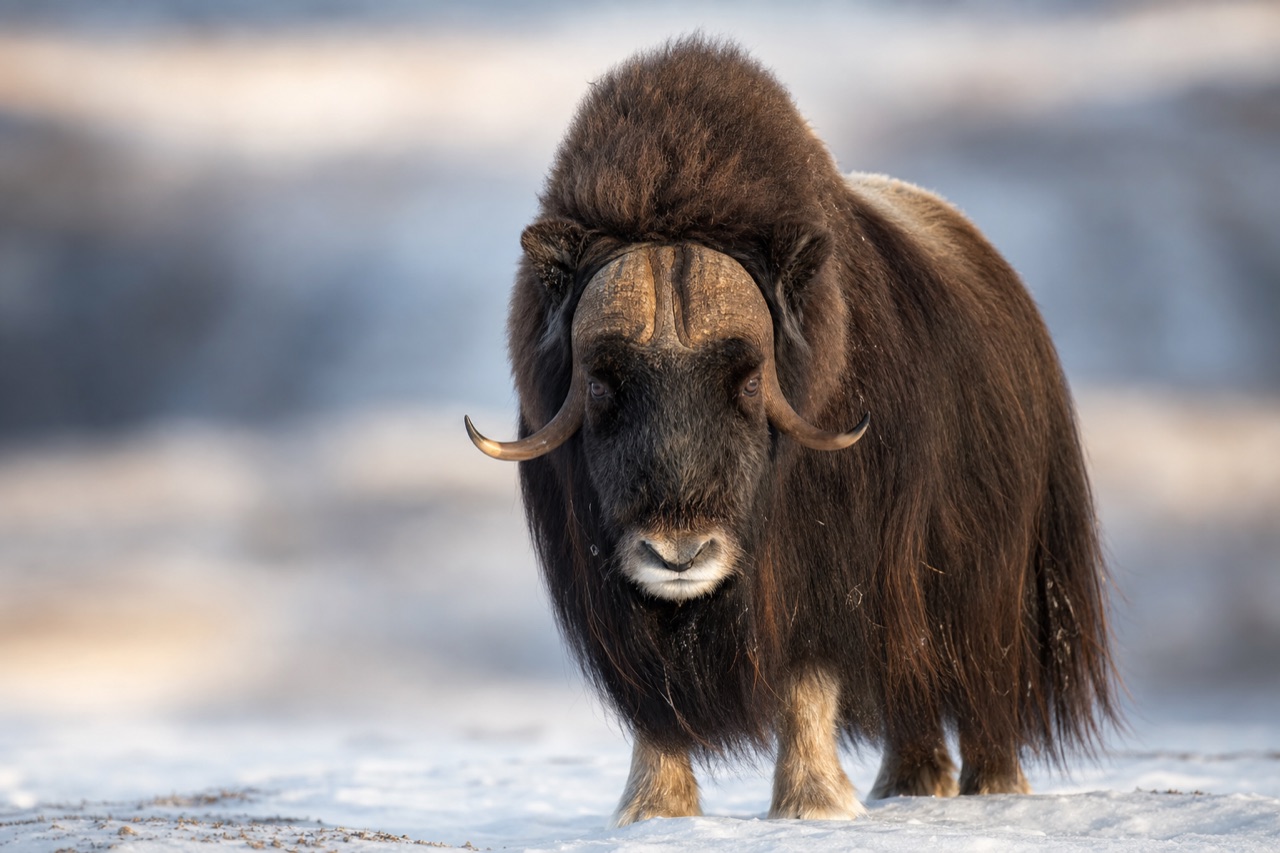
AI-generated educational wildlife portrait — World Animal Rescue Network · AI visualisation, not a photograph
In brief
The muskox (Ovibos moschatus) is an Arctic bovid with a shaggy coat, curved horns and defensive circle formation — recovered from near extinction and now Least Concern, but vulnerable to rapid Arctic climate change.
Also in Animals A to Z · Animals that start with M
By WARN Research & Conservation Team Last updated
The muskox is not an ox. It is a caprine — closer to goats and sheep than to cattle — adapted to the Arctic tundra of Canada and Greenland. Bulls stand about 1.5 m at the shoulder and weigh up to 400 kg, draped in a double coat: long coarse guard hairs reaching almost to the ground, and beneath them qiviut, an extraordinarily fine underwool eight times warmer than sheep's wool by weight. The name 'musk' refers to a strong odour bulls produce in rut, not to any ox ancestry. Horns are the other signature. Both sexes carry them, sweeping down beside the face and curving outward at the tips. In defence, muskoxen form a static circle — adults facing outward with horns, calves hidden in the centre — a formation that deterred wolves for millennia and now tests hungry bears in a warming Arctic. They do not flee far; they hold ground. Muskoxen were nearly exterminated by hunting in the nineteenth century, reduced to a few hundred animals in Arctic Canada. Protection and reintroduction rebuilt populations to tens of thousands. They are Least Concern today, but climate change — rain on snow, thaw-freeze cycles, shrub expansion and increased bear predation on calves — is an emerging pressure on an animal built for cold dry tundra, not for an Arctic that is greening and warming fastest on Earth. Fossil evidence places muskoxen across Pleistocene Eurasia and North America — a wider range than today — making the current Arctic distribution a relict of climate and hunting history rather than the species' maximum extent. Winter photography tourism to muskox herds pays local guides in Greenland and Norway — economic value attached to live muskoxen complements subsistence hunting rather than replacing it, when quotas stay evidence-based. Calves born in late spring align with brief Arctic plant productivity; a mismatch from earlier green-up without earlier birth could become a phenology risk under rapid warming.
Qiviut
Fine underwool — warmer than sheep wool by weight
Circle
Defensive formation — horns out, calves within
~400 kg
Large bull weight
Recovered
From near extinction in the nineteenth century
Figures sourced from IUCN Red List — Ovibos moschatus, Arctic Council — muskox .
Muskox: Quick Facts
| Weight | Up to ~400 kg (bulls) |
|---|---|
| Coat | Guard hairs + qiviut underwool |
| Defence | Circle formation, horns outward |
| Native range | Arctic Canada and Greenland |
| IUCN status | Least Concern |
| Main threats | Climate change, predation on calves |
Scientific Classification
| Kingdom | Animalia |
|---|---|
| Phylum | Chordata |
| Class | Mammalia |
| Order | Artiodactyla |
| Family | Bovidae |
| Subfamily | Caprinae |
| Species | Ovibos moschatus |
Conservation Status
- IUCN Status
- Least Concern
- Population
- Roughly 100,000–150,000 globally
- Trend
- Stable to increasing in core range; local declines suspected
- Assessed
- 2016
- CITES
- Not listed
Recovery from nineteenth-century near-extinction is a success story. Arctic warming poses the next long-term risk.
Did you know?
When threatened, muskoxen form a ring — adults facing out with horns, calves hidden inside — a defence unchanged since the Pleistocene.
Key Facts: Muskox
- Muskoxen are Arctic bovids — related to goats and sheep, not cattle.
- Qiviut underwool is among the finest natural fibres; shed and collected without shearing live animals in managed herds.
- Defence is a stationary horn-outward circle protecting calves in the centre.
- Hunted nearly to extinction; protection and reintroduction recovered populations.
- Reintroduced in Alaska, Russia and Scandinavia outside core Canadian-Greenland range.
- Climate change — rain-on-snow, shrub expansion, bear predation — is the emerging threat.
Built for Arctic cold
Muskox physiology assumes cold. The metabolic strategy conserves heat; the coat is the primary insulation. Guard hairs shed water and snow; qiviut traps air against the skin. Calves are born in late spring when tundra plants green, already able to follow the herd within hours.
Diet is low-quality forage — sedges, grasses, willow and birch leaves, mosses — extracted efficiently by rumination. Muskoxen dig through snow to reach vegetation, and in summer graze wetlands and river margins where protein is higher. They require access to ice-free water or snow for hydration; winter dehydration is a real stressor when thaw cycles create crust layers locking away forage.
Movement is sedentary compared with caribou. Herds occupy home ranges on coastal plains and inland tundra, shifting locally with season rather than migrating thousands of kilometres. That sedentary habit makes them sensitive to local habitat change — if rain-on-snow events increase in their range, the whole herd suffers without option to move elsewhere.
Circle defence and predation
When threatened, muskoxen do not scatter. Adults cluster with horns facing outward and young inside. Wolves probe the circle, testing for gaps; bears, especially grizzlies in Canada and polar bears in coastal Greenland, attempt to panic the formation or pick off stragglers. Bulls charge from the circle if a predator commits — a 400 kg impact with sharp horns is lethal.
Calves are the vulnerability. Bears take calves when circles break or when solitary cows calve slightly apart from the herd. Increased bear activity linked to sea-ice loss and longer ice-free periods on land has been suggested as a calf mortality factor in some Arctic regions, though data are still regional.
Humans historically hunted muskoxen for meat and hides until populations crashed. Modern subsistence hunting is regulated in Canada and Greenland; sport hunting occurs under quota. The recovery story is one of legal protection working when habitat remained available.
Recovery and reintroduction
By the early twentieth century muskoxen survived only in isolated Arctic Canada and Greenland, numbering in the low hundreds. Hunting bans, relocation projects and captive breeding at the University of Alaska Fairbanks' Large Animal Research Station rebuilt numbers. Today estimates run to roughly 100,000–150,000 globally, mostly in Canada and Greenland.
Reintroductions established free-ranging populations on Alaska's North Slope, in Russia's Taymyr and on Norway's Dovrefjell — the latter a tourist attraction and conservation experiment in recreating Pleistocene-like megafauna communities. Not all reintroductions persist; failures teach that muskoxen need suitable tundra, predator regimes and legal protection simultaneously.
Qiviut harvesting from farmed and semi-domestic herds — combed from the coat at shed rather than sheared — supports Arctic economies without culling wild populations. Wild muskoxen remain fully wild; farmed qiviut is a parallel industry.
Warming Arctic, uncertain future
Climate models project the Arctic warming faster than lower latitudes. For muskoxen, consequences include rain falling on snow and freezing into ice crusts that block winter forage; increased shrub encroachment changing grazing plant communities; parasite and disease ranges expanding northward; and predator pressure shifting as bear behaviour changes with ice timing.
Population monitoring shows mixed signals — some herds stable, others declining locally. Muskoxen are not facing immediate global extinction; they are facing incremental habitat degradation in the only biome they inhabit. Least Concern today does not mean secure tomorrow if rain-on-snow mortality becomes frequent rather than episodic.
Conservation is climate policy plus continued hunting regulation plus research on calf survival. Muskoxen cannot move to colder latitudes when the Arctic itself warms — there is no fallback biome. They are a flagship for what 'Least Concern in a melting habitat' looks like.
Muskoxen and Indigenous livelihoods
In Greenland and Arctic Canada, muskoxen support subsistence hunting and guided sport hunting economies. Qiviut combing from farmed herds adds textile income without requiring large-scale wild culls. Co-management boards set quotas reflecting both cultural harvest rights and population monitoring.
Tourism to view muskox herds — Dovrefjell in Norway, Alaska's North Slope — generates revenue that competes with extractive land uses. The animal's Pleistocene appearance sells camera time; protecting tundra sells less easily but underpins both muskox and tourism.
Indigenous knowledge of muskox behaviour, migration timing and sustainable harvest long predates scientific census. Modern management works best when it integrates that knowledge rather than treating muskox as a blank-slate population model.
What WARN Does
WARN publishes free, sourced species education for species whose recovery story is real but whose habitat is changing faster than management adapts. Muskoxen recovered from hunting; climate is the next test.
If this guide helps you understand wildlife and the pressures it faces, a gift to WARN supports habitat protection and free public education in our partner countries.
Muskox: Frequently Asked Questions
Is a muskox an ox?
What is qiviut?
How do muskoxen defend themselves?
Are muskoxen endangered?
Where do muskoxen live?
What do muskoxen eat?
Are muskoxs dangerous?
How long do muskoxs live?
How big is a muskox?
Sources & References
Population figures, conservation status and biological facts on this page are drawn from authoritative scientific and intergovernmental sources.
Terms used on this page
Plain-English definitions, from our wildlife and conservation glossary.
Explore more animals
Discover more animals, their habitats and their conservation status in the WARN wildlife-guide library.
Enjoyed this Muskox guide?
Receive appeal updates, animal-welfare news and published funding reports. Unsubscribe any time.
We only use your address for WARN updates. See our privacy policy.