Wildlife Guide · Native: North America & Invasive: Europe, Asia, South America and Iceland
Mink
Neogale vison (Schreber, 1777) — family Mustelidae
Secure in North America, devastating in Europe — fur farming turned a river predator into a continent-scale invasive.
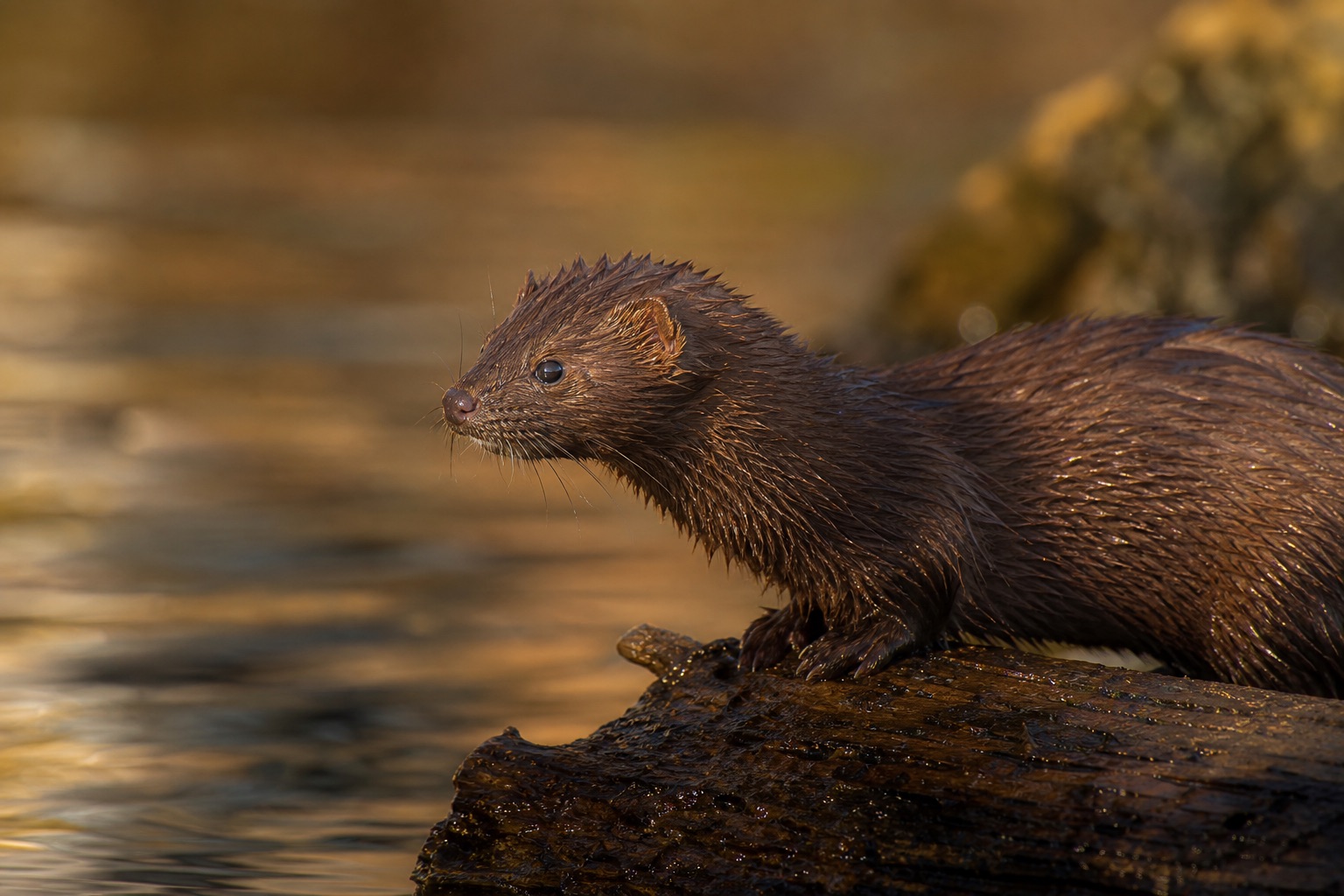
AI-generated educational wildlife portrait — World Animal Rescue Network · AI visualisation, not a photograph
In brief
The American mink (Neogale vison) is a semi-aquatic mustelid listed Least Concern in native North America but invasive across Europe after fur-farm escapes, where it devastated water vole populations and displaced the Critically Endangered European mink.
Also in Animals A to Z · Animals that start with M
By WARN Research & Conservation Team Last updated
The American mink is a semi-aquatic mustelid native to North America — sleek, dark-furred, and adapted to hunting along streams, lakes and coastlines. In its native range it is widespread and listed Least Concern. In Europe, where it was introduced deliberately and through fur-farm escapes from the 1920s onwards, it is one of the most damaging invasive mammals on the continent. American mink are generalist predators: fish, crayfish, frogs, water voles, ground-nesting birds and eggs. They swim well, enter burrows, and kill prey larger than themselves. European wildlife had no evolutionary experience of a semi-aquatic carnivore at this size and efficiency. Water vole populations in Britain collapsed — American mink predation is cited as a primary factor alongside habitat loss — and ground-nesting seabird colonies on Scottish islands were decimated. European mink, a native congener now Critically Endangered, was displaced and killed by the American species across much of its range. Fur farming drove the invasion. At peak production, millions of pelts were processed annually; escapes and deliberate releases established feral populations from Scandinavia to Iberia. Several European countries have now banned fur farming; managing the feral legacy remains the harder problem. The American mink story parallels other fur-farm introductions — nutria, muskrat — where a commercial species became an ecological liability.
1920s
Deliberate and accidental releases begin in Europe
>90%
Approximate water vole range loss in Britain — mink among causes
Least Concern
Native North American status
Fur farms
Source of most introduced populations
Figures sourced from IUCN Red List — Neovison vison / Neogale vison, EU non-native organism risk assessment — American mink, WildCRU — mink research and water vole restoration .
Mink: Quick Facts
| Body length | About 30–45 cm plus tail |
|---|---|
| Weight | About 0.7–1.5 kg (males) |
| Diet | Fish, crayfish, voles, birds, amphibians |
| Native range | North America |
| Lifespan | About three to four years in the wild |
| IUCN status (native) | Least Concern |
| Invasive range | Europe, parts of Asia and South America |
Scientific Classification
| Kingdom | Animalia |
|---|---|
| Phylum | Chordata |
| Class | Mammalia |
| Order | Carnivora |
| Family | Mustelidae |
| Genus | Neogale |
| Species | Neogale vison |
Conservation Status
- IUCN Status
- Least Concern globally — invasive in introduced range
- Population
- Widespread and abundant in native North America; feral populations across Europe
- Trend
- Stable in native range; established and managed in invasive range
- Assessed
- 2016
- CITES
- Not listed
The Least Concern listing reflects North American security. In Europe the species is a high-impact invasive requiring ongoing control to protect water voles, seabirds and the Critically Endangered European mink.
Did you know?
Otters aggressively exclude mink from territory — in parts of Europe, otter recovery is being used as a natural component of mink control alongside trapping.
Key Facts: Mink
- American mink are Least Concern in native North America but invasive and ecologically destructive across Europe.
- Introduction followed fur farming from the 1920s — escapes and deliberate releases established feral populations.
- Water vole declines in Britain are linked to American mink predation alongside habitat loss and fragmentation.
- European mink (Mustela lutreola) is Critically Endangered; American mink competition and predation contributed to the decline.
- Ground-nesting seabird colonies on Scottish islands suffered heavy predation from mink.
- Several European countries have banned fur farming; feral mink control continues through trapping and rafts.
- Otter recovery may help suppress mink in some areas through territorial aggression.
Native predator, invasive catastrophe
In North America the American mink occupies a normal mesopredator role along waterways, coexisting with otters, raccoons and native prey communities that evolved alongside it. The IUCN lists it Least Concern because populations remain secure across Canada, Alaska and most of the United States.
In Europe the same species behaves differently because the food web is different. Introduced mink encounter naive prey — water voles that never evolved mink avoidance, ground-nesting birds with no defence against a swimming egg predator, and the European mink, a smaller native congener that loses in direct competition. The pattern repeats on other continents: feral mink in Argentina threaten endangered hooded grebes on remote plateau lakes. Secure globally does not mean harmless everywhere — a lesson shared with other fur-farm escapees and with island extinctions such as the dodo, where introduced mammals destroyed naive native wildlife.
Fur farming and the escape problem
American mink became the most farmed fur-bearing carnivore in the twentieth century, exceeding fox and sable in economic output. Farms across Europe, Russia and China held animals in wire cages; escapes during storms, vandalism and deliberate release by animal-welfare activists all contributed to feral establishment. Soviet introductions in the 1930s and 1940s spread mink across Russia and Belarus deliberately to create a harvestable wild population.
Banning fur farming stops new escapes but does not remove established ferals. The Netherlands, the United Kingdom, Norway and several other countries have ended mink farming; control of wild populations relies on trapping — including mink rafts that detect footprints and trigger traps — and in some areas on encouraging otter recovery, as otters aggressively exclude mink from territories.
Impact on water voles and European mink
The water vole — Britain's largest native vole, the animal Kenneth Grahame's Rat was probably meant to be — has lost more than 90% of its range since the mid-twentieth century. Habitat loss, pollution and fragmentation started the decline; American mink predation accelerated it because water voles have no effective defence against a predator that enters burrows from water and land simultaneously.
Experimental mink removal on British rivers has allowed water vole reintroductions to succeed where habitat is restored — demonstrating that predation was the limiting factor in those sites. European mink, now Critically Endangered and confined to isolated fragments in Spain, France, Romania and the Danube delta, face competition and hybridisation pressure from American mink across much of the former range.
Management and the fur-trade legacy
Complete eradication of American mink from continental Europe is not considered feasible. Management targets local suppression — protecting seabird colonies before breeding season, maintaining mink-free islands, and supporting water vole recovery projects with ongoing trapping. EU risk assessments classify the species as high-impact; member states implement varying control programmes.
The broader lesson is about introduction pathways. Fur farming, pet trade and deliberate acclimatisation have repeatedly moved species into environments where they outperform native competitors. The American mink is among the clearest cases because the evidence chain from farm escape to population collapse in native prey is well documented across decades of research.
What WARN Does
WARN publishes free, sourced species education including invasive-species stories that complicate simple status labels. The American mink is Least Concern on the IUCN Red List and a conservation emergency in Europe — the same animal, two incompatible ecological roles.
If this guide helps you understand wildlife and the pressures it faces, a gift to WARN supports habitat protection and free public education in our partner countries.
Mink: Frequently Asked Questions
What do mink eat?
Where do mink live?
Are mink dangerous to humans?
How long do mink live?
How big is an American mink?
Why are American mink a problem in Europe?
Is mink fur farming still legal?
Sources & References
Population figures, conservation status and biological facts on this page are drawn from authoritative scientific and intergovernmental sources.
Terms used on this page
Plain-English definitions, from our wildlife and conservation glossary.
Explore more animals
Discover more animals, their habitats and their conservation status in the WARN wildlife-guide library.
Enjoyed this Mink guide?
Receive appeal updates, animal-welfare news and published funding reports. Unsubscribe any time.
We only use your address for WARN updates. See our privacy policy.