Wildlife Guide · Africa, the Middle East and southern Asia for desert locust & Other locust species on every inhabited continent
Locust
Grasshoppers (Acrididae) in the gregarious phase — e.g. Schistocerca gregaria (Forskål, 1775), the desert locust
A grasshopper that physically transforms when crowding triggers the gregarious phase.
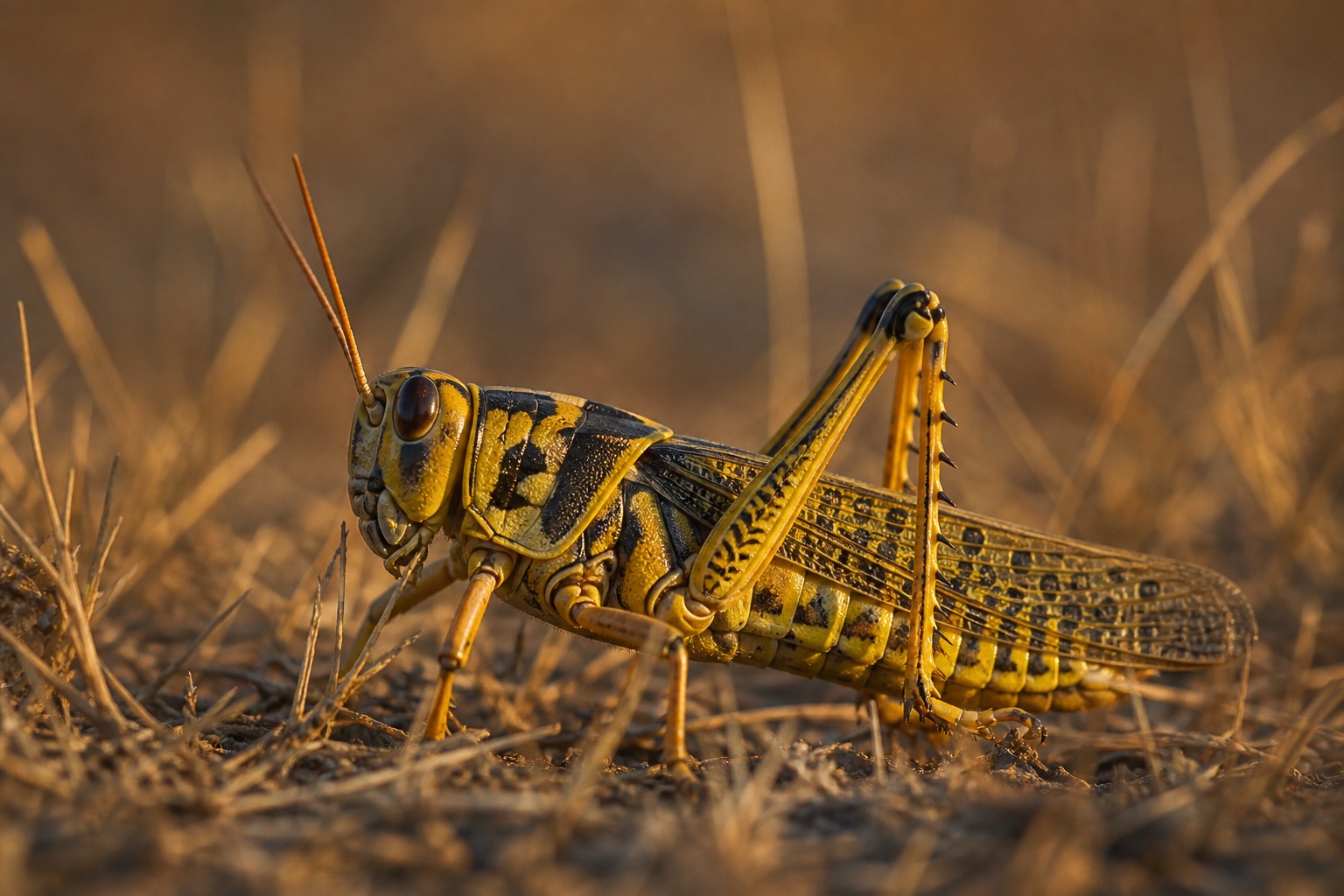
AI-generated educational wildlife portrait — World Animal Rescue Network · AI visualisation, not a photograph
In brief
A locust is a grasshopper (family Acrididae) in its gregarious phase — triggered by crowding, it changes colour, shape and behaviour and forms swarms; the desert locust (Schistocerca gregaria) can devastate crops across Africa, the Middle East and southern Asia.
Also in Animals A to Z · Animals that start with L
By WARN Research & Conservation Team Last updated
A locust is not a separate kind of insect from a grasshopper. It is the same animal in a different phase. Many grasshopper species in the family Acrididae can switch between a solitary phase — cryptic green or brown, dispersed, relatively inactive — and a gregarious phase triggered by crowding. In that phase the colour, body shape, behaviour and metabolism change together, and the insects march or fly in vast swarms that can strip landscapes bare. The desert locust, Schistocerca gregaria, is the species behind most historic plague headlines. Its gregarious phase can form swarms of billions covering hundreds of square kilometres, crossing continents on wind. The mechanism is phenotypic plasticity: one genome, two bodies, selected by tactile stimulation from other locusts' hind legs. It is among the clearest demonstrations in insects that environment can rewrite form without changing DNA.
1 genome
Two phases — solitary and gregarious
Billions
Desert locust swarms at peak — area and density vary
4,000 km
Approximate range span of desert locust breeding areas
Serotonin
Crowding triggers neurochemical shift toward gregariousness
Figures sourced from FAO — Desert Locust Information Service, IUCN Red List .
Locust: Quick Facts
| Adult length | Roughly 6–9 cm in desert locust |
|---|---|
| Diet | Green vegetation and crops |
| Habitat | Arid breeding belts; swarms travel widely |
| Phase trigger | Crowding and tactile stimulation |
| Plague species | Schistocerca gregaria — desert locust |
| Human risk | Crop damage, not venom or bite |
Scientific Classification
| Kingdom | Animalia |
|---|---|
| Phylum | Arthropoda |
| Class | Insecta |
| Order | Orthoptera |
| Family | Acrididae |
| Species | Schistocerca gregaria — desert locust (best-known plague species) |
| Phase | Solitary versus gregarious — same species, different phenotype |
Conservation Status
- IUCN Status
- Not Evaluated
- Population
- Swarm populations can reach billions during outbreaks
- Trend
- Cyclic — plague years versus recession years
- Assessed
- Desert locust not globally Red-Listed
- CITES
- Not listed
Locust management is about agricultural impact, not species rarity. Outbreaks reflect phase dynamics and weather, not population collapse.
Did you know?
Touching a locust's hind leg against another locust's body can help trigger the shift from solitary hopper to gregarious swarm member — one of the best-studied examples of crowding rewriting an insect's body and behaviour without changing its genes.
Key Facts: Locust
- Locusts are grasshoppers in a gregarious phase — not a separate taxonomic group.
- Crowding — especially tactile stimulation from other locusts — triggers the phase change.
- Gregarious locusts differ in colour, body proportions, activity and tendency to swarm.
- The desert locust (Schistocerca gregaria) is the species behind most transcontinental plague events.
- Swarms can travel with wind and cross borders; control requires international coordination.
- Solitary-phase locusts look and behave like ordinary grasshoppers and are easily overlooked.
One species, two bodies — phenotypic plasticity
Solitary-phase Schistocerca gregaria is green or brown, avoids other locusts, and moves relatively little. Raise density in a laboratory or field cage until individuals touch repeatedly, and within hours to days the offspring and sometimes the adults shift toward gregarious traits: stronger yellow and black colouration, longer wings relative to body, higher activity and attraction to others of the same species.
The switch involves serotonin signalling in the central nervous system — a neurochemical cascade linking touch stimulus to behavioural and developmental change. Reverse the crowding and successive moults can move the population back toward solitary form. One genome produces two ecologically different animals depending on population density.
Swarms, migration and crop damage
Gregarious desert locusts form bands on the ground that march in the same direction, then take wing as adults in swarms that follow wind and vegetation flushes. A single swarm can contain billions of insects and consume its own weight in green vegetation daily — a figure often quoted in plague reporting and one that scales terrifyingly with swarm mass even when the per-insect rate is ordinary for a large herbivorous insect.
Breeding areas span roughly 16 million square kilometres across more than 60 countries from West Africa to India. Drought followed by rainfall can trigger simultaneous hatching and crowding, initiating a plague cycle that may persist for years if control and weather align against it. Crop loss hits subsistence farmers first; international monitoring through the Food and Agriculture Organization coordinates survey and treatment.
Why ordinary grasshopper control is not locust control
Spraying a garden grasshopper does not address a transcontinental plague species. Locust management relies on early detection of gregarious bands in remote breeding areas, targeted application of approved pesticides or biological agents such as Metarhizium fungus, and cross-border reporting obligations under international agreements.
Confusing a solitary locust-capable grasshopper with a non-swarming species is harmless; confusing a forming band with ordinary hopper density is not. The phase change is the diagnostic: gregarious nymphs march together in coordinated bands rather than dispersing. That behaviour is visible from the ground and in satellite-assisted survey programmes.
Climate, conflict and the next outbreak
Locust plagues correlate with weather patterns that produce green vegetation in normally dry breeding belts — often after drought breaks. War and inaccessible territory complicate survey: undetected bands in Yemen or the Sahel can seed swarms that reach other countries before control begins.
Schistocerca gregaria is not Red-Listed as a species because it is abundant by definition during outbreaks. The human problem is agricultural and economic, not extinction risk. Other locust species — Australian plague locust, migratory locust in Asia — follow similar phase logic on regional scales.
What WARN Does
WARN publishes free insect education that explains mechanisms, not just headlines. Locust plagues are a phase-change story — understanding crowding and phenotypic plasticity is what separates informed reporting from plague panic.
If this guide helps you understand wildlife and the pressures it faces, a gift to WARN supports habitat protection and free public education in our partner countries.
Locust: Frequently Asked Questions
What do locusts eat?
Where do locusts live?
Are locusts dangerous to humans?
How long do locusts live?
How big are locusts?
What is the difference between a locust and a grasshopper?
Sources & References
Population figures, conservation status and biological facts on this page are drawn from authoritative scientific and intergovernmental sources.
Explore more animals
Discover more animals, their habitats and their conservation status in the WARN wildlife-guide library.
Enjoyed this Locust guide?
Receive appeal updates, animal-welfare news and published funding reports. Unsubscribe any time.
We only use your address for WARN updates. See our privacy policy.