Wildlife Guide · Africa & Asia
Jumping Spider
Salticidae
The big-eyed spider that pounces on its prey
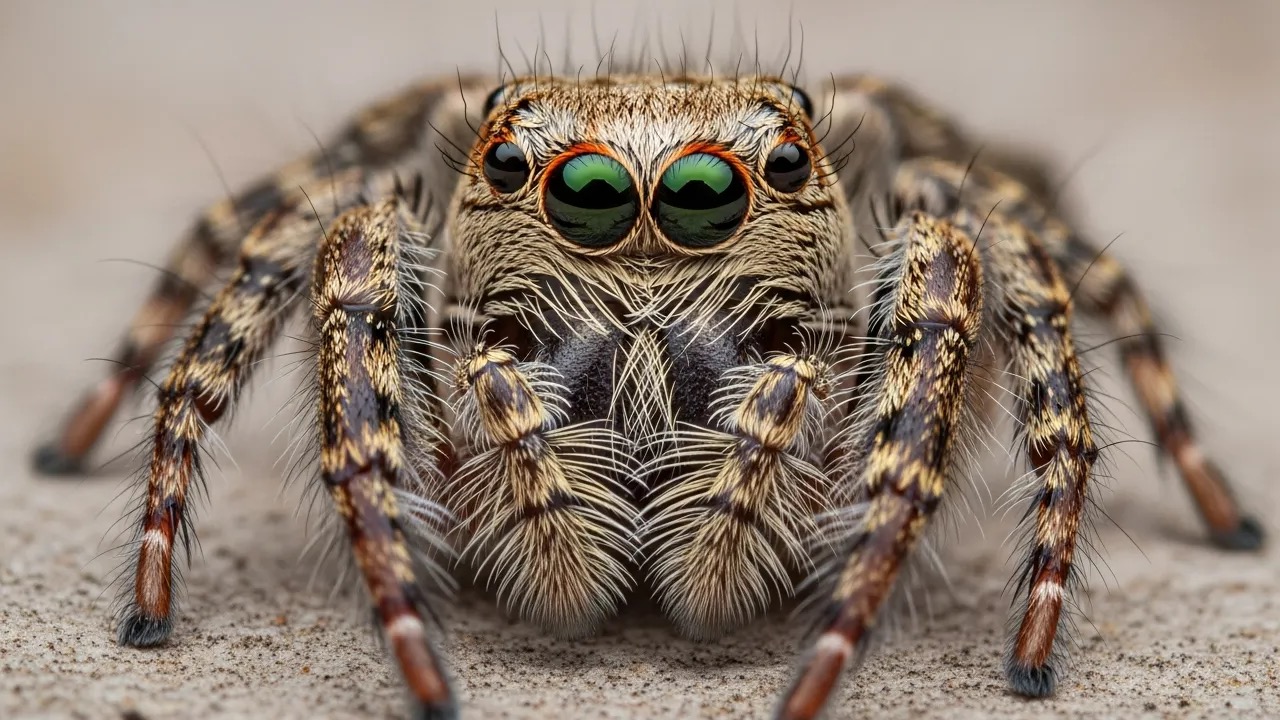
Photo: Kevincollins123 / Wikimedia Commons (CC BY-SA 3.0)
In brief
Jumping spiders (family Salticidae) are small, sharp-eyed hunters found on sunny walls, plants, and woodlands worldwide. Most are just 1 to 2 cm (0.4 to 0.8 in) including their legs, yet they have superb vision and can leap many times their body length to pounce on prey.
Also in Animals A to Z · Animals that start with J
By WARN Research & Conservation Team Last updated
Jumping spiders (family Salticidae) are small, sharp-eyed hunters found on sunny walls, plants, and woodlands worldwide. Most are just 1 to 2 cm (0.4 to 0.8 in) including their legs, yet they have superb vision and can leap many times their body length to pounce on prey. Rather than build webs to catch food, they stalk and ambush insects by day. Individuals typically live about a year and are of Least Concern.
0.015 m
Typical length
1 g
Typical weight
1.6 km/h
Top speed
1 yrs
Lifespan
Figures sourced from Wikipedia — Jumping Spider, Wikidata — Jumping Spider .
Jumping Spider: Quick Facts
| Scientific name | Salticidae (family) |
|---|---|
| Diet | Carnivore (insects and other small arthropods) |
| Habitat | Sunny walls, plants, and woodlands worldwide |
| Lifespan | About 1 year (varies by species) |
| Size | Mostly 1–2 cm (0.4–0.8 in) including legs |
| Top speed | Leaps many times its body length |
| Conservation status | Least Concern (IUCN, most species) |
Scientific Classification
| Kingdom | Animalia |
|---|---|
| Phylum | Arthropoda |
| Class | Arachnida |
| Order | Araneae |
| Family | Salticidae |
Conservation Status
- IUCN Status
- Least Concern (IUCN Red List category)
- Population
- Global population not compiled for this guide
- Trend
- See the IUCN Red List assessment
- Assessed
- See the IUCN Red List assessment
- CITES
- See CITES appendices
Conservation figures are drawn from the IUCN Red List and CITES; this guide links to the authoritative sources rather than restating population counts.
Key Facts: Jumping Spider
- Jumping spiders are compact and often furry, with most species measuring just 1 to 2 cm (0.4 to 0.8 in) including the legs.
- Rather than snaring prey in a web, jumping spiders are active daytime hunters that stalk and pounce.
- Jumping spiders do not have large muscles in their legs to power a jump.
Appearance and remarkable eyes
Jumping spiders are compact and often furry, with most species measuring just 1 to 2 cm (0.4 to 0.8 in) including the legs. Their standout feature is a set of eight eyes, dominated by two large forward-facing eyes that give them the sharpest vision of any spider. This excellent eyesight lets them judge distance accurately before a leap and recognise prey, mates, and rivals. Many species are boldly patterned, and the males of some are strikingly colourful.
How jumping spiders hunt
Rather than snaring prey in a web, jumping spiders are active daytime hunters that stalk and pounce. Using their keen eyes, a spider will spot an insect, creep closer, carefully line up the distance, and then leap onto it with a precise pounce. Before jumping it anchors a silk dragline to the surface, which acts as a safety line if it misses. They do not run down their prey over long distances, relying instead on stealth and a sudden, accurate leap.
The secret of the leap
Jumping spiders do not have large muscles in their legs to power a jump. Instead they rapidly increase the blood-like fluid pressure inside the body, which extends the rear legs almost explosively and launches the spider forward. This hydraulic mechanism lets them leap many times their own body length despite an overall crawling speed of only about 1.6 km/h. The trailing silk dragline helps steady them in flight and lets them climb back if a jump falls short.
Diet and behaviour
Jumping spiders are carnivores that feed on insects and other small arthropods, including flies, moths, and even other spiders. A few species supplement their diet with nectar or plant matter, and some specialise in hunting particular prey. They are curious and alert by nature, often turning to face and track movement, which gives them an unusually inquisitive appearance. Being active by day, they are among the spiders people most often notice on sunlit walls and leaves.
Courtship and life cycle
Male jumping spiders perform elaborate courtship displays, waving their legs and, in some colourful species, showing off bright body patterns to females. After mating, the female lays eggs in a silk nest, often tucked under bark or a leaf, and may guard them until the young hatch. Most jumping spiders live for around a year, growing through a series of moults before reaching adulthood. They are harmless to humans and are of Least Concern.
What WARN Does
WARN does not run a dedicated jumping spider programme — this guide is part of the World Animal Rescue Network's free educational library. The jumping spider is currently widespread and not globally threatened, and this guide helps readers understand the pressures that can change that. Building public understanding of species like the jumping spider supports the broader conservation awareness that underpins WARN's partner-led rescue work across its network.
If clear, science-based wildlife guides like this help you understand and value animals, please consider supporting the World Animal Rescue Network's educational and rescue work so we can keep producing them.
Jumping Spider: Frequently Asked Questions
Do jumping spiders build webs?
How far can a jumping spider jump?
Are jumping spiders dangerous to humans?
What do jumping spiders eat?
Why do jumping spiders have such good eyesight?
How long do jumping spiders live?
Where do jumping spiders live?
How big is a jumping spider?
Sources & References
Population figures, conservation status and biological facts on this page are drawn from authoritative scientific and intergovernmental sources.
Terms used on this page
Plain-English definitions, from our wildlife and conservation glossary.
Latest Jumping Spider Stories
Quick, fact-checked reads on the jumping spider — amazing facts, key questions and the threats it faces.
Species
Slow Loris: Why the Internet's Favourite Pet Is a Conservation Disaster
The slow loris looks like a cartoon character — and that has nearly destroyed the species. Here is the truth behind the viral videos.
Read the storySpecies
The Snow Leopard: Why the Ghost of the Mountains Is Still Vulnerable
The snow leopard is one of the most elusive big cats on earth, with an estimated 4,000-6,500 individuals across twelve range states — including Pakistan, where WARN is preparing to operate. This briefing explains why the species was downlisted from Endangered to Vulnerable in 2017 and why that is not the success story it sounds like.
Read the storyGuides
Sun Bear vs Moon Bear: The Two Most Trafficked Asian Bears
The sun bear and the Asiatic black bear (moon bear) are the two most commonly trafficked bears in Asia — for the pet trade, for traditional medicine and for bear-bile farming. Here is how to tell them apart.
Read the storyExplore more animals
Discover more animals, their habitats and their conservation status in the WARN wildlife-guide library.
Enjoyed this Jumping Spider guide?
Receive appeal updates, animal-welfare news and published funding reports. Unsubscribe any time.
We only use your address for WARN updates. See our privacy policy.