Wildlife Guide · Temperate woodlands across Europe, North Africa and western Asia & Deciduous and mixed forest with oak in Britain
Jay
Garrulus glandarius (Linnaeus, 1758) — family Corvidae
The pink corvid that screams from cover — and plants oakwoods one acorn at a time.
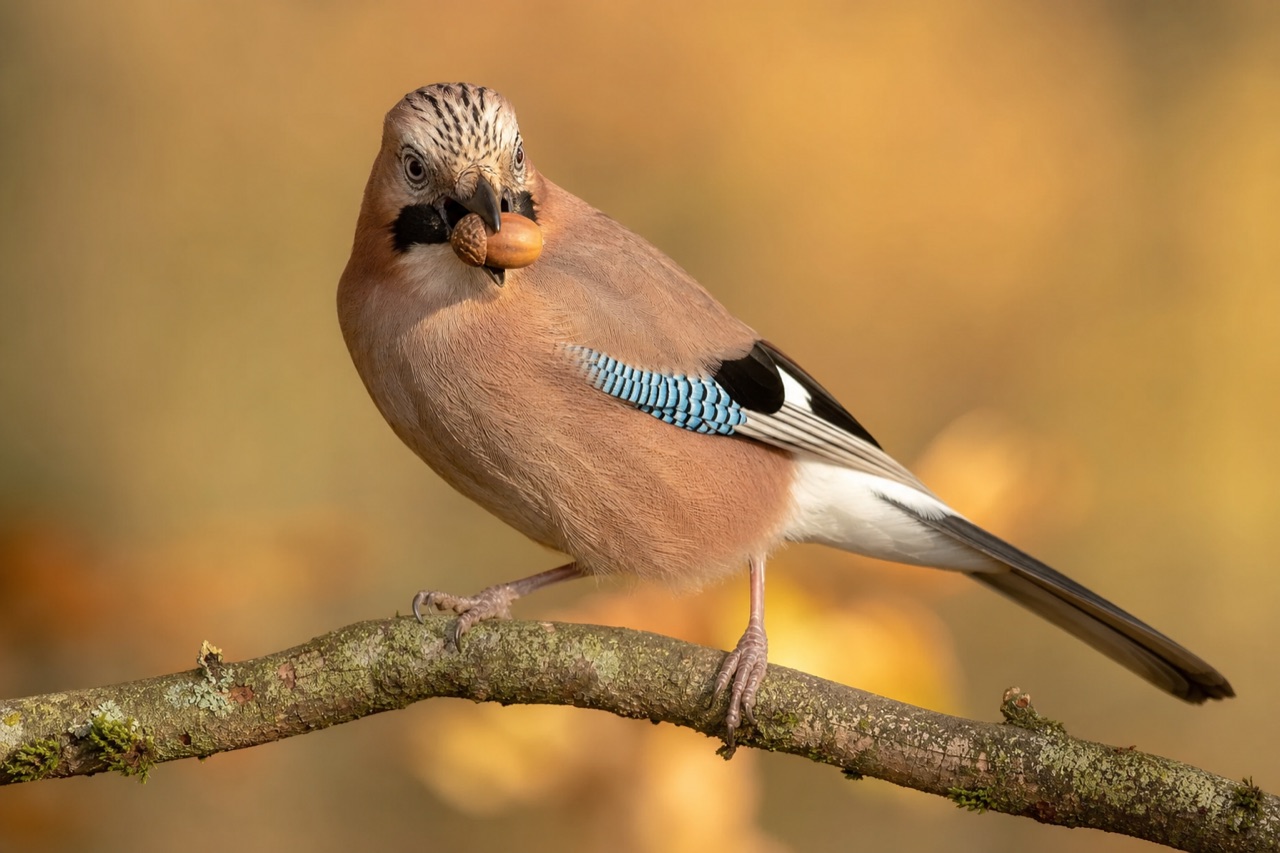
AI-generated educational wildlife portrait — World Animal Rescue Network · AI visualisation, not a photograph
In brief
The Eurasian jay (Garrulus glandarius) is a pink-brown woodland corvid with a blue wing patch, known for its harsh screech, secretive habits and autumn acorn caching that helps regenerate oak woodland across Britain and temperate Eurasia.
Also in Animals A to Z · Animals that start with J
By WARN Research & Conservation Team Last updated
The Eurasian jay is the most colourful corvid in Britain: pink-brown body, black-and-white wing patch and a barred panel of electric blue on the closed wing that flashes when the bird flies. It is also the most elusive. Jays spend much of their time in woodland canopy and understorey, moving quietly until something alarms them — then the harsh, screeching call carries far through the trees. That call is the sound most people know the jay by, because the bird itself is rarely seen clearly. In autumn, though, jays become more visible at woodland edges and in parks with mature oaks, gathering acorns and burying them in scattered caches across the forest floor. A single jay may store thousands of acorns in a season, and the ones it forgets — or never retrieves — germinate into saplings. Jays are one of the main dispersers of oak in European woodland, and their caching behaviour directly shapes which oak trees grow where. Jays are omnivores. Acorns dominate the autumn diet, but through spring and summer they take insects, small mammals, eggs and nestlings of other birds. That predatory side makes them unpopular with some birdwatchers, but it is standard corvid ecology — magpies and crows play the same role. In gardens, jays visit peanut feeders cautiously, usually from cover, and disappear at the first sign of disturbance.
Acorn caches
Thousands stored per bird each autumn
Oak dispersal
Major agent of oak regeneration in European woods
~34 cm
Length — similar to a jackdaw but bulkier
Shy feeder
Visits garden peanuts cautiously from cover
Figures sourced from IUCN Red List — Garrulus glandarius, BTO — BirdFacts: Jay .
Jay: Quick Facts
| Length | 32–35 cm |
|---|---|
| Wing patch | Blue, black and white bar on inner wing |
| Key food | Acorns, beech mast, insects, small vertebrates |
| Nest site | Tree fork in deciduous woodland |
| Call | Harsh screech — often heard, less often seen |
| Ecological role | Major acorn disperser for oak regeneration |
| Main threats | Woodland loss, habitat fragmentation |
Scientific Classification
| Kingdom | Animalia |
|---|---|
| Phylum | Chordata |
| Class | Aves |
| Order | Passeriformes |
| Family | Corvidae |
| Genus | Garrulus |
| Species | Garrulus glandarius |
Conservation Status
- IUCN Status
- Least Concern
- Population
- Widespread across temperate Eurasia; common in British oak woodland
- Trend
- Stable in much of range
- Assessed
- 2017
- CITES
- Not listed
Not a species of conservation concern. Dependent on oak and mixed deciduous woodland for food and nesting.
Did you know?
A single jay may bury several thousand acorns each autumn — and the ones it forgets can germinate into the oak trees of future woodland.
Key Facts: Jay
- Jays are pink-brown corvids with a striking blue patch on the wing — the most colourful crow-family bird in Britain.
- They are secretive woodland birds more often heard screeching than seen clearly.
- Autumn acorn caching is their signature behaviour; forgotten caches germinate into oak saplings.
- Jays eat insects, small mammals and other birds' eggs as well as acorns — standard corvid omnivory.
- They visit garden peanut feeders but rarely linger in the open.
- Domestic cats and disturbance at woodland edges are the main garden-adjacent pressures.
- Least Concern globally; locally common in oak woodland across Britain.
A corvid that prefers cover to confrontation
Unlike magpies and crows, which patrol open ground and rooftops, jays are fundamentally woodland birds. They move through oak and beech canopy, hop along shaded paths and freeze when exposed. The pink-brown plumage is excellent camouflage against leaf litter and bark; the blue wing patch stays hidden until the bird flies, when it becomes a vivid flash that may startle a predator or rival into hesitation.
The screech call — harsh, rising, unmistakable — is both alarm and contact. Jays use it when disturbed, when crossing open ground and when mobbing owls or cats. In spring, a softer version accompanies courtship display, with the male posturing and showing the blue wing panel to the female. Territories are held in woodland, not gardens, though birds will travel to feeders at woodland edges.
Jays are intelligent and wary. A garden jay will watch from a tree for minutes before dropping to a feeder, and will flee at movement behind a window. That caution is adaptive: jays are hunted by goshawks and persecuted historically by gamekeepers who blamed them for egg losses. Their elusiveness is not shyness for its own sake but a corvid that learned to stay out of sight. Where woodland cover reaches garden boundaries, jays become possible — but never bold in the open way magpies are.
Acorn caching and the oaks it plants
From September through November, jays gather acorns — mainly pedunculate and sessile oak — and bury them in loose soil, leaf litter and grass across their territory. Each cache holds one or a few acorns, placed tens of metres apart. A productive jay may store several thousand acorns in a season, and research in oak woodland has shown that jays can transport acorns hundreds of metres from the parent tree, far beyond wind dispersal range.
Not every cache is recovered. Jays have excellent spatial memory but imperfect recall, and some acorns are left to germinate. Over decades, this behaviour shapes woodland structure: oak stands appear where jays cached heavily, and genetic studies confirm that jays move acorns between woodland fragments. In landscapes where oak regeneration is failing because of deer browsing or lack of seed trees, jay dispersal becomes one of the few natural mechanisms still operating.
The caching season makes jays more visible. Birds cross rides and park edges carrying acorns in the gullet and bill, and the white rump shows clearly in flight. This is the best time to see a jay well — not because they become tame, but because the food task forces them into the open more often.
Predator, prey and the nest in a fork
Jay diet shifts with season. Acorns and beech mast dominate autumn and winter; in spring and summer the menu adds caterpillars, beetles, small rodents and the eggs and chicks of smaller birds. Jays are capable nest predators, and studies of songbird breeding success in woodland sometimes find jay predation among the causes of failure — though habitat quality, weather and cat predation usually matter more in suburban settings.
Jays nest in a fork of a deciduous tree, typically three to six metres above ground, building a cup of twigs lined with fine roots and hair. Both parents incubate and feed chicks. The nest is well concealed in foliage, and adults approach silently during breeding — a contrast to their noisy autumn behaviour. Fledglings leave the nest before they fly well and hide in undergrowth, where cats and foxes are the main threats.
In gardens, jays are occasional visitors rather than residents. Mature trees, especially oak, within a hundred metres of a garden bring jays into range of feeders. Whole peanuts and suet attract them; they will not use small-perch seed feeders. Providing cover — a nearby hedge or shrub line — makes jays more likely to visit because they have an escape route.
What jays need from a changing landscape
Jays are Least Concern globally and remain widespread in Britain wherever oak woodland persists. They have expanded into suburban parks and large gardens with mature trees, and are not a conservation priority in the way curlew or lapwing are. The pressures they face are those facing woodland birds generally: loss of mature oak, overgrazing that prevents acorn germination, and fragmentation that isolates caching territories from regeneration sites.
In gardens, the practical contribution is simple: plant oak if you have space and time, tolerate leaf litter where acorns can germinate, and offer peanuts at a quiet feeder with cover nearby. Jays are not a species that needs nest boxes or specialist food — they need woodland nearby and a landscape that still produces acorns. Removing mature oak from a neighbourhood removes jays even if feeders remain full.
Their role as oak dispersers connects a shy garden visitor to the long-term health of the woods beyond the fence. A jay that caches in your local park may be planting the oak that shades the path in decades to come — an ecological service most people never associate with the bird screeching from the treeline. That service depends on germination space, not just acorn production.
What WARN Does
WARN publishes free, sourced species education for woodland birds people hear more often than they see. The jay is a corvid whose acorn caching quietly regenerates oak — a behaviour worth understanding before the woodland it depends on is thinned past recovery.
If this guide helps you understand wildlife and the pressures it faces, a gift to WARN supports habitat protection and free public education in our partner countries.
Jay: Frequently Asked Questions
What does a jay look like?
Why do jays scream?
Do jays steal other birds' eggs?
How do jays help oak trees?
What do eurasian jays eat?
Where do eurasian jays live?
Are eurasian jays dangerous?
How long do eurasian jays live?
How big is an eurasian jay?
Sources & References
Population figures, conservation status and biological facts on this page are drawn from authoritative scientific and intergovernmental sources.
Terms used on this page
Plain-English definitions, from our wildlife and conservation glossary.
Explore more animals
Discover more animals, their habitats and their conservation status in the WARN wildlife-guide library.
Enjoyed this Jay guide?
Receive appeal updates, animal-welfare news and published funding reports. Unsubscribe any time.
We only use your address for WARN updates. See our privacy policy.