Wildlife Guide · Asia
Asian Giant Hornet
Vespa mandarinia
The world's largest hornet
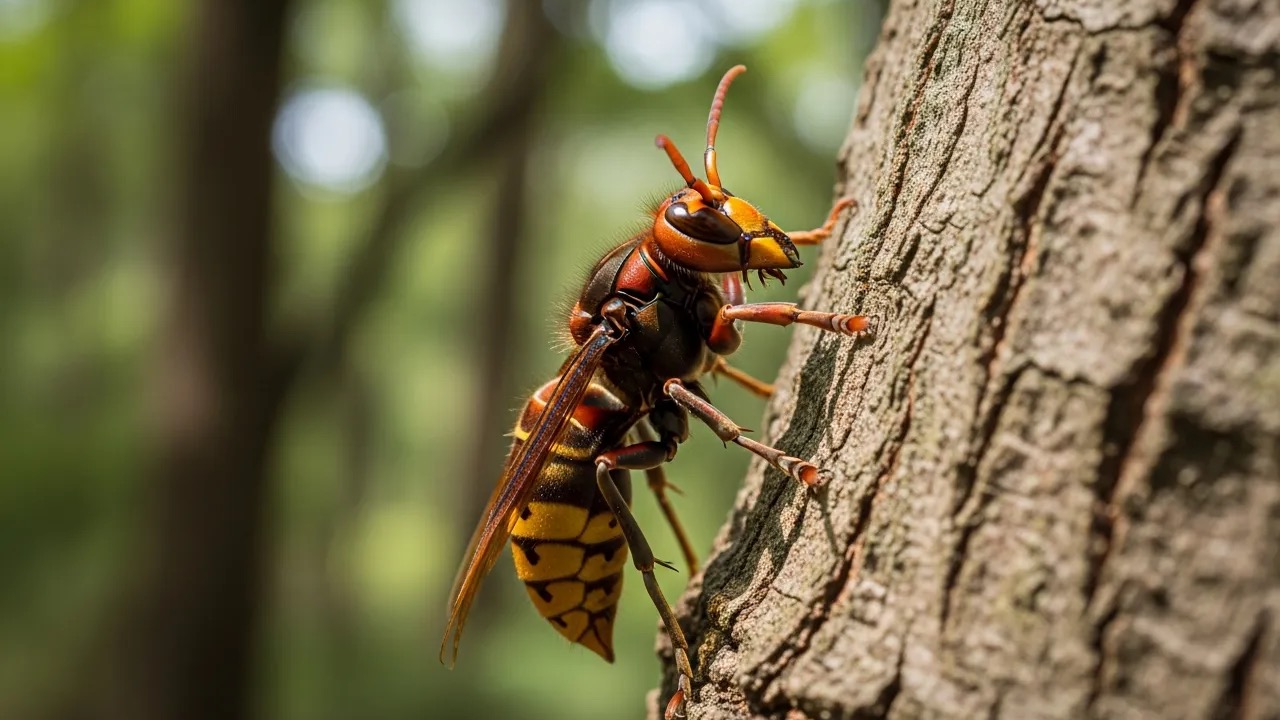
Photo: Mehdi Taba / Wikimedia Commons (CC BY-SA 4.0)
In brief
The Asian giant hornet (Vespa mandarinia) is the world's largest hornet, with queens reaching up to 5 cm long and a wingspan close to 7.5 cm. Native to the forests and low mountains of East and Southeast Asia, it is a powerful predator that hunts other insects and can fly at up to 40 km/h.
Also in Animals A to Z · Animals that start with A
By WARN Research & Conservation Team Last updated
The Asian giant hornet (Vespa mandarinia) is the world's largest hornet, with queens reaching up to 5 cm long and a wingspan close to 7.5 cm. Native to the forests and low mountains of East and Southeast Asia, it is a powerful predator that hunts other insects and can fly at up to 40 km/h. Colonies last a single year, and despite its fearsome reputation the species is common and listed as Least Concern.
0.045 m
Typical length
1 g
Typical weight
40 km/h
Top speed
1 yrs
Lifespan
Figures sourced from Wikipedia — Asian Giant Hornet, Wikidata — Asian Giant Hornet .
Asian Giant Hornet: Quick Facts
| Scientific name | Vespa mandarinia |
|---|---|
| Diet | Carnivore (insects, especially other bees and wasps) |
| Habitat | Forests and low mountains |
| Lifespan | Workers a few weeks; queens about a year |
| Length | 3.5–5 cm (1.4–2 in) |
| Wingspan | Up to about 7.5 cm (3 in) |
| Conservation status | Least Concern (IUCN) |
Scientific Classification
| Kingdom | Animalia |
|---|---|
| Phylum | Arthropoda |
| Class | Insecta |
| Order | Hymenoptera |
| Family | Vespidae |
| Genus | Vespa |
Conservation Status
- IUCN Status
- Least Concern (IUCN Red List category)
- Population
- Global population not compiled for this guide
- Trend
- See the IUCN Red List assessment
- Assessed
- See the IUCN Red List assessment
- CITES
- See CITES appendices
Conservation figures are drawn from the IUCN Red List and CITES; this guide links to the authoritative sources rather than restating population counts.
Key Facts: Asian Giant Hornet
- The Asian giant hornet earns its name: queens can reach about 5 cm in length, with workers a little smaller at around 3.5 to 4.5 cm, and a wingspan approaching 7.5 cm.
- Asian giant hornets are carnivores that prey on other insects, particularly bees and wasps.
- Like other social wasps, the Asian giant hornet lives in an annual colony that lasts a single year.
The world's largest hornet
The Asian giant hornet earns its name: queens can reach about 5 cm in length, with workers a little smaller at around 3.5 to 4.5 cm, and a wingspan approaching 7.5 cm. Its large orange-yellow head, dark thorax and boldly banded abdomen make it unmistakable. Powerful wings let it fly at speeds of up to 40 km/h and cover long distances in a day. This impressive size and strength make it a formidable hunter of other insects.
Hunting and diet
Asian giant hornets are carnivores that prey on other insects, particularly bees and wasps. Adults hunt widely, using their large jaws to dismember prey, and carry protein-rich meat back to feed the colony's developing larvae. They are best known for raiding honeybee hives, where a small group of hornets can slaughter thousands of bees to seize the brood inside. In turn the adult hornets feed largely on sugary secretions produced by their own larvae.
Colony life and life cycle
Like other social wasps, the Asian giant hornet lives in an annual colony that lasts a single year. A mated queen emerges in spring to found a nest, usually in a burrow or hollow at ground level, and raises the first workers herself. Through summer the colony grows as sterile female workers, which live only a few weeks each, expand the nest and gather food. In autumn the colony produces new queens and males; the old colony then dies, and only young mated queens survive the winter to start again.
The sting and danger to people
The Asian giant hornet has a sting several millimetres long that can pierce ordinary clothing, delivering a potent venom. A single sting is very painful, and multiple stings can be dangerous, especially to people who are allergic. In parts of its range it is responsible for a number of deaths each year, usually where victims disturb a nest and are stung many times. That said, the hornet is not aggressive away from its nest and generally ignores people who leave it alone.
Range and habitat
The species is native to eastern and southern Asia, from Japan and the Korean Peninsula through China to parts of Southeast Asia. It favours forests and low mountains, where it can find both prey and suitable ground sites for nesting. Nests are typically hidden underground in abandoned rodent burrows or among tree roots. The hornet is widespread across this range and is classed as Least Concern by the IUCN.
The "murder hornet" reputation
The Asian giant hornet drew worldwide attention when a few individuals turned up in North America, earning it the sensational nickname 'murder hornet'. The alarm centres on its ability to devastate honeybee colonies, which threatens both wild pollinators and beekeeping. Interestingly, some Asian honeybees have evolved a defence, swarming over an intruding hornet and cooking it to death with their combined body heat. Efforts to detect and remove any nests outside its native range aim to protect local bees.
What WARN Does
WARN does not run a dedicated asian giant hornet programme — this guide is part of the World Animal Rescue Network's free educational library. The asian giant hornet is currently widespread and not globally threatened, and this guide helps readers understand the pressures that can change that. Building public understanding of species like the asian giant hornet supports the broader conservation awareness that underpins WARN's partner-led rescue work across its network.
If clear, science-based wildlife guides like this help you understand and value animals, please consider supporting the World Animal Rescue Network's educational and rescue work so we can keep producing them.
Asian Giant Hornet: Frequently Asked Questions
How big is the Asian giant hornet?
What do Asian giant hornets eat?
How dangerous is an Asian giant hornet sting?
How fast can an Asian giant hornet fly?
How long do Asian giant hornets live?
Why is it called the murder hornet?
Where do asian giant hornets live?
Sources & References
Population figures, conservation status and biological facts on this page are drawn from authoritative scientific and intergovernmental sources.
Terms used on this page
Plain-English definitions, from our wildlife and conservation glossary.
Latest Asian Giant Hornet Stories
Quick, fact-checked reads on the asian giant hornet — amazing facts, key questions and the threats it faces.
Species
Slow Loris: Why the Internet's Favourite Pet Is a Conservation Disaster
The slow loris looks like a cartoon character — and that has nearly destroyed the species. Here is the truth behind the viral videos.
Read the storySpecies
The Snow Leopard: Why the Ghost of the Mountains Is Still Vulnerable
The snow leopard is one of the most elusive big cats on earth, with an estimated 4,000-6,500 individuals across twelve range states — including Pakistan, where WARN is preparing to operate. This briefing explains why the species was downlisted from Endangered to Vulnerable in 2017 and why that is not the success story it sounds like.
Read the storyGuides
Sun Bear vs Moon Bear: The Two Most Trafficked Asian Bears
The sun bear and the Asiatic black bear (moon bear) are the two most commonly trafficked bears in Asia — for the pet trade, for traditional medicine and for bear-bile farming. Here is how to tell them apart.
Read the storyExplore more animals
Discover more animals, their habitats and their conservation status in the WARN wildlife-guide library.
Enjoyed this Asian Giant Hornet guide?
Receive appeal updates, animal-welfare news and published funding reports. Unsubscribe any time.
We only use your address for WARN updates. See our privacy policy.