Wildlife Guide · Tropical forests of Africa and Asia & Not native to Britain — flagship tropical forest birds
Hornbill
Bucerotidae — family of tropical birds including Buceros, Anthracoceros and related genera
The casqued giants of tropical forest — nothing like a British garden bird.
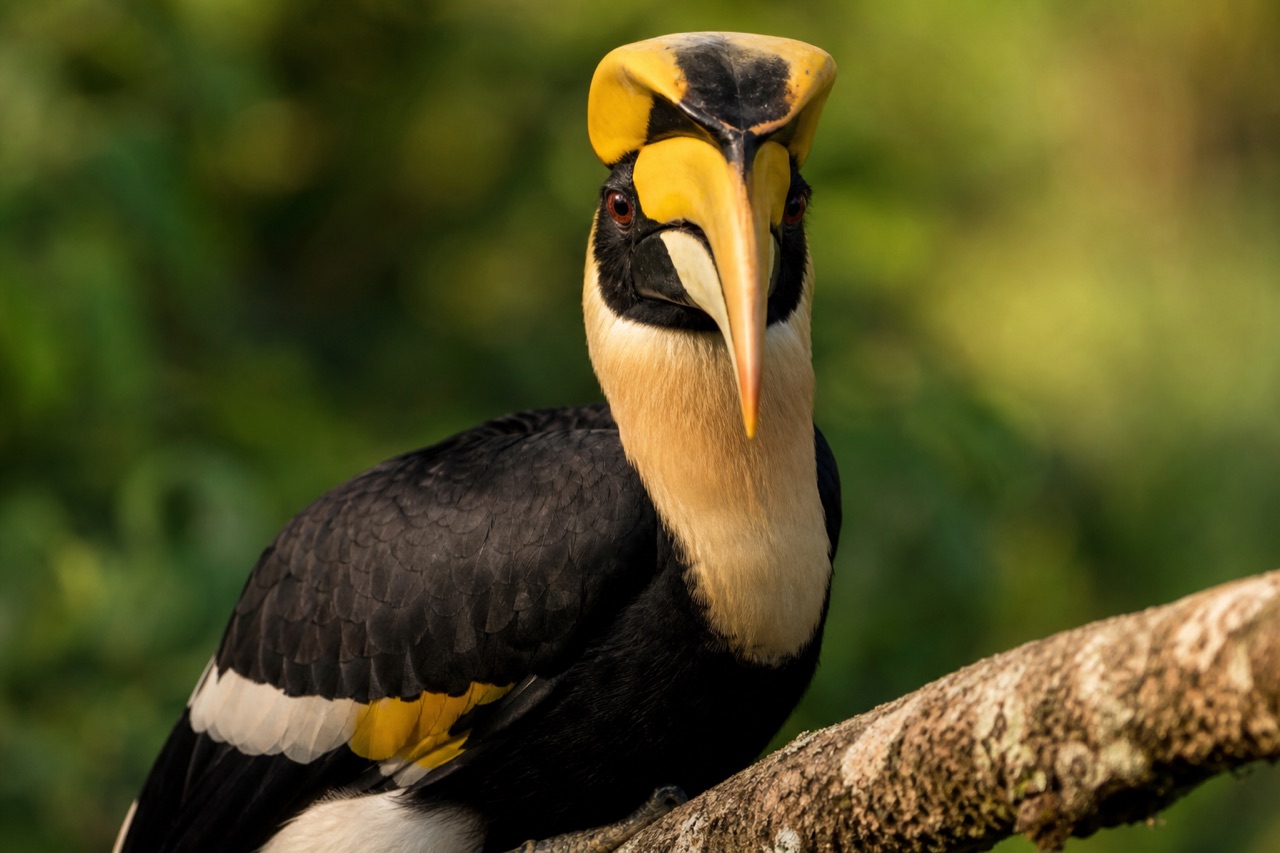
AI-generated educational wildlife portrait — World Animal Rescue Network · AI visualisation, not a photograph
In brief
Hornbills are tropical forest birds of Africa and Asia with massive casqued bills; females seal themselves in tree-cavity nests, species disperse forest seeds, and family status ranges from Least Concern to Critically Endangered through logging, hunting and casque trade.
Also in Animals A to Z · Animals that start with H
By WARN Research & Conservation Team Last updated
Hornbills are large tropical birds named for the hollow casque — often dramatic in size and colour — mounted on a massive bill. They occur in the forests of sub-Saharan Africa and South and Southeast Asia, from the great hornbill (Buceros bicornis) of Indian and Southeast Asian rainforest to the smaller red-billed hornbills of African savanna woodland. None occur wild in Britain; they appear in searches through wildlife media, zoo visits and conservation news from the tropics. Hornbill ecology centres on forest trees. Most species nest in trunk cavities; the female seals herself inside with mud and faeces, leaving only a slit through which the male passes food — a strategy that protects eggs and chicks from predators but requires large old trees with suitable holes. Hornbills eat fruit, insects and small animals, and are important seed dispersers for forest trees with large fruit. Family status spans Least Concern to Critically Endangered. Forest logging, hunting and capture for the cagebird trade have eliminated hornbills from much of their range. The helmeted hornbill's solid casque is carved as 'red ivory' — driving Critically Endangered status. A family overview matches how people search: 'hornbill' as tropical flagship, not a single species. Hornbill searches from Britain reflect documentary exposure and zoo visits — honest education connects that interest to tropical forest loss and illegal casque trade rather than treating hornbills as exotic curiosities without conservation context.
Casque
Hollow bill ornament — solid in helmeted hornbill ('red ivory')
Sealed nest
Female walls herself in cavity; male feeds through slit
Seed dispersers
Move large forest fruit — ecology tied to trees
Tropical only
Not native to Britain — African and Asian forest
Figures sourced from IUCN Red List — Rhinoplax vigil (Helmeted Hornbill), IUCN Red List — Buceros bicornis (Great Hornbill) .
Hornbill: Quick Facts
| Casque | Hollow keratin structure on bill — solid in helmeted hornbill |
|---|---|
| Nesting | Female sealed in tree cavity; male feeds through slit |
| Ecological role | Seed dispersers for tropical forest trees |
| Helmeted hornbill | Critically Endangered — casque poaching |
| Great hornbill | Vulnerable — Asian forest loss |
| British wild status | Not native — tropical species only |
| Main threats | Deforestation, hunting, casque and cagebird trade |
Scientific Classification
| Kingdom | Animalia |
|---|---|
| Phylum | Chordata |
| Class | Aves |
| Order | Bucerotiformes |
| Family | Bucerotidae |
| Example genera | Buceros, Anthracoceros, Bycanistes |
| Range | Sub-Saharan Africa and tropical Asia — not Britain |
Conservation Status
- IUCN Status
- Least Concern
- Population
- Family-wide; helmeted hornbill and several Asian species severely reduced
- Trend
- Decreasing for forest-dependent species
- Assessed
- Varies by species
- CITES
- Several species on CITES Appendix I and II
Family overview. Helmeted hornbill Critically Endangered from casque trade. Great hornbill Vulnerable. Not applicable to Britain as wild species.
Did you know?
Female hornbills seal themselves inside tree cavities to nest — shedding flight feathers and relying entirely on the male to pass food through a narrow slit until chicks are ready to fly.
Key Facts: Hornbill
- Hornbills are large tropical birds with casqued bills — African and Asian forest, not British wildlife.
- Females seal themselves in tree-cavity nests; males feed the family through a narrow slit.
- Important seed dispersers for tropical forest trees with large fruit.
- Status varies: great hornbill Vulnerable; helmeted hornbill Critically Endangered from casque hunting.
- Require old trees with large cavities — logging removes nest sites directly.
- Helmeted hornbill casques traded as 'red ivory' — major poaching pressure.
- Zoo populations support education and captive breeding for some threatened species.
The casque and the bill — what hornbills are
Hornbill bills are among the largest in birds relative to body size — often brightly coloured with a casque of hollow keratin atop the upper mandible. Function varies: amplification of calls, sexual selection, species recognition. In the helmeted hornbill of Southeast Asia, the casque is solid keratin — traded as red ivory for carving, which drives illegal hunting independent of meat or feathers.
Plumage ranges from the black-and-white great hornbill with yellow throat to African species with red bills and grey or brown bodies. Sexes often differ — male great hornbill has red eyes, female white. Flight is heavy, with loud wingbeats audible through forest canopy.
Hornbills are not related to British birds despite search overlap with 'hornbill' curiosity from documentaries and zoos. They belong to tropical forest ecosystems where their size and seed dispersal link them to old-growth trees.
Hornbill fruit diet ties them to specific tree species — figs, nutmeg-family fruits and large drupes that smaller birds cannot swallow whole. Forest fragmentation removes both fruiting trees and cavity-bearing old growth; hornbills need large home ranges that intact forest provides and fragmented plantation forest cannot.
Hornbill casque size varies by sex and age — in most species the casque is hollow and lightweight; only helmeted hornbill casque is solid and trade-targeted. Understanding that distinction matters for trade enforcement and public messaging about which species face casque poaching.
Hornbill flight is heavy but capable — birds commute long distances between roosting and fruiting trees daily. Home range size makes small forest reserves insufficient for large hornbill species that need landscape-scale forest cover.
Sealed nest — female imprisoned for survival
Hornbill nesting is unique. The pair selects a natural cavity in a large tree; the female enters, sheds flight feathers, and walls the entrance with mud, droppings and fruit pulp — leaving a slit too narrow for most predators. She lays eggs, incubates and broods chicks inside; the male brings food to the slit throughout.
If the male is killed — hunting, collision, predation — the female and chicks die sealed inside. The strategy trades female mobility for nest security and makes hornbills dependent on both old trees with cavities and intact forest where males can forage widely.
Chicks emerge when ready to fly; the female breaks out with them. The nest cavity may be reused in later years if the tree stands. Logging that removes old trees removes nest sites for decades until replacement trees mature.
Ground hornbills of Africa — a related group — walk rather than fly between forest patches; forest hornbills fly canopy routes. Both groups share heavy dependence on mature trees and face hunting and habitat loss, but British searches for 'hornbill' usually mean Asian or African forest species seen in media, not ground hornbills.
Female hornbills moult remige feathers while sealed in the nest — they cannot fly until emerging with chicks. Total dependence on the male during incubation and brooding makes hornbill nesting uniquely vulnerable to male mortality from hunting or collision.
Forest loss, hunting and the helmeted hornbill crisis
Hornbills need contiguous forest with fruiting trees and cavity-bearing old growth. Southeast Asian and African deforestation for palm oil, logging and agriculture has reduced range across multiple species. Hunting for bushmeat affects African hornbills; the cagebird trade takes chicks and adults.
The helmeted hornbill crisis is specific: solid casques are carved like ivory for the illegal wildlife trade — 'red ivory' — decimating populations across Indonesia, Malaysia and Thailand. Critically Endangered, the species is the clearest example of hornbill decline driven by a single commodity rather than general habitat loss.
Great hornbill, rhinoceros hornbill and wrinkled hornbill are Vulnerable — forest specialists losing range as lowland rainforest contracts. African forest hornbills face parallel pressures at varying intensity by region.
CITES listing for threatened hornbill species restricts international trade in live birds and casques — enforcement at borders complements in-forest anti-poaching. Consumer refusal of carved casques reduces demand that drives helmeted hornbill poaching independent of general deforestation pressure.
Fig trees and other hornbill food plants are often keystone species in tropical forest — hornbill seed dispersal in return maintains forest composition. Lose hornbills and forest tree recruitment changes; lose forest and hornbills disappear. The mutual dependence runs both ways.
Why hornbills appear in British searches
Britain has no wild hornbills, but searches occur — zoo visits, BBC documentaries, tropical tourism, conservation fundraising imagery. A family guide serves that curiosity honestly: tropical forest birds whose fate is tied to old trees and anti-poaching enforcement thousands of kilometres away.
Captive breeding in zoos supports education and reintroduction for some species — though most hornbill conservation must happen in forest reserves with logging controlled and casque trade suppressed. Buying carved casques or supporting unverified 'hornbill conservation' products can fund the trade that destroys them.
Hornbills connect British public interest to tropical forest integrity — seed dispersers, cavity nesters, casque targets. The family overview sets expectations: not a garden bird, not one status, but a group where forest standing and trade enforcement decide which species survive.
British zoo hornbill exhibits support education and captive breeding for some threatened species — but ex-situ populations cannot replace wild forest standing. Hornbill conservation for searchers in Britain is primarily about informed concern, trade refusal and support for forest protection abroad rather than local habitat action.
Documentary footage of hornbill nest sealing introduced millions of viewers to the behaviour — that exposure drives search interest from countries where hornbills never occur wild, which is why British search traffic needs honest tropical context rather than faux-local guidance.
What WARN Does
WARN publishes free, sourced species education for tropical species people search without local context. Hornbills are forest giants — sealed-nest specialists, seed dispersers, and Critically Endangered where casques are carved as red ivory.
If this guide helps you understand wildlife and the pressures it faces, a gift to WARN supports habitat protection and free public education in our partner countries.
Hornbill: Frequently Asked Questions
Are there hornbills in Britain?
Why do hornbills seal the nest?
What is red ivory?
Are hornbills endangered?
What do hornbills eat?
Can hornbills be kept as pets?
Where do hornbills live?
Are hornbills dangerous?
How long do hornbills live?
Sources & References
Population figures, conservation status and biological facts on this page are drawn from authoritative scientific and intergovernmental sources.
Terms used on this page
Plain-English definitions, from our wildlife and conservation glossary.
Explore more animals
Discover more animals, their habitats and their conservation status in the WARN wildlife-guide library.
Enjoyed this Hornbill guide?
Receive appeal updates, animal-welfare news and published funding reports. Unsubscribe any time.
We only use your address for WARN updates. See our privacy policy.