Wildlife Guide · Sub-Saharan Africa & Arabian Peninsula
Honey Badger
Mellivora capensis (Schreber, 1776) — family Mustelidae
Loose skin, a venom tolerance and a reputation that is mostly, awkwardly, deserved.
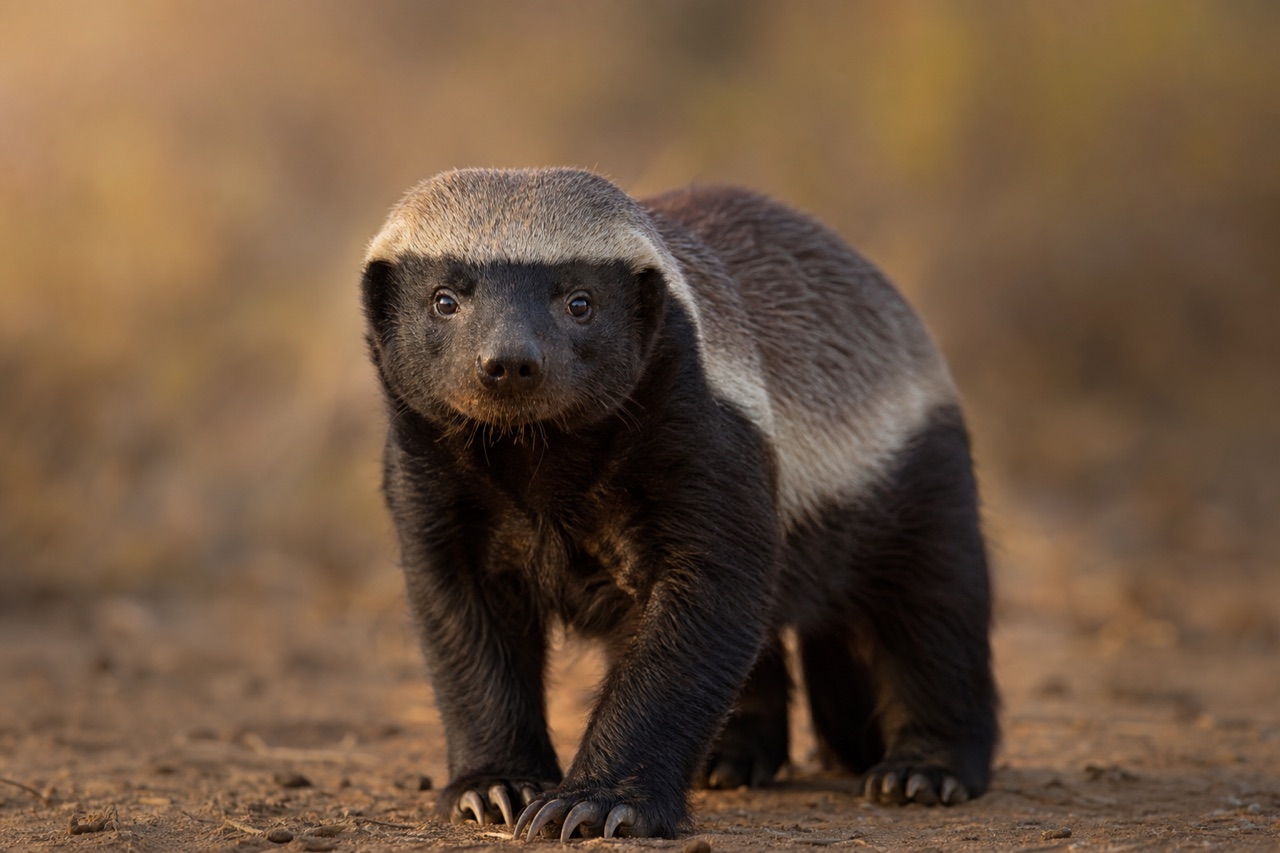
AI-generated educational wildlife portrait — World Animal Rescue Network · AI visualisation, not a photograph
In brief
The honey badger (Mellivora capensis) is a stocky African and Asian mustelid with exceptionally thick, loose skin that lets it twist within its own hide when gripped, a partial tolerance to snake venom, and well-documented problem-solving and escape ability.
Also in Animals A to Z · Animals that start with H
By WARN Research & Conservation TeamLast updated
The honey badger, or ratel, is a stocky member of the weasel family found across Africa, the Arabian Peninsula and into India. Its reputation for fearlessness is genuine and has a physical basis: exceptionally thick, remarkably loose skin that lets a gripped animal twist around inside its own hide and bite whatever is holding it. It is also an unusually capable problem-solver. Honey badgers have been documented using objects to climb, working out latches and gates, and cooperating with a bird — the greater honeyguide — in one of the few reported mutualisms between a wild bird and a wild mammal, though the strength of that particular story is debated.
~6 mm
Skin thickness at the neck — very tough and very loose
Partial
Tolerance to some snake venoms; not immunity
~10 kg
Typical adult weight
Documented
Tool use and latch-opening in captivity
Figures sourced from IUCN Red List — Mellivora capensis, CITES Appendices .
Honey Badger: Quick Facts
| Weight | 9–16 kg |
|---|---|
| Family | Mustelidae — weasels, not true badgers |
| Defence | Thick loose skin, claws, repellent anal glands |
| Venom | Partial tolerance, not immunity |
| Diet | Omnivorous — insects, reptiles, rodents, honey and bee brood |
| Main conflict | Beehive raiding |
Scientific Classification
| Kingdom | Animalia |
|---|---|
| Phylum | Chordata |
| Class | Mammalia |
| Order | Carnivora |
| Family | Mustelidae |
| Genus | Mellivora |
| Species | Mellivora capensis |
Conservation Status
- IUCN Status
- Least Concern
- Population
- Unknown; widespread across a very large range
- Trend
- Decreasing
- Assessed
- 2015
- CITES
- Appendix III (Botswana, Ghana)
A Least Concern listing reflects range size, not local security. Persecution by beekeepers and snare bycatch drive substantial local declines.
Did you know?
A honey badger held by the scruff can rotate almost completely around inside its own skin and bite whatever is holding it.
Key Facts: Honey Badger
- Honey badgers are mustelids — closer to weasels and otters than to true badgers.
- Their skin is thick and unusually loose, so a gripped animal can turn inside it and bite back.
- They have partial tolerance to some snake venoms, not immunity — bites can still kill them.
- Documented tool use and latch-opening make them notorious escape artists in captivity.
- They raid beehives, which drives conflict with beekeepers across their range.
- Least Concern globally, but persecuted and declining in many local populations.
Built to be hard to kill
The honey badger's defence is structural. Its hide is thick enough to resist most bites and stings, and it is attached loosely enough that a badger seized by the neck can rotate almost freely inside its own skin and reach the attacker's face.
Add powerful jaws, long claws, and anal glands that release a strongly repellent secretion, and the result is an animal of about 10 kg that larger predators frequently decide is not worth the trouble. That is the real basis of the reputation: not that a honey badger wins fights, but that it makes fights expensive.
Venom tolerance, accurately stated
Honey badgers do prey on venomous snakes including cobras and puff adders, and they can survive bites that would kill a similar-sized mammal. The mechanism appears to involve mutations in the receptor that neurotoxins target, reducing binding — a change seen convergently in mongooses and some hedgehogs.
The crucial qualification is that this is tolerance, not immunity. Bitten honey badgers can be incapacitated for hours and can die. Popular accounts of a badger shrugging off a cobra bite and walking away are describing the best-case outcome as if it were the only one.
The honeyguide question
The greater honeyguide is famous for leading honey badgers to bees' nests, which the badger opens and both then feed on. It is a compelling story and it is genuinely uncertain: direct observations of a honeyguide guiding a honey badger are rare, and some researchers argue the relationship is far better documented between honeyguides and humans.
What is not in doubt is the badger's appetite for honey and bee brood, which is where the name comes from and where the conflict starts.
Conflict, and why 'Least Concern' understates it
Honey badgers raid beehives and occasionally poultry, so beekeepers and smallholders trap, poison and shoot them. They are also caught as bycatch in snares set for other animals and killed in retaliation for livestock losses that are often misattributed.
The IUCN lists the species as Least Concern because it remains widespread across a vast range. That masks substantial local declines, particularly where commercial beekeeping and honey badger range overlap. Badger-proof hive stands — raising hives on smooth metal poles — reduce the conflict effectively and are the standard mitigation.
The escape artist
The honey badger's reputation for getting out of things is not folklore. It is one of the better-documented cases of problem-solving in a non-primate mammal, largely thanks to a rehabilitated male named Stoffel at a South African wildlife centre, whose repeated escapes were filmed over years.
The behaviour recorded is not trial and error. He stacked rocks to reach a wall, dragged a rake over and climbed it, rolled a ball of mud into a usable step when the rocks were removed, and worked out gate latches by manipulating them directly. Each time an enclosure was modified, he solved the modification.
What makes this notable is the combination of physical capability and persistence. Honey badgers have long front claws built for digging, considerable strength for their size, and a very high tolerance for repeated failure. In practical terms this is why honey badgers are difficult to exclude from beehives, poultry runs and rubbish stores using ordinary fencing, and why exclusion has to be designed rather than improvised.
What they actually eat
The name is misleading twice over: they are not badgers, and honey is a minor part of the diet.
Honey badgers are generalist carnivores that will take more or less anything they can overpower or dig out. Insects and their larvae make up a large share, along with scorpions, rodents, ground-nesting birds and their eggs, lizards, tortoises and snakes. They also eat carrion, fruit and roots when those are easier. Much of their foraging is excavation — a honey badger working a patch of ground will dig dozens of holes in an evening.
What they want from a beehive is mostly the brood, the protein-rich larvae, rather than the honey itself. That distinction matters for beekeepers, because it means the attraction is strongest when colonies are actively rearing young and the damage is done to the comb rather than to stored honey.
Beekeeping conflict, and what actually stops it
Across much of the honey badger's range, the sharpest conflict is with beekeepers. A single animal can destroy several hives in a night, and the response has historically been poisoning or trapping — which is a significant driver of local declines even though the species is globally Least Concern.
The interventions that work are physical rather than lethal, and they are well tested. Raising hives on stands roughly a metre high puts them above the height a honey badger can comfortably work at, and stands with smooth metal poles or sleeves prevent climbing. Suspending hives from wires or frames removes the leverage the animal needs. Where stands are impractical, sturdy fencing with a buried skirt to stop digging is effective, though it is more expensive.
These are cheap compared with the hives they protect, and they are the reason honey badger conflict is generally a solvable problem rather than an intractable one. The obstacle is usually not the method but access to the materials and the knowledge that the method exists.
Where they live, and how they are doing
The honey badger has one of the largest ranges of any carnivore. It occurs across almost all of sub-Saharan Africa, up through the Arabian Peninsula, and eastwards through Iran and Central Asia into India and Nepal. It tolerates an unusually wide spread of habitats — desert, savanna, dry woodland, montane grassland and rainforest edge — which is the main reason it is listed as Least Concern.
That listing describes the global picture and hides a patchier reality. The species is protected in some range states and unprotected in others, and it is uncommon or absent across large parts of its historical range in South Africa, Morocco and parts of the Arabian Peninsula. Declines are local, driven by persecution rather than habitat loss, and they are poorly measured because a solitary, nocturnal, wide-ranging animal is genuinely difficult to census.
The pressures are consistent wherever they are recorded: retaliatory killing by beekeepers and poultry keepers, incidental capture in traps set for other species, road mortality, and — in parts of West and Central Africa — collection for the traditional medicine trade, where honey badger parts are valued precisely because of the animal's reputation for toughness.
None of these is a threat of the kind that produces an Endangered listing. All of them are the kind that quietly empties a landscape while the global assessment stays reassuring.
Honey badger vs the animals it is confused with
| Honey badger | European badger | Wolverine | |
|---|---|---|---|
| Family | Mustelidae | Mustelidae | Mustelidae |
| Closest kin | Weasels and otters | True badgers | Martens |
| Typical weight | 9–16 kg | 10–12 kg | 11–18 kg |
| Range | Africa, Arabia, South Asia | Europe and West Asia | Northern boreal and tundra |
| Social | Largely solitary | Lives in social clans | Solitary |
| IUCN status | Least Concern | Least Concern | Least Concern |
What WARN Does
WARN publishes this guide for education and is developing support through assessed animal-welfare grants. A species range, source citation or photograph does not establish a recipient or funding agreement. Check /about/where-your-money-goes/#grant-register for published grant and payment records; records not yet published must not be read as zero activity. Browse /appeals/ for the purposes currently available to support.
If this guide helps you understand wildlife and the pressures it faces, a gift to WARN supports habitat protection and free public education in our partner countries.
Honey Badger: Frequently Asked Questions
Why are honey badgers considered the most fearless animal?
Can a honey badger kill a lion?
How do you stop honey badgers raiding beehives?
Are honey badgers immune to snake venom?
Are honey badgers actually badgers?
Why are honey badgers so hard to kill?
Do honey badgers really work with honeyguide birds?
What do honey badger / ratels eat?
Where do honey badger / ratels live?
Are honey badger / ratels dangerous?
How long do honey badger / ratels live?
How big is a honey badger / ratel?
Sources & References
Population figures, conservation status and biological facts on this page are drawn from authoritative scientific and intergovernmental sources.
Terms used on this page
Plain-English definitions, from our wildlife and conservation glossary.
Latest Honey Badger Stories
Quick, fact-checked reads on the honey badger — amazing facts, key questions and the threats it faces.
Species
Tiger vs Lion: 7 Key Differences Between the Two Biggest Cats
Tigers are bigger, stripier and solitary; lions are social and live in prides. Here's how the two largest cats really differ in size, habitat and behaviour.
Read the storySpecies
12 Astonishing Facts About the Pangolin, the World's Only Scaly Mammal
From a tongue anchored near its pelvis to scales that weigh a fifth of its body, the pangolin is one of nature's strangest mammals. Here are 12 facts that explain why.
Read the storySpecies
How Big Is a Pangolin — and How Long Is Its Tongue?
Pangolins range from house-cat size to over 30 kg, and the largest have a tongue longer than their entire body. Here are the real numbers.
Read the storyExplore more animals
Discover more animals, their habitats and their conservation status in the WARN wildlife-guide library.