Wildlife Guide · Europe, North Africa and western Asia & Introduced to Australia, New Zealand and Uruguay
Goldfinch
Carduelis carduelis (Linnaeus, 1758) — family Fringillidae
The brightest finch on the feeder — and a bill built for thistle seeds.
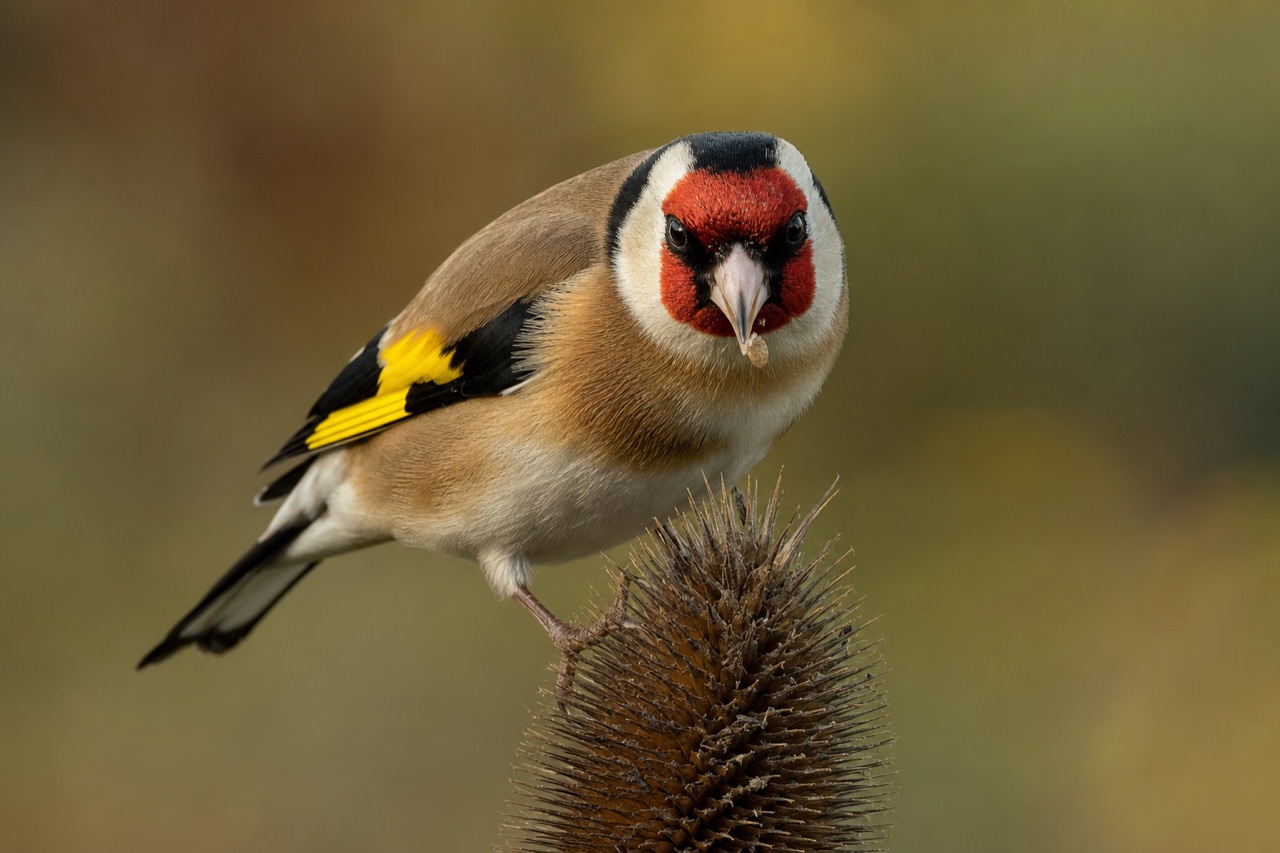
AI-generated educational wildlife portrait — World Animal Rescue Network · AI visualisation, not a photograph
In brief
The European goldfinch (Carduelis carduelis) is a seed-eating finch with a red face and yellow wing bars; in Britain it has increased in gardens where nyjer and sunflower feeders are provided, nesting high in trees while feeding in sociable flocks at specialist seed feeders.
Also in Animals A to Z · Animals that start with G
By WARN Research & Conservation Team Last updated
The goldfinch is the most colourful finch in a British garden: a crimson face, black and white head, warm brown back and a broad yellow wing bar visible in flight. It feeds mainly on small seeds — thistle, teasel, dandelion and nyjer — and uses a fine, pointed bill to extract them with precision. The flight call — a liquid, tinkling note — often announces the flock before the birds appear at a feeder. Goldfinches breed later than many garden birds, often into August, and nest in the outer branches of trees and tall shrubs. Their rise in suburban gardens over recent decades tracks the spread of nyjer-seed feeders and sunflower hearts — one of the few common species whose garden numbers have increased rather than fallen. They visit feeders in chattering groups, and their dependence on small oily seeds makes them one of the garden birds most directly shaped by what people choose to put out. A garden that stops feeding nyjer in winter often sees its goldfinch flock disperse to neighbours who continue.
Nyjer seed
Specialist feeder food that reliably attracts goldfinches
Late breeder
Often nests into July and August when thistles seed
Flock feeder
Visits feeders in chattering groups
Fine bill
Extracts small seeds from thistle heads and teasels
Figures sourced from IUCN Red List — Carduelis carduelis, BTO — BirdFacts: Goldfinch, RSPB — Goldfinch .
Goldfinch: Quick Facts
| Length | 12–13 cm |
|---|---|
| Wingspan | 21–25 cm |
| Best feeder food | Nyjer seed and sunflower hearts |
| Nest site | Outer branches of trees and tall shrubs |
| Breeding season | Often June to August in Britain |
| Garden trend | Increased in UK gardens since the 1990s |
| Main threats | Cat predation, window strikes, dirty feeders, trapping in some regions |
Scientific Classification
| Kingdom | Animalia |
|---|---|
| Phylum | Chordata |
| Class | Aves |
| Order | Passeriformes |
| Family | Fringillidae |
| Genus | Carduelis |
| Species | Carduelis carduelis |
Conservation Status
- IUCN Status
- Least Concern
- Population
- Tens of millions in Europe; increasing in British gardens
- Trend
- Stable to increasing in much of range
- Assessed
- 2018
- CITES
- Appendix III in some range states; not listed in UK
Widespread and common. Garden populations in Britain have risen with nyjer feeding. Historic trapping for cage birds reduced numbers in some regions before legal protection.
Did you know?
Goldfinches breed late — often into August — because their chicks are timed to thistle and teasel seed, which ripens when most other garden birds have already fledged.
Key Facts: Goldfinch
- Goldfinches have a red face, black and white head and bright yellow wing bars.
- They feed on small seeds — thistle, teasel, nyjer and sunflower hearts — not insects or bread.
- Nyjer-seed feeders have helped goldfinch numbers rise in British gardens since the 1990s.
- They nest high in tree canopies, often in loose colonies, breeding later than tits or robins.
- Domestic cats ambush goldfinches at ground-level feeders and beneath hanging stations.
- Window strikes occur when feeders sit close to large reflective glass.
- The liquid, twittering call is often heard before the birds appear at a feeder.
Feeders, nyjer seed and what actually works
Goldfinches are specialist small-seed eaters. In the wild they take thistle, teasel, groundsel and birch seed from seed heads; in gardens nyjer seed in a fine-mesh feeder is the most reliable attractant. Sunflower hearts in a standard feeder also work, but nyjer draws goldfinches that ignore other offerings. The fine bill that extracts nyjer is poorly suited to large seeds, which is why goldfinches often ignore standard mixed seed while greenfinches and chaffinches take it readily.
They feed in sociable flocks — a feeder visited by one bird is often joined within minutes by others. Clean feeders and dry seed matter: nyjer goes rancid quickly in warm weather and can harbour mould that spreads disease. Position stations where cats cannot sit directly beneath or beside them — open lawn with a clear view helps birds spot danger. A feeding station beside dense shrubbery gives cats an ambush site.
Supplementary feeding supports goldfinches through winter and the breeding season, but the species also needs seed-bearing plants. Leaving teasel, thistle and dandelion to set seed in a border provides natural food and nesting material. Teasel heads in particular attract goldfinches through autumn and winter, and the down from ripening thistles lines their nests. A garden with both nyjer feeders and seed-bearing wildflowers supports goldfinches more reliably than either alone — and keeps them returning when feeder food runs short.
Breeding high in the trees
Goldfinches nest in the outer forks of trees and tall shrubs — often at the canopy edge rather than deep inside cover. The nest is a neat cup of moss, grass and plant down, lined with thistle down and wool. Breeding starts later than many garden birds, with nests active into July and August when thistles seed. Alder, birch and rowan are common nest trees in suburban gardens where these species reach sufficient height.
They sometimes nest in loose colonies where habitat suits. Nest boxes are rarely used; conservation in gardens is mainly about feeding, seed plants and keeping cats away from the canopy edge — difficult when nests sit in tall trees beyond reach. Wind-thrown nests are a common cause of failure in exposed suburban trees, which is one reason goldfinches favour the leeward side of canopy edges.
Chicks are fed regurgitated seed paste. Insect food is minimal compared with tits or blackbirds, which ties goldfinch breeding less directly to garden pesticide use — though insect-rich habitat still supports general biodiversity. Late breeding is an adaptation to seed availability: goldfinch chicks fledge when thistles and teasels are ripening, not when caterpillars peak in spring. A pair may raise two broods in a good year, timed to successive seed crops.
Cats, windows and feeder placement
Goldfinches are killed by domestic cats at feeders — especially ground trays and low tables where finches spill seed. Cats that wait beneath hanging feeders take birds when they flush. Sparrowhawks also hunt goldfinches at feeders, particularly in winter when finch flocks concentrate at food sources — a natural predator, but one whose kills increase where feeders draw birds into predictable locations.
Feeder placement reduces risk: avoid dense shrubbery immediately beside stations where cats can hide; use poles with baffles where practical; keep cats indoors at dawn and dusk. Collar bells reduce but do not stop predation. A feeder mounted on a pole in open lawn, at least two metres from cover, gives goldfinches time to see a cat approaching.
Window strikes kill goldfinches when feeders sit close to large panes that reflect sky or vegetation. The one-metre or three-metre rule applies: either very close so birds cannot build speed, or far enough that they can see the glass. External markings — decals, strings, film — break up reflections and cut fatalities. A goldfinch flock startled from a feeder beside a window is a common collision scenario, particularly with modern double glazing that reflects sharply on bright days.
A rare garden success story
While many British garden birds declined since the 1970s, goldfinch garden numbers increased substantially — linked to nyjer feeders, sunflower hearts and a spread of seed-rich planting in suburban gardens. The rise is one of the clearest examples of supplementary feeding shifting a species' garden distribution, though it depends on people continuing to provide clean nyjer rather than a one-time change.
The species is Least Concern globally and widespread across Europe. Trapping for the cage-bird trade caused historic declines in some regions; legal protection and changing fashion reduced that pressure. In Britain, garden feeding is now the dominant human interaction, and goldfinches have become a standard sight at suburban feeders in areas where they were scarce thirty years ago.
Goldfinches remain vulnerable to disease at dirty feeders — trichomonosis and salmonella spread where seed is wet and mouldy. Regular cleaning with a weak disinfectant and dry storage of nyjer reduce outbreaks that can affect greenfinches and chaffinches as well. The goldfinch's garden success is real but conditional: clean feeders, cat-aware placement and seed plants together sustain the increase that nyjer alone started. Without all three, local goldfinch numbers can fall as quickly as they rose.
What WARN Does
WARN publishes free, sourced species education for garden birds whose fortunes track everyday choices. The goldfinch is one of the few British species that increased as nyjer feeders spread — proof that feeding done well helps, while dirty feeders and cat ambush sites still kill birds at the window.
If this guide helps you understand wildlife and the pressures it faces, a gift to WARN supports habitat protection and free public education in our partner countries.
Goldfinch: Frequently Asked Questions
What is the best food for goldfinches?
Why have goldfinches increased in British gardens?
Do goldfinches use nest boxes?
How do I stop cats catching goldfinches?
What do european goldfinchs eat?
Where do european goldfinchs live?
Are european goldfinchs dangerous?
How long do european goldfinchs live?
How big is an european goldfinch?
Sources & References
Population figures, conservation status and biological facts on this page are drawn from authoritative scientific and intergovernmental sources.
Terms used on this page
Plain-English definitions, from our wildlife and conservation glossary.
Explore more animals
Discover more animals, their habitats and their conservation status in the WARN wildlife-guide library.
Enjoyed this Goldfinch guide?
Receive appeal updates, animal-welfare news and published funding reports. Unsubscribe any time.
We only use your address for WARN updates. See our privacy policy.