Wildlife Guide · North America, Europe and Asia & Tropical and temperate forests
Flying Squirrel
Tribe Pteromyini — over 50 species in the squirrel family Sciuridae
They do not fly — they glide. And under ultraviolet light, North American species glow pink.
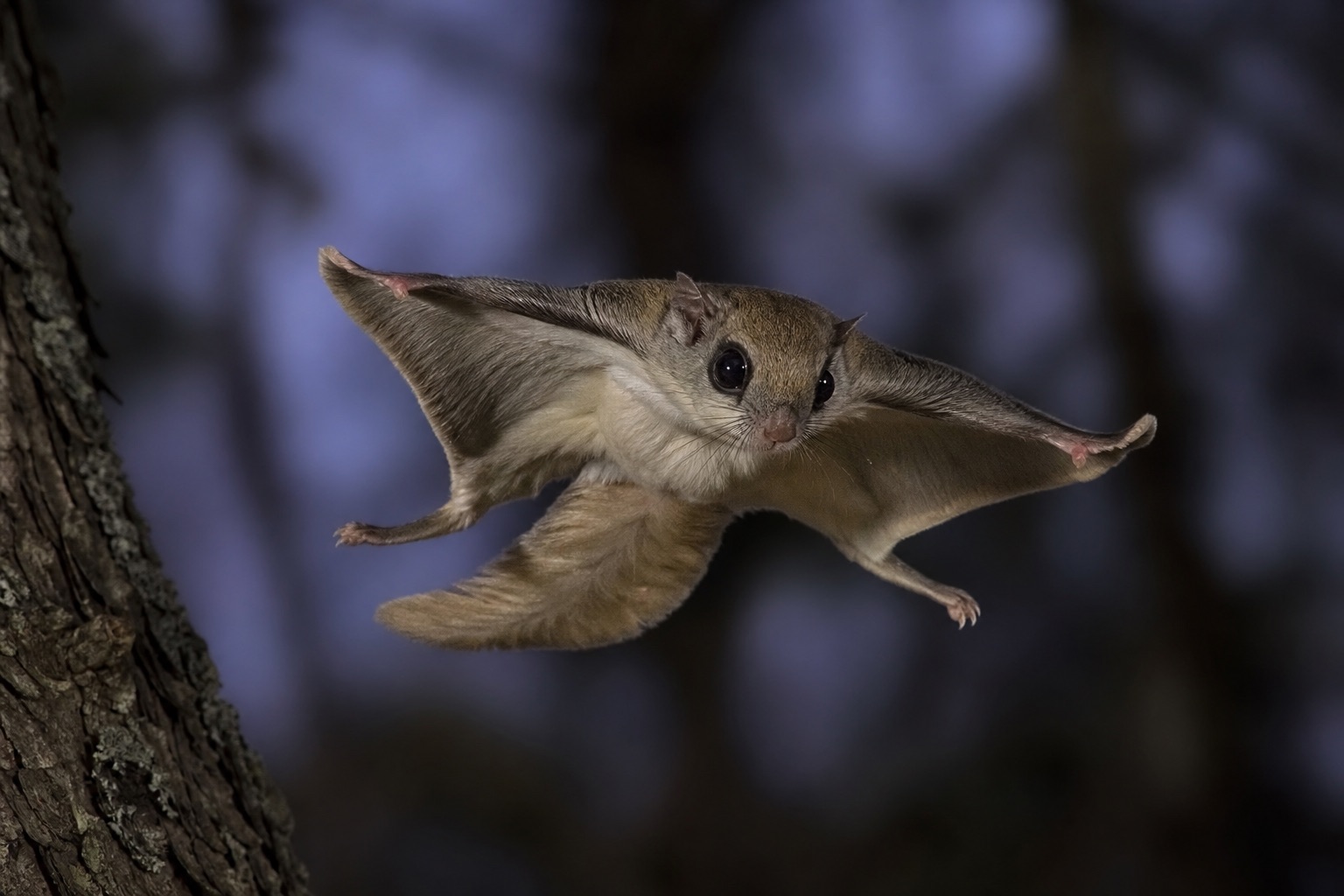
AI-generated educational wildlife portrait — World Animal Rescue Network · AI visualisation, not a photograph
In brief
Flying squirrels are over 50 species of nocturnal gliding rodents with a skin membrane between wrists and ankles; they cannot truly fly, and a 2019 study found that all three North American Glaucomys species fluoresce pink under ultraviolet light.
Also in Animals A to Z · Animals that start with F
By WARN Research & Conservation Team Last updated
Flying squirrels are gliding rodents — not true fliers — with a membrane of skin called a patagium stretching from wrist to ankle on each side. Launching from a height, they spread limbs to tense the membrane and steer with tail and body angle, covering tens of metres in a controlled descent to the next tree. Roughly fifty species occur across North America, Eurasia and Southeast Asia, from the tiny Japanese dwarf flying squirrel to the giant flying squirrels of the Himalayas. The distinction from birds and bats matters: flying squirrels cannot gain altitude or sustain level flight. They are arboreal specialists that reduce travel cost between scattered food trees. Most are nocturnal, with large eyes and sensitive whiskers for navigation in darkness. In 2019, researchers reported that all three North American Glaucomys species fluoresce vivid pink under ultraviolet light — a trait absent in co-occurring diurnal tree squirrels. The function remains unknown; hypotheses include communication, camouflage in UV-rich twilight, or mimicry of lichen and owl patches. What is established is the discovery itself: Kohler and colleagues published the finding in the Journal of Mammalogy after examining museum specimens spanning 130 years and five wild individuals.
50+
Species in the tribe Pteromyini
2019
UV pink fluorescence reported in Glaucomys
Glide
Controlled descent — not powered flight
Nocturnal
Most species active at night
Figures sourced from Kohler et al. 2019 — UV fluorescence in Glaucomys (Journal of Mammalogy), IUCN Red List — Glaucomys volans, IUCN Red List — Glaucomys sabrinus .
Flying Squirrel: Quick Facts
| Movement | Gliding on patagium — not true flight |
|---|---|
| Typical glide | About 20–50 m between trees |
| Activity | Mostly nocturnal |
| UV fluorescence | Pink under UV in all three Glaucomys species (2019) |
| Diet | Seeds, nuts, fungi, insects — varies by species |
| Lifespan | About five to six years in the wild |
| Main threats | Habitat loss; hunting of some Asian species |
Scientific Classification
| Kingdom | Animalia |
|---|---|
| Phylum | Chordata |
| Class | Mammalia |
| Order | Rodentia |
| Family | Sciuridae |
| Tribe | Pteromyini |
| Species | Over 50 described species |
Conservation Status
- IUCN Status
- Varies — North American Glaucomys Least Concern; several Asian species threatened
- Population
- Varies by species; no global estimate
- Trend
- Stable for most North American species; decreasing for some Asian giants
- Assessed
- Varies
- CITES
- Some Asian species on Appendix II or III
The family-level Least Concern label reflects widespread North American species. Giant flying squirrels in Asia face deforestation and hunting pressure.
Did you know?
Flying squirrels were first found to fluoresce pink under UV light when a researcher checking lichens with an ultraviolet torch noticed a squirrel at a bird feeder — the 2019 paper followed from that accident.
Key Facts: Flying Squirrel
- Flying squirrels glide on a patagium; they cannot gain altitude or fly like bats or birds.
- All three North American Glaucomys species fluoresce pink under UV light — reported in 2019 by Kohler et al.
- Diurnal tree squirrels in the same forests do not show the same fluorescence.
- Most flying squirrels are nocturnal with large eyes adapted for low light.
- Glides typically cover 20–50 metres; longer glides are recorded downhill.
- Old World giant flying squirrels in Asia include threatened species from habitat loss and hunting.
- Flying squirrels are rodents in Sciuridae — relatives of tree squirrels, not related to sugar gliders.
Gliding mechanics — controlled fall, not flight
A flying squirrel climbs high, launches, and spreads its limbs to extend the patagium — a furred membrane supported by cartilage spurs at the wrist. The tail acts as a rudder; body angle and limb position adjust trajectory. Typical glides cover 20–50 m; downhill glides can exceed that. At landing, the squirrel swoops upward to bleed speed, then grips bark with sharp claws.
This is energetically cheaper than climbing down one tree and up the next, which matters for an animal that commutes between scattered food sources at night. The patagium folds against the body when climbing. New World flying squirrels (Glaucomys) and Old World species (Petaurista, Pteromys and others) evolved gliding independently within Sciuridae — the same solution in separate lineages.
The 2019 pink fluorescence discovery
The discovery was accidental. In 2017, forester Jonathan Martin noticed a flying squirrel at a bird feeder glowing pink under a UV flashlight in Wisconsin. Allison Kohler, Paula Spaeth Anich and colleagues then examined 109 museum specimens of Glaucomys oregonensis, G. sabrinus and G. volans, plus five wild animals, and found pink fluorescence on both dorsal and ventral fur in all but one specimen. Co-occurring diurnal squirrels — grey, fox and red squirrels — did not fluoresce.
The paper, published in the Journal of Mammalogy in 2019, noted fluorescence across 130 years of collection dates, both sexes, and a geographic range from Guatemala to Canada. The ecological function is not established. Proposed explanations include nocturnal signalling visible to UV-sensitive animals, camouflage against lichen-coloured bark in twilight, or predator confusion — but each remains hypothesis. Subsequent work found fluorescence in some other mammals; Glaucomys remains the best-documented rodent case.
North American species and ecology
Three Glaucomys species occupy North and Central America: the southern flying squirrel (G. volans) across eastern deciduous and mixed forest, the northern flying squirrel (G. sabrinus) in boreal and montane conifer forest, and the Humboldt's or Oregon flying squirrel (G. oregonensis) of Pacific coastal forest — recognised as a separate species in 2017 after genetic work. All three are Least Concern but face local pressure from habitat fragmentation and, for northern populations, climate-driven range shifts.
Diet is omnivorous: seeds, nuts, fungi, lichen, insects and bird eggs when available. Southern flying squirrels often nest in tree cavities communally in winter — aggregations of a dozen or more share a hollow to conserve heat. Owls, martens and domestic cats are the main predators.
Old World giants and confusion with sugar gliders
Asia holds the largest flying squirrels — Petaurista species can exceed 1.5 kg with glides spanning over 100 m. Several are threatened by deforestation and hunting. The Japanese dwarf flying squirrel (Pteromys momonga) is a cultural favourite but occupies a vulnerable forest type under pressure from logging and urban expansion.
Flying squirrels are sometimes confused with sugar gliders — marsupials of Australia and New Guinea that also glide on a patagium. The two are unrelated; convergent evolution produced similar solutions in a rodent and a marsupial. Sugar gliders are kept as exotic pets; flying squirrels are protected in many jurisdictions and are not domestic animals.
What WARN Does
WARN publishes free, sourced species education for animal groups where popular misunderstanding is common. Flying squirrels glide rather than fly, and the 2019 UV fluorescence finding is one of the few genuinely new discoveries about a familiar mammal group in recent years.
If this guide helps you understand wildlife and the pressures it faces, a gift to WARN supports habitat protection and free public education in our partner countries.
Flying Squirrel: Frequently Asked Questions
What do flying squirrels eat?
Where do flying squirrels live?
Are flying squirrels dangerous?
How long do flying squirrels live?
How big are flying squirrels?
Can flying squirrels actually fly?
Why do flying squirrels glow pink under UV light?
Sources & References
Population figures, conservation status and biological facts on this page are drawn from authoritative scientific and intergovernmental sources.
Terms used on this page
Plain-English definitions, from our wildlife and conservation glossary.
Explore more animals
Discover more animals, their habitats and their conservation status in the WARN wildlife-guide library.
Enjoyed this Flying Squirrel guide?
Receive appeal updates, animal-welfare news and published funding reports. Unsubscribe any time.
We only use your address for WARN updates. See our privacy policy.