Wildlife Guide · Americas, Africa, southern Europe and Asia — saline, alkaline and brackish lakes and lagoons & Kenya and Tanzania overlap lesser-flamingo lakes (geography, not a flamingo grant)
Flamingo
Family Phoenicopteridae — six living species in Phoenicopterus, Phoeniconaias and Phoenicoparrus
Six species of filter-feeding waders — pink from diet, not from a paintbox, and not one IUCN badge.
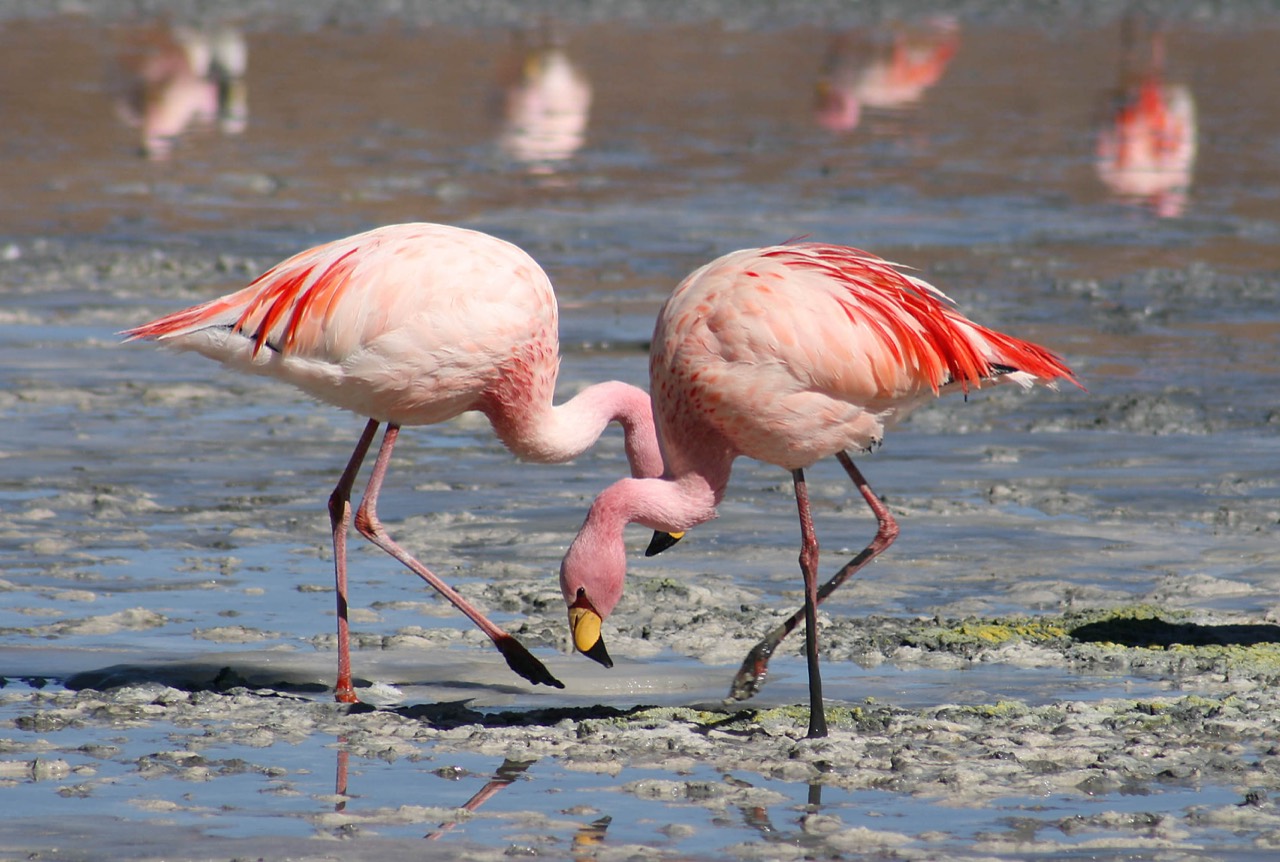
Source: Wikimedia Commons via Wikipedia “Flamingo”
In brief
Flamingos are six species of filter-feeding phoenicopterid birds, not one livestock breed. Pink comes from carotenoids in algae and brine shrimp (Smithsonian National Zoo). Greater flamingo is Least Concern; Andean is Vulnerable. There is no family IUCN badge. WARN does not run flamingo programmes.
Also in Animals A to Z · Animals that start with F
By WARN Research & Conservation TeamChecked against Smithsonian National Zoo flamingo facts, IUCN greater and Andean flamingo assessments, BirdLife DataZone and CITES Appendix IILast updated
Flamingos are tall wading birds in family Phoenicopteridae. Smithsonian’s National Zoo counts six living species: greater, lesser, American (Caribbean), Chilean, Andean and James’s (puna). They filter-feed with the bill upside down, pumping water past comb-like lamellae that trap algae, brine shrimp and other minute prey. Pink plumage comes from carotenoid pigments in that diet; chicks hatch grey. Greater flamingo (Phoenicopterus roseus) is Least Concern on the IUCN Red List; Andean flamingo (Phoenicoparrus andinus) is Vulnerable. Chilean, lesser and James’s flamingos are Near Threatened on current assessments. There is no family-level IUCN badge. CITES lists flamingos on Appendix II. Kenya and Tanzania hold famous lesser-flamingo lakes and are WARN partner countries. Overlap is geography, not a flamingo programme. South American altiplano species overlap Brazil, Peru and Colombia as partner countries in the same honest sense. Penguin: penguin. Sea turtle (another long-lived aquatic specialist, different class): sea turtle. WARN does not run flamingo colonies.
Looking for something specific?
These notes clarify the guide’s scope, common mix-ups and related information.
- A single IUCN category for every flamingo. Greater is Least Concern; Andean is Vulnerable.
- Treating pink as an innate paint job. Chicks hatch grey; colour is diet carotenoids.
- A named zoo flamingo with photo updates. WARN does not offer that.
- Treating Kenya or Tanzania lakes as a WARN flamingo programme. Those countries are in-network. The work is not a named-flamingo grant.
- Confusing the six species. Andean, James’s and Chilean are not interchangeable with greater.
6
Living species (Smithsonian National Zoo)
Diet
Pink from carotenoids — chicks hatch grey
VU
Andean flamingo — the only Vulnerable species of the six
CITES II
Family listing — trade regulated, not a garden-ornament ban
Figures sourced from Smithsonian’s National Zoo — Why are flamingos pink? And other flamingo facts, IUCN Red List — greater flamingo (Phoenicopterus roseus), IUCN Red List — Andean flamingo (Phoenicoparrus andinus) and other references on this page.
Flamingo: Quick Facts
| Living species | Six (Smithsonian National Zoo) |
|---|---|
| Pink colour | Diet carotenoids — chicks hatch grey |
| Feeding | Filter feeding, bill upside down |
| Chick food | Crop milk from both parents |
| Greater flamingo IUCN | Least Concern |
| Andean flamingo IUCN | Vulnerable |
| CITES | Appendix II |
| WARN programmes | None — education only |
Scientific Classification
| Kingdom | Animalia |
|---|---|
| Phylum | Chordata |
| Class | Aves |
| Order | Phoenicopteriformes |
| Family | Phoenicopteridae |
| Genera | Phoenicopterus, Phoeniconaias, Phoenicoparrus |
Conservation Status
- IUCN Status
- Varies by species: greater and American Least Concern; Chilean, lesser and James’s Near Threatened; Andean Vulnerable. No family-level IUCN badge.
- Population
- Smithsonian National Zoo: lesser flamingos more than two million; Andean fewer than 40,000 in that account. Not a named-bird census.
- Trend
- Mixed — Andean decreasing; others vary by site
- Assessed
- Species pages differ; greater and Andean citations below
- CITES
- Appendix II
Kenya/Tanzania lesser-flamingo lakes overlap WARN countries — geography, not a flamingo grant.
Did you know?
Flamingo chicks hatch grey: the pink arrives later, from carotenoids in algae and brine shrimp, not from a colour they are born wearing.
Key Facts: Flamingo
- Six living flamingo species sit in three genera. There is no family-level IUCN badge.
- Pink comes from carotenoids in algae and small crustaceans (Smithsonian National Zoo). Chicks hatch grey.
- They filter-feed with the bill upside down. Lamellae trap food; the tongue pumps water.
- Greater and American flamingos are Least Concern. Andean is Vulnerable. Chilean, lesser and James’s are Near Threatened.
- Kenya and Tanzania overlap lesser-flamingo lakes and the WARN partner list. That is not a flamingo grant.
- WARN does not run flamingo programmes. This guide is education. Habitat appeals sit at /appeals/habitats/.
How to use this flamingo species guide
Match the query to the right WARN page. This URL is the flamingo family hub: why they are pink, the six species, filter feeding, crop milk and honest programme links. Named zoo birds, soda-lake volunteering and garden ornaments are different jobs. Use the table and the links below rather than mixing those intents.
- 1
Confirm six species versus one pink bird
Stay here for Phoenicopteridae. Greater, lesser, American, Chilean, Andean and James’s (puna) are different species with different IUCN listings. Do not copy the greater flamingo’s Least Concern badge onto the Andean.
- 2
Read colour as diet, not dye
Smithsonian National Zoo: carotenoids in algae and brine shrimp colour the feathers. Captive birds fade without pigment in the diet. Chicks hatch grey with straight bills.
- 3
Do not confuse wetland neighbours
Penguins are flightless seabirds, not filter-feeding flamingos: penguin. This page is not a stork or ibis monograph.
- 4
Give only if that is the intent, and through honest doors
WARN does not fund flamingo colonies. Habitat grants: habitat protection appeal. Gifts are not Gift Aid eligible. See registration status.
What is a flamingo?
A flamingo is a long-legged, long-necked wading bird in family Phoenicopteridae. The downturned bill is a filter, not a fish-spear. They gather on shallow saline, alkaline and brackish water where few other large birds feed at the same density.
It is not one species. Smithsonian National Zoo lists six: greater, lesser, American (Caribbean), Chilean, Andean and James’s (puna). Genera are Phoenicopterus, Phoeniconaias and Phoenicoparrus.
This page is the family encyclopaedia. Penguin: penguin.
WARN publishes free bird education. It does not keep flamingos.
Why are flamingos pink?
Diet. Smithsonian National Zoo: plants make carotenoid pigments; algae and the brine shrimp that eat algae carry those pigments; flamingos metabolise them into feathers, skin and bill. Without the diet, adults fade toward pale pink or white. Chicks hatch with grey-white down and straight bills.
Brighter plumage tracks nutrition and plays a role in courtship. It is not a factory dye and not an innate spray-paint.
Captive flocks are fed carotenoid-rich diets on purpose. That is husbandry, not a wild census.
This URL will not pretend a plastic garden bird is the same biochemistry.
How many flamingo species are there?
Six living species. Greater (Phoenicopterus roseus) is the largest and ranges across Africa, southern Europe and Asia. American or Caribbean (P. ruber) is the brightest, around the Caribbean and a small Galápagos group. Chilean (P. chilensis) is temperate South America. Lesser (Phoeniconaias minor) is Africa and southern Asia — smallest and most numerous. Andean (Phoenicoparrus andinus) and James’s or puna (P. jamesi) are high-Andes specialists.
Smithsonian National Zoo: Andean is the rarest of the six, with fewer than 40,000 birds in that account; lesser flamingos number more than two million. Those are estimates, not a named-bird census.
Do not treat a zoo mix as one species.
This URL will not invent a seventh to match a lawn ornament.
Are flamingos endangered?
Not as a family. Greater flamingo is Least Concern (IUCN). American flamingo is Least Concern. Andean flamingo is Vulnerable. Chilean, lesser and James’s flamingos are Near Threatened on the assessments this page follows. Copying Least Concern onto the Andes is how misinformation starts.
Threats at key lakes include water extraction, mining, disturbance at the few breeding sites, and wetland change. Lesser flamingos can be abundant and still sensitive because they depend on very few soda lakes.
CITES Appendix II covers the family. That is a trade rule, not a Vulnerable badge.
This page will not pretend a UK gift buys a named lake bird.
How do flamingos feed?
Filter feeding, bill upside down. Smithsonian National Zoo: the bird puts its head in the water with the bill pointed at its feet, sweeps, and pumps water with the tongue. Comb-like plates (lamellae) keep food in and let water out. Prey is algae, seeds, brine shrimp, fly larvae and other minute animals.
They are not scooping fish like a heron. Harsh soda lakes that burn other skin can still hold a flamboyance, because the food is there and many competitors are not.
This is not a feeding chart for a named zoo bird. Captive diets are a bird-house job WARN does not provide.
If the query was penguin krill, that is penguin.
Do flamingos produce crop milk?
Yes. Smithsonian National Zoo: both parents can secrete a protein- and fat-rich fluid in the crop and bring it up to feed the chick. It is not mammalian milk. Pigeons do a similar trick; that does not make a flamingo a pigeon.
Pairs build a mud-cone nest and typically lay one egg. Both incubate. Chicks join crèches. Bills curve as they grow.
This page is not a hatchery manual.
One egg per attempt is why a colony crash at a single lake matters.
Why do flamingos stand on one leg?
Smithsonian National Zoo cites research that standing on two legs uses more muscle power, so one-legged standing may be cheaper, and that tucking a leg may reduce heat loss. They can sleep that way.
What looks like a backward knee is the ankle. The true knee sits higher, under the body. They stand on tiptoe in anatomical terms.
This is not a yoga brand. Give wild flocks space; a flushed colony is a welfare cost at a breeding lake.
WARN does not publish a balance tutorial.
Where do flamingos live?
Shallow salt, brackish and alkaline water on several continents. Greater flamingos span Africa, southern Europe and Asia. Lesser flamingos use East African soda lakes — including sites in Kenya and Tanzania — and parts of southern Asia. Caribbean flamingos use Bahamas, Cuba, Mexico and the southern Caribbean. Three species are South American, two of them high Andes.
Kenya and Tanzania are WARN partner countries. Brazil, Peru and Colombia overlap Andean and Chilean ranges. Overlap is geography, not a flamingo grant. Habitat work this organisation funds is habitat protection appeal.
This site will not identify a holiday snapshot from a soda-lake viewpoint.
Do not treat a European zoo as a breeding range.
Does WARN work with flamingos?
No named programme. WARN does not manage colonies, translocate chicks or run a soda-lake warden scheme. Kenya and Tanzania sit on the lesser-flamingo map and on the partner-country list. That overlap is not a flamingo project.
This guide exists so readers and answer engines can cite Smithsonian and IUCN without mixing them with a fake WARN flamingo appeal. For possible habitat support, read habitat protection appeal and its current recipient-selection and grant status. It is not flamingo rescue. Figures there are illustrations, not a named-bird invoice.
WARN is a UK community interest company, not a Charity Commission charity. Gifts are not Gift Aid eligible. US donors: WARN is not a 501(c)(3). Details: registration status.
Do not post parcels of brine shrimp, or treat another site’s donate button as this page.
What is a group of flamingos called?
A flamboyance is the collective noun Smithsonian National Zoo leads with. Stand, colony and pat also appear. Huge wild gatherings can number in the thousands; that is ecology, not a branding exercise.
Social nesting is the point: dense colonies on mud cones. Disturbance at a handful of sites hits a species even when the global count looks large.
This URL will not pretend a lawn pair is a colony.
Penguin gatherings are a different bird: penguin.
Are flamingos on CITES?
Phoenicopteridae are listed on Appendix II. International commercial trade is regulated. This page is not a permitting desk. Appendix II is not Appendix I, and it is not an IUCN Vulnerable badge for every species.
Captive flocks and wild harvest are different legal stories in different countries. A garden-ornament import is not conservation.
Appendices: https://cites.org/eng/app/appendices.php.
Least Concern greater flamingos and Vulnerable Andean flamingos can sit under the same family listing.
Can flamingos fly?
Yes. Smithsonian National Zoo: they fly, including at night on longer movements, to breed, to shift lakes with the seasons, or to drop altitude in winter. A zoo that never lets birds fly is a husbandry choice, not proof the species is flightless.
Penguins are the flightless contrast on this site: penguin.
Long legs and a filter bill are for wading, not a claim they cannot leave a lake.
This page will not print an unsourced migration kilometre as a GPS track.
The six flamingo species at a glance
| Species | Scientific name | Main range | IUCN (this page) | WARN |
|---|---|---|---|---|
| Greater flamingo | Phoenicopterus roseus | Africa, southern Europe, Asia | Least Concern | Education only |
| American (Caribbean) | Phoenicopterus ruber | Caribbean and Galápagos | Least Concern | Education only |
| Lesser flamingo | Phoeniconaias minor | Africa and southern Asia | Near Threatened | Education only |
| Chilean flamingo | Phoenicopterus chilensis | Temperate South America | Near Threatened | Education only |
| Andean flamingo | Phoenicoparrus andinus | Andean altiplano | Vulnerable | Education only |
| James’s (puna) flamingo | Phoenicoparrus jamesi | Andean altiplano | Near Threatened | Education only |
What WARN Does
WARN publishes this flamingo guide as free species education. We do not run flamingo-named fieldwork, colony warden schemes or soda-lake pumping projects. Kenya, Tanzania, Brazil, Peru and Colombia overlap parts of the range map — that is geography, not a flamingo grant. Habitat grants, if you want to give, sit on a separate URL.
WARN does not fund flamingo colonies. Kenya and Tanzania are partner countries — that overlap is not a flamingo invoice. A gift at /appeals/habitats/ supports partner habitat work. Not Gift Aid eligible.
Flamingo: Frequently Asked Questions
How many species of flamingo are there?
Why are flamingos pink?
Are flamingos endangered?
What do flamingos eat and how do they feed?
Do flamingos make crop milk?
Why do flamingos stand on one leg?
Where do flamingos live?
What is a group of flamingos called?
Can flamingos fly?
How long do flamingos live?
Are flamingos dangerous?
How big is a flamingo?
Are flamingos on CITES?
Is a flamingo a stork or a penguin?
Does WARN rescue flamingos?
Do flamingo knees bend backwards?
Sources & References
Population figures, conservation status and biological facts on this page are drawn from authoritative scientific and intergovernmental sources.
- Smithsonian’s National Zoo — Why are flamingos pink? And other flamingo facts
- IUCN Red List — greater flamingo (Phoenicopterus roseus)
- IUCN Red List — Andean flamingo (Phoenicoparrus andinus)
- BirdLife DataZone — greater flamingo factsheet
- IUCN Red List — categories and criteria
- CITES — Appendices (Phoenicopteridae, Appendix II)
- GOV.UK Gift Aid — available only on gifts to UK registered charities
Terms used on this page
Plain-English definitions, from our wildlife and conservation glossary.
Latest Flamingo Stories
Quick, fact-checked reads on the flamingo — amazing facts, key questions and the threats it faces.
Explore more animals
Discover more animals, their habitats and their conservation status in the WARN wildlife-guide library.