Wildlife Guide · Hedges, scrub and woodland edge across Europe and western Asia & Widespread in British gardens with dense cover
Dunnock
Prunella modularis (Linnaeus, 1758) — family Prunellidae
The little brown bird under the hedge — shy, streaked and more complicated than it looks.
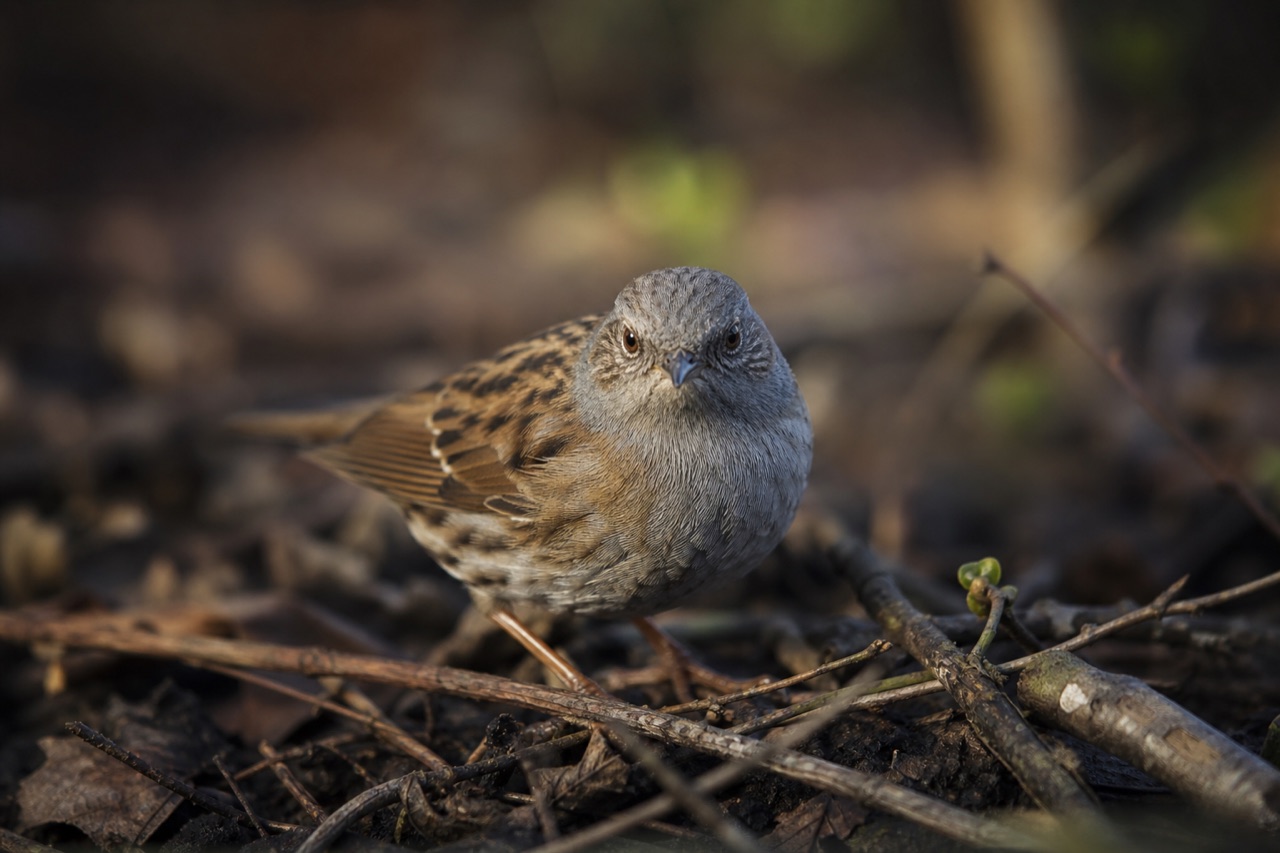
AI-generated educational wildlife portrait — World Animal Rescue Network · AI visualisation, not a photograph
In brief
The dunnock (Prunella modularis) is a small streaky brown hedge bird that forages on the ground beneath garden shrubs, sings a thin reeling warble, and is known for complex breeding arrangements — multiple males or females sharing territories — while depending on dense cover and cat-safe hedges.
Also in Animals A to Z · Animals that start with D
By WARN Research & Conservation Team Last updated
The dunnock — also called hedge accentor or hedge sparrow, though it is neither a sparrow nor closely related to one — is a small, streaky brown bird that shuffles mouse-like beneath hedges and shrubs. Most people see it briefly on the ground beneath feeders, flicking its wings in a nervous display, and mistake it for a dull sparrow. Closer inspection shows a slender bill, fine streaking and a grey head and breast on adults. Dunnocks live in dense cover. They nest in hedges, ivy on walls and thick shrubbery, and forage on the ground for insects and seed. They visit garden feeding stations cautiously, taking spillage and small seeds from beneath trays. Their song is a thin, reeling warble — easy to overlook among louder blackbirds and robins. Many garden lists include dunnock without the observer ever having identified one deliberately — it is the streaky bird that was always there beneath the hedge. What makes dunnocks scientifically famous is breeding behaviour: pairs are not always what they seem. Multiple males may share a territory with one female, or females compete for males, and chick care is not always by the social father. In gardens, though, dunnocks matter as hedge birds — indicators of dense cover and ground-level feeding opportunity, vulnerable to cats in exactly the places they feed.
Hedge bird
Lives and nests in dense shrubby cover
Not a sparrow
Family Prunellidae — accentors, not sparrows
Ground shuffle
Feeds beneath hedges and feeder spillage zones
Complex pairs
Multiple mates and parental arrangements documented
Figures sourced from IUCN Red List — Prunella modularis, BTO — BirdFacts: Dunnock .
Dunnock: Quick Facts
| Length | 13–14 cm |
|---|---|
| Old name | Hedge sparrow — not a true sparrow |
| Feeding | Ground beneath hedges; insects and fine seed |
| Song | Thin reeling warble from cover |
| Nest | Cup in dense hedge or ivy, low down |
| Movement | Resident in Britain |
| Main garden threat | Domestic cat predation at hedge base |
Scientific Classification
| Kingdom | Animalia |
|---|---|
| Phylum | Chordata |
| Class | Aves |
| Order | Passeriformes |
| Family | Prunellidae |
| Genus | Prunella |
| Species | Prunella modularis |
Conservation Status
- IUCN Status
- Least Concern
- Population
- Widespread across Europe; common in British hedgerow habitat
- Trend
- Stable in much of range
- Assessed
- 2018
- CITES
- Not listed
Not Red-listed. Dependent on hedgerow and scrub cover. Cat predation significant in gardens.
Did you know?
Dunnock territories can hold complicated arrangements — multiple males, multiple females, and chicks in one nest with different fathers.
Key Facts: Dunnock
- Dunnocks are small streaky brown birds that shuffle beneath hedges — often mistaken for sparrows.
- They are accentors (family Prunellidae), not sparrows — slender bill and fine streaking distinguish them.
- They need dense cover for nesting and feed on insects and seed on the ground.
- Song is a thin reeling warble, easily missed among louder garden birds.
- Breeding behaviour can involve multiple males or females in one territory — unusual among garden birds.
- Domestic cats kill dunnocks at ground level in hedges — the main garden threat.
- Least Concern and widespread — presence indicates good hedge cover nearby.
The bird beneath the hedge
Dunnocks are ground feeders that never stray far from cover. They hop and shuffle beneath hedges, along fence lines and under shrubbery, picking insects, spiders and small seeds. At feeders they take spillage from the ground zone — the same niche chaffinches occupy but lower and closer to the hedge base. When both species are present, dunnocks yield to chaffinches on open ground but persist along the hedge line where chaffinches venture less often.
Plumage is deliberately unobtrusive: brown back, streaked flanks, grey face and breast on adults. Juveniles are browner. The slender bill suits insects and fine seed rather than large hard seeds. Wing-flicking — rapid opening and closing of the wings while feeding — is a display and displacement behaviour seen in social interactions as well as at food. It signals submission or agitation depending on context.
Dunnocks are resident in Britain — most do not migrate — and hold territories centred on hedgerow. A garden with intact hedge, ivy on walls and uncut shrub base supports dunnocks year-round. Removing hedge bottom cover — bare soil beneath a trimmed privet — removes dunnock habitat directly. The bird that shuffles beneath your feeder needs the hedge base left rough.
Dunnocks often feed alongside robins and wrens at the ground zone beneath feeders — three skulking species sharing spillage without forming mixed flocks. Aggression is low; wing-flicking and chase replace the open confrontation robins show. Multiple dunnocks may forage in one garden without obvious territorial exclusion.
Song, nest and the hedge as home
The dunnock song is a fast, thin reeling warble — sustained but quiet, often drowned out by blackbirds. Males sing from within cover rather than exposed perches, which matches their skulking ecology. Territories overlap more than those of blackbirds, and boundaries are maintained by song and chase rather than open confrontation. Several dunnocks may forage in the same garden without holding exclusive territories — unlike robins, which would fight.
The nest is a cup of moss, grass and hair in dense hedge, ivy or shrub — low down, well hidden. Clutch size is typically four or five eggs; incubation is mainly by the female. Both parents feed chicks on insects gathered from the hedge base and lawn edge. Multiple males may feed chicks in one nest when mating arrangements are complex — which makes dunnock parental care harder to observe than in apparently monogamous garden birds.
Fledglings leave the nest before they fly well and stay in undergrowth — the stage when cats hunting along hedge bottoms cause serious losses. A dunnock nest in a cat-patrolled garden often fails even when food is plentiful. Keeping cats indoors at dawn and dusk during breeding season helps dunnocks as much as blackbirds and song thrushes.
In cold weather, dunnocks may join roving tit and finch flocks through woodland edge before returning to hedge base feeding. They do not travel far from cover even in snow — a feeder placed in open lawn centre will not attract dunnocks regardless of food quality.
Complicated breeding — why dunnocks surprised scientists
Dunnock mating systems vary more than most garden birds. A territory may hold one male and one female, but also configurations with two males and one female, one male and two females, or multiple males and females. Paternity does not always match social pairing — chicks in one nest may have different fathers.
The behaviour is an adaptation to habitat and food: where territories are small and cover is continuous, overlapping ranges and shared parental effort can raise reproductive output. For garden observers the point is simpler: dunnocks are not monogamous in the simple pair-bond sense that robins appear to be. What looks like a pair at the feeder may be a more complicated arrangement.
This biology does not change garden management. Dense hedge, cat control and ground feeding support dunnocks regardless of their mating arrangements. It explains why dunnocks remain a subject of ornithological study while being overlooked by most feeder watchers. The dull brown bird beneath the hedge is one of the most studied social systems in British bird ecology.
Dunnock nests are vulnerable to corvid predation when hedges are trimmed to expose the cup — late winter hedge cutting that opens the nest site before breeding is a common garden mistake. Leaving the hedge interior dense through March and April protects dunnocks as well as song thrushes nesting in the same structure.
Cats, hedges and the quiet indicator species
Dunnocks are Least Concern globally and widespread in Britain — not Red-listed, not a priority species. Their conservation interest in gardens is as an indicator: dunnocks present means hedge cover persists; dunnocks absent from a feeder-rich garden often means hedges are trimmed to bare stems or cats patrol every cover line.
Cat predation at the hedge base is the dominant garden mortality source. Dunnocks feed and nest exactly where cats hunt — low, concealed, on the ground. Keeping cats indoors at dawn and dusk during breeding season helps dunnocks as much as blackbirds. A garden that feeds finches above but loses dunnocks below usually has a cat problem at hedge level, not a food problem.
Hedge management matters: allow leaf litter and rough ground at the hedge bottom, retain ivy on walls, plant native mixed hedgerow rather than single-species laurel, and avoid pesticide treatment of the hedge line that removes insect food for chicks. The dunnock rewards untidy hedge bases — the same management that helps hedgehogs and wrens. It is a common bird whose presence or absence tells you whether your hedge is still functioning as habitat.
Population trend in Britain is stable — dunnocks are not Red-listed. Their garden interest is as a hedge-health indicator and as one of the commonest victims of cat predation at ground level. A dunnock-rich garden with failing thrush nests often has cats, not lack of food, as the limiting factor.
What WARN Does
WARN publishes free, sourced species education for the overlooked birds beneath the hedge. The dunnock is common, shy and cat-vulnerable — a streaky reminder that feeder spillage on the ground only helps birds that survive the hedge bottom.
If this guide helps you understand wildlife and the pressures it faces, a gift to WARN supports habitat protection and free public education in our partner countries.
Dunnock: Frequently Asked Questions
Is a dunnock the same as a hedge sparrow?
How do I tell a dunnock from a sparrow?
Do dunnocks use feeders?
What does a dunnock sound like?
What do dunnock / hedge accentors eat?
Where do dunnock / hedge accentors live?
Are dunnock / hedge accentors dangerous?
How long do dunnock / hedge accentors live?
How big is a dunnock / hedge accentor?
Sources & References
Population figures, conservation status and biological facts on this page are drawn from authoritative scientific and intergovernmental sources.
Terms used on this page
Plain-English definitions, from our wildlife and conservation glossary.
Explore more animals
Discover more animals, their habitats and their conservation status in the WARN wildlife-guide library.
Enjoyed this Dunnock guide?
Receive appeal updates, animal-welfare news and published funding reports. Unsubscribe any time.
We only use your address for WARN updates. See our privacy policy.