Wildlife Guide · Asia & Oceans
Coconut Crab
Birgus latro
The world's largest land arthropod and tree-climbing island giant
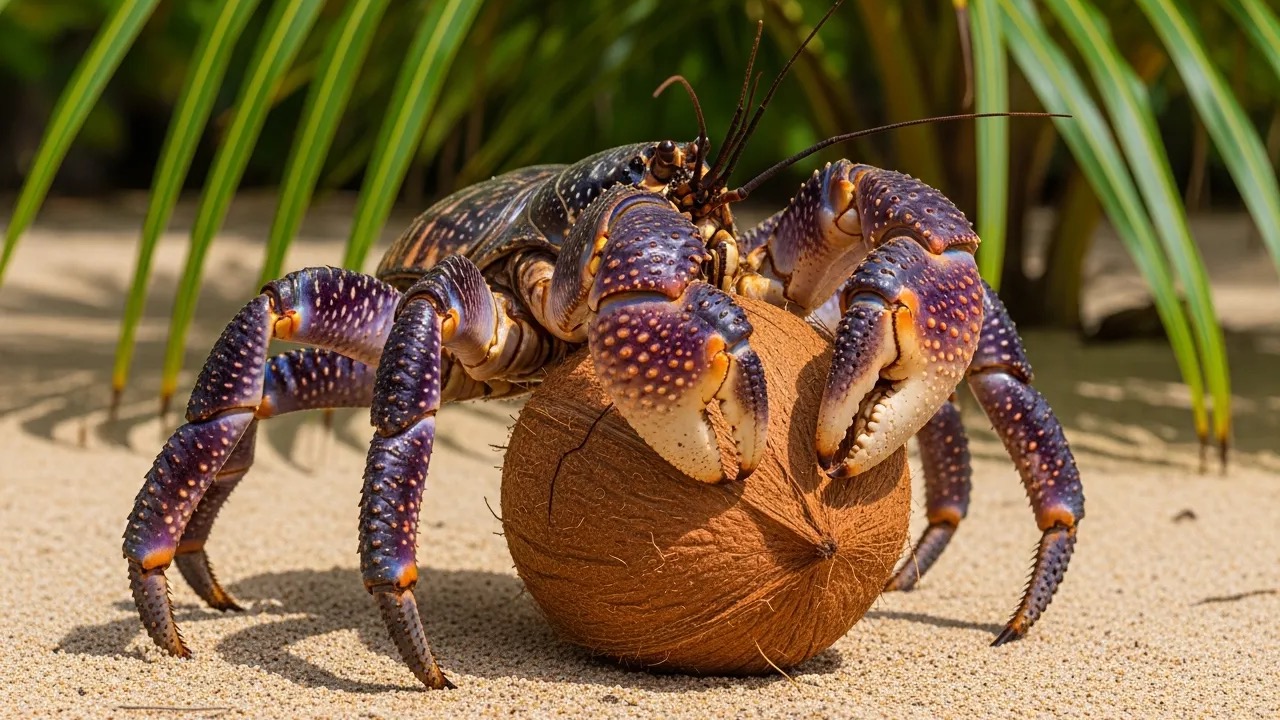
Photo: Franz Eugen Köhler, Köhler's Medizinal-Pflanzen / Wikimedia Commons (Public domain)
In brief
The coconut crab (Birgus latro) is the world's largest land-living arthropod, a giant terrestrial hermit crab found on tropical islands across the Indo-Pacific. Adults reach a leg span of about 1 m (3 ft) and weigh up to roughly 4 kg (9 lb).
Also in Animals A to Z · Animals that start with C
By WARN Research & Conservation Team Last updated
The coconut crab (Birgus latro) is the world's largest land-living arthropod, a giant terrestrial hermit crab found on tropical islands across the Indo-Pacific. Adults reach a leg span of about 1 m (3 ft) and weigh up to roughly 4 kg (9 lb). Famous for climbing trees and cracking open coconuts with powerful claws, it is a long-lived omnivore that may survive 40 to 60 years. The IUCN lists it as Vulnerable.
0.4 m
Typical length
4 kg
Typical weight
4 km/h
Top speed
40 yrs
Lifespan
Figures sourced from IUCN Red List — Birgus latro, Wikipedia — Coconut Crab, Wikidata — Coconut Crab .
Coconut Crab: Quick Facts
| Scientific name | Birgus latro |
|---|---|
| Diet | Omnivore (coconuts, fruit, seeds, carrion) |
| Habitat | Tropical islands across the Indo-Pacific |
| Lifespan | Possibly 40–60 years |
| Weight | Up to about 4 kg (9 lb) |
| Leg span | Up to about 1 m (3 ft) |
| Conservation status | Vulnerable (IUCN) |
Scientific Classification
| Kingdom | Animalia |
|---|---|
| Phylum | Arthropoda |
| Class | Malacostraca |
| Order | Decapoda |
| Family | Coenobitidae |
| Genus | Birgus |
Conservation Status
- IUCN Status
- Vulnerable (IUCN Red List category)
- Population
- Global population not compiled for this guide
- Trend
- See the IUCN Red List assessment
- Assessed
- See the IUCN Red List assessment
- CITES
- See CITES appendices
Conservation figures are drawn from the IUCN Red List and CITES; this guide links to the authoritative sources rather than restating population counts.
Key Facts: Coconut Crab
- The coconut crab is the heaviest land arthropod on Earth, with a leg span reaching about 1 m (3 ft) and a body mass of up to roughly 4 kg (9 lb).
- Coconut crabs are accomplished climbers that scale palm trunks and other trees, sometimes several metres up, to reach fruit or to escape the heat.
- Despite the name, the coconut crab is a broad omnivore rather than a coconut specialist.
Size and body
The coconut crab is the heaviest land arthropod on Earth, with a leg span reaching about 1 m (3 ft) and a body mass of up to roughly 4 kg (9 lb). Unlike its smaller hermit-crab relatives, an adult no longer carries a borrowed shell, instead hardening its own abdomen for protection. Its front claws are extraordinarily strong, capable of a pinch measured among the most powerful of any animal for its size. The body is armoured in a thick exoskeleton that ranges from bluish to reddish-orange depending on the island population.
Climbing and coconuts
Coconut crabs are accomplished climbers that scale palm trunks and other trees, sometimes several metres up, to reach fruit or to escape the heat. They are named for their habit of husking and cracking coconuts, using their claws to strip the fibrous outer layer and hammer through to the flesh inside, a task that can take days. On the ground they are slow, moving at only around 4 km/h, so climbing gives them access to food that faster animals cannot reach. Their grip is strong enough to carry objects heavier than their own body.
Diet and feeding
Despite the name, the coconut crab is a broad omnivore rather than a coconut specialist. It eats fallen fruit, seeds, nuts, the pith of toppled trees, and carrion, and will scavenge almost anything organic it encounters at night. It also feeds on other crabs and has been recorded taking small live animals when the chance arises. A keen sense of smell, unusual among crustaceans and more like that of insects, guides it to food across the forest floor.
Life cycle and breeding
Coconut crabs are terrestrial as adults but remain tied to the sea for reproduction. After mating on land, a female carries her eggs on the underside of her abdomen and then releases the hatching larvae into the ocean, usually at high tide. The tiny larvae drift and develop in the water for several weeks before settling and, like young hermit crabs, occupying small shells while they mature on land. Once large enough, they abandon the shell for good and never return to the water, growing slowly over decades.
Distribution and habitat
The species is found on tropical islands and coastlines throughout the Indo-Pacific, from the western Indian Ocean to islands scattered across the central Pacific. It favours forested coastal areas with plenty of cover, sheltering by day in rock crevices or burrows lined with fibre and emerging to forage after dark. Because populations are isolated island by island, numbers vary widely from place to place. It has vanished from some islands where humans are numerous and survives best on remote, undisturbed land.
Conservation status
The coconut crab is listed as Vulnerable by the IUCN, with populations declining across much of its range. Its slow growth, late maturity, and long lifespan of possibly 40 to 60 years make it slow to recover from losses. Hunting for food, habitat loss, and predation of larvae and juveniles by introduced animals all put pressure on island populations. Several countries now regulate harvesting, setting size limits and protecting breeding females to keep local populations from collapsing.
What WARN Does
WARN does not run a dedicated coconut crab programme — this guide is part of the World Animal Rescue Network's free educational library. The coconut crab faces documented conservation pressure in the wild, which is why clear, sourced public information about it matters. Building public understanding of species like the coconut crab supports the broader conservation awareness that underpins WARN's partner-led rescue work across its network.
If clear, science-based wildlife guides like this help you understand and value animals, please consider supporting the World Animal Rescue Network's educational and rescue work so we can keep producing them.
Coconut Crab: Frequently Asked Questions
How big can a coconut crab get?
Can coconut crabs actually open coconuts?
Do coconut crabs climb trees?
How long do coconut crabs live?
Are coconut crabs dangerous to humans?
Where do coconut crabs live?
What do coconut crabs eat?
Sources & References
Population figures, conservation status and biological facts on this page are drawn from authoritative scientific and intergovernmental sources.
Terms used on this page
Plain-English definitions, from our wildlife and conservation glossary.
Latest Coconut Crab Stories
Quick, fact-checked reads on the coconut crab — amazing facts, key questions and the threats it faces.
Species
Why Are Sea Turtles Endangered? The Threats — and How to Help
Sea turtles have survived for more than 100 million years, yet within a few human generations most species have been pushed toward extinction. Here is what is driving the decline — bycatch, plastic, poaching and lost nesting beaches — and what actually helps.
Read the storySpecies
Slow Loris: Why the Internet's Favourite Pet Is a Conservation Disaster
The slow loris looks like a cartoon character — and that has nearly destroyed the species. Here is the truth behind the viral videos.
Read the storySpecies
The Snow Leopard: Why the Ghost of the Mountains Is Still Vulnerable
The snow leopard is one of the most elusive big cats on earth, with an estimated 4,000-6,500 individuals across twelve range states — including Pakistan, where WARN is preparing to operate. This briefing explains why the species was downlisted from Endangered to Vulnerable in 2017 and why that is not the success story it sounds like.
Read the storyExplore more animals
Discover more animals, their habitats and their conservation status in the WARN wildlife-guide library.
Enjoyed this Coconut Crab guide?
Receive appeal updates, animal-welfare news and published funding reports. Unsubscribe any time.
We only use your address for WARN updates. See our privacy policy.