Wildlife Guide · Southeast Asia & Vietnam, Laos, Borneo and Sundaland forests
Chevrotain
Tragulus spp.; silver-backed form Tragulus versicolor (Thomas, 1910) — family Tragulidae
Mouse-deer that are not deer — and one species filmed again in Vietnam after nearly thirty years unseen.
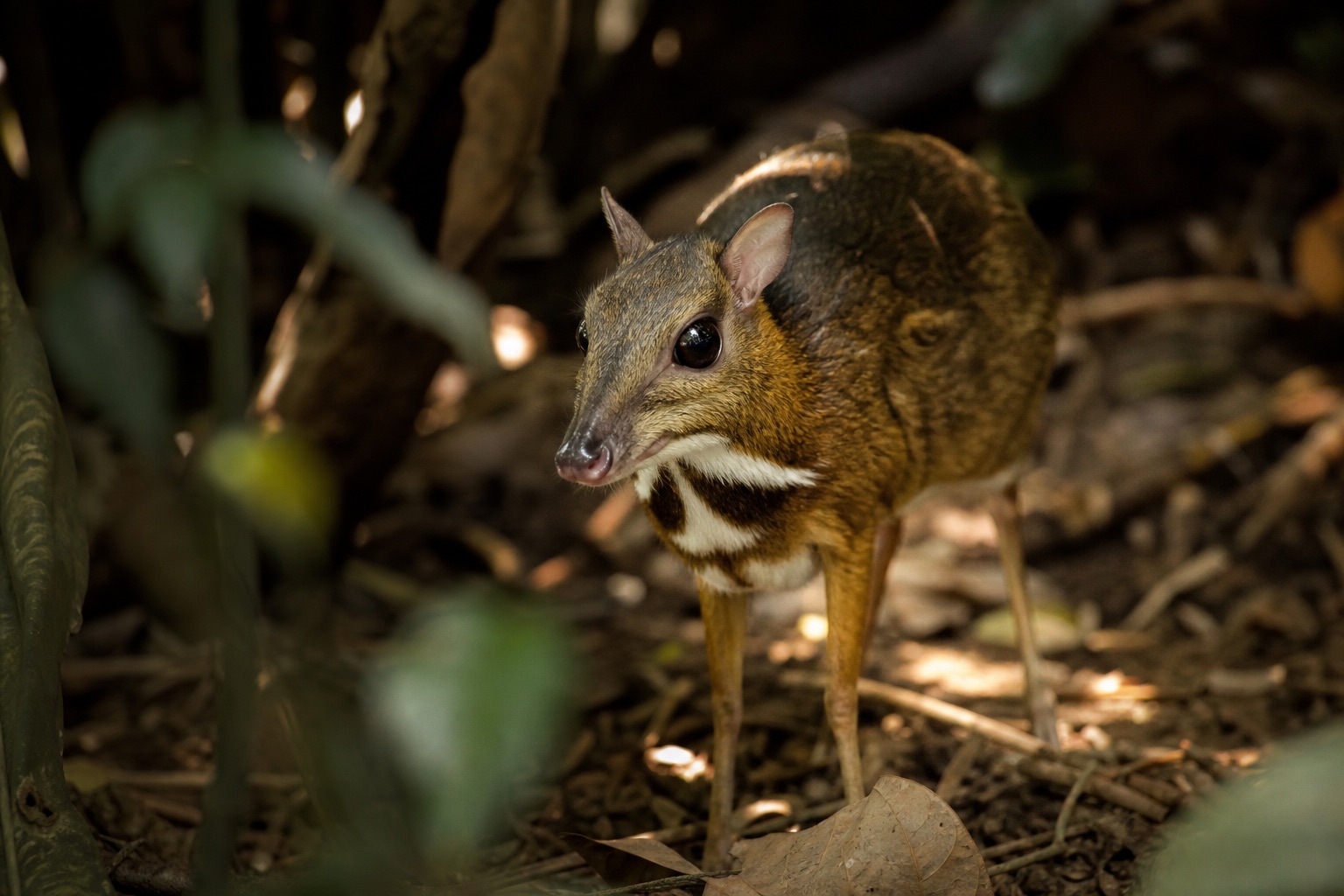
AI-generated educational wildlife portrait — World Animal Rescue Network · AI visualisation, not a photograph
In brief
Chevrotains are tiny Tragulidae hoofed mammals called mouse-deer but not related to deer; the silver-backed chevrotain was rediscovered in Vietnam in 2019 on camera trap after decades without confirmed records.
Also in Animals A to Z · Animals that start with C
By WARN Research & Conservation Team Last updated
Chevrotains are called mouse-deer, which captures their size but not their taxonomy. They belong to the family Tragulidae — an ancient lineage of hoofed mammals separate from true deer in Cervidae. Adults may weigh under two kilograms, stand barely thirty centimetres at the shoulder, and carry tusk-like upper canines especially prominent in males. In 2019 camera traps in Vietnam captured the silver-backed chevrotain (Tragulus versicolor) — a species last recorded in the 1990s and feared lost to hunting and habitat change. The rediscovery made headlines; it did not mean the species was secure. The same forests face snaring, timber extraction, and conversion pressure across mainland Southeast Asia. For comparison with true deer, WARN's deer guide covers cervids — antlered animals in a different family. Chevrotains share a herbivorous, secretive understorey niche but not deer biology: no antlers, different dentition, and a digestive system closer to pigs than to red deer or roe deer.
<2 kg
Adult weight of smaller species
2019
Silver-backed chevrotain rediscovered on camera trap
Fangs
Tusk-like upper canines — especially in males
Not deer
Family Tragulidae — separate from Cervidae
Figures sourced from Nature Ecology & Evolution — silver-backed chevrotain rediscovery, IUCN Red List — Tragulidae .
Chevrotain: Quick Facts
| Size | Under 2 kg in smaller species |
|---|---|
| Canines | Tusk-like in males |
| Rediscovery | Silver-backed — Vietnam 2019 |
| Not | True deer (Cervidae) |
| Activity | Secretive; often nocturnal |
| Main threats | Snaring; oil palm, pulpwood, mining |
Scientific Classification
| Kingdom | Animalia |
|---|---|
| Phylum | Chordata |
| Class | Mammalia |
| Order | Artiodactyla |
| Family | Tragulidae |
| Genus | Tragulus |
| Species | Several; T. versicolor rediscovered 2019 |
Conservation Status
- IUCN Status
- Not Evaluated
- Population
- Unknown for most species
- Trend
- Decreasing where snaring intensity is high
- Assessed
- 2019–2020
- CITES
- Not listed (most species)
IUCN status varies by species (T. versicolor Data Deficient; several threatened). 2019 rediscovery of silver-backed chevrotain highlighted persistence in snared landscapes, not population security.
Did you know?
The silver-backed chevrotain was filmed in 2019 after going unrecorded for decades — a rabbit-sized ungulate with fangs, hiding in forests still full of snares.
Key Facts: Chevrotain
- Chevrotains are mouse-deer in name only — they belong to Tragulidae, not the deer family Cervidae.
- Males bear tusk-like upper canines used in fights, unlike antlered deer.
- The silver-backed chevrotain was rediscovered in Vietnam in 2019 after going unrecorded for decades — proof of how little we know about understorey mammals.
- Snaring and bushmeat hunting remove chevrotains across Southeast Asia; oil palm and pulpwood conversion removes understorey habitat.
- Several species are Data Deficient or Endangered with poor survey data — absence of records often means absence of search, not absence of animals.
- WARN's deer guide at /wildlife-guides/deer/ covers true deer for comparison — antlers, Cervidae biology and different conservation framing.
Not a deer
True deer — red deer, roe deer, muntjac in the strict modern sense — belong to Cervidae, with antlers or small antlers in males and a ruminant lifestyle scaled to their size. Chevrotains are tragulids: no antlers, elongated canines, simpler stomachs closer to non-ruminant artiodactyls, and a body plan miniaturised for dense understorey.
The confusion is linguistic. 'Mouse-deer' describes appearance — tiny, deer-like legs, cautious gait — not genealogy. WARN's deer guide explains cervid identification and ecology; chevrotains need their own frame because snaring campaigns and habitat advice differ when the animal weighs less than two kilograms and hides by day.
The silver-backed rediscovery
Tragulus versicolor was known from specimens collected in the early twentieth century, then effectively vanished from scientific record. Vietnam's forests continued to be logged, snared and fragmented. In 2019 a team deployed camera traps in coastal lowland forest and obtained the first confirmed images in decades.
Rediscovery is not recovery. The species' range and population remain unknown; the IUCN lists it Data Deficient or with heightened concern depending on assessment date. The event shows how understorey mammals can persist unseen while trade and conversion continue — and how quickly they can disappear when snares are indiscriminate.
Snares, trade and plantation conversion
Mainland and Sundaland forests face industrial snaring for bushmeat markets — wire loops that catch everything walking a game trail, including chevrotains. Oil palm and pulpwood replace forest with monoculture; mining opens access. Wildlife trade in Southeast Asia is not only rhino horn and ivory; local bushmeat networks supply urban demand.
Chevrotains are too small for trophy trade but perfect snare size. Forest that looks green from above may be empty at ground level where snare lines run. Protection requires anti-snaring patrols and demand reduction, not only protected-area boundaries on maps.
Ancient ungulates in modern landscapes
Tragulids are among the most primitive living hoofed mammals — a lineage that diverged early from the branch that became deer, cattle and antelope. They survived by staying small and secretive. That strategy fails when every forest path carries a snare.
On Borneo and Sumatra, lesser and greater mouse-deer species share understorey with banteng and bearded pigs at different scales of the same converted landscape. Chevrotain conservation is ungulate conservation at the smallest scale — and among the least visible.
What WARN Does
WARN publishes free, sourced species education for animals hidden in the understorey. Chevrotains are not deer — and the 2019 silver-backed rediscovery shows both how much remains unknown and how fast snaring and plantation conversion can erase it.
If this guide helps you understand wildlife and the pressures it faces, a gift to WARN supports habitat protection and free public education in our partner countries.
Chevrotain: Frequently Asked Questions
Is a mouse-deer a deer?
What was rediscovered in Vietnam in 2019?
Why do chevrotains have fangs?
How big is a chevrotain?
What threatens chevrotains?
Where do chevrotains live?
Are mouse-deer / chevrotains dangerous?
Sources & References
Population figures, conservation status and biological facts on this page are drawn from authoritative scientific and intergovernmental sources.
Terms used on this page
Plain-English definitions, from our wildlife and conservation glossary.
Latest Chevrotain Stories
Quick, fact-checked reads on the chevrotain — amazing facts, key questions and the threats it faces.
Species
Slow Loris: Why the Internet's Favourite Pet Is a Conservation Disaster
The slow loris looks like a cartoon character — and that has nearly destroyed the species. Here is the truth behind the viral videos.
Read the storyGuides
Sun Bear vs Moon Bear: The Two Most Trafficked Asian Bears
The sun bear and the Asiatic black bear (moon bear) are the two most commonly trafficked bears in Asia — for the pet trade, for traditional medicine and for bear-bile farming. Here is how to tell them apart.
Read the storySpecies
12 Amazing Facts About the Asian Elephant
From a 22-month pregnancy to a trunk with tens of thousands of muscles, here are 12 surprising, science-backed facts about Asia's largest land animal.
Read the storyExplore more animals
Discover more animals, their habitats and their conservation status in the WARN wildlife-guide library.
Enjoyed this Chevrotain guide?
Receive appeal updates, animal-welfare news and published funding reports. Unsubscribe any time.
We only use your address for WARN updates. See our privacy policy.