Wildlife Guide · Woodland, farmland and gardens across Europe and western Asia & Widespread throughout Britain and Ireland
Chaffinch
Fringilla coelebs (Linnaeus, 1758) — family Fringillidae
Britain's commonest finch — pink-breasted in spring, picking seed beneath your feeders.
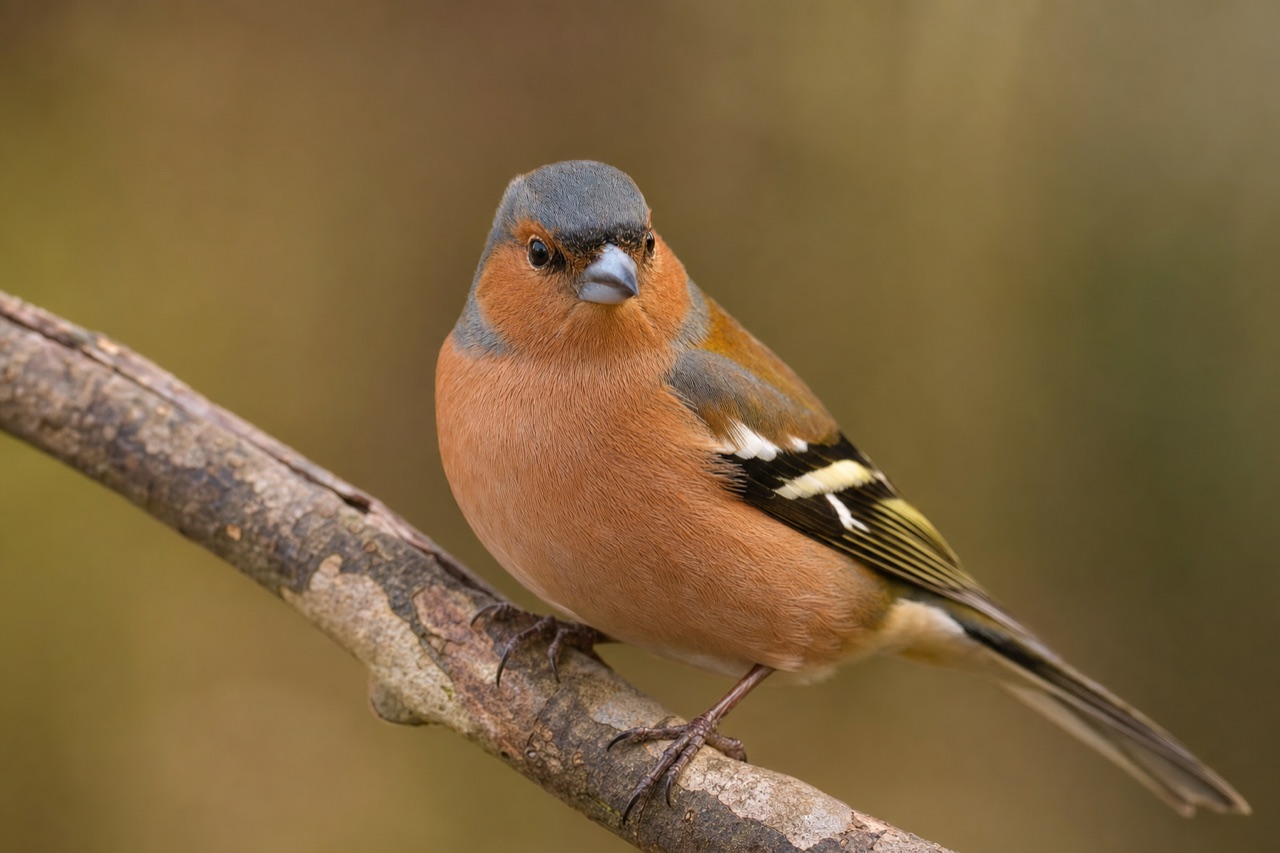
AI-generated educational wildlife portrait — World Animal Rescue Network · AI visualisation, not a photograph
In brief
The chaffinch (Fringilla coelebs) is Britain's commonest finch — a pink-breasted male in spring, brown female year-round, feeding on invertebrates in summer and seed beneath garden feeders in winter, with a loud cascading song from treetops.
Also in Animals A to Z · Animals that start with C
By WARN Research & Conservation Team Last updated
The chaffinch is the most widespread finch in Britain — present in almost every garden near woodland, hedgerow or park trees. The male is one of the smartest garden birds: pink breast, blue-grey crown, olive back and bold white wing bars that flash in flight. Females and juveniles are brown with the same wing bars but without the male's colour. Chaffinches are flexible feeders. In summer they take caterpillars and other invertebrates to chicks; in winter they shift to seed and dominate the ground beneath hanging feeders, taking spillage other birds drop. They are less acrobatic on mesh tubes than goldfinches but more numerous — a typical garden feeding station supports several chaffinches daily through cold weather. Their willingness to feed on the ground makes them visible to cats and sparrowhawks in ways that clinging finches partly avoid. The song is loud and repeated: a descending cascade of notes ending in a sharp flourish, delivered from a high perch from February through summer. Chaffinches hold territories by song and are largely sedentary — the birds in your garden in winter are likely the same individuals that nested nearby in spring. That year-round presence makes them the baseline against which rarer finches — bullfinch, hawfinch, siskin — are noticed when they appear.
Commonest finch
Most widespread finch in Britain
White wing bars
Diagnostic in flight for male and female
Ground feeder
Takes spillage beneath hanging feeders
Sedentary
Most British birds stay near breeding territory year-round
Figures sourced from IUCN Red List — Fringilla coelebs, BTO — BirdFacts: Chaffinch .
Chaffinch: Quick Facts
| Length | 14–16 cm |
|---|---|
| Male plumage | Pink breast, blue-grey cap, white wing bars |
| Feeding habit | Ground spillage beneath feeders; invertebrates in summer |
| Song | Descending cascade with terminal flourish |
| Movement | Mostly sedentary in Britain |
| Nest | Moss cup in tree fork, often in evergreen |
| UK status | Abundant; Least Concern |
Scientific Classification
| Kingdom | Animalia |
|---|---|
| Phylum | Chordata |
| Class | Aves |
| Order | Passeriformes |
| Family | Fringillidae |
| Genus | Fringilla |
| Species | Fringilla coelebs |
Conservation Status
- IUCN Status
- Least Concern
- Population
- Tens of millions in Europe; one of Britain's commonest finches
- Trend
- Stable in much of range
- Assessed
- 2018
- CITES
- Not listed
Abundant and widespread. Not a UK Red List species.
Did you know?
Chaffinch song varies regionally — birds respond more strongly to their local dialect than to songs from distant populations.
Key Facts: Chaffinch
- Chaffinches are Britain's commonest finch — present in gardens near trees across the country.
- Males are pink-breasted with a blue-grey cap in spring; females are brown with white wing bars.
- They feed on invertebrates in summer and seed in winter, often on the ground beneath feeders.
- Song is a loud descending cascade ending in a flourish — among the first finch songs in late winter.
- Largely sedentary — winter garden visitors often bred locally.
- Feeder hygiene matters — chaffinches share diseases at concentrated feeding stations.
- Domestic cats and sparrowhawks take chaffinches at feeders; window strikes occur near glass.
The finch beneath the feeder
Chaffinches exploit a feeding niche other finches ignore: the ground. Hanging feeders drop seed constantly — sunflower hearts, millet, split peanuts — and chaffinches patrol the area beneath, picking spillage while tits and goldfinches cling above. In gardens with several feeding stations, chaffinches often monopolise the ground zone, hopping in quickly when larger birds flush seed down.
In breeding season the diet shifts. Caterpillars, aphids and other invertebrates feed chicks — chaffinches are capable parents raising two broods where habitat allows. The conical bill that husks seed in winter probes leaf clusters and bark for larvae in spring. This dual diet is why chaffinches thrive in mixed woodland-edge gardens: trees for nesting and song, lawn and feeders for winter seed, shrubbery for summer insects.
Chaffinches visit tray feeders and tables as well as ground spillage. They are less specialised than goldfinches on nyjer and less bulky than greenfinches on peanuts. Generalist seed — sunflower hearts, mixed finch seed — suits them well. A garden that feeds tits and goldfinches above will almost always feed chaffinches below, whether or not the ground is deliberately provisioned.
Chaffinches are among the first finches to respond when feeding stations go up in autumn — often appearing within days of the first peanut fill. Their ground-feeding habit means they also pick through leaf litter and shrub bases for natural seed when feeders are empty, which helps them persist in gardens where feeding is intermittent rather than daily.
Song, territory and the sedentary habit
Male chaffinches establish territories from late winter, singing from the highest available perch. The song varies regionally — British chaffinches share a general pattern but local dialects exist, and birds respond more strongly to their own population's song type. Females choose mates partly on territory quality and song performance. A male with a good territory — feeding trees, nesting cover, minimal cat pressure — holds his song post from dawn through June.
The nest is a compact cup of moss, grass, hair and spider silk, built in a forked branch or against a trunk, often in conifer or evergreen where the nest is concealed from above. Clutch size is typically four to five eggs; both parents feed chicks. Fledglings disperse gradually rather than moving long distances. Young males may not sing fully until their second year, when they establish their own territories.
Most British chaffinches are sedentary or move only short distances in hard weather. Ringing recoveries show birds remaining within a few kilometres of their natal site. Your garden chaffinches in January are likely local breeders — which makes feeder hygiene and cat control year-round investments rather than winter-only concerns.
Regional song dialects in chaffinches are among the best-studied examples of cultural variation in birds. A male arriving in a garden from outside the local dialect area may sing for weeks before integrating — females often prefer local song types, which slows colonisation of new suburbs even when habitat is suitable.
Disease, cats and windows at feeding stations
Chaffinches share feeders with greenfinches, goldfinches and tits — the concentration that spreads trichomonosis and other finch diseases. Sick chaffinches show the same symptoms as greenfinches: fluffed plumage, difficulty swallowing, lethargy. Regular feeder cleaning reduces risk for all finch species using the station. Rotating feeding locations prevents droppings accumulating under one spot where parasites persist in damp conditions.
Cats hunt chaffinches at ground feeders where birds are distracted and exposed. Sparrowhawks strike at hanging and ground feeders alike — a natural predator whose presence indicates healthy prey numbers. Bells on cat collars reduce but do not eliminate kills. A ground-feeding chaffinch has nowhere to hide when a cat stalks across open lawn between hedge and feeder.
Window collisions affect chaffinches when feeders sit between vegetation and large glass panes. Moving feeders to within a metre of glass or beyond three metres reduces fatal strikes. External decals break up reflections on patio doors beside feeding areas. Chaffinches flying between woodland edge and ground feeders cross garden airspace daily — any glass in that corridor is a collision risk.
Winter flocks of chaffinches sometimes form in woodland before dispersing to feeders at dawn. In hard weather, chaffinches may join mixed finch and bunting flocks on farmland stubbles near gardens — the birds at your feeder in a cold snap may have roosted together in nearby trees overnight.
Status and what chaffinches indicate
The chaffinch is Least Concern globally and abundant in Britain — one of the commonest breeding birds in woodland and garden-edge habitat. Population trend is broadly stable, though regional fluctuations occur with seed crop failure and disease outbreaks affecting finch communities generally. A sharp local drop in chaffinches alongside greenfinches may indicate trichomonosis; a drop in chaffinches alone may reflect cat pressure or loss of nearby nesting trees.
Chaffinch presence in a garden indicates trees nearby, working feeders and seed spillage on the ground. They are not a conservation priority species — they are the baseline finch against which rarer relatives are measured. A garden with chaffinches but no greenfinches may simply reflect disease history; one with neither finch usually lacks tree cover or feeding provision.
Supporting chaffinches is supporting general finch hygiene: clean feeders, cat control at dawn and dusk, berry and seed plants in borders, and native shrubs for nesting cover. Nothing exotic is required — the commonest finch is common because it fits British gardens well when those basics are met. Its abundance is useful: when even chaffinches disappear, the problem is structural — habitat or disease — not species rarity.
Chaffinch populations in Britain track woodland cover and garden feeding culture more than climate — they are not a migrant escape from continental weather. Their stability makes them a useful comparator when greenfinch or bullfinch numbers shift in the same garden over the same years.
What WARN Does
WARN publishes free, sourced species education for the birds people feed daily without always naming. The chaffinch is Britain's commonest finch — the ground-feeding baseline beneath every hanging feeder.
If this guide helps you understand wildlife and the pressures it faces, a gift to WARN supports habitat protection and free public education in our partner countries.
Chaffinch: Frequently Asked Questions
How do I identify a male chaffinch?
Do chaffinches use hanging feeders?
When do chaffinches sing?
Are chaffinches migratory?
What do common chaffinchs eat?
Where do common chaffinchs live?
Are common chaffinchs dangerous?
How long do common chaffinchs live?
How big is a common chaffinch?
Sources & References
Population figures, conservation status and biological facts on this page are drawn from authoritative scientific and intergovernmental sources.
Terms used on this page
Plain-English definitions, from our wildlife and conservation glossary.
Explore more animals
Discover more animals, their habitats and their conservation status in the WARN wildlife-guide library.
Enjoyed this Chaffinch guide?
Receive appeal updates, animal-welfare news and published funding reports. Unsubscribe any time.
We only use your address for WARN updates. See our privacy policy.