Wildlife Guide · Sub-Saharan Africa — different species occupy different regions
Xerus & African Ground Squirrels
Xerus, Euxerus and Geosciurus
Burrowing African squirrels, a famous sunshade and a name that needs explaining.
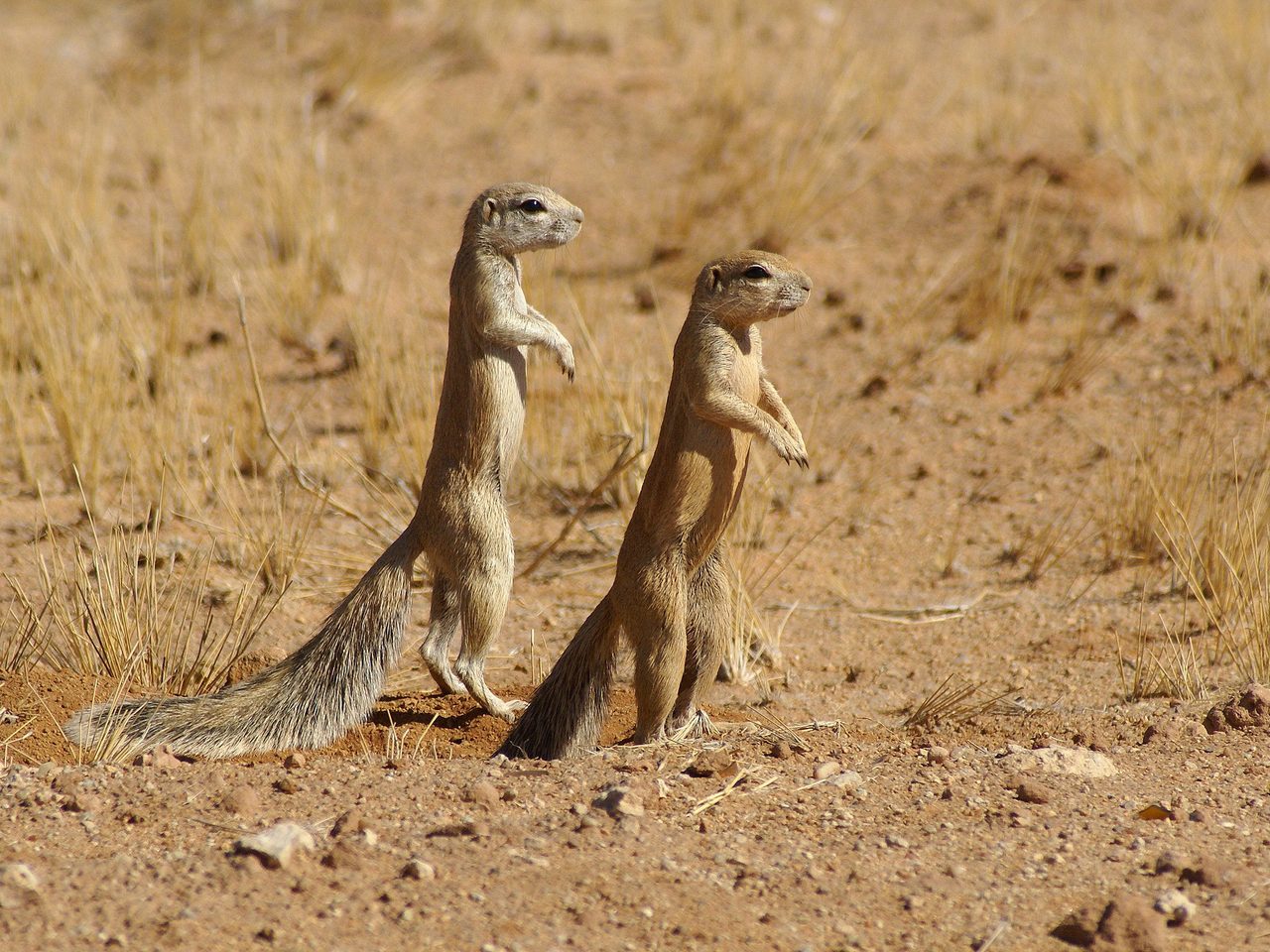
Photo: © Hans Hillewaert / Wikimedia Commons (CC BY-SA 3.0). Resized. · Original photograph · Licence

Cape ground squirrels (Geosciurus inauris, formerly Xerus inauris) near Solitaire, Namibia, photographed on 15 June 2007. The photograph does not show the unstriped ground squirrel Xerus rutilus.
In brief
“Xerus” is commonly used for several African ground squirrels. Current mammal taxonomy keeps the unstriped ground squirrel as Xerus rutilus, places the striped ground squirrel in Euxerus, and puts the Cape and Damara ground squirrels in Geosciurus. The famous parasol-tail research concerns the Cape ground squirrel.
Also in Animals A to Z · Animals that start with X
By WARN Research & Conservation TeamChecked against Mammal Diversity Database, mammal species accounts and published thermal researchLast updated
An African ground squirrel can disappear into a burrow, return to forage in the sun and lift a bushy tail over its back. That familiar scene is often captioned “xerus”, especially when the animal is a Cape ground squirrel. The name is useful when searching older books, but it can conceal differences between species. The American Society of Mammalogists’ Mammal Diversity Database now separates the four animals traditionally grouped in Xerus into three genera. This page explains both the older usage and the current names. It also separates what researchers observed in Cape ground squirrels from what is known about the unstriped species of eastern Africa. A squirrel without a side stripe is not simply an immature striped squirrel, and not every African ground squirrel lives in a large social colony. Understanding the species makes the behaviour, distribution and conservation information much more useful.
3 genera
Current names for the four traditionally grouped species
Daytime
Active above ground during daylight
Burrows
Shelter from weather and predators
Species first
Taxonomy, range and behaviour need to be matched
Figures sourced from MDD — Xerus rutilus, MDD — Euxerus erythropus, MDD — Geosciurus inauris and other references on this page.
Xerus & African Ground Squirrels: Quick Facts
| Animal group | Rodents in the squirrel family, Sciuridae |
|---|---|
| Scope of this page | Four historically associated species, not one biological species |
| Activity | Diurnal: active during daylight |
| Unstriped species size | About 260–420 g; head and body 20–25.5 cm (Animal Diversity Web) |
| Wild lifespan | No reliable single value for this group |
Scientific Classification
| Class | Mammalia |
|---|---|
| Order | Rodentia |
| Family | Sciuridae |
| Tribe | Xerini |
| Genera covered | Xerus, Euxerus, Geosciurus |
Conservation Status
- IUCN Status
- Species-specific; the four cited MDD records report Least Concern
- Population
- No combined population estimate
- Trend
- Consult each species assessment; not inferred from status
- Assessed
- Varies by species; taxonomy and status records reviewed September 2026
- CITES
- Check the exact species and applicable national rules before any proposed trade
This page covers several taxa. Its review date is not an IUCN assessment date.
Did you know?
A study of a squirrel’s “parasol” used thermal models to test what changing the tail position did to heat exposure.
Key Facts: Xerus & African Ground Squirrels
- Xerus rutilus is the unstriped ground squirrel; it does not have the conspicuous flank stripe seen in the Cape species.
- Cape ground squirrel is now Geosciurus inauris in the Mammal Diversity Database; older research calls it Xerus inauris.
- Tail shade is a documented Cape ground squirrel behaviour, not a reason to assume identical heat tolerance in every species.
- Burrows and surface shade are part of an animal’s habitat, so trampling, blocking or flooding burrows can remove essential refuge.
- A wide distribution or Least Concern category does not tell us whether a particular local population is increasing.
What does xerus mean in current taxonomy?
Older mammal references placed the unstriped, striped, Cape and mountain ground squirrels together in Xerus. A 2016 revision by Kryštufek and colleagues examined genetic and anatomical evidence and recognised separate genera. The current Mammal Diversity Database uses Xerus rutilus, Euxerus erythropus, Geosciurus inauris and Geosciurus princeps. The last of these is also called the Damara or mountain ground squirrel.
A changed genus does not mean a new animal appeared or the old research became useless. It means the classification changed. Search the old and new scientific names when following research citations. The species epithet, such as inauris, often provides the connection. This also explains why a museum label and a newer field guide can use different names for the same squirrel. For a wildlife record, retain the identification source and its date rather than silently merging all four species into a single “xerus” population.
How to tell the four ground squirrels apart
The unstriped ground squirrel’s common name is a practical starting point: it lacks the prominent pale stripe running along each side of the Cape and Damara squirrels. Its coarse coat can vary from tawny to reddish tones. Animal Diversity Web gives Xerus rutilus a head-and-body length of about 20–25.5 cm and a mass of about 260–420 g. Those figures belong to that species, not to the whole group.
Range and habitat help narrow an identification. A ground squirrel photographed in Namibia requires a different comparison from one photographed in Kenya or Senegal. The Cape and Damara species can be harder to distinguish from a quick image, particularly without a clear tail and side view. Record where the photograph was taken and ask a local mammal specialist when the distinction matters. A photo showing two squirrels together does not, by itself, establish their species or typical social structure.
Where do African ground squirrels live?
These squirrels are associated with sub-Saharan Africa, but their ranges are not interchangeable. The unstriped ground squirrel occupies parts of eastern Africa and the Horn. The Cape ground squirrel is a southern African animal. The Damara ground squirrel is associated with the rocky landscapes of Namibia and Angola. The striped ground squirrel has a much broader belt across parts of western, central and eastern Africa. The species accounts linked below give the individual distributions.
At a smaller scale, shelter matters as much as the broad habitat label. A burrowing animal needs suitable ground, routes to food and places to avoid danger. “Savanna” includes many different combinations of soil, grass, shrubs and trees. A country-level map should therefore be read as a range overview rather than evidence that squirrels occur at every location inside a border. Keep observations of habitat use separate from assumptions based on a shaded map.
Does the tail really work as a parasol?
Yes, tail shade has been studied in Cape ground squirrels. Bennett and colleagues’ 1984 experiment compared thermal models with different tail positions in the southern Kalahari. Raising the tail reduced the environmental heat load on the model. This is evidence for a shading benefit and helps explain why the posture is so conspicuous during daytime activity. It is not evidence that the squirrel can remain safely in unlimited heat.
A parasol blocks part of the incoming radiation; it does not create a cold environment. The animal can also change its posture, use vegetation shade or retreat underground. The distinction matters when watching an individual: the same tail can be involved in balance, signalling and responses to disturbance, so not every raised tail is a temperature measurement. This guide attributes the experiment to the Cape species and does not repeat the old blanket claim that every xerus gains a fixed number of extra foraging hours.
Burrows, breeding and the limits of what we know
Burrows offer refuge and can be used for raising young. Reports on Xerus rutilus describe females using maternity burrows, but published observations do not establish a single breeding calendar for every part of its range. Rainfall and local conditions may influence timing. A brief species summary should not transform observations from one place into a rule for the entire continent.
Wild longevity is also poorly documented in the sources used here. A maximum age recorded in captivity would be a different kind of evidence from average survival in the wild. We therefore do not give all “xerus” a shared lifespan or a precise global population. If you find a small squirrel alone near a burrow, being alone is not sufficient evidence of abandonment. Keep people and pets back and seek local wildlife advice if it is injured or in immediate danger. Avoid digging out a burrow to investigate.
Are xerus endangered, and how can people help?
The Mammal Diversity Database reports Least Concern for the four species covered here. That is a species-level summary; this group page is not itself an IUCN assessment. It does not supply a current global count or prove that every local population is stable. The linked records should be consulted individually when conservation status is central to a report.
Practical help starts with keeping habitat usable: protect burrow areas from unnecessary disturbance, keep food waste secure and avoid feeding wildlife to obtain close photographs. Where squirrels conflict with crops or buildings, identify the animal and seek locally appropriate advice before intervening. Poisoning or improvised burrow destruction can harm other wildlife as well. WARN publishes this guide as education. It does not claim a dedicated African ground-squirrel rescue programme or a grant to the researchers cited here.
Old xerus names and the names used today
| Common name | Current scientific name | Older name | Range overview |
|---|---|---|---|
| Unstriped ground squirrel | Xerus rutilus | Xerus rutilus | Eastern Africa and the Horn |
| Striped ground squirrel | Euxerus erythropus | Xerus erythropus | Parts of western, central and eastern Africa |
| Cape ground squirrel | Geosciurus inauris | Xerus inauris | Southern Africa |
| Damara / mountain ground squirrel | Geosciurus princeps | Xerus princeps | Namibia and Angola |
What WARN Does
WARN provides this guide for public education. No dedicated xerus programme or verified ground-squirrel grant is claimed here. Our transparency page separates intended grant-making from published payments.
Read the purpose and recipient status of any appeal before choosing to support it.
Xerus & African Ground Squirrels: Frequently Asked Questions
Is a xerus a squirrel?
Is the Cape ground squirrel still called Xerus inauris?
Do all xerus have stripes?
Why does a ground squirrel hold its tail over its head?
Are African ground squirrels the same as meerkats?
What is the lifespan of a xerus?
Can I feed or keep a wild ground squirrel?
Sources & References
Population figures, conservation status and biological facts on this page are drawn from authoritative scientific and intergovernmental sources.
- MDD — Xerus rutilus
- MDD — Euxerus erythropus
- MDD — Geosciurus inauris
- MDD — Geosciurus princeps
- Kryštufek et al. (2016) — revision of African bristly ground squirrels
- O’Shea (1991) — Xerus rutilus species account
- Animal Diversity Web — unstriped ground squirrel
- Bennett et al. (1984) — parasol tail experiment
Terms used on this page
Plain-English definitions, from our wildlife and conservation glossary.
Explore more animals
Discover more animals, their habitats and their conservation status in the WARN wildlife-guide library.