Wildlife Guide · Captive populations worldwide & Historical records in India
White Tiger
Panthera tigris — white colour morph
The genetics behind the white coat, and what responsible tiger care involves.
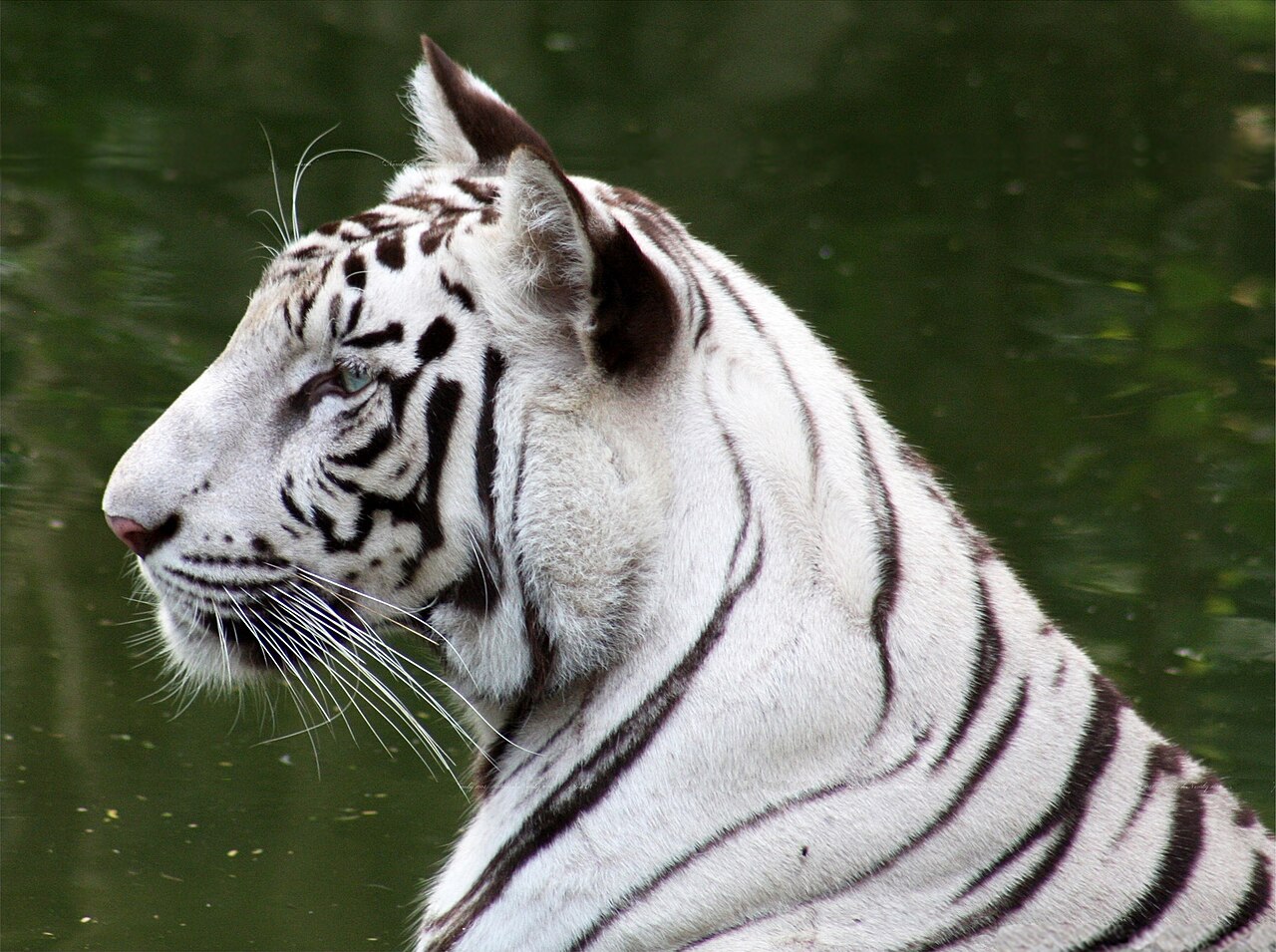
Photo: Santosh Namby Chandran / Wikimedia Commons (CC BY-SA 4.0). Commons edit by Hwttdz; resized by Wikimedia. · Original photograph · Licence

White tiger photographed at New Delhi Zoo, India, on 8 June 2008. This historical zoo photograph does not document a WARN rescue or establish the animal’s pedigree or health.
In brief
A white tiger is a colour variant of Panthera tigris, not a separate species. Its pale coat is associated with a recessive SLC45A2 variant. White tigers have no separate IUCN assessment; the tiger species is Endangered.
Also in Animals A to Z · Animals that start with W
How you can help
You can symbolically adopt a tiger from £5 a month — a donation to WARN’s wild tiger appeal, with a personalised certificate you can keep or give as a gift — or give once to where it is needed most.
By WARN Research & Conservation Team Checked against Genetics research, conservation assessments and zoo policy Last updated
White tigers attract attention because their pale coats make the familiar tiger pattern look strikingly different. The distinction matters: colour describes an individual’s appearance, while a species name identifies the animal being assessed or conserved. A white tiger is still a tiger. This guide separates three questions that are often confused: how the colour is inherited, how captive breeding and care affect welfare, and how conservation helps wild tiger populations. It also explains what a photograph or a claim about “saving rare white tigers” can actually establish.
Colour morph
Not a separate tiger species
SLC45A2
Gene linked to the white coat
Recessive
Inheritance does not require close relatives
Endangered
Tiger species assessment, published 2022
Figures sourced from Xu et al. (2013): The genetic basis of white tigers — original study, NHGRI: recessive traits and alleles, AZA: white paper on inbreeding for rare alleles (approved 2011; PDF dated 2012) and other references on this page.
White Tiger: Quick Facts
| Identity | Tiger with a white coat variant |
|---|---|
| Inheritance | Recessive SLC45A2 variant |
| Typical appearance | Pale coat with dark stripes |
| Historical wild records | India; not a current population estimate |
| Care needs | Specialist tiger husbandry and veterinary care |
| Separate Red List category | None for the colour morph |
Scientific Classification
| Kingdom | Animalia |
|---|---|
| Phylum | Chordata |
| Class | Mammalia |
| Order | Carnivora |
| Family | Felidae |
| Genus | Panthera |
| Species | Panthera tigris |
| Colour form | White; not a separate taxonomic rank |
Conservation Status
- IUCN Status
- No separate assessment for the white colour morph; Panthera tigris is Endangered
- Population
- No reliable current global white-tiger census established for this guide
- Trend
- Not separately assessed for the colour morph
- Assessed
- Tiger species: 2021, published 2022; no colour-morph assessment
- CITES
- Panthera tigris: Appendix I; consult CITES and national authorities for applicable requirements
Species conservation, captive population management and individual animal welfare describe different questions. White colour alone does not establish a conservation priority or a health diagnosis.
Key Facts: White Tiger
- The white coat does not define a separate species or an independently assessed subspecies.
- A genetic study identified a recessive SLC45A2 variant associated with white tiger colouration.
- Recessive inheritance and inbreeding are different concepts; close relatives are not necessary for a recessive trait to appear.
- Historical wild records exist. This guide does not claim a verified current census of white tigers in the wild or captivity.
- Welfare must be assessed for each animal. Appearance alone cannot establish its ancestry, health or quality of care.
- Caring for an existing white tiger and breeding deliberately for a rare colour are separate decisions.
What makes a tiger white?
Xu and colleagues’ 2013 study identified a change in SLC45A2 associated with the white coat. The usual white tiger retains dark stripes and some pigmentation; “albino” is therefore an inaccurate description of this familiar colour form. The study also recognised white colouration as a naturally occurring variant.
Use the terms carefully when identifying an animal. A pale photograph, unusual lighting or an overexposed image is not genetic evidence. The photograph on this page is labelled with its zoo location and historical capture date. It illustrates appearance and does not demonstrate the pictured animal’s pedigree or medical condition.
Does a white tiger have to be inbred?
No. Recessive describes how a trait is inherited. Inbreeding describes reproduction between related animals. For a simple recessive trait, an animal can carry one copy without showing it; two carriers can pass the relevant copy to the same offspring. Those parents do not have to be close relatives.
Repeatedly choosing relatives because they carry a desired rare trait can nevertheless narrow a population’s genetic diversity. The question to ask about a breeding programme is how it manages relatedness and wider population goals, rather than whether a cub has an attractive colour. A coat photograph cannot answer that question.
An explanation of inheritance is also not a recommendation to produce more white cubs. Decisions about captive breeding require appropriate expertise, records, facilities and a justified purpose. Buyers or visitors should not interpret rarity alone as evidence of responsible management.
Are white tigers a separate species or endangered?
White tiger is a colour description within Panthera tigris. It is not a separately listed IUCN taxon. The tiger species was assessed as Endangered on 15 December 2021, in an assessment published in 2022. That assessment concerns extinction risk for the species in the wild, rather than the number of pale animals displayed in captivity.
This distinction helps when evaluating a conservation claim. A statement that a venue has bred a white cub does not, by itself, show a benefit to threatened wild populations. Ask which population or recognised programme benefits, what the intervention is intended to achieve, and what evidence of outcomes is available. The full tiger guide explains the species’ ecology and threats in more detail.
Did white tigers ever live in the wild?
Yes. The 2013 genetic paper discusses historical wild white tigers in India. It is therefore misleading to describe the colour itself as an invention that could only arise in captivity. Historical occurrence does not establish a surviving wild population today.
WARN has not established a reliable, current worldwide count of white tigers. Photographs circulated online can be old, duplicated, edited or missing a location. To assess a claimed recent wild sighting, look for an original record, a date, a location that can be safely disclosed, and verification by an appropriate wildlife authority or research team.
The same care applies to ancestry. A famous founder or a well-documented captive lineage should not automatically be treated as proof of the pedigree of every living white tiger. A universal claim requires records covering the animals it describes.
What are the welfare concerns?
The Association of Zoos and Aquariums’ white paper on breeding for rare alleles addresses the risks of selecting unusual appearances at the expense of sound population management. Its recommendation against intentional breeding for anomalous phenotypes is a policy for AZA-accredited institutions, not a worldwide law. It also recognises that rescuing or caring for existing animals can be appropriate.
These concerns should not turn into a diagnosis of an individual animal from its coat. A useful welfare assessment considers veterinary findings, behaviour, housing, opportunities to retreat and the animal’s history. A tiger may require care for reasons that a visitor cannot see; an apparently calm photograph cannot establish good welfare either.
For a rescue or sanctuary, ask how animals are acquired, who provides veterinary care, whether visitors have direct contact, and how lifetime care is financed. A transparent organisation should explain its choices and limitations without relying on a rare colour as the whole conservation story.
What does recent research say about zoo displays?
A study published in February 2026 examined tiger colour morphs in 44 Thai zoos using observations from 2017–2025. The authors also assessed exhibit information and animal–visitor interactions. Their findings raise concerns about how colour morphs are marketed and explained to visitors.
This is evidence from a defined group of facilities and observation periods. It is not a global health survey of every white tiger. Its practical relevance is the need for accurate interpretation: visitors should be told what a colour morph is and how an institution’s activities relate to welfare and conservation.
When comparing places to visit, look beyond a photograph of a cub. Read their published animal-care and breeding policies, look for independent accreditation with a clear scope, and ask whether conservation claims identify actual activities and results. Where answers are missing, choose an experience with better documented standards.
Are white tigers suitable pets or photo props?
A white coat does not make a tiger domesticated. It remains a large wild carnivore with the same need for secure, specialist care as other tigers. An animal that tolerates one supervised encounter is not thereby safe for casual handling. WARN recommends observing tigers behind appropriate barriers and choosing experiences without direct-contact photographs.
For visitors, the useful decision is whether the activity respects the animal’s needs. Can it move away from view? Is access to food or rest dependent on repeated interactions? Does the operator explain how staff protect both animals and people? These questions are more informative than the claim that a tiger is friendly or has been raised by people.
If you are concerned about a facility, record factual observations from a safe and lawful place and contact the relevant animal-welfare or wildlife authority. Avoid entering enclosures, attempting a private rescue or sharing sensitive animal locations publicly.
How can you help tigers responsibly?
Support should have a clear purpose: for example, appropriate lifetime care for an animal already in captivity, or a specified intervention benefiting wild tiger habitat and populations. These are different outcomes, and a fundraising appeal should say which it seeks. Both deserve evidence, realistic costs and reporting.
Before donating, read the appeal terms and check who would deliver the work, how recipients are selected and how grants will be reported. WARN’s tiger appeal describes its proposed funding purpose. This guide does not establish a named white tiger in WARN’s care or a payment to a sanctuary.
If you cannot donate, share the guide with its source links and explain the distinction between colour, welfare and conservation. Accurate information helps people assess a claim without treating every rare-looking animal as a separate endangered species.
White tiger, tiger species and captive care: what each tells you
| Question | What the evidence can establish | What it cannot establish alone |
|---|---|---|
| Coat appearance | An observable colour form | Pedigree, individual health or a new species |
| Genetic testing | The tested animal’s relevant genetic variants | Quality of care or conservation outcomes |
| IUCN species assessment | Extinction risk for the assessed taxon | A separate global status for white tigers |
| Veterinary and welfare records | Evidence about a particular animal and its care | Benefits to wild populations without further evidence |
| Grant and outcome reports | Documented support and reported results | A guarantee that every future intervention succeeds |
What WARN Does
WARN publishes this guide for education. It does not document a white tiger in WARN’s care or a completed sanctuary grant. Read /appeals/tigers/ for the proposed funding purpose and /about/where-your-money-goes/#grant-register for published grant and payment records.
Help people make informed choices about tiger welfare. Read the appeal’s purpose and funding terms before deciding whether to give; sharing accurate information can help too.
White Tiger: Frequently Asked Questions
What is a white tiger?
Are white tigers albino?
Does recessive inheritance mean the parents were related?
Are all white tigers unhealthy?
How many white tigers are left?
Have white tigers existed in the wild?
Does AZA prohibit caring for white tigers?
Is breeding a white tiger the same as tiger conservation?
Can I donate to a specific white tiger through this guide?
Sources & References
Population figures, conservation status and biological facts on this page are drawn from authoritative scientific and intergovernmental sources.
- Xu et al. (2013): The genetic basis of white tigers — original study
- NHGRI: recessive traits and alleles
- AZA: white paper on inbreeding for rare alleles (approved 2011; PDF dated 2012)
- Erzinçlioğlu et al. (2026): Tiger colour morphs in zoos raise conservation and welfare concerns
- IUCN Red List: Panthera tigris, assessed 2021 and published 2022
- CITES: official appendices and species listings
Terms used on this page
Plain-English definitions, from our wildlife and conservation glossary.
Latest White Tiger Stories
Quick, fact-checked reads on the white tiger — amazing facts, key questions and the threats it faces.
Explore more animals
Discover more animals, their habitats and their conservation status in the WARN wildlife-guide library.