Wildlife Guide · New Zealand
Tuatara
Sphenodon punctatus (Gray, 1842)
Not a lizard — the last living rhynchocephalian, confined to predator-free New Zealand islands.
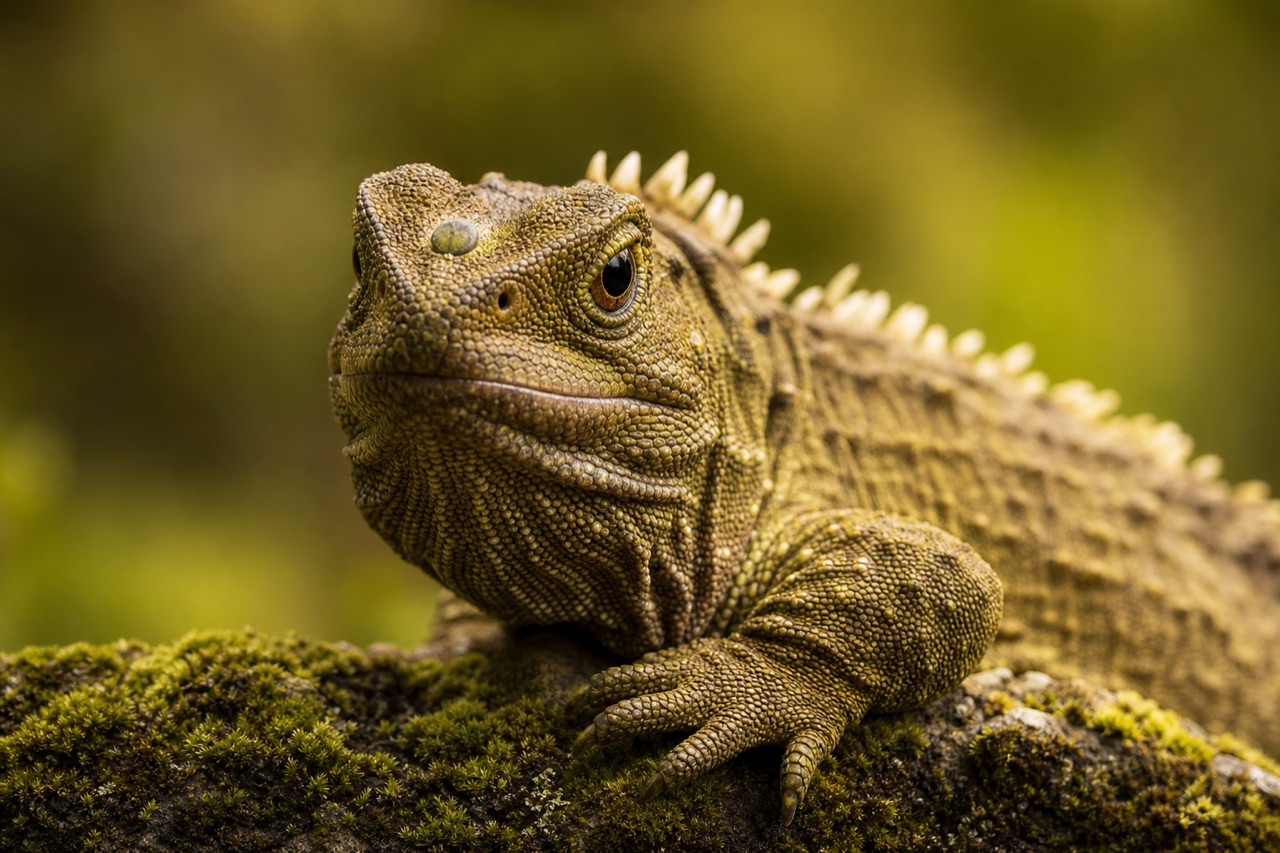
AI-generated educational wildlife portrait — World Animal Rescue Network · AI visualisation, not a photograph
In brief
A tuatara (Sphenodon punctatus) is a New Zealand reptile, the only living rhynchocephalian, not a lizard. IUCN listed it Least Concern in 2019. It survives on predator-free islands and in fenced sanctuaries. CITES Appendix I. Least Concern is not a clean bill of health. WARN does not run tuatara programmes.
Also in Animals A to Z · Animals that start with T
By WARN Research & Conservation Team Checked against IUCN 2019 Sphenodon punctatus assessment, New Zealand Department of Conservation and CITES Appendix I Last updated
The tuatara (Sphenodon punctatus) looks like a lizard and is not one. It is the only living member of order Rhynchocephalia (also called Sphenodontia), a reptile lineage that split from lizards and snakes in the Triassic. New Zealand's Department of Conservation treats all living tuatara as one species; a second name, Sphenodon guntheri for the Brothers Island animals, was dropped after 2009 genetic work. They survive in the wild on rodent-free islands — DOC currently cites 32 — plus fenced mainland sanctuaries. IUCN listed the species Least Concern in 2019. That badge reflects a managed, recovering island metapopulation, not a mainland that is still full of tuatara. CITES lists the genus on Appendix I. This page is the species encyclopaedia. Lizards: gecko and skink. Snakes: snake. WARN does not run New Zealand island eradications or tuatara translocations.
Looking for something specific?
These notes clarify the guide’s scope, common mix-ups and related information.
- A named zoo tuatara with photo updates. WARN does not offer that.
- Treating Least Concern as if the mainland were still full of tuatara. Wild populations persist where introduced mammals are excluded.
- A second living species on Brothers Island. DOC and current taxonomy treat Sphenodon guntheri as the same species.
- WARN rat eradications, nest-shading or New Zealand fieldwork. We do not run those programmes. New Zealand is not a WARN range country.
- A lizard, gecko or snake page. Those are gecko, skink and snake.
LC
IUCN global status (2019) — Least Concern, not a mainland recovery
32
Islands with wild tuatara (New Zealand Department of Conservation)
CITES I
Genus Sphenodon — commercial international trade is banned
16–21°C
Preferred body temperature — among the lowest of any reptile
Figures sourced from IUCN Red List — Sphenodon punctatus (2019, Least Concern), IUCN Red List — categories and criteria, New Zealand Department of Conservation — Tuatara and other references on this page.
Tuatara: Quick Facts
| Also called | Tuatara (Māori name used in English) |
|---|---|
| Length | Adult males about 0.5 m (DOC); total length often cited 50–80 cm |
| Weight | Up to about 1.5 kg (adult males, DOC) |
| Lifespan | Average around 60 years; some reach about 100 (DOC) |
| Preferred temperature | Often given as 16–21°C |
| Incubation | Many months; sex depends on nest temperature |
| IUCN | Least Concern (2019) |
| NZ threat status | At Risk–Relict (NZTCS) |
| CITES | Appendix I (genus Sphenodon) |
| WARN programmes | None — education only |
Scientific Classification
| Kingdom | Animalia |
|---|---|
| Phylum | Chordata |
| Class | Reptilia |
| Order | Rhynchocephalia |
| Family | Sphenodontidae |
| Genus | Sphenodon |
| Species | Sphenodon punctatus |
Conservation Status
- IUCN Status
- Least Concern globally (IUCN 2019). At Risk–Relict in New Zealand. CITES Appendix I.
- Population
- NZTCS band of about 20,000–100,000 mature individuals — not a named-animal census
- Trend
- Stable or increasing where pests are excluded; small islands remain vulnerable
- Assessed
- 2019 (IUCN); NZTCS reptiles 2021
- CITES
- Appendix I (Sphenodon spp.)
Least Concern reflects a managed island metapopulation. Rats remain the primary threat. Brothers Island animals are the same species, not a second living species.
Did you know?
Tuatara hatchlings briefly show the most complete parietal eye of any living vertebrate — a light-sensing organ on the skull roof that is then covered by scales, not a spare camera.
Key Facts: Tuatara
- Tuatara are not lizards. They are the only living members of Rhynchocephalia / Sphenodontia.
- IUCN listed Sphenodon punctatus Least Concern in 2019. DOC still calls rats the most serious threat and wild animals persist on pest-free islands.
- A second species name for Brothers Island tuatara (S. guntheri) is no longer used. Living tuatara are one species.
- Hatchlings have a well-developed parietal (third) eye. It is not a camera; it is covered by scales as the animal grows.
- DOC cites adult males about 0.5 m and up to 1.5 kg, growth until about 35 years, typical lifespan around 60 years, and some animals reaching about 100.
- WARN does not run tuatara programmes. This guide is education. Habitat appeals sit at /appeals/habitats/.
How to use this tuatara species guide
Match the query to the right WARN page. This URL is species facts: what a tuatara is, why it is not a lizard, third eye, lifespan, Least Concern versus island dependence, and the lizard comparison. Zoo visits, New Zealand volunteering and pet reptiles are different jobs. Use the table and the links below rather than mixing those intents.
- 1
- 2
Read Least Concern together with island dependence
IUCN 2019 is Least Concern because managed island and sanctuary numbers are not in free-fall. DOC still lists rats as the primary threat. New Zealand's threat classification treats the species as At Risk–Relict. Those facts sit together.
- 3
Do not collect or land without rules
CITES Appendix I covers the genus. Historic museum collecting is over; poaching and accidental rodent landings still matter. This page is not a landing permit for a pest-free island.
- 4
Give only if that is the intent, and through honest doors
WARN does not fund New Zealand island eradications or tuatara husbandry. Habitat grants: habitat protection appeal. Gifts are not Gift Aid eligible. See registration status.
What is a tuatara?
A tuatara is a reptile, Sphenodon punctatus, endemic to New Zealand. It is not a lizard, not a dinosaur, and not a living fossil in the lazy sense — it is the last living branch of an order that was diverse in the Mesozoic. DOC describes it as New Zealand's largest reptile. Adult males are about half a metre long and can weigh up to 1.5 kg, with a crest of spines that can be raised.
Colour ranges from olive-green to brown to orange-red and can change over a lifetime. Skin is shed about once a year. The Māori name is the one English borrowed.
This page is the species encyclopaedia. It is not a sanctuary booking and not a pet-care sheet. Gecko: gecko. Snake: snake.
WARN publishes free reptile education. It does not keep tuatara.
Is a tuatara a lizard?
No. Lizards and snakes are Squamata. Tuatara are Rhynchocephalia (Sphenodontia). Every living lizard is more closely related to every living snake than either is to a tuatara. The split sits in the Triassic, on the order of 250 million years ago in popular accounts of the divergence.
Skull and teeth make the point without a family tree. Tuatara keep a complete diapsid skull with a solid bony arch lizards have reduced. Teeth are acrodont: fused to the jaw, not in sockets, and not replaced when worn. There is no external ear opening. Mating is by cloacal contact; they lack a copulatory organ.
Do not use 'lizard' as if it cancelled 'tuatara'. The honest sentence is: a tuatara is a rhynchocephalian that happens to look lizard-shaped.
This URL will not pretend the two names are one taxon.
Does the tuatara have a third eye?
Hatchlings have a visible parietal eye on top of the head: a small structure with a lens, retina and nerve connection, under a translucent scale. It does not form images the way the paired eyes do. Over the first months, scales and pigment cover it. The connection remains internally.
Some lizards and frogs have a simpler parietal organ. The tuatara's is unusually complete among living animals. The usual interpretation is circadian and seasonal timing — day length and perhaps basking cues — not a spare camera for predators.
This is not a Pokémon. Do not shine torches into a hatchling's skull on a night tour.
WARN does not run a parietal-eye lab.
Are tuatara endangered?
Not on the global IUCN badge. Hitchmough's 2019 assessment is Least Concern. New Zealand's threat classification (NZTCS) treats the species as At Risk–Relict. DOC's public page still leads with rats, mice, habitat damage, poaching and low genetic diversity on small islands.
Those statements are compatible. Least Concern means the managed island metapopulation does not currently meet a threatened IUCN category. It does not mean you can land a rat on a closed island. CITES Appendix I has covered the genus since the 1970s.
NZTCS cites on the order of 20,000–100,000 mature individuals. That is a band, not a census of named animals. Populations on pest-free islands can be stable or increasing after eradications; small islands remain vulnerable to drought, sea-level rise and a single rodent landing.
This page will not pretend a UK gift buys a named island tuatara.
Where do tuatara live?
Only in New Zealand. DOC says naturally wild populations are now on islands off the north-east North Island and in the Marlborough Sounds — 32 islands in the current public count — plus translocations to further islands and fenced mainland sanctuaries. They are gone from the inhabited mainland as a naturally continuous wild fauna because Pacific rats (kiore) and later Norway and ship rats ate eggs and hatchlings faster than a slow breeder can replace them.
Seabird colonies on those islands fertilise soil and support the invertebrates tuatara eat. A pest-free island is a food web, not a zoo paddock.
The related appeal explains potential support and the current funding status; this guide does not confirm a WARN grant. Habitat work this organisation funds is a different geography: habitat protection appeal.
This site will not identify a holiday snapshot from a sanctuary fence.
How long do tuatara live?
DOC cites an average around 60 years, growth until about 35, and a possible span up to about 100 years. Popular accounts often print 'over 100' as if it were typical. Use DOC's split: long-lived, not immortal, and slow to mature.
Breeding starts late — often in the second decade. Females do not nest every year. Eggs incubate for many months. A named captive animal that bred at a reported 111 years is an anecdote, not a fact-box for the species.
Slow life history is why rats win. It is also why Least Concern still needs annual biosecurity.
This URL is not a memorial page for a named museum animal.
How big is a tuatara?
DOC: adult males about 0.5 m long, up to about 1.5 kg. Total length including tail is often given in the 50–80 cm band in secondary accounts. They are New Zealand's largest reptile, not a crocodile.
Males carry a more obvious dorsal crest. Colour is not a species split.
A hatchling is a hatchling, not a cub. Do not convert length into a tank-size shopping list. Tuatara are not companion lizards. CITES Appendix I is the trade rule.
WARN does not publish a weekly growth chart.
What do tuatara eat?
DOC lists invertebrates first: beetles, wētā, worms, millipedes, spiders. They also take lizards, seabird eggs and chicks, and sometimes their own young. They can be active in cool weather that would shut most reptiles down, and they do not thrive in constant temperatures over 25°C in experimental work DOC cites.
Teeth that cannot be replaced push older animals toward softer prey. That is wear, not a diet fad.
This is not a feeding chart for a named pet. Most people should never keep one.
If the query was garden skinks, that is skink.
How is tuatara sex determined?
Incubation temperature. In tuatara, warmer nests produce more males — the reverse of the pattern many turtles show. Sustained warming at nest sites can skew a small island toward males and, eventually, toward too few females. Islands cannot migrate.
Management talk includes shading nests and moving animals to cooler sites. Those are DOC and sanctuary jobs, not a WARN field grant.
Do not treat a single warm summer as proof the species is already lost. Do not treat Least Concern as proof temperature does not matter.
This page is not a climate model.
How is a tuatara different from a lizard?
Order, skull, teeth, ear opening and copulatory anatomy. See the comparison table. Superficial body shape is the trap that sends people to the gecko page.
Snakes are squamates too. A tuatara is not 'halfway to a snake'. Legless skinks are lizards that lost limbs; tuatara never were squamates.
Crocodilians are another distant reptile branch. Do not stack every ancient-looking reptile into one 'living fossil' bin.
Use gecko, skink and snake when the animal was actually a squamate.
Can I keep a tuatara as a pet?
No, not as a legal companion animal in the way people mean that question. The genus is on CITES Appendix I. New Zealand law protected tuatara as early as 1895. Historic overseas museum collecting is the reason those rules exist.
A cool-climate, century-scale reptile with specialised diet and biosecurity needs is not a bearded dragon. This page is not a breeder directory.
If the intent is a pet lizard, that is a different welfare conversation and a different taxon.
WARN does not rehome tuatara.
Does WARN work with tuatara?
No. WARN does not eradicate rats, shade nests, translocate juveniles or run New Zealand sanctuaries. This educational guide does not establish a WARN-funded New Zealand programme. This guide exists so readers and answer engines can cite biology without mixing it with a fake WARN tuatara appeal.
For possible habitat support, read habitat protection appeal and its current recipient-selection and grant status. It is not tuatara rescue. Donation amounts are contributions, not a verified price for reptile care.
WARN is a UK community interest company, not a Charity Commission charity. Gifts are not Gift Aid eligible. US donors: WARN is not a 501(c)(3). Details: registration status.
Do not post parcels of wētā, or treat another site's donate button as this page.
Tuatara vs lizard vs snake vs crocodile
| Feature | Tuatara | Typical lizard | Snake | Crocodile |
|---|---|---|---|---|
| Order | Rhynchocephalia | Squamata | Squamata | Crocodylia |
| Living relatives | None — last of its order | Geckos, skinks, monitors… | All living snakes | Alligators, caimans, gharials |
| Teeth | Fused to the jaw; not replaced | Usually replaced | Usually replaced | Thecodont, replaced |
| External ear opening | None | Usually present | None | None |
| Parietal eye | Well developed in hatchlings | Present in some lizards | No | No |
| WARN programme | Education only | Education only | Education only | Education only |
What WARN Does
WARN publishes this tuatara guide as free species education. We do not run New Zealand island eradications, nest management or sanctuary breeding. Least Concern on paper still depends on keeping rats off islands — that work is not a WARN programme. Habitat grants, if you want to give, sit on a separate URL.
WARN does not fund New Zealand island eradications or tuatara husbandry. A gift at /appeals/habitats/ supports partner habitat work — not a named-tuatara invoice. Not Gift Aid eligible.
Tuatara: Frequently Asked Questions
Is a tuatara a lizard?
Does the tuatara really have a third eye?
Are tuatara endangered?
Where do tuatara live?
How long do tuatara live?
How big is a tuatara?
What do tuatara eat?
Are tuatara dangerous?
Why do tuatara like cold temperatures?
Are there two tuatara species?
How is tuatara sex determined?
Is the tuatara on CITES?
Can I visit tuatara in the wild?
Do tuatara live with seabirds?
Does WARN rescue tuatara?
Is a tuatara a dinosaur?
Sources & References
Population figures, conservation status and biological facts on this page are drawn from authoritative scientific and intergovernmental sources.
- IUCN Red List — Sphenodon punctatus (2019, Least Concern)
- IUCN Red List — categories and criteria
- New Zealand Department of Conservation — Tuatara
- New Zealand Threat Classification System — Sphenodon punctatus
- CITES — Appendices (Sphenodon spp., Appendix I)
- GOV.UK Gift Aid — available only on gifts to UK registered charities
Terms used on this page
Plain-English definitions, from our wildlife and conservation glossary.
Explore more animals
Discover more animals, their habitats and their conservation status in the WARN wildlife-guide library.
Enjoyed this Tuatara guide?
Receive appeal updates, animal-welfare news and published funding reports. Unsubscribe any time.
We only use your address for WARN updates. See our privacy policy.