Wildlife Guide · Madagascar & Also the Comoros — but the radiation is overwhelmingly Malagasy
Tenrec
Order Tenrecidae — around 30 species in Madagascar and the Comoros
Madagascar's answer to everything — shrews, hedgehogs, otters and moles, all in one island family.
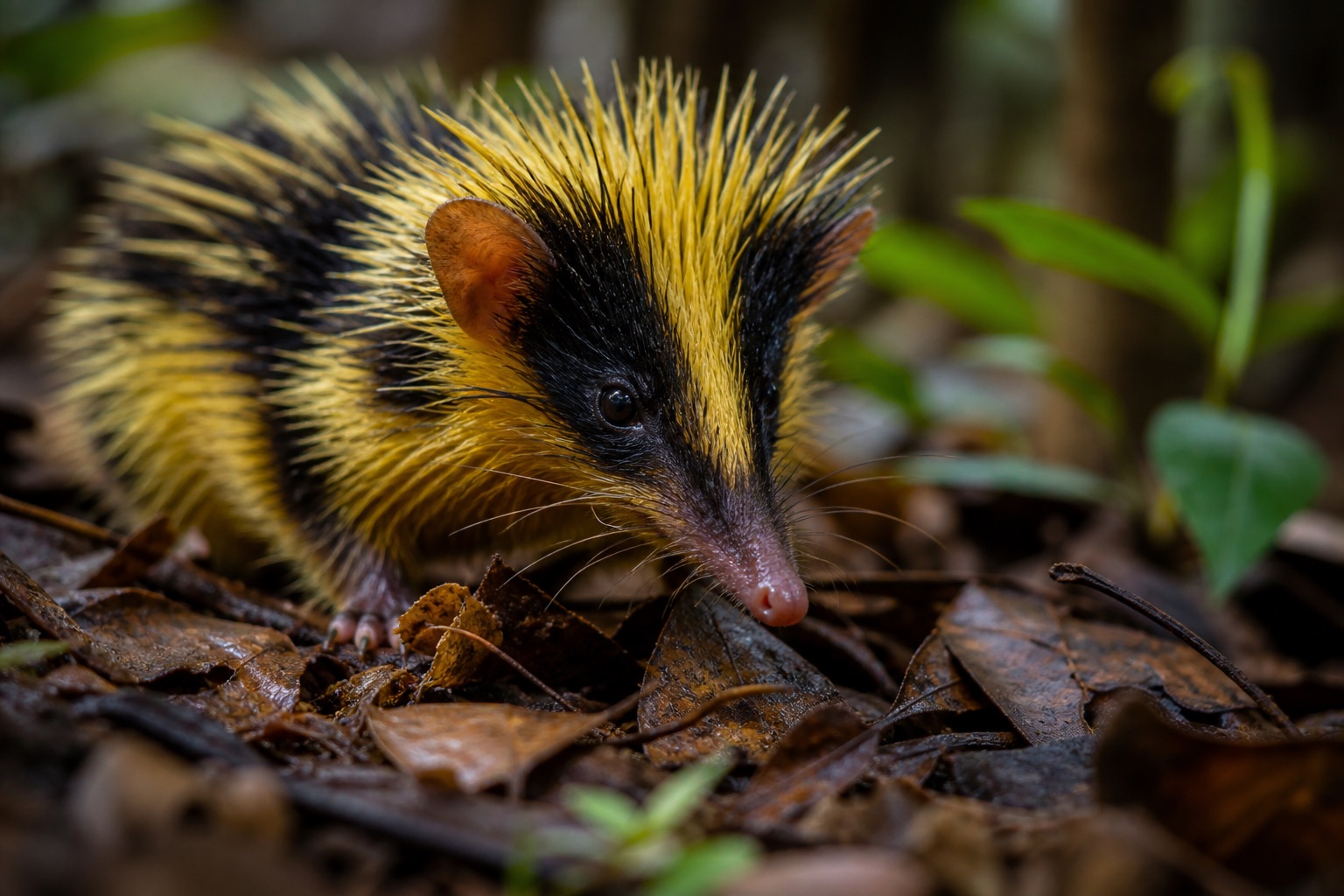
AI-generated educational wildlife portrait — World Animal Rescue Network · AI visualisation, not a photograph
In brief
Tenrecs are around 30 species of mammal in the family Tenrecidae, an adaptive radiation endemic to Madagascar; the lowland streaked tenrec is the only mammal known to stridulate with quills, and the family persists as an estimated 80–90% of Madagascar's original forest has been lost.
Also in Animals A to Z · Animals that start with T
By WARN Research & Conservation Team Last updated
Tenrecs are a family of small mammals that underwent one of the most dramatic adaptive radiations on Earth after reaching Madagascar. Around 30 species occupy niches filled elsewhere by shrews, hedgehogs, otters, moles and even elephants — the largest tenrec, the common tenrec, can weigh over a kilogram, while the smallest are shrew-sized. Madagascar holds roughly 90% vertebrate endemism, and tenrecs are a textbook example of why: an ancestral colonist arrived once and diversified into forms that look unrelated but share a common ancestry. The lowland streaked tenrec carries a distinction no other mammal matches — it stridulates by rubbing specialised quills together to produce a high-pitched sound, the only mammal known to do so. An estimated 80–90% of the island's original forest has been lost, and while many tenrecs persist in disturbed habitat, forest specialists decline as tavy, charcoal production and the pet trade remove cover — pressures rooted in rural poverty, not in subsistence farming alone.
~30
Tenrec species — one of Madagascar's great radiations
~90%
Share of Madagascar's vertebrates found nowhere else
1
Mammal known to stridulate with quills — the lowland streaked tenrec
1 colonist
Ancestral tenrec that diversified into shrew-, hedgehog- and otter-like forms
Figures sourced from IUCN Red List — Tenrecidae, Encyclopedia of Life — Tenrecidae .
Tenrec: Quick Facts
| Species | Around 30, mostly Madagascar endemic |
|---|---|
| Radiation | Shrew-, hedgehog-, otter- and mole-like forms |
| Unique trait | Lowland streaked tenrec stridulates with quills |
| Superorder | Afrotheria — related to elephants, not hedgehogs |
| Endemism context | Part of Madagascar's ~90% vertebrate endemism |
| Main threats | Forest loss from tavy and charcoal production |
Scientific Classification
| Kingdom | Animalia |
|---|---|
| Phylum | Chordata |
| Class | Mammalia |
| Order | Afrosoricida |
| Family | Tenrecidae |
| Notable species | Hemicentetes semispinosus (lowland streaked tenrec) |
| Species count | Around 30 |
Conservation Status
- IUCN Status
- Varies by species — many Least Concern
- Population
- Unknown for most species
- Trend
- Decreasing for forest specialists
- Assessed
- Varies by species
- CITES
- Not listed (most species)
An estimated 80–90% of Madagascar's original forest has been lost. Generalist tenrecs persist; forest specialists retreat to fragments.
Did you know?
The lowland streaked tenrec is the only mammal that stridulates — rubbing quills together like a cricket, a sound no other mammal on Earth produces.
Key Facts: Tenrec
- Tenrecs are an adaptive radiation of around 30 species, mostly endemic to Madagascar.
- They fill niches occupied elsewhere by shrews, hedgehogs, otters and moles — all from a common ancestor.
- The lowland streaked tenrec (Hemicentetes semispinosus) stridulates by rubbing quills together — the only mammal known to do this.
- Madagascar holds roughly 90% vertebrate endemism; tenrecs illustrate how one colonist can diversify on an isolated island.
- An estimated 80–90% of Madagascar's original forest has been lost; forest-specialist tenrecs decline as habitat fragments.
- Tavy, charcoal production and the pet trade follow the same poverty-driven pattern threatening every Malagasy forest species.
An island radiation
When the ancestral tenrec reached Madagascar, it found an island with no shrews, hedgehogs, moles or otters. Over tens of millions of years its descendants split into forms that convergently resemble all of them. The common tenrec is hedgehog-like. The aquatic tenrec swims like an otter. The shrew tenrecs are tiny insectivores. The mole tenrecs burrow.
They are not closely related to the animals they resemble. They are related to each other — and to elephants and aardvarks, as members of the afrotherian superorder. Madagascar's roughly 90% vertebrate endemism means this radiation has no parallel elsewhere; it is one of the clearest demonstrations of what isolation produces.
The quill that sings
The lowland streaked tenrec carries barbed quills like a hedgehog, but it uses them differently. When threatened or communicating, it rubs specialised quills together to produce a high-pitched stridulation — the same mechanism crickets use, but executed by a mammal. No other mammal is known to stridulate.
The sound may warn predators, coordinate group movement or advertise territory. What matters for identification is that tenrecs are not hedgehogs — they are a Malagasy lineage with a communication system unique among mammals. Hearing a high chirp from leaf litter in eastern Madagascar may mean a streaked tenrec, not an insect.
Generalists and specialists
Some tenrecs tolerate disturbed habitat well. The common tenrec forages in gardens and secondary scrub. Others need intact forest and decline as cover disappears. An estimated 80–90% of Madagascar's original forest has been lost, and the pattern affects tenrecs unevenly: generalists persist while specialists retreat to fragments.
Tenrecs are not major pet-trade targets compared with lemurs or chameleons, but forest loss is the common pressure. Tavy clears understorey where streaked tenrecs forage. Charcoal production removes the trees that maintain humidity. Both are driven by rural poverty and the lack of affordable cooking fuel — the context without which blaming subsistence farmers misstates the problem.
Why tenrecs matter ecologically
Tenrecs are insectivores and omnivores that control invertebrate populations across Madagascar's forest floor. They are prey for fossas, snakes and birds of prey. Remove them and you alter a food web that evolved in isolation for millions of years.
They are also a reminder that Madagascar's biodiversity is not only lemurs and baobabs. The small, unglamorous mammals in the leaf litter carry evolutionary stories found nowhere else — including a quill-based stridulation that no textbook outside the island explains.
What WARN Does
WARN publishes free, sourced species education across Madagascar's radiations, including the groups tourists overlook. Tenrecs are part of the roughly 90% vertebrate endemism that makes Madagascar irreplaceable — and they lose ground every time forest is cleared for tavy or charcoal without alternatives in place.
If this guide helps you understand wildlife and the pressures it faces, a gift to WARN supports habitat protection and free public education in our partner countries.
Tenrec: Frequently Asked Questions
What is a tenrec?
Are tenrecs related to hedgehogs?
Which tenrec stridulates?
Why did tenrecs diversify so much?
What do tenrecs eat?
Where do tenrecs live?
Are tenrecs dangerous?
How long do tenrecs live?
How big is a tenrec?
Sources & References
Population figures, conservation status and biological facts on this page are drawn from authoritative scientific and intergovernmental sources.
Terms used on this page
Plain-English definitions, from our wildlife and conservation glossary.
Latest Tenrec Stories
Quick, fact-checked reads on the tenrec — amazing facts, key questions and the threats it faces.
Explore more animals
Discover more animals, their habitats and their conservation status in the WARN wildlife-guide library.
Enjoyed this Tenrec guide?
Receive appeal updates, animal-welfare news and published funding reports. Unsubscribe any time.
We only use your address for WARN updates. See our privacy policy.