Wildlife Guide · Europe & Southern England and Wales for the best-known populations
Stag Beetle
Lucanus cervus (Linnaeus, 1758) — family Lucanidae
Britain's largest beetle — and entirely dependent on rotting wood nobody thinks to keep.
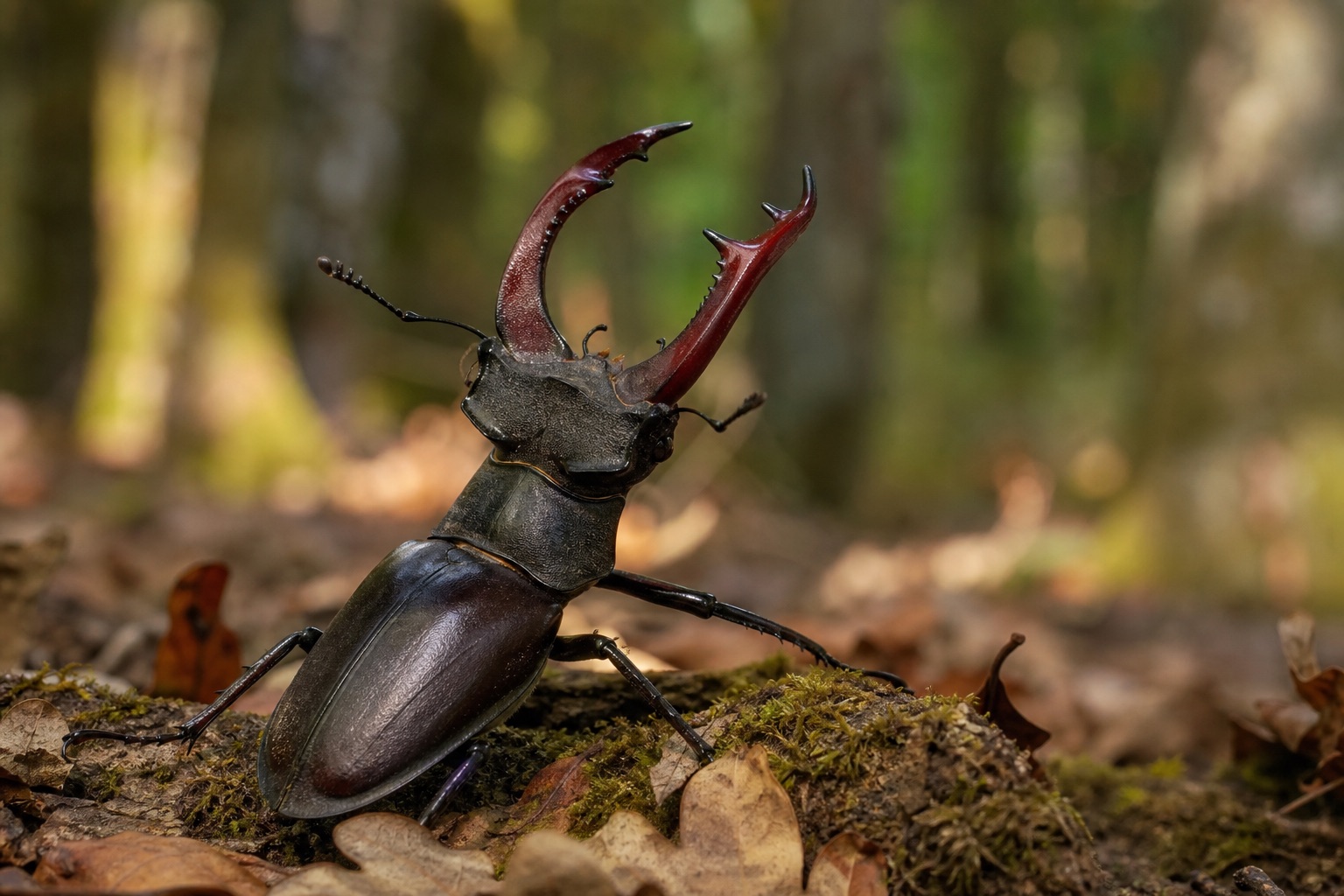
AI-generated educational wildlife portrait — World Animal Rescue Network · AI visualisation, not a photograph
In brief
The stag beetle (Lucanus cervus) is Europe's largest lucanid beetle at up to about 75 mm, with males bearing branched mandibles for wrestling; larvae live for years in rotting wood, adults emerge briefly in summer, and the species is Near Threatened.
Also in Animals A to Z · Animals that start with S
How you can help
You can support the related appeal — read its purpose, recipient status and fund terms first — or give once to where it is needed most. Sharing accurate information helps too.
By WARN Research & Conservation Team Last updated
The stag beetle is Britain's largest land insect. Males carry enlarged mandibles branched like antlers — used in wrestling matches on tree trunks, not for biting people — and can reach roughly 75 millimetres in total length. Females are smaller, with shorter, stronger jaws used for digging. The life cycle explains the conservation problem. Adults live only a few weeks in summer; larvae spend three to seven years feeding on rotting wood underground and in decaying tree roots. Remove dead wood from parks and gardens, pave over old orchards, and the next generation has nowhere to grow. The IUCN lists Lucanus cervus as Near Threatened in Europe, and it is a priority species in Britain.
~75 mm
Maximum length of a male including mandibles
3–7 yr
Typical larval stage in rotting wood
Weeks
Adult lifespan above ground
Near Threatened
IUCN status in Europe
Figures sourced from IUCN Red List — Lucanus cervus, People's Trust for Endangered Species — Stag beetle, Natural History Museum — Stag beetle life cycle .
Stag Beetle: Quick Facts
| Male length | Up to about 75 mm including mandibles |
|---|---|
| Larval stage | Three to seven years in rotting wood |
| Adult season | May to August, mainly at dusk |
| Diet | Larvae: rotting wood; adults: sap and fruit |
| Habitat | Dead wood in broadleaved woodland and gardens |
| IUCN status | Near Threatened (Europe) |
Scientific Classification
| Kingdom | Animalia |
|---|---|
| Phylum | Arthropoda |
| Class | Insecta |
| Order | Coleoptera |
| Family | Lucanidae |
| Genus | Lucanus |
| Species | Lucanus cervus |
Conservation Status
- IUCN Status
- Near Threatened
- Population
- No reliable global estimate; locally common in strongholds
- Trend
- Decreasing across much of European range
- Assessed
- 2014
- CITES
- Not listed
Dead-wood removal in managed landscapes is the primary driver. The adult beetle is the visible tip of a multi-year larval life hidden in decay.
Did you know?
The beetle spends up to seven years as a grub inside rotting wood, then lives above ground for only a few weeks — long enough to mate before the mandibles that define it are gone for good.
Key Facts: Stag Beetle
- Lucanus cervus is Britain's largest beetle; males use branched mandibles for territorial wrestling, not for biting people.
- Larvae feed on rotting wood in tree roots and stumps for three to seven years before pupating.
- Adults live only a few weeks in late spring and summer, feeding on tree sap and fruit.
- Loss of dead wood in parks, gardens and woodland is the main threat — tidiness removes the larval habitat.
- The IUCN lists the species as Near Threatened in Europe; it is a UK Biodiversity Action Plan priority species.
- Females are smaller with stronger jaws and are often mistaken for a different species entirely.
Why the jaws are for wrestling, not hunting
Male stag beetles look formidable. The branched mandibles can exceed half the body length and are used to lift and push rival males off tree trunks and sap runs where females gather. Matches are slow shoving contests; the loser is flipped or driven away, rarely injured.
Females have shorter, much stronger mandibles suited to excavating rotting wood for egg-laying. Neither sex hunts with the jaws — adults drink sap and eat fallen fruit. The mandible size difference is classic sexual selection: males invest in weapons for mating access, females in tools for reproduction.
Years underground in rotting wood
A stag beetle larva is a white grub feeding on decaying heartwood and root material, usually of broadleaved trees — oak, beech, ash and similar. Development takes three to seven years depending on food quality and temperature. The larva moults repeatedly, growing until it pupates in a soil chamber adjacent to the wood.
Adult emergence is synchronised to warm evenings in May to August. Males patrol territories on trunks and fly at dusk with a low buzzing flight. Within weeks they mate, females lay eggs in wood, and the adults die. The visible beetle is the brief final stage of a multi-year life almost entirely spent hidden in decay.
Dead wood as a deliberate habitat choice
Modern woodland management often removes standing dead timber and fallen logs for safety and tidiness. Stag beetles need that material left in place — not necessarily ancient forest, but gardens with old stumps, parks with decaying trees, and hedgerows with buried root wood.
Log piles, leaving old tree stumps in situ, and avoiding compaction over root zones are practical measures that cost nothing and benefit other saproxylic insects too. Stag beetles are a flagship for a whole community of dead-wood specialists that disappear quietly when every fallen branch is cleared.
Near Threatened and still declining locally
Lucanus cervus is listed as Near Threatened on the European Red List. Britain holds a significant western outpost; numbers are highest in the south-east, with scattered records elsewhere. Local extinctions follow suburbanisation of old orchards and sterilisation of park woodland.
Recording schemes rely on public sightings of adults at dusk — the beetles are conspicuous when they fly but easy to miss in larval form. A Near Threatened listing means the species is not yet Endangered but is moving in that direction without habitat reversal.
What WARN Does
WARN publishes free, sourced education for species whose habitat is removed by everyday land management. Stag beetles need rotting wood left in place — a requirement that costs nothing to provide and disappears when gardens and parks are over-tidied.
If this guide helps you understand wildlife and the pressures it faces, a gift to WARN supports habitat protection and free public education in our partner countries.
How can I help save the stag beetle?
Explore practical ways to support the stag beetle, from everyday choices and sharing reliable information to reviewing a related appeal before giving.
Explore ways to support
Read the related appeal’s purpose, recipient status and fund terms. Choose an affordable gift after checking what is proposed and what has been reported.
Ease the pressures
Avoid the wildlife trade and souvenirs, never buy wild animals as pets, and choose sustainable, habitat-friendly products — the threats behind the stag beetle's decline fall when demand does.
Spread the word
Share accurate, sourced information about the stag beetle. Wider awareness is what turns concern into lasting protection.
Stag Beetle: Frequently Asked Questions
How can I help save the stag beetle?
What do stag beetles eat?
Where do stag beetles live?
Are stag beetles dangerous?
How long do stag beetles live?
How big are stag beetles?
Why are stag beetles declining?
Are stag beetles endangered?
Sources & References
Population figures, conservation status and biological facts on this page are drawn from authoritative scientific and intergovernmental sources.
Terms used on this page
Plain-English definitions, from our wildlife and conservation glossary.
Latest Stag Beetle Stories
Quick, fact-checked reads on the stag beetle — amazing facts, key questions and the threats it faces.
Species
12 Amazing Facts About Grey Wolves (And Why Alpha Wolves Aren't Real)
A howl that carries 16 km, a pack that is really a family, and the debunked study behind the 'alpha wolf' myth. Twelve verified facts.
Read the storySpecies
12 Amazing Facts About Flamingos (They Are Born Grey and Eat Upside Down)
Pink from diet, a bill that filters upside down, and milk produced by both parents. Twelve verified flamingo facts.
Read the storySpecies
12 Amazing Facts About Beavers (Iron in Their Teeth, and They Rebuild Rivers)
Orange iron-hardened incisors, transparent eyelids, and a keystone role that reduces flooding and drought. Twelve facts.
Read the storyExplore more animals
Discover more animals, their habitats and their conservation status in the WARN wildlife-guide library.
Enjoyed this Stag Beetle guide?
Receive appeal updates, animal-welfare news and published funding reports. Unsubscribe any time.
We only use your address for WARN updates. See our privacy policy.