Wildlife Guide · New Guinea & Cape York Peninsula, Australia
Spotted Cuscus
Spilocuscus maculatus (É. Geoffroy, 1803) — family Phalangeridae
A marsupial possum where only the male wears the spots — and both sexes are slower than they look.
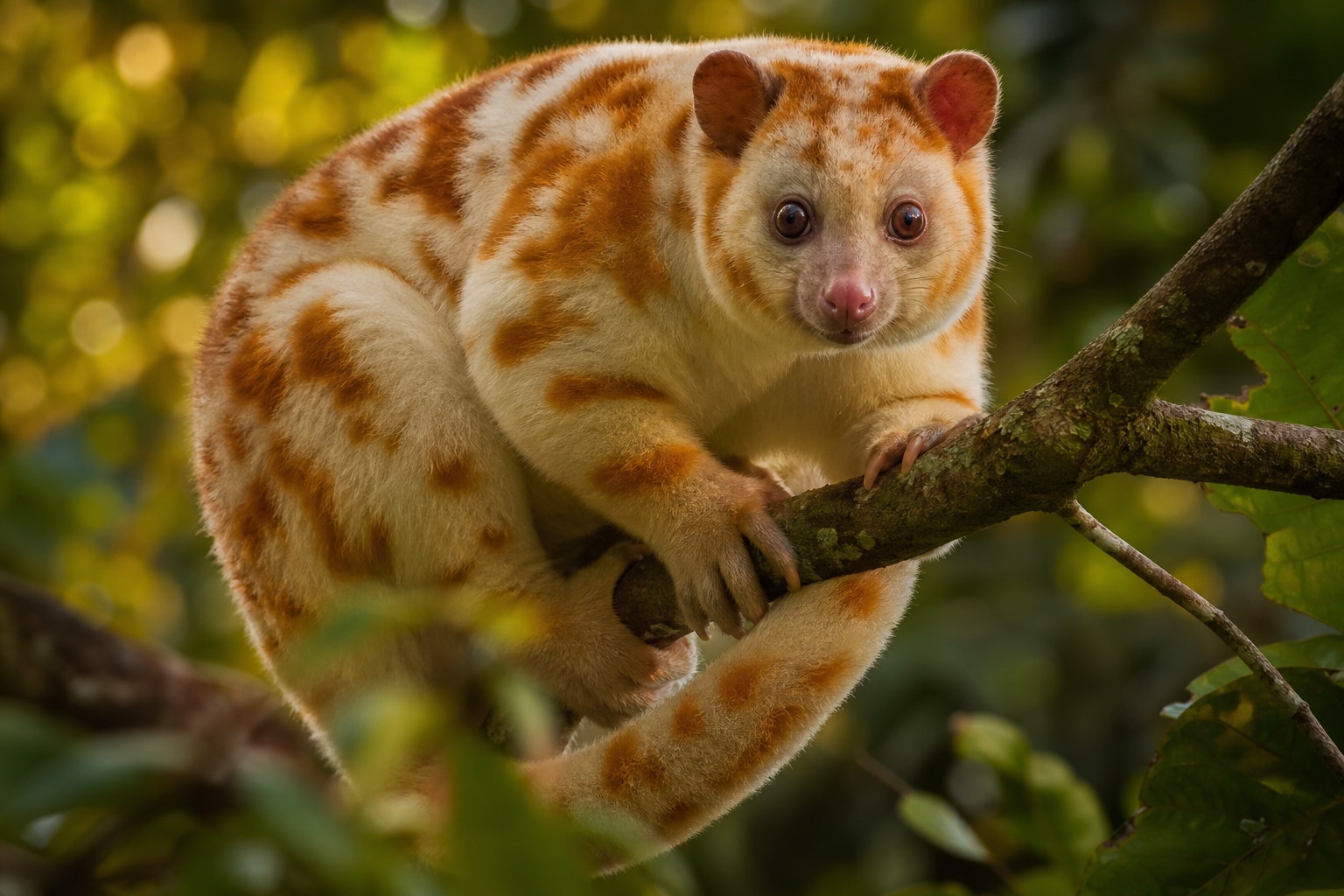
AI-generated educational wildlife portrait — World Animal Rescue Network · AI visualisation, not a photograph
In brief
The spotted cuscus (Spilocuscus maculatus) is a nocturnal marsupial possum of New Guinea and northern Australia in which males are white with dark spots and females are plain grey or brown; it is listed Least Concern but is heavily hunted across accessible lowland forest.
Also in Animals A to Z · Animals that start with S
By WARN Research & Conservation Team Last updated
The spotted cuscus is a nocturnal, tree-dwelling marsupial of New Guinea and northern Australia, and one of the most striking examples of sexual dimorphism in mammals. Adult males are thick-furred and white with dark spots or patches across the body; adult females are plain grey or brown with little or no spotting. The contrast is so strong that early collectors sometimes treated males and females as different species. Like the grey cuscus — covered in WARN's guide at grey cuscus — spotted cuscuses are possums in the family Phalangeridae, not primates. They climb with grasping feet and a prehensile tail, feed mainly on leaves and fruit, and complete development in a forward-opening pouch after a short gestation. Their slowness makes them easy to hunt, which matters more than a Least Concern listing suggests wherever logging roads and settlement reach the forest.
Dimorphic
Spotted males; plain grey or brown females
Prehensile
Tail with bare gripping tip for canopy climbing
Nocturnal
Active at night, resting curled in foliage by day
Possum
Family Phalangeridae — related to the grey cuscus
Figures sourced from IUCN Red List — Spilocuscus maculatus, Australian Museum — possums and cuscuses .
Spotted Cuscus: Quick Facts
| Sexual dimorphism | Spotted white males; plain grey-brown females |
|---|---|
| Activity | Nocturnal |
| Diet | Leaves, fruit and flowers |
| Group | Marsupial possum — Phalangeridae |
| IUCN status | Least Concern |
| Main threats | Hunting; lowland forest clearance |
Scientific Classification
| Kingdom | Animalia |
|---|---|
| Phylum | Chordata |
| Class | Mammalia |
| Order | Diprotodontia |
| Family | Phalangeridae |
| Genus | Spilocuscus |
| Species | Spilocuscus maculatus |
Conservation Status
- IUCN Status
- Least Concern
- Population
- No reliable estimate exists
- Trend
- Decreasing near settlements and logging roads
- Assessed
- 2016
- CITES
- Not listed
The listing reflects range size rather than security. Hunting pressure is intense in accessible lowland forest across New Guinea.
Did you know?
Male spotted cuscuses look so different from females that the sexes were once classified as separate species — white spotted males and plain grey females.
Key Facts: Spotted Cuscus
- Male spotted cuscuses are white with dark spots; females are plain grey or brown — one of the strongest sexual dimorphisms among marsupials.
- Despite a primate-like face and slow climbing gait, spotted cuscuses are possums in the family Phalangeridae, closely related to the grey cuscus.
- They are nocturnal folivores and frugivores, moving deliberately through the canopy with a prehensile tail and syndactylous hind feet typical of diprotodont marsupials.
- The IUCN lists the species as Least Concern because of a wide range, but that describes geography rather than safety near settlements and logging roads.
- Cuscuses are among the most heavily hunted mammals in New Guinea for meat, and their slowness makes them exceptionally easy to catch with dogs or at night.
- Over 90% of land in Papua New Guinea is held under customary tenure, so whether lowland forest where cuscuses live survives depends on landowning clans rather than on protected-area designations alone.
Why only the male is spotted
Sexual dimorphism in coat pattern is uncommon among mammals outside birds-of-paradise country, but common enough in cuscuses. In the spotted cuscus, males develop a white pelage with dark spots or saddles at maturity while females remain cryptic grey-brown.
The function is debated. Brighter male pelage may advertise fitness to females in a nocturnal species where scent and vocalisation also matter, or spots may break up the outline of a large male roosting in dappled canopy light. What is clear is the taxonomic confusion it caused: males and females look sufficiently different that they were once described under separate names. Females carry the young in a forward-opening pouch; males play no role after mating.
Possum, not primate
New Guinea has no native monkeys. The spotted cuscus fills part of the slow arboreal folivore niche with marsupial hardware: a pouch, syndactylous grooming toes on the hind foot, and procumbent lower incisors. Its round face and forward-set eyes resemble a small primate or sloth, but the anatomy is possum.
WARN's grey cuscus guide at grey cuscus covers the wider cuscus group — archaeology of human translocation, hunting pressure and the distinction from primates. Spotted cuscuses overlap in range with grey cuscuses in parts of New Guinea and differ mainly in size, coat pattern and habitat preference toward lowland and hill forest edge.
Living slowly in the canopy
Leaves and unripe fruit yield little energy per bite. Spotted cuscuses rest through the day in tree hollows or dense foliage and feed at night with a deliberateness that reflects fermentation time in the gut rather than caution. They rarely descend to the ground, which makes canopy continuity essential: a gap in forest cover that forces ground travel exposes a slow animal to dogs and hunters.
Lowland forest — the altitude band this species occupies most densely — is being cleared for oil palm, logging and mining across New Guinea faster than montane forest. A Least Concern listing based on range size does not capture local absence along new roads and near villages where hunting is routine.
Customary land and hunting
In Papua New Guinea and the Indonesian provinces of New Guinea, over 90% of land is under customary ownership rather than state control. A government-declared reserve has no force unless the clans who own the land agree, and hunting rules are set locally — some communities maintain taboos on certain species or seasons; others do not.
Cuscus meat is widely eaten. Firearms and logging roads have made previously inaccessible forest reachable, and a slow arboreal marsupial is among the easiest animals to remove once dogs and torches enter the picture. Conservation that works in this context treats customary landowners as decision-makers, because legally and practically they control whether lowland forest stands or is converted.
What WARN Does
WARN publishes free, sourced species education, including for marsupials that look like primates and receive little coverage in English. The spotted cuscus is widely photographed for its male spotting, but the conservation story is customary land, hunting and lowland forest loss — not coat colour.
If this guide helps you understand wildlife and the pressures it faces, a gift to WARN supports habitat protection and free public education in our partner countries.
Spotted Cuscus: Frequently Asked Questions
Why is the spotted cuscus spotted?
Is a spotted cuscus a monkey?
How is the spotted cuscus related to the grey cuscus?
Where do spotted cuscuses live?
Are spotted cuscuses endangered?
Who controls forest where spotted cuscuses live?
What do spotted cuscus eat?
Are spotted cuscus dangerous?
How long do spotted cuscus live?
Sources & References
Population figures, conservation status and biological facts on this page are drawn from authoritative scientific and intergovernmental sources.
Terms used on this page
Plain-English definitions, from our wildlife and conservation glossary.
Explore more animals
Discover more animals, their habitats and their conservation status in the WARN wildlife-guide library.
Enjoyed this Spotted Cuscus guide?
Receive appeal updates, animal-welfare news and published funding reports. Unsubscribe any time.
We only use your address for WARN updates. See our privacy policy.